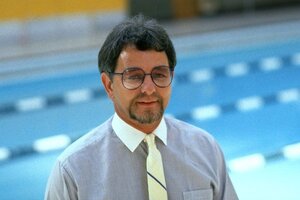
George Gibney
George Gibney was charged with 27 counts of indecency against young swimmers and of carnal knowledge of girls under the age of 15 in April, 1993 but the charges were dropped because of the length of time which had passed since the abuse took place.
The former Irish swimming coach was granted a visa during a visit to the United States in 1992 – seemingly aided by a Garda character reference – a year after people who had been abused by him started to speak up and organise themselves.
In addition, a 2010 application by Gibney to obtain US citizenship – some months after Evin Daly, of the Florida-based advocacy group One Child International alerted the US government of Gibney’s past in Ireland – was rejected.
It’s also understood Gibney may have lied in this application.
And yet.
Gibney remains in the United States.
The revelations about his 1992 visa and 2010 citizenship bid have been revealed by US journalist Irvin Muchnick who has been trying to get Gibney’s immigration file from the Department of Homeland Security, under the Freedom of Information Act.
He has received partial documents, most of them redacted, over the past number of years.
But a senior federal judge for the Northern District of California, Judge Charles Breyer, revealed the details of the 1992 visa and the rejected 2010 citizenship application during a court hearing of the FOI bid last year.
Mr Muchnick was only able to publish details of this hearing last weekend.
A transcript of that court hearing on October 28, 2016, in San Francisco can be read here
The federal government is appealing a previous ruling by Judge Breyer in Mr Muchnick’s favour and the matter is now at the Ninth Circuit Court of Appeals Mediation Service so discussions are ongoing.
However, during the court hearing on October 28, 2016, Judge Breyer questioned why Gibney suffered no consequences from the US authorities.
He said the following:
“How is a person permitted to remain in the United States when, in fact, the circumstances of the Ireland experience or what occurred in Ireland are publically known, that’s number one.
And number two, if, and I would use the word ‘if,’ he gave false answers in connection with an application, how is it that that somehow doesn’t bring into question the term of his initial visa permit or his initial visa.”
Let’s say I, as an example, am granted a visa to come to the United States. And subsequent — and I answer all the questions and I don’t answer falsely. Okay. So I mean, I have that visa application.
And then a series of events occur which would normally disqualify a person from getting a visa, which maybe is an assumption that I don’t know, that I can’t figure out, but I have to assume that if somebody has been charged with the types of offenses that Mr. Gibney has been charged with, the United States, absent other circumstances, would not grant a visa.
We’re not a refuge for pedophiles. And there’s no issue here of which I’m aware of, which is the asylum issue. Okay.
“So I apply — it’s unfortunate I’m using me as an example — but I apply, and then some things surface and I go back to Ireland and then I come back to the United States.
Now, if we froze events at that point, of course, my question would be, does the visa in the United States, one, expire? And two, if it doesn’t expire, is there a process where Department of Homeland Security reviews visa applications in light of undiscovered information and then takes some conduct, or takes some action.
I have no idea whether that’s the case or not.
“But that’s not necessarily the case I wanted to posit because the case I wanted to posit goes on from there. And it involves, at that point, me. Because I’m the applicant, I filled out a form, and perhaps, theoretically, I’m not honest in the form that I fill out for further relief; that is, to be a citizen. And so it’s denied.
But my question would be, by virtue of that activity, does that then go — didn’t — did somebody in the Department of Homeland Security say, Well, you know this person lied to us today, or whenever that application, I think we have to go back and question the legitimacy of allowing that person to remain in the United States.
“There may be reasons to allow him to remain in the United States. There’s nothing that you have submitted to me that indicates any reasons why he’s allowed in the United States, nor any investigation, that I can see, of going back and looking at the original application or the continuation of the visa.”
The revelations mean that Gibney got a US visa a year before he was charged in Ireland.
He went on to seek and win a High Court judicial review in 1994 that quashed all the charges against him.
The judicial review was secured after a Supreme Court decision, during which Gibney’s senior counsel Patrick Gageby argued that the delay in initiating the prosecution against Gibney infringed his right to a fair trial.
Mr Gageby’s sister, future Chief Justice Susan Denham was on the bench of the Supreme Court that day.
Gibney subsequently left Ireland, first for Scotland and then America.
Justine McCarthy in The Sunday Times, reported that other documents released to Mr Muchnick showed Gardaí gave Gibney a certificate of character – issued on January 20, 1992 – to support his application for an American visa.
The certificate given to Mr Muchnick was reported to be partially redacted with the name of the issuing officer and its contents obscured.
The issue of the Garda character reference came despite claims that gardai were notified of allegations against Gibney prior to January 1992.
According to the Murphy Inquiry – which was set up to look at abuse in swimming in 1998 – a parent from a club other than Trojan Swimming Club, where Gibney coached, was told by an assistant coach of Trojan in November 1991 that the gardai and the ISPCC were informed of the allegations in relation to Gibney.
However, later, the ISPCC said it had no record of any such complaint in 1991 or in 1992. The Murphy Inquiry states the first record on the Garda file is dated December 15, 1992.
Further to this…
Readers may wish to recall the following timeline of events leading up to 1992…
In December 1990, swimmer Chalkie White told European silver medalist Gary O’Toole that Gibney abused him from the age of 11 in 1967, prompting O’Toole to find out who else had been abused by whom in the Irish swimming world.
In January, 1991, while in Australia, swimmer Mr White told the honorary medical officer of both the Irish Amateur Swimming Association and the Leinster Branch of the IASA, Moira O’Brien, that he had been abused by Gibney.
White would later tell the Murphy Inquiry – set up to look at abuse in swimming – that Ms O’Brien told him it would be his word against Gibney and that he should ‘get on with it’.
Ms O’Brien would later tell the Murphy Inquiry, Chalkie was ‘confused’ and ’emotionally unstable as a result of a head injury’ and that Chalkie didn’t want her to report the matter. She would also later say a ‘doctor-patient relationship’ existed and that Chalkie didn’t want his complaint to be reported.
In 1991, GIbney allegedly raped a female swimmer, aged 17, in a hotel room while they were on a swimming trip with the Trojan Swimming Club in Tampa, Florida. He previously attacked the same girl in Holland in 1990.
The rape resulted in the girl becoming pregnant and a high-ranking official in swimming taking her to England for an abortion. It’s also alleged that the official warned the girl not to tell anyone about the termination.
In February 1991, Mr White told the then President of the Leinster Branch of the IASA, Frank McCann about Gibney’s abuse and McCann says he’ll deal with the matter. (McCann, who also abused child swimmers, is later found guilty of murdering his wife and niece, in an attempt to cover up for his abuse in 1996)
Also around this time in February 1991, assistant female coach Carol Walsh, to whom Mr White also confided, also tells McCann about the abuse. She claims McCann replied that, “he hoped to fuck it wouldn’t break while he was president”.
He also tells her there was nothing he could do about the allegations and advised her “to back off and not get involved”.
Later, in an interview with RTÉ in 1998, Ms Walsh says that, after approaching the IASA about the matter, she received threats and anonymous phone calls.
On February 8, 1991, Gibney announced he was stepping down from his position as Irish swimming coach, after 11 years, “to devote more time to the Trojan Club and the sports centre he manages in Dublin”. Another abusive coach Derry O’Rourke succeeds him.
Mr White tells the National Development Officer of the IASA, in March 1991, about the abuse he suffered at the hands of Gibney. The officer later tells the Murphy Inquiry nothing specific was told to him and that he didn’t know of any abuse until November 1992.
In June of that year, Mr White told the secretary of the IASA, Hillary Hughes, about the abuse he suffered. The secretary later tells the Murphy Inquiry that she did not remember his allegations.
In November of 1991, according to the Murphy Inquiry, a parent from a club other than Trojan Swimming Club was told by an assistant coach of Trojan that the gardai and the ISPCC were informed of the allegations in relation to Gibney.
But later the ISPCC said it had no record of any such complaint in 1991 or in 1992. According to the Murphy Inquiry, the first record on the Garda file was dated December 15, 1992.
In addition, the Murphy Inquiry states: “The President of the IASA in 1992, had been told at the end of 1991 by a senior swimmer of complaints that [Gibney] was in serious trouble for molesting young children. The senior swimmer requested that the President organise a meeting at which Gardai would be present. The President took legal advice. No meeting was held.”
Irish Times journalist Johnny Watterson later reported that, after Mr O’Toole wrote to the IASA seeking a meeting, he received a reply on January 15, 1992 which said: “The IASA cannot act on mere rumour and innuendo and the person concerned has a basic right to his good name and reputation unless and until first hand complaint is made.”
Previously: Unreasonable Delay
The Chief Justice, Her Brother, And How George Gibney Got Away
How George Gibney Lied on His 2010 Application For American Citizenship (Concussion, Irvin Muchnick)
George Gibney’s 2010 Application For American Citizenship Was Rejected, With No Other Consequences, Federal Judge Said (Concussion, Irvin Muchnick)