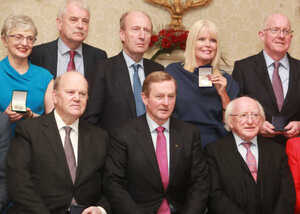
From top: Independents – back row from left: Katherine Zappone, Finian McGrath and Shane Ross – and Fine Gael TDs assemble at the Aras after the 2016 election; Derek Mooney
Spinning against your own junior partners may play well with dispirited Fine Gael members,
But collapsing the government will dishearten them even more.
Derek Mooney writes;
“To provide spurious intellectual justifications for the Secretary of State’s prejudices”
This is how the late Maurice Peston (father of ITV’s political editor Robert Peston) responded in the early 1970s when a senior UK civil servant asked him to explain how he saw his role as Roy Hattersley’s newly appointed Special Adviser (Spad).
It was more than just a casual witty remark from the Professor of Economics: it specifically referenced the fears the Department of Prices and Consumer Protection had about having an acknowledged policy expert in their midst and gainsaying their more generalist advice.
For a serious and nuanced consideration of the role of the Special Adviser in the Irish context the research work of the University of Limerick’s Dr Bernadette Connaughton is a good starting point, especially her August 2010 Irish Political Studies article.
In that article Connaughton argues that while the main role of most Irish Ministerial Spad is that of a ‘minder’ or gofer – working vertically within Departments to help their Ministers’ obtain results – Spads can, as a collective – also have the potential to contribute effectively to the political coordination of policy-making by working horizontally across Government.
As someone who spent almost six years in partnership governments, and someone who contributed to Dr Connaughton’s research, I can attest to the truth of the latter part of her argument.
From my experience the most effective Spads were those whose commitment is as much to the whole of government as it is to their individual minister.
I suspect the troubles and turmoil which has beset the current Government are due in no small measure to the absence of this.
When Fianna Fáil cut the number of ministerial advisers in 1997, before that each Minister had a separate Special Adviser and Programme Manager,
it did so by effectively merging the two roles so that each Special Adviser was also fulfilling the role of departmental programme manager, being responsible of assisting the Minister get that Department’s portion of the Programme for Government (PfG) implemented.
Each party in Government still retained a single Programme Manager – each responsible for co-ordinating the delivery of their party’s elements of the PfG. This co-ordination was done both between the two programme managers, and also through the individual Spads, making the weekly meeting of advisers particularly important.
At these meetings, which took place of the afternoon before Cabinet meetings, the individual Spads would advise the group on memos their Ministers were brining to Cabinet the following morning and gauge the reaction from others.
While Cabinet memos are circulated to other Department before cabinet for reaction, some Departments are less forthcoming in expressing their views in advance than others.
Often times the first real signal that another Department (by which I mean the Department at “official” level, rather than “political”) might have an issue with what your Minister was proposing came at these meetings.
Another key component in this process were the group of Spads working for the Taoiseach. Each of them usually co-ordinated with 3 or 4 Departmental Spads to also work as an early warning system for issues and problems.
As with all information channels, these systems worked best when they worked both ways – not that I think they worked both ways all the time during the time of the FF/Green government, but that’s an article for another day.
They also worked best when the larger party recognised that partnership in communications should not just be pro-rata and that the smaller party in Government has to be given a bit more space and room than their size or strength of numbers dictates.
The major party sometimes needs to roll with the punches when the junior partner attempts to assert its identity and influence. It doesn’t have to respond to every snide comment, particularly those from the “reliable sources close to the Minister”, indeed the senior partner’s responsibility is to take the heat out of situations, not inflame it.
This is something that the spin conscious Fine Gael appeared not to learn in the last FG/Labour government.
I know this may seem heretical for many in Fine Gael, particularly those who saw the headlines in the Irish Times or listened to Marian Finucane every weekend and convinced themselves that the Labour tail was wagging the FG dog, but when you look at the Government’s policy output, the evidence is clear – Fine Gael got its way most of the time.
Fast forward to this week and you realise that publicly accusing one of your independent Ministerial colleagues of “showboating” doesn’t achieve anything, apart from having one of that Minister’s allies responding in kind saying: “Fine Gael’s problem is they don’t like any dialogue and just want it all their own way” as Philip Ryan reported in yesterday’s Sunday Independent.
I can understand Fine Gael’s frustration in not having a single junior partner – with a single identity and a single voice – sitting at the table with it, but that is the reality and it is long past the time for it to develop the internal systems to address that.
Just continuing to do what it did when it was in government with Labour, isn’t going to work… indeed, as we have seen over the past few months it is not working.
If Fine Gael wants the independents to work cohesively as a group within a wider partnership, then it has to equip those independent ministers with the supports and internal early warning systems they need to allow the Spad system to work horizontally as it should.
The office of the Taoiseach has a vital role to play in that, especially when there is no single and identifiable programme manager to speak on behalf of the group of independents.
It needs to recognise that those non Fine Gael faces around the table are not just interlopers, they are their partners in Government and while occasionally spinning against them may play well with its own dispirited back-benchers, collapsing your own government might even dishearten them more.
Derek Mooney is a communications and public affairs consultant. He previously served as a Ministerial Adviser to the Fianna Fáil led government 2004 – 2010. His column appears here every Monday mid afternoon. Follow Derek on Twitter: @dsmooney