



Eoin Neylon, president of Fianna Fáil’s youth section
Following last night revelations of local councillors on the take, including two Fianna Fáil members….
Eoin Neylon president of Ográ Fianna Fail writes:
The saddest thing about the Prime Time special is that it will serve to put off more young people from getting involved in politics. What is needed is exactly the opposite however. Only by standing up for high moral and ethical standards can you hope to have them implemented.
Only by asking the tough questions where it matters will things change. That is why Ógra’s five representatives to the Fianna Fáil Ard Chomhairle will be proposing the immediate adoption of measures, including:
An obligation for annual full public publication of all political party accounts;
One single independent oversight body for ethics in public life covering both elected politicians and officials.
Sufficiant staffing of same body to carry out rigorous investigations of declarations akin to those done by RTÉ.
All candidates for election should sign a declaration of interests before the election….
FIGHT!
Earlier: A Limerick A Day
Dickensian
at
This morning.
Dame Street, Dublin 2
John Lawrence of @kidsneedahome writes:
10.15am…Merry Christmas to one and all.



From top: Hazel Mountain Chocolate, Burren, Co Clare; Hazel’s Mince pie truffles: Hazel collage.
Give the gift of Irish-made nom.
Darragh Conboy writes:
Hazel Mountain Chocolate, based in the burren Co.Clare. We’re two years old as a business, and we directly source top quality grades of cacao from cacao plantations in South America and Africa, and every aspect of manufacture we control ourselves, unlike choclatiers who import premade chocolate.
We make our chocolate in very small batches using rare Trinitario cacao beans and raw cane sugar for our dark chocolate and Irish milk from grass-fed cows in our milk chocolate delivering you the finest, purest and multi-award* winning chocolate.
Our team of chocolate makers begin by hand roasting, cracking and winnowing cacao beans before stone grinding it for 40 hours. We then age our chocolate for further 3 weeks before our chocolatiers create our award winning range of bean to bar chocolates. You can’t just rush the process of making the world’s best chocolate.
Hazel Mountain Chocolate shop here
Hazel Mountain Chocolate (Facebook)
Irish-made stocking fillers to broadsheet@broadsheet.ie marked ‘irish-made stocking fillers’. No fee.

What you may need to know:
1. Jane Hammond (Natalie Portman) seeks aid from Dan Frost (Joel Edgerton) when she is targeted by a gang of outlaws.
2. “In a world…” Classic.
3. This has had a very troubled gestation. Original director Lynne Ramsay left on the first day of production. Gavin O’Connor then took over. Ewan McGregor replaced both Jude Law and Bradley Cooper, and Joel Edgerton replaced Michael Fassbender.
4. Combined with distribution troubles, high production costs and traditional audience apathy for Westerns in general, and the prognosis doesn’t look too healthy.
5. Broadsheet prognosis: Western woes.
Release Date: January 29
Mark blogs at Whybother.ie
Stuffed
at
Further to the government’s report on Non Parental Childcare and Child Cognitive Outcomes at Age 5. part of the Growing Up In Ireland study…
Liggy writes:
The Irish Independent has published their interpretation of the latest Growing Up in Ireland Study.
Their amazing conclusion was: Child’s development suffers if mum works full-time, says study
Got that? All children suffer if their Mother works full time.
Kind of rude to fathers who do the childcare. Not to mention how outdated, anachronistic and 1950s the attitude is that Mum should be the one looking after the children.
So I read the report: Amazingly, it made the point in many instances that where a care-giver (in or out of the child’s home) is better educated than the parent who works full-time, the child will have better vocabulary and non-verbal reasoning skills.
So logically if the full time employee is the best educated person in the child’s life, they will not have the same skills in these areas as children of a parent of a similiar educational level who stays at home. Nowhere in the report does it conclude that this role is best played by the Mother.
P8
Looking at change over time in vocabulary scores between three and five, a modest positive effect was found for non-relative care (e.g. childminders), meaning that children in this type of care made more progress between the two time points than those in full-time parental care at age three.
It goes on….
Positive effects of centre-based care were also found for the Foundation Stage Profile results at age five, and these were stronger for children with less-educated mothers.
P10
None of the findings suggest a significant negative effect of non-parental childcare on either vocabulary or non-verbal reasoning at five for the full sample of children. On average, children attending different types of care at age three fared as well in terms of cognitive outcomes at age five as children in full-time parental care.
P11
For children whose whose Primary Caregiver had Leaving Certificate qualifications or higher, there was a modest positive effect of relative and non-relative care on change in vocabulary scores between three and five compared to full-time parental care
P19
At nine months, the authors (Byrne & O’Toole, 2015) found infants in the care of a relative had higher scores for communication and personal/social development, while those in the care of a non-relative had significantly lower communication and problem-solving scores.
Infants attending centre-based care had significantly lower communication and gross-motor scores than those in full-time parental care. However, as noted in McGinnity et al (2013), in the majority of cases the children had been in non-parental care for a very short period, and therefore it is not possible to attribute causal relationships.
P74
For children of Primary Caregivers with lower secondary educational qualifications, the first model (Table 4.3) shows that there is no significant effect of any form of non-parental care at age three, compared to children in full-time parental care, on vocabulary at age five. Adding vocabulary scores at age three (Model 3) does not affect this pattern of results for childcare. There is no evidence of a positive association between non-parental childcare and vocabulary at age five for the children of low-educated Primary Caregivers in this sample.
For the children of Primary Caregivers with upper secondary education or higher, it was found that all forms of non-parental care at age three years had a significant small positive association with vocabulary scores at age five, but these effects did not remain statistically significant once child and other family characteristics were held constant in Model 2.
Interestingly, in Model 3, home-based care types, relative care and non-relative care are associated with slightly higher increases in vocabulary between ages three and five than sole parental care, though the coefficients were not statistically significant.
This echoes the finding from Hansen and Hawkes (2009) that the children of more highly educated Primary Caregivers show vocabulary gains from home-based care, albeit grandparental childcare in their study using the Millenium Cohort Study. This effect is not found for children in centre-based care.
Download report here
Dat Ass
at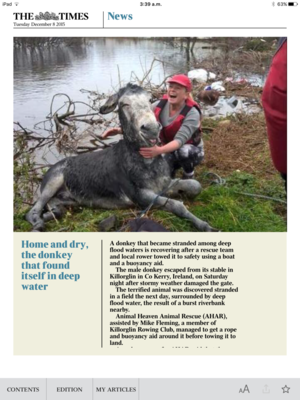
Donkey saving heroics in Killorglin, County Kerry at the weekend by Animal Heaven Animal Rescue and Mike Fleming of Killorglin Rowing Club.
Fair play, in fairness.
Thanks Richie Oakley
