



MORE to folly



MORE to folly

https://www.youtube.com/watch?v=tSVFYnCUugM
You may recall previous claims made by Independent TD Mick Wallace in the Dáil about the sale of Nama’s northern Ireland portfolio, Project Eagle.
During Leaders’ Questions in the Dáil today, Mr Wallace made further claims, alleging that Nama gave him an ‘untrue’ answer in relation to a question he asked about Nama’s former head of asset recovery, Ronnie Hanna.
In addition, Mr Wallace said:
“Ronnie Hanna was part of a cabal to seek payment for affecting the biggest property deal in the history of the State.”
The Irish Times has since reported a Nama spokesman saying:
“Deputy Wallace has today falsely accused Nama of giving untrue answers to his questions. He is wrong to do so.”
Meanwhile, in response to his claims, Tánaiste Joan Burton told the Dáil:
As somebody who was involved in the building trade, I know from some of the public records and the media that he suffered. This does not mean that because he feels a very strong personal sense of grievance, which I understand, that his claims of wrongdoing against NAMA stand up.
From the Dáil proceedings…
Mick Wallace: “I have been co-operating with An Garda Síochána on a number of issues relating to NAMA and it has been back to me regarding some of these issues. As the Tánaiste is aware, I have asked many questions in the Chamber about NAMA but I have not got many answers. In fact I have got none. I have put some of the questions and others to NAMA directly and I have got answers from it, some satisfactory and some not. One of the questions I asked about Project Eagle was whether Ronnie Hanna, along with Frank Cushnahan or David Watters, ever met any US investment fund personnel. NAMA’s reply was “No”, that Mr. Hanna had no such meetings with these individuals. We now know that Ronnie Hanna, head of asset recovery in NAMA, did meet at least one of the US investment funds. NAMA’s answer to my question is not true.”
“PIMCO pulled out of the Project Eagle deal because its compliance department would not agree to the success fee. Cerberus replaced it and paid the success fee. What would PIMCO have got for this fee? What did Cerberus get for the fee? It got insider information and the ability to affect the deal. An executive of NAMA, Ronnie Hanna, was part of a cabal to seek payment for affecting the biggest property deal in the history of the State. The three individuals, Ronnie Hanna, David Watters and Frank Cushnahan, had information above and beyond what was available in the data room. David Watters had reviewed the business plan for many of the debtors.
An Leas-Cheann Comhairle Michael Kitt: “The Deputy is naming many names…”
Peter Mathews: “We need them.”
Kitt: “… and it is a long-standing convention that accusations should not be made against people outside of the House.”
Wallace: “These are all in the public domain.”
Robert Dowds: “Go before the Committee of Public Accounts on this.”
Wallace: “Frank Cushnahan was looking after the political side in the North and Ronnie Hanna was looking after matters inside NAMA in Dublin. We are not talking about Belfast; this is Dublin. This is at the heart of NAMA in Dublin, and this is on the Tánaiste’s watch. The Taoiseach assured us that NAMA had dealt comprehensively with all matters put to it at the Committee of Public Accounts, but what is this worth now? We need an independent commission of inquiry. I realise that Fine Gael certainly does not want one, but the Tánaiste is the leader of the Labour Party and she should ensure there is an independent commission of inquiry.”
Tánaiste Joan Burton: “With regard to Project Eagle, I am advised the loan sale was executed in a proper manner, and despite all the different charges the Deputy has made, and charges against named individuals who are not in a position to comment or defend their good name in the House…”
Bernard Durkan: “Hear, hear.”
Burton: “…but the Deputy has named them nonetheless, I am told the facts are there are no claims of wrongdoing against NAMA. However, the Deputy clearly has issues with regard to the people he has named.”
“Clearly, at the base or back of his particular complaints is probably his own unfortunate experience, to which he has referred on many occasions. Understandably, he has a very strong vested interest in, and probably even stronger feelings about, what happened in the context of the collapse in the values of properties when the economy and property valuations collapsed. A portfolio worth almost €6 billion, like many people’s personal domestic houses, lost 60%, 70%, 80% or 90% of its value. If the Deputy is saying this loss of value can be attributed entirely to NAMA, and not to the actual impact of one of the most devastating property crashes in the world, then I want to acknowledge he has suffered.”
Mathews: “It was a banking crash that led to a property crash.”
Burton: “As somebody who was involved in the building trade, I know from some of the public records and the media that he suffered. This does not mean that because he feels a very strong personal sense of grievance, which I understand, that his claims of wrongdoing against NAMA stand up. I said to him before on this that NAMA is answerable to the Committee of Public Accounts. I strongly advise the Deputy to take the issues he has raised here, if they are additional to the issues he has already raised, to the Committee of Public Accounts and seek to have them examined there. He knows as well, because we discussed it on a previous occasion, that in the North the Comptroller and Auditor General there is conducting a value for money review into the Northern Ireland sale, and I strongly recommend that the Deputy seeks to get the findings of this report and what it will have to say.
Mary Lou McDonald: “That report is happening here and not in the North.”
Kitt: “Under Standing Order 59 there is a mechanism whereby a Deputy can give prior notice to the Ceann Comhairle concerning matters in the nature of being defamatory and Deputy Wallace should avail of this. I ask him not to name people who are outside the House.”
Wallace: “Any allegations I have made against NAMA have zero to do with my business. I never had interaction with NAMA through my business. I did not go into NAMA. The Tánaiste seems to be deliberately failing to interpret what I have said. I have given her some new information and I have outlined how I was told untruths by NAMA when it was questioned. The Tánaiste does not seem to have a problem with this. This is shocking.”
Pearse Doherty: “Hear, hear.”
Wallace: “It has nothing to do with me; it has to do with the people. NAMA has failed to serve them properly. There are serious question marks. An executive of NAMA, Ronnie Hanna, in Dublin, deliberately interfered in the process. Does the Tánaiste not have a problem with this? Is she just going to let this flow on and not look for a proper independent commission of investigation into this? Is this possible? I find it hard to credit.”
Eric J. Byrne: “Say it before the Committee of Public Accounts.”
Dowds: “Go before the Committee of Public Accounts on this.”
Wallace: “I will put a number of questions to the Tánaiste, and she should get answers to them from NAMA. It might tell her the truth. What date and time and to whom was the Fortress bid submitted? What date and time and to whom was the Cerberus bid submitted? Were the bidders advised that the bids were to be the best and final bids? Were they advised that the reserve was £1.24 billion? When and by whom was Fortress advised that its bid was not successful? Did Fortress offer in writing or verbally to increase its bid? Mr. Hanna resigned six months to the day after the Cerberus deal went through. Why?”
Arthur Spring: “Does Deputy Wallace know the answers to any of those questions?”
Burton: “I appreciate the Deputy’s concern in the matter, and if he has had no contact with NAMA, I accept that, but I certainly have seen in the public media and I am aware that he was a very fine developer and builder who lost out, as so many others did, in the course of the property collapse in Ireland.”
Clare Daly: “What has that got to do with it?”
Mathews: “That has nothing do with it. How dare the Tánaiste say that? The Tánaiste should withdraw that remark as it has nothing to do with Deputy Wallace’s question.”
Burton: “The Deputy has set out on Leaders’ Questions a series of very detailed questions relating to a specific institution – NAMA – that is answerable to the Committee of Public Accounts. The Deputy is, I suppose, using a trick deployed by lawyers. He is asking a question and he is very confident he knows the answer to it but I have had no notice of it.”
Nama accuses Mick Wallace of making false allegations on Project Eagle (Irish Times)
Previously: Project Eagle And The €3.5 Billion Haircut
‘Cerberus Told Me I Was Going To Get Sorted’
Transcript: Oireachtas.ie

Charleville Train Station in Co. Cork this evening.
Ronan Kelly writes:
“Disgruntled staff member making a comment or just ran out of full stops?”

Protesters gathered earlier today at the site of where 22 modular homes are being built in Ballymun
You may recall how yesterday Labour TD Ann Phelan explained that a new policy directive will give the chief executives of Dublin’s four local authorities the power to “dispense with the normal Part 8 planning process” – or public consultation process – for any situation they deem to be an emergency in regards to homelessness.
Further to this…
RTÉ reports:
“Work has stopped on the site where the first set of modular homes are to be located in Dublin due to a protest.”
“Around 20 people have gathered at the entrance of the site Balbutcher Lane in Ballymun.”
“They say the modular housing project puts plans by a local co-op to build 40 social housing units on the same land in serious doubt.”
“…Dublin City Council said the modular homes provide no issues for the co-op’s plans.”
Update:
Dublin City Council say:
If the current protest being held at the Baile na Laochra Modular Homes site in Poppintree, Ballymun continues, 22 families will remain in unsuitable accommodation in commercial hotels for the Christmas and into early 2016.
The four Dublin Local Authorities, An tArdmhéara Críona Ní Dhálaigh and the Peter McVerry Trust are asking the protesters to stop obstructing building works on the site and enter into constructive discussion with Dublin City Council.
The contract was awarded to Western Building Systems following an Accelerated Restricted Procedure (ARP) to provide homes in recognition of the extreme urgency to respond to family homelessness in the Dublin region.
Protest disrupts work at modular housing site in Ballymun (RTE)
Previously: Modularity Of Mind
We’re thankful for overwhelming firepower. What are you thankful for? Happy Thanksgiving, Marines. https://t.co/OIFkdBoGu6
— U.S. Marines (@USMC) November 26, 2015
Gulp.
Thanks Donal McLoughlin


Gruesome typographic photo manipulations by Lightfarm Studios for an anti texting-while-driving PSA by Mitsubishi.

Tim O’Leary (right), of the Irish Farmers’ Association
This afternoon.
Tim O’Leary, who is running for president of the Irish Farmers’ Association, following last night’s resignation of Eddie Downey, spoke to Richard Crowley on RTÉ’s News At One earlier.
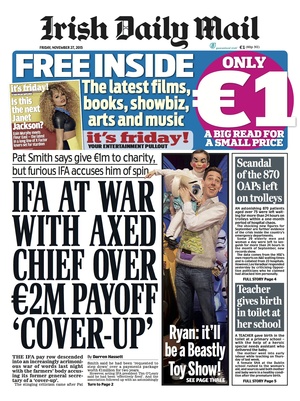
Mr Downey’s resignation came after it emerged the former IFA general secretary Pat Smith was to get a €2million severance package, on top of a €2.7million pension deal.
Mr O’Leary spoke to Mr Crowley about how the severance deal was struck during a meeting between Mr Smith and Mr Downey.
Grab a tay. Large mug.
Richard Crowley: “Why did Eddie Downey resign?”
Tim O’Leary: “He resigned because the pressure got too much as the controversy was going on, over the package or the deal done with Pat Smith. He felt himself he thought that he could step back and leave the review take place but he felt that things were just not going to work, as long as he remained as president and he took the very honourable decision to resign. And it’s a very difficult decision.”
Crowley: “Did he, but was the straw that broke the camel’s back the deal he did with Pat Smith in relation to his exit package?”
O’Leary: “That made his position very difficult, yes it did.”
Crowley: “Did you know anything about that deal?”
O’Leary: “The exit package?”
Crowley: “Yes.”
O’Leary: “I was aware of the figure, after the fact.”
Crowley: “Not during the negotiations?”
O’Leary: “No.”
Crowley: “Shouldn’t you?”
O’Leary: “No. Because under the present structures, I was not responsible for that.”
Crowley: “And what about the Treasurer or any other member of the executive board?”
O’Leary: “My understanding is nobody else was aware of the deal until it was initially agreed. Now it wasn’t signed off completely because it needed more than one signature. It needed approval from a wider area but certainly…”
Crowley: “From who? From who else?”
O’Leary: “From, I would suspect that the Treasurer would have had to approve it and…”
Talk over each other
Crowley: “You don’t know that for a fact, as of now?”
O’Leary: “I would say yes he would, yes he would.”
Crowley: “OK, but he wasn’t involved in the negotiations?”
O’Leary: “No.”
Crowley: “Were there negotiations?”
O’Leary: “I’m told there were. I’m told there was a discussion about Pat Smith’s position in the organisation and that it had to finish.”
Crowley: “But once that was agreed. Then the business of negotiating his exit package got under way.”
O’Leary: “That’s correct.”
Crowley: “And in that negotiation there was, by the sounds of it, just two men, Eddie Downey, Pat Smith.”
O’Leary: “That’s correct.”
Crowley: “Is that not ludicrous?”
O’Leary: “Well it wasn’t acceptable to the organisation.”
Crowley: “But did you know this was going on last week?”
O’Leary: “I was aware that the discussions were going on, that’s right.”
Crowley: “And you knew it was about money and the exit package for Pat Smith?”
O’Leary: “I would always assume that it would be because it would have to be.”
Crowley: “And did anybody raise an eyebrow about that?”
O’Leary: “Yes.”
Crowley: “And?”
O’Leary: “And it was not agreed.”
Crowley: “How do you mean it was not agreed?”
O’Leary: “By the general, it was not agreed outside of the room where the negotiations went on. It is not acceptable. It is not agreed.”
Crowley: “And at what point did you make that protest?”
O’Leary: “After that agreement.”
Crowley: “But not during?”
O’Leary: “We weren’t aware of it during, we weren’t aware of the agreement during the agreement, if I sounds stupid on that now, but you understand what I mean. We have to wait until after the agreement…”
Crowley: “But did you know they were talking about a package and a package that was in the region of a million up front and €100,000 every year for ten years?”
O’Leary: “No.”
Crowley: “No. You didn’t know anything about that?”
O’Leary: “Yes, I knew they were talking about a package. No, I wasn’t aware of the figures.”
Crowley: “And had you had heard those numbers, what would your reaction have been?”
O’Leary: “Don’t do it.”
Crowley: “Who else would have known about this? Or who else was in a position to cry foul as this was going on?”
O’Leary: “What was going on? The discussion or the discussion on the numbers?”
Crowley: “The discussion on the numbers and who was involved. Or the exclusion of others.”
O’Leary: “It was, there was no exclusion, it was done by Eddie Downey and Pat Smith.”
Crowley: “Yes but that excluded you and it excluded others on the executive council, didn’t it?”
O’Leary: “I didn’t have a role in that.”
Crowley: “Should you have a role though, that’s the point.”
O’Leary: “I was governed by the rules of the organisation.”
Crowley: “And you’re prepared to go along with that. Who set up that system in the first instance by the way?”
O’Leary: “This is a, you know, we’re dealing with an organisation that’s 60 years old right? So we have structures that we inherited from a different time, from a different process and we are changing those. We had a review 10 years ago and we’re having another review now. So, you know, we have to move with the times…”
Later
Crowley: “Did Pat Smith resign? Or was he pushed?”
O’Leary: “Pat Smith resigned, the way I understand it.”
Crowley: “And so was it then open to the IFA or to Eddie Downey, specifically, to negotiate a better package from the point of view of the IFA and from your subscribers than the one that was eventually offered to Pat Smith?”
O’Leary: “I don’t know that, I wasn’t in the room with Eddie, so I don’t know what went on but I know that Eddie would do his best for the organisation. I think that it was probably a very difficult situation to be in. I think that, in hindsight, he probably shouldn’t have been in the room on his own, if you want me to say what I really think. But, you know…”
Crowley: “Did you have a legal advisor there?”
O’Leary: “He had legal advice, I think, yes.”
Crowley: “And Pat Smith, presumably?”
O’Leary: “I don’t know who was in the room. But I know that Eddie had legal advice.”
Crowley: “But the nub of it now is that the IFA is going to challenge this in the courts if you have to?”
O’Leary: “Yes. Well the nub of it now is that the IFA is not agreeing to any severance package.”
Crowley: “I beg your pardon, I missed that. Sorry.”
O’Leary: “The nub of it now is that the Irish Farmers’ Association is not agreeing to any severance package with Pat Smith.”
Crowley: “So, no signature was put on a piece of paper, on the night in question, when the deal was done between Pat Smith and Eddie Downey.”
O’Leary: “That’s not what I said. What I said is the nub of it now is the IFA is not agreeing with any severance package…”
Crowley: “I know but my question to you was: was…”
O’Leary: “It wasn’t enough to tie the deal down completely.”
Crowley: “Because, is there another signature missing?”
O’Leary: “Because there was more required. It needed legal, it needed legal oversight and stuff like that but there was more required, yeah. The treasurer would have had to have signed as well and he was not prepared to sign, in fairness.”
Listen back in full here

It’s Thursday, 3.37pm.
Time for a review of this weekend’s cinema releases from ‘sheet movie critic Mark Ryall.
*popcorn*

THE GOOD DINOSAUR (100 minutes, PG) Directed by Peter Sohn. Starring Raymond Ochoa, Jack Bright, Sam Elliott.
Perhaps it was too much to expect two classics from Pixar in one year. So it’s not entirely unexpected that The Good Dinosaur seems mundane in comparison to the wonderful Inside Out. Peter Sohn’s movie is sadly lacking in the humour, charm and the big ideas we have come to expect from the studio.
It’s a relatively small story. A young dinosaur, Arlo (voiced by Raymond Ochoa) is separated from his family and tries to find his way back home. The world he wanders through is practically deserted, with only the occasional supporting character popping up to break the monotony. Arlo carries the movie, but the voice acting is sub-par and the character design is ugly – too clumsy and angular in all the wrong places.
This is Pixar-lite. Younger viewers will be entertained, but it doesn’t hold the all-ages appeal of future classics like Wall-E (2008) or Up (2009). It also lacks any emotional heft, with a by-the-numbers resolution that feels inorganic and tacked on. It’s hard to come away without feeling a little disappointed, but at least there’s no singing.
TLDR: Underwhelming

CAROL (118 minutes, 15A) Directed by Todd Haynes. Starring Cate Blanchett, Rooney Mara, Sarah Paulson.
Todd Haynes returns to the classic melodrama of Far From Heaven (2002) for his adaption of “The Price of Salt,” Patricia Highsmith’s 1952 novel.
Therese Belivet (Rooney Mara) is a shy New York shopgirl with a dull job and a fiancé she doesn’t really like. Therese is practically invisible to the outside world, but when she meets sophisticated housewife Carol Aird (Cate Blanchett) she senses a deep connection. Companionship eventually develops into love, but the affair – and Carol’s pattern of “aberrant behaviour” – could result in her losing custody of her daughter.
The film manages to reproduce the confusion and woozy excitement of first love. Mara plays Therese as a sort of cipher swept along in Carol’s slipstream. It’s an appropriate choice given the inherent risk of conducting a lesbian relationship in a repressive society, but it does leave the restrained character as rather hard to read. Blanchett is the opposite, an expressive combination of strength, poise and elegance.
Haynes’ meticulous replication of 1950s Hollywood is truly remarkable. Every detail – from the costumes and sets down to the expressions of the extras in the background – captures the mood of the era.
Carol addresses themes that Douglas Sirk might have tackled were it not for the repressive Hay’s code. It calls attention to the rarity of a mainstream Hollywood movie carried by two strong female leads. The result is profoundly beautiful.
TLDR: Affecting
Pick of the week

BRIDGE OF SPIES (141 minutes, 12A) Directed by Steven Spielberg. Starring Tom Hanks, Mark Rylance, Amy Ryan.
The release of a new Steven Spielberg movie is quite rightly seen as an event. The tedium of his recent historical awards bonanza Lincoln (2012) notwithstanding, what the director has achieved in a remarkable 45-year career is more than enough to warrant the anticipation.
This Cold War thriller, set during the “Duck and Cover” Red scare paranoia of 1957, is a masterclass in suspense executed by one of the finest visual storytellers of our time.
James B. Donovan (Tom Hanks) is an insurance claims lawyer handed the poisoned chalice of defending Soviet spy Rudolf Abel (Mark Rylance). The Government and the Court want to hand Abel a quick death sentence, but Donovan’s by-the-book tenacity sees the spy’s life spared. When the pilot of an American U-2 spy plane is captured by the Soviets, Abel becomes a handy bargaining chip, and Donovan is entrusted with the task of facilitating a prisoner swap in Berlin just as the GDR have started building the wall.
Bridge of Spies is a proper old school spy thriller, with microfilms, tense border crossings, bluffs and double bluffs. It’s a film of two halves, and they’re both fantastic. The two strands of narrative fit together like a jigsaw, and Spielberg knows exactly where to find the substance in the story.
The director’s affinity for sentimental manipulation is averted until the closing scenes, where the beatification of Donovan becomes more than a little cloying. Donovan is the kind of all American boy scout role that Hanks can pull off in his sleep. He doesn’t, but is still outclassed by Mark Rylance in every scene that the two share. With a mix of laid-back serenity and sardonic resignation, Rylance is simply superb.
TLDR: Gripping
Also on release from Friday 27th November: BLACK MASS, RADIATOR.
Find Mark at WhyBother.ie

Hugh Rodgers writes:
“Hoping you’ll share our film on John Kavanagh – fight trainer to The Notorious Conor McGregor, SBG Ireland owner, and all-round inspirational nice guy. The film captures a glimpse of his story, from a quiet childhood to international success in the UFC both with his fight team and his gym, revealing his positive spirit and inspirational philosophy on life inside and outside of the octagon.”
“It was made as part of a project called ‘1 of 6’ – a series of magazines, each with accompanying short documentary films, that showcases the life and work of unique Dublin characters.”
“This is the first of six instalments celebrating Dublin and its inhabitants, bringing to life the charm and character of our capital city and its influence on the people who live and work here. Each edition will take a core theme and explore it through conversation. In this issue we talk to people that challenge convention, champion the everyday and face adversity with tenacity.”
Project 1 of 6 is spearheaded by Mark Shiels of Form
