




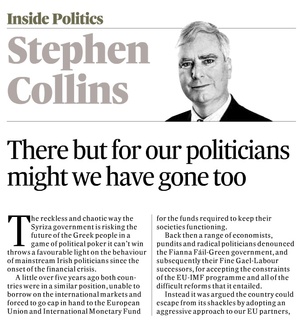
Celebrations last night in Athens, Greece (top) and a column on Saturday from Stephen Collins, Irish Times Political Editor
It’s Oxi Monday.
Greece has rejected spin, bullying and extreme media bias.
Dr Julien Mercille writes:
It is now clear that the NO side has won the referendum in Greece by a substantial margin of 61% to 39% for the YES side. Therefore, the Greek people have rejected the bailout offer from their creditors and associated austerity conditions.
What this does for now is to give a democratic mandate to Syriza to negotiate for a better bailout package with European authorities, which may now involve some debt relief. It remains to be seen to what extent the creditors will be influenced by the referendum’s outcome, however.
The result is a tremendous victory for ordinary people over European elites in every capital, who have tried to bully the Greeks into accepting more austerity while piling up more debts on their shoulders.
The arrogance of power was visible all along. As it became clear that the NO side would win, Brian Hayes, the Fine Gael MEP, called on Syriza’s leaders to “ditch their aggressive, provocative language”. Nevermind that it is the troika, not Syriza, that has inflicted pain on Greece.
It is also important to observe that even if heralded as a great democratic moment, the referendum could only be partially considered as such. Democracy is supposed to refer to the expression of one’s opinion as coming out of a free exchange of ideas and discussion about a subject. There isn’t supposed to be blackmail in that process.
But this is what the Greeks have endured in the days before the vote and before.
First, shortly after Alexis Tsipras, the Greek Prime Minister, announced that a referendum would be held, the European Central Bank (ECB) decided to restrain credit to Greece, forcing its banks to close and pushing the country deeper into crisis, a move that has been widely recognized as financial blackmail. And the troika has always been opposed to Syriza. Earlier, in February, the ECB had cut off its main credit line to Greek banks in a move difficult to justify on economic grounds.
Second, this has been compounded by the last five years of drastic austerity implemented in Greece, resulting in a deterioration of the economy and social fabric. Effectively, Greece is now faced with a humanitarian crisis. Voting in such a situation of fear and desperation is not exactly one’s idea of ideal democracy.
Third, the Greek and European media have been hysterically in favour of a YES vote, repeating ad nauseam that a NO vote would lead to catastrophe. That’s not a balanced and open discussion of the issues, it’s mere propaganda.
For example, the Irish Times’ weekend edition had four opinion pieces on Greece. Three were clearly in favour of a YES vote.
Alan Ahearne, the right wing economist who was adviser to Minister for Finance Brian Lenihan in 2009-11 when austerity package was rolled out in Ireland, had a piece criticising Syriza for supposedly being guilty of weakening the Greek economy which allegedly was doing great before it came to power. Nevermind that it is the troika austerity policies enacted by the governments that preceded Syriza that crashed the economy.
Recall that Ahearne, not so long ago, authored a report entitled “Condoms and House Prices: The Irish Experience”. In it he claimed that contraception was a “major factor” in pushing up house prices to such high levels.
Ahearne also praised NAMA as a “bold and radical action” and “a proven way of solving banking crises” because it “protects taxpayers”. He also said that austerity was “necessary in countries with large fiscal deficits”, especially in Ireland.
Does it matter to the Irish Times that this record turned out to be wrong on every count? Not at all, it seems, as Ahearne still gets his op-eds accepted for publication.
John Bruton, the former Fine Gael Prime Minister, also had an article trying to discredit the views of Nobel Prize winning economists Paul Krugman and Joseph Stiglitz, who both advocated a NO vote.
In the third article, Stephen Collins talked about Syriza’s “juvenile behaviour” which he said was “risking the future of the Greek people”, something which apparently “throws a favorable light on the behavior of mainstream Irish politicians” who he claimed have done the right thing here during the financial crisis (nevermind the policy of austerity). He also says that the last bailout to Greece gave it “the most generous lending conditions ever”, but nevermind the fact that the country has been plunged into a humanitarian crisis.
The fourth piece was by Diarmaid Ferriter, and is supposed to give the balance needed by adopting a position more supportive of Greece. But when you read the piece, it is so mild that you wonder if anybody would be convinced by it. Indeed, it talked about the role of a Cork man in Greece’s war of independence in 1801, whose relevance to the current referendum is beyond me. It also discussed a few things said by the Irish government about Greece in the 1970s, whose relevance again escapes me.
The idea of “balance” in journalism is always brought up by the mainstream media to pretend they are objective and impartial. However, this is problematic for two main reasons.
First, it is not true. The mainstream media is very biased towards the interests of those in power and is not balanced at all. That’s why you see many right wing economists, financial “experts” and politicians from the austerity parties (Labour, Fine Gael, Fianna Fail) writing and talking in newspapers and on the radio and television. However, you very rarely see trade unionists and members of progressive organisations allowed to do the same.
Second, the goal of journalism should not be to reach some kind of mystical “balance”, but simply, to tell the truth. For example, austerity applied in an economic downturn is anti-growth: so just say it like that.
How ridiculous the idea of “balance” is can be understood with a number of examples. Imagine we had a referendum about whether or not to grant the right to vote to women (if they didn’t have it). Would we then really hope to have 50% of news pieces giving us all the supposed arguments why women are too stupid, irresponsible, immature and emotional to get the right to vote? No, we’d just want to be told that women should be able to vote.
It’s the same thing for any other topic. When the subject is inherently debatable, fine, we should aim for “balance”. But there are so many important issues that are rather clear and which only require to be explained for what they are.
In any case, this time, the propaganda lost. But many other battles are coming up this week, as a deal still has not been struck with Greece.
@JulienMercille is lecturer at UCD and the author of The Political Economy and Media Coverage of the European Economic Crisis: The Case of Ireland (2015, Routledge). His new book, Europe’s Treasure Ireland (Palgrave), will be out this month.


