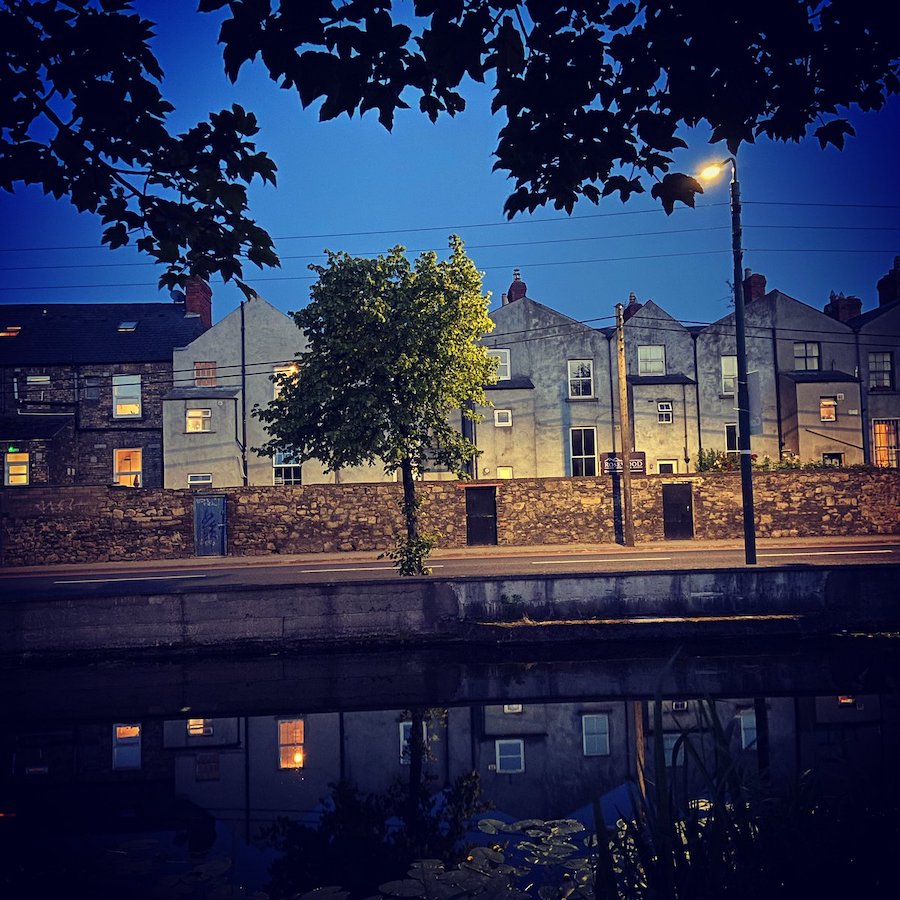



From top: Bermingham Tower and Middle Tower, Dublin Castle; Cook Street (top) and Ship Street; Isolde’s Tower, Exchange Street; Lamb Alley. and The Record Tower, Dublin Castle
The Dublin City Wall.
Harry writes:
During the medieval era Dublin had a protective wall surrounding it with Dublin Castle at its heart but only traces of the wall and its towers remain today. Dublin’s city wall was constructed between 1100 and 1125 to replace the earlier earthen and wooden stake defences of the Viking town of Dyflinn that had developed along the south bank of the River Liffey. In 1170, the Anglo Normans ruled Dublin and developed the town into a city, strengthening its fortifications and building gates, such as Newgate at what is now Cornmarket.
The Normans also built a moat at Dublin Castle, and from around 1240, began to extend the city wall to the north towards new quays on the River Liffey. On completion the limestone wall would have been very impressive towering to between 5m and 7m in height by a massive 1.50m and 3m in width
Although only limited parts of the wall and some of its towers survive today, with a little imagination almost the entire circuit can be walked along today’s streets: Cook Street, the wall along here has been pretty much reconstructed but it provides an excellent idea of how it originally appeared along with an entrance gate to what once was the medieval city. Essex Street West outlines the northern limit, while Ship Street Little and Lamb Alley just off Cornmarket, outlines the southern and western lines respectively.
Arguably the best places to view what remains of the wall are along Cook St with the wall being 83m in length and towering to at least 10m in height along with the entrance gate at St Audoen’s Arch. A continuation of this part of the wall approx. 100m in length, was discovered during excavations at Wood Quay and it is still partly intact, hiding in the basement of the bunkers of Dublin Civic Office.
There is a fine section of wall 14.20m in length by 4.80m in height to view at Lamb Alley. This is where the western gate (New Gate) stood. The original tower that was sited here was used as a prison until 1780, public hangings were carried out at gallows beside the prison while punishments were carried out at nearby Cornmarket. Other parts of the wall and its towers to see are within Dublin Castle along with the hidden remains of Isolde’s tower in Exchange Street Lower, Temple Bar.
Every section and tower of Dublin’s walls have an interesting history. In Dublin Castle the Bermingham Tower along the city wall was utilised as a main cell and dungeon block. It was named after Sir William Bermingham who was arrested in 1331 and imprisoned by the newly appointed Viceroy, Sir Anthony Lacey. Bermingham was later hanged for treason, ‘notwithstanding his great military services against the natives’. Today only the base of the medieval tower is unchanged, the upper level had to be rebuilt in 1777 following an explosion in the castle’s armoury.
Following along the circuit in Dublin Castle we arrive at the Medieval Tower (Record Tower) one of the most historic, intact and important parts of medieval Dublin to survive today. Dating from 1204-28, it was largely constructed during the reign of Henry III (1207–72), King of England and Lord of Ireland. Its walls are up to 4.8 metres thick.
Over the centuries it was used as the king’s Wardrobe Tower, storing his armour, clothes and the king’s treasure. The Wardrobe was also the name for the department of the royal household that managed the king’s personal property. The tower was later used to house prisoners.
By the seventeenth century it was renamed as the Gunner’s Tower serving as the headquarters for the Master Gunner of Ireland. In 1811, it was converted to the Record Tower and used to store state papers, expensively bound books and ancient manuscripts, along with the correspondence of Viceroys and governments. It ended this usage in 1989 and the tower is now undergoing preservation.
Continuing along the circuit in Dublin Castle you will find the sign posted location of the Powder Tower. If you would like to view the remains of the Powder Tower you will have to do a highly recommended tour of the Castle where you can view below ground level, the towers Undercroft where gunpowder was stored.
This tower was originally 5 stories in height and the top floor contained the penthouse chambers of lord deputy John Perrot. Perrot had previously served as ‘President of Munster’ in 1571 to suppress a rebellion there.
Though he failed in his mission, his methods were characteristically violent as he hanged over 800 of the Irish rebels. He is probably mainly known for sanctioning the kidnap of Hugh Roe O’Donnell (Red Hugh O’Donnell) in which he was lured to a wine tasting on a merchant ship and then sealed in a cabin and later imprisoned at Dublin Castle. latterly the tower was used to store gunpowder, earning its name.
The base that you can view beneath ground level today has walls that are 5.5m thick and the interior is 5.5 to 6m in diameter. During excavation discoveries of plates of iron, mounts of bronze and buckles suggest it may have been used as an armourer’s workshop. Intriguingly a gold ring set with a small green stone was also found here.
Isolde’s Tower at the north-east corner of the city walls had strongly fortified foundations, the walls measuring 4m thick, but what is left today is only 2.50m in height. The remnants of the tower in Essex Street West, is behind a barred gate in an underground chamber and are viewable from the street. During excavation interesting but gruesome discoveries were made as human remains were discovered.
The heads of rebels and convicted criminals that had been executed in the city were mounted on poles as a warning to its citizens. Forensic archaeologists identified the skulls of six executed males with one displaying signs of a horrific death. The executioner missed his mark, perhaps his victim was struggling, his axe smashed into his victim’s jaw shattering it along with portions of facial bones rather than his neck resulting in the ensuing butchery of his head being hacked off with multiple blows.
The wall was used many times in the defence of Dublin from military attack but in an early use of quarantine when the Bubonic plague (The Black Death) arrived in 1348, people who wanted to enter the city were forced to remain outside the gates for a number of days until it was clear that they had no symptoms of the infection before being allowed to enter.
So, today if you decide to explore the route of the wall and its towers you will visit some of Dublin’s most historically interesting streets, its backstreets and side lanes as the wall appears, disappears and reappears again, enjoy your walk.
Harry’s Dublin appears here every Friday.
All pics by Harry Warren