

This morning.
Killary Harbour, Leenane, Co Mayo.
Thanks Andy Tyrrell



This morning.
Killary Harbour, Leenane, Co Mayo.
Thanks Andy Tyrrell
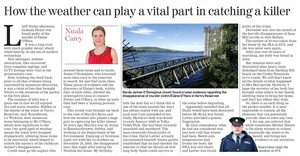 Today’s Irish Independent.
I, for one, am relieved that while sometimes Mother Nature is the silent witness to crimes eventually she wants to be heard and brings key evidence to our attention…
Sounds reasonable.
How the weather can play a vital part in catching a killer (Nuala Carey, Independent.ie)
Thanks Bodz


Des writes:
Part of the Driving Licence form (above) insists I provide my PPS number (to drive a car!) it further says details may be shared with third parties. If the issuing of driving licences is ever handed over to a private company (like NCT) is that not the same stuff that Irish Water went through? Are they building a national ID card by proxy?
Anyone?
Related: Gardai Could be Given PPS Numbers Of Two Million Drivers (Mark O’Regan, Independent.ie)

The Castlepalooza music and arts in Charleville, Tullamore Co Offaly festival this morning confirmed its headliners for their 10th anniversary festival.
Of Montreal, Hercvles & Love Affair and Aeroplane lead the charge, propped by Jape and Fight Like Apes to name but two.
Three day ticket only €49.
Castlepalooza Music And Arts Festival (31st July – 2nd Aug 2015)

From left: Somaiaa Halawa, Omaima Halawa and Fatima Halawa with a photo of their brother Ibrahim at the Department of Foreign Affairs on Saturday
Following claims that their brother has been tortured and is on a list to be executed in Egypt.
The family of Ibrahim Halawa has confirmed that his trial in Cairo, which was scheduled for today has been put back until 26 April.
The 19-year-old, from Tallaght in Dublin, has been detained since his arrest 18 months ago at a demonstration in Cairo.
[Ibrahim and his sisters were arrested in the al-Fateh mosque after taking part in a protest related to the ousting of former Egyptian president Mohammed Mursi in Cairo. His sisters were released after three months in prison]
Mr Halawa and 493 others are facing charges of murder, attempted murder and participating in an illegal protest. But Amnesty International, which has investigated the case, says he has no case to answer and has declared him a prisoner of conscience.
Trial of Dublin teenager in Egypt adjourned until April (RTÉ)
(Sam Boal/Photocall Ireland)

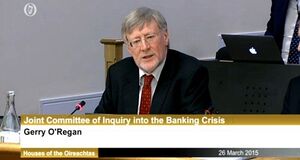
 From top: Geraldine Kennedy; Gerry O’Regan; Dan O’Brien; Julien Mercille
An inevitable thing happened at the banking inquiry.
Dr Mercille Writes:
Last week, the Banking Inquiry forced some members of the media to undergo questioning about their poor performance during the housing bubble years. They didn’t enjoy it.
The Inquiry’s media deliberations started with myself and [Dublin Institute of Technology journalism lecturer] Harry Browne, who provided a critical look at the media.
Then, a string of media individuals were called in to reassure everybody that what we said was garbage.
The media’s defence mostly has revolved around personal attacks and flimsy arguments. I don’t want to delve too much into the personal diatribes because it distracts from the important issues, but many are funny, so here is a short list of what I’ve been called:
-A “messiah” and “self-appointed guru”, and also “an obscure academic” (Gerry O’Regan, ex-editor of the Irish Independent).
-“The finest conspiracy theorist I have heard in a long time” (Geraldine Kennedy, ex-editor of the Irish Times).
-A “man of the hard left” (Dan O’Brien, a hard right-wing journalist)
-“I attach no credence whatsoever to Dr. Mercille and his views regarding the Irish Examiner. They are from a planet I neither recognise nor inhabit and they do not apply to the Irish Examiner” (Tim Vaughan, Irish Examiner editor).
-“Far left”, “not a media academic”, and has “never worked in the Irish media” (Michael Clifford, Irish Examiner journalist).
The real issues, however, are this: the Irish media has a record of failure over the last 15 years on reporting economic issues of the highest national significance.
It’s easy to see: news organisations missed the housing bubble in 2000-2007, and then from 2008 onwards, have argued that austerity is the best strategy out of the downturn, even though it actually worsens economic performance.
Therefore, if accountability was a value espoused by our media, a lot of journalists and editors should by now have been fired for incompetence.
A few responses to the (false) claims that have been made at the Inquiry and since then will clarify the role of the mass media during the housing bubble and since then.
-“Saying that the media conveys elite views is a conspiracy theory.”
A conspiracy happens when a few people plot in secret outside the normal institutional channels to accomplish something from which they benefit personally. This has nothing to do with my analysis of the media, which is an institutional one: the media give us the views of the elites because they’re owned and funded by elites. Nothing surprising in this.
-“Journalists just reported what the ‘experts’ said so they shouldn’t be blamed for missing the housing bubble.”
This is very interesting and is often heard from journalists attempting to absolve themselves of any blame. When you think about it, it is actually a very harsh indictment of the media.
Indeed, it implies that journalists don’t think and are not critical of anything: they only report what others say, like robots.
I recall a senior RTE journalist who said to me that he wasn’t to blame for missing the housing bubble because he wrote his articles in this way: “When I come back from lunch, I check my smartphone, and I’ve usually received about 12 press releases from companies and the government. I just copy them and that’s my article!” Great. Journalists are supposed to think and challenge viewpoints, not report them without question. Thankfully, some journalists still believe in those principles and apply them.
-“We really tried to find out but all the experts were telling us the economy was fine.”
For example, at the Inquiry, former Irish Independent editor Gerry O’Regan claimed that the Irish media had missed the boat on the banking crisis, but that “it was not for want of trying,” and that the state of the banking sector was “hidden from the view of everybody” at the time.
Really? In 2007, when Morgan Kelly wrote his newspaper article essentially predicting that the Irish banks would collapse, he first sent it to the Irish Independent, whose editor was Gerry O’Regan. What happened? The editor wrote to Kelly and told him his article was “offensive” and that he wouldn’t publish it.
-“Commercial interests don’t affect news content.”
Advertising revenues are crucial to today’s news industry. For example, at the height of the boom, 17% of the Irish Times’ revenues came from property advertising only, which means nearly €100 million over the period 2002-2006.
In any case, some journalists have already revealed in published academic research that they faced pressures not to attack the banking and property sectors during the housing bubble.
-Some, like Irish Examiner journalist Michael Clifford, say that “The notion of ‘the media’ as some homogenous beast that takes a line and follows it like a political party, for instance, is complete garbage.”
Yes, and that’s why nobody is saying that. The media reflect the range of opinion among elites. So there is diversity in the news, but it is relatively narrow.
-“If you can’t give examples of journalists who have been prevented from their editors or owners from challenging those in power, then you can’t say the media represses contrarian viewpoints.”
First, we have academic research that has reported on journalists who said they were leaned on not to criticise the housing bubble. But more broadly, the point is that those who work in the media, journalists and editors included, mostly agree with the values and principles of the organization they work for.
It’s the same in any institution: for example, if you’ve been a military officer for years, you probably believe in armed operations in world affairs, or at least you’re not too strongly opposed to that. Those who don’t assimilate their organisation’s values will most likely leave it or be forced to leave.
So most journalists won’t question or challenge elites, because they largely agree with them on the basics of policy. Sure, policy will be questioned in the details, but not fundamentally.
Therefore, when editors claim that they never came under pressure on the part of commercial interests or owners, in a sense, that’s probably true, because no pressure is needed to make them toe the line, with which they agree. (Of course, some journalists are very much aware of the pressures they face, so there are always exceptions).
-In his Sunday Independent article yesterday, Dan O’Brien [former Irish Times Economics Editor] insinuates that I overlooked a clear warning he supposedly gave to the nation on Prime Time in April 2006 about the housing bubble.
This is not at all true, and would mean that Dan O’Brien counts himself, together with David McWilliams and Morgan Kelly, as having warned us all about the bubble. But you don’t need to do any research to find out that O’Brien is wrong. In the same article, he says himself that he didn’t have a clue about the housing bubble until 2008:
“I did not see the size of the risks building up in the financial sector in Ireland and across the western world before 2008. I accept this was a failing and do not seek to distract from my culpability.”
But then he complains that I should have classified him as one of those who warned us about the impending crisis. Go figure. This is indeed reasoning from another planet.
@JulienMercille is lecturer at UCD and the author of The Political Economy and Media Coverage of the European Economic Crisis: The Case of Ireland (2015, Routledge). His new book, Europe’s Treasure Ireland, will be out in a few months.
Yesterday: Don’t Hate Him Because He’s Beautiful

Bleurgh.
Aron writes:
Mouldly pitta bread in Dunnes in Charlestown Shopping Centre [Dublin 11]…! May 25 expiry? Something not quite right here.
Something not quite right! ;)

Finally.
Formerly unemployed mapper Omar Sarhan writes:
You may have noticed a lack of maps, that’s because I am now gainfully employed! So no staying up to till all hours mapping kebabs and the like.
I covered a topic on my blog about students in Dublin 2004-2014 before and followed up by creating a map and a few charts and graphs that some may find interesting. I’ll let the map (above) speak for itself and you can explore more on the topic via my blog post here.
If anyone is curious I am working with global spatial geo-datasets and logistics software in London, for a small firm called Map Mechanics. It’s pretty cool to work in a country where real business gets done and ….. (I better stop there before I offend :P ). I’ll hopefully create more maps over the next few weeks…

