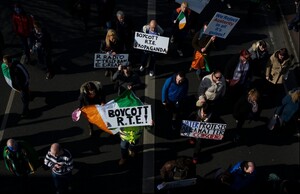
Alan Kelly, the minister of environment, community and local government, said that creating an authority with a dedicated revenue stream that can sell bonds is the best way to finance the infrastructure work that is needed. He dismisses the protesters as “left wing” or “populists” and recently suggested they were in “cloud cuckoo land.”
But Sarah Murphy, 35, who lives in Ballymun, one of the poorest areas of Dublin, said that her husband has been unable to find work since his business collapsed in 2008. The family, after paying rent and electricity, lives on $73 a week for five people, she said.
“We are not paying it,” she said. “We don’t have it.”
Ireland’s economy has been recovering. It grew by nearly 4.8 percent in 2014, and unemployment fell to about 10 percent from a high of 15 percent. But many experts say the figures are misleading, as the unemployed continue to leave the country and many multinational companies, based in Ireland because of its low corporate tax rate, are recording financial transactions that actually take place elsewhere.
A report by the country’s Central Statistics Office that was released in January painted a more dire picture of what has happened in Ireland since the crisis began. The most recent figures available show that Nearly a third of the population in 2013 was suffering from “enforced deprivation” characterized by a lack of two or more basic requirements for a comfortable standard of living, such as adequate food, heating or a warm winter coat, up from 13.7 in 2008, before the financial crisis and the recession.
Many in Ireland Vow Not to Pay a New Water Tax (Suzanne Daly, The New York Times)
(Paulo Nunes/New York Times)
Thanks Niinecare




 Gary Cooke (above) and Vinzeno