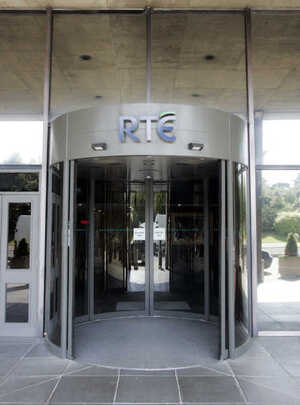
 RTE Television Centre (top) and Julien Mercille (above)
It’s Monday.
It’s 9.10am.
It’s Mercille on Monday.
Julien Mercille writes:
A fortnight ago a scandal involved Europe’s largest bank, London-based HSBC and its Swiss banking arm, in a large tax evasion scheme.
The charges are that the bank helped its clients hide accounts while providing services to corrupt businessmen and criminals.
Some have called it the biggest banking leak in history. Newspapers immediately gave much attention to the story, but the UK’s Daily Telegraph gave it minimal coverage. Why?
It’s partly because the Telegraph feared that HSBC would stop funding the paper through advertising. Peter Oborne, the Daily Telegraph’s chief Political Commentator, actually resigned in protest because his paper’s editor let commercial advertisers influence the news content and reporting.
HSBC also used to sponsor RTÉ’s Drivetime radio show, which suggests obvious conclusions, but more on that below.
Advertising revenues are crucial to the news industry. They allow newspapers to be sold for a cheaper price, making them more competitive.
This affects news content because corporate advertisers tend not to subsidise television programmes or news stories that seriously question or attack their own business or the political economic system of which they are part, which would be contrary to their interests.
The same goes for corporate or state ownership of the media: owners don’t favour stories that directly challenge government or the corporate sector simply because that’s directly against their interests.
Former Telegraph executives and journalists have confirmed the allegations, saying they were ‘spot on’, and additional claims have been made that:
– HSBC pays about £3.5 million per year to the Telegraph in advertising fees.
– The paper’s commercial department is ‘stronger’ than the editorial one and this has been a ‘dirty little secret for some time’. The Telegraph ‘can’t afford to offend’ some ‘key advertisers’. This means ‘stories being softened, stories being downgraded in terms of placement, headlines softened or stories not run at all’.
– HSBC withdrew advertising from the Telegraph three years ago after negative reporting on the bank.
– Often, ‘If there was a story related to a big Telegraph advertiser and something that was deemed critical was going to appear, subsequently you’d get a call of irritation from someone very senior saying: “We’ve heard that you might be running a story about Tesco… Did you know that they spend X amount with us advertising each year?’
The Irish media faces the same situation. For example, RTÉ gets about €150 million in advertising revenue every year, and in 2008 before the economic crisis that reached €240 million. It’s almost half of its total annual revenues (the other half is made up by the TV licence fees it collects).
Some of its main sponsors are banks, insurance firms and car companies:
-Ulster Bank
-Bank of Ireland
-RaboDirect Bank
-Aviva insurance
-Chill insurance
-Volkswagen
-Volvo
-Mitsubishi Motors
-Land Rover
-Toyota
-Burger King
-Coca-Cola
The full list can be seen here.
A quick look at RTÉ’s website shows how desperate it is for corporate advertising, telling potential advertisers that RTÉ is ready ‘to help you plan the process of getting your message across the largest audience in TV, Radio, Print and Online in the Irish market’ and that advertising on RTÉ ‘is the ideal platform to enhance your tactical plans or long term brand objectives’.
There are telling examples: Bank of Ireland sponsors RTÉ Radio’s The Business show by paying a fee of €160,000 for 12 months.
Ulster Bank sponsors RTÉ’s Drivetime radio programme by giving the show €260,000 for the year. Before that the sponsor was Danske Bank, and before that, HSBC bank. Who really thinks those shows will give us a critical and objective picture of financial issues?
A clear example of the significance of advertising to the Irish media is the large amount of funding from property advertising received during the housing boom years.
The Irish media went even further than benefiting from property advertising money: they became owners of property websites, acquiring a direct stake in the growing housing bubble.
For example, in 2006, Independent News & Media bought PropertyNews.com (along with the PropertyNews monthly newspaper), the largest internet property site in Ireland.
In 2006, the Irish Times bought the property website MyHome.ie for €50 million, along with the website newaddress.ie, which aims to make it easier for home owners to move residences.
Also, most newspapers published weekly supplements for commercial and residential property, ‘glamourising the whole sector’, while ‘glowing editorial pieces about a new housing estate were often miraculously accompanied by a large advertisement plugging the same estate’, in the words of Shane Ross, former Sunday Independent business editor:
‘Unfavorable coverage of developers and auctioneers in other parts of the newspapers was regularly met by implied threats from property interests that advertising could go elsewhere’. Moreover, a reporter working for an Irish news organisation stated that journalists ‘were leaned on by their organisations not to talk down the banks [and the] property market because those organisations have a heavy reliance on property advertising’.
Some people will deny that advertisers and owners influence news content. That’s contrary to all evidence, but think about it this way. We don’t have any problem understanding that a trade union newspaper reflects the trade union’s viewpoint.
Or that a student paper reflects the students’ viewpoint. Or that a television show that would be sponsored by Greenpeace or Amnesty International would promote environmental and human rights issues. Or that a radio station sponsored by the Irish Palestine Solidarity Campaign would highlight views favourable to Palestine.
So why is it so hard to understand that a show sponsored by Ulster Bank or Bank of Ireland will likely present favourable views of bankers? Or that a programme sponsored by private health insurance companies won’t tell you that a private, profit-driven health care system is inefficient, wastes money, and bad for people’s health? Or that a show sponsored by a car company won’t exactly be keen on promoting real alternatives to our car culture?
@JulienMercille is lecturer at UCD and the author of The Political Economy and Media Coverage of the European Economic Crisis: The Case of Ireland. He will provide evidence to the Banking Inquiry on the role of the media during the housing bubble years.
Related: Ireland’s Biggest Problem Is RTÉ Says Max Keiser
(Mark Stedman/Photocall Ireland)