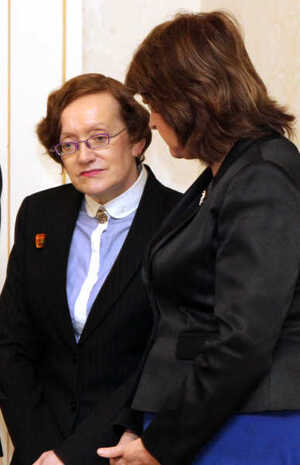
Attorney General Marie Whelan (left) with Tanaiste Joan Burton
Government TDs this week voted down Clare Daly’s bill to allow abortion in cases of fatal fetal abnormalities claiming it was unconstitutional
But was it?
We asked Legal Coffee Drinker what it’s all about
Broadsheet: “Legal Coffee Drinker, What’s it all about?”
Legal Coffee Drinker: “It’s about Article 40.3.3 of the Constitution, which provides as follows:-
‘The State acknowledges the right to life of the unborn and, with due regard to the equal right to life of the mother, guarantees in its laws to respect, and, as far as practicable, by its laws to defend and vindicate that right.’
The Protection of Life in Pregnancy (Fatal Foetal Abnormalities) Bill 2013 provides that, in addition to the existing grounds for abortion set out in the Protection of Life During Pregnancy Act, it shall be lawful to carry out an abortion in the case of a fatal foetal abnormality, defined in Section 1 of the Act as “a medical condition suffered by a foetus such that it is incompatible with life outside the womb”.
The argument is that this is in breach of the foetus’s constitutional right to life. The reasoning goes that, on the wording of Section 40.3.3, the foetus’s life can only be justifiably ended where there is a threat to the life of the mother, which threat does not necessarily exist in the case of a foetus suffering from fatal foetal abnormality.”
Broadsheet: “Is this correct?”
LCD: “It’s a simplified reading of Section 40.3.3. A number of issues arise in relation to this section. Firstly, what is meant by ‘the right to life’ of the unborn, and does it apply, or apply to the same extent, where the unborn in question has no possibility of surviving outside the womb? Secondly, the obligation in relation to the right to life is an obligation to defend it ‘so far as practicable’.
Is it practicable to defend, to the same extent, the rights of a foetus with no viable possibility of life outside the womb?
Thirdly, although Section 40.3.3 might on its face indicate that the only thing which can limit the right to life of the unborn is the right to life of the mother, it is recognised that constitutional rights generally may be limited by other constitutional rights even where the Constitution does not expressly state this. The mother of a foetus with fatal foetal abnormality has other rights apart from the right to life, which may be infringed by the continuing of the pregnancy.”
Broadsheet: “A tricky one to call then?”
LCD: “Not quite as difficult as it was before the recent decision of P(P) v Health Service Executive [2014] IEHC 622. You might remember this recent case, in which a three-judge High Court permitted the withdrawal of life support from a woman, who was brain dead, and whose foetus had no viable prospect of survival outside the womb.
In this case, the Court took the view that such withdrawal of support would be a failure of the State’s obligation to vindicate the right to life of the foetus, stating that “the question which must be addressed is whether even if such measures are continued there is a realistic prospect that the child will be born alive,” concluding that “although the State has an interest in preserving life, this interest is not absolute in the sense that life must be preserved and prolonged at all costs no matter what the circumstances.”
Broadsheet: “But this case related to withdrawal of support rather than active steps to end life within the womb?”
LCD: “True. But the view of the court that the right to life was not absolute is significant, as is its explicit focus on the question of whether there is a realistic prospect of survival outside the womb, which seems to be a key factor in determining the weight to be given to its right to life. In circumstances where the unborn has no realistic prospect of survival, considerations relating to the welfare of mother, other than her right to life, may well fall to be taken into consideration.”
Broadsheet: “Can you say this for certain?”
LCD: [Drains coffee] “Absolutely not. But equally, and particularly following the P(C) decision, it is not possible to say with certainty, or even as a matter of probability, that the Bill is unconstitutional. Many Bills, including those put forward by governments, have constitutional question marks hanging over them. That this will happen is expressly recognised by the Constitution itself, Article 26 of which provides that the President, before signing a Bill, may refer it to the Supreme Court to have a decision taken as to its constitutionality.
To regard possible unconstitutionality, falling short of certainty, or even probability, as a ground for not voting for legislation would have ruled out much of the most important legislation passed in this jurisdiction. Constitutional rights – even the right to life of the unborn – are not absolute; nor, in this case, is the question of unconstitutionality. Indeed, it could be argued that, if anything, it is in the public interest that we get the opportunity to hear more, from the Supreme Court, on the meaning and scope of Article 40.3.3.”
Broadsheet: “So telling people not to vote for the Bill above on the basis that it ‘is’ unconstitutional, is not really correct?”
LCD: “Yes. The sole arbiter of unconstitutionality is the Courts. In cases where there are grounds, based on existing caselaw, for saying that legislation is definitely, or most likely, unconstitutional, a statement like the above might be justified. However where there is limited caselaw, and such as there in no way raising even a probability of unconstitutionality, such a statement rings a bit hollow, to say the least.”
Broadsheet: “Oh.”
LCD: “Yes.”
Broadsheet: “Or more like: Oooooh.”
LCD: “Are we done?”
Broadsheet: “We are . Most grateful. Thank you Legal Coffee Drinker so much.”
LCD: *click*
Previously: Sent Away
“I Could Not But Have Supported Clare Daly’s Bill”
Do you have a thorny legal issue but short on guineas? Send your brief ‘brief’ to Legal Coffee Drinker at broadsheet@broadsheet.ie.