

Screen Shot 2014-05-28 at 01.50.01

Screen Shot 2014-05-28 at 01.50.34

Screen Shot 2014-05-28 at 01.55.10

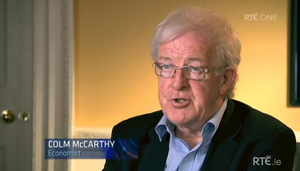
Economist Colm McCarthy, Dr Edgar Morgenrath, of the ESRI, and Elizabeth Arnett, head of communications at Irish Water. Ms Arnett is the former head of project communications at consultancy firm, RPS, which advised Dublin City Council on the Poolbeg incinerator project when managing director of Irish Water John Tierney was Dublin City Manager

Last night, the first half of RTÉ’s Prime Time focused on Irish Water. In an initial report by Barry Cummins, the matter of last summer’s deal made between the Government and the 35 local authorities – the 12-year Service Level Agreements – was discussed.

The agreements essentially mean that the pre-existing structures and staff in relation to the provision of water will remain in place for 12 years before transferring into Irish Water.

This is what some of the contributors had to say:

Colm McCarthy: “There had to be some transitional arrangement but 12 years seems like an awful long time and, to the degree, that the intention of having a single water authority was to economise on costs, having 12-year service agreements with all the existing operators means there won’t be any savings for 12 years.”

Dr Edgar Morgenrath: “Personally, I would not have put those service level agreements into legislation. That’s going to be very difficult if you find that you want to change that, to do so. I think that could have been done on a contractual basis. And if Irish Water were simply just an amalgamation of the water services of the 34 local authorities, as they existed previously, then there wouldn’t be any efficiency gains and that would certainly be a wasted opportunity.”

Elizabeth Arnett: “We can’t underestimate the scale of the transformation programme that we’re undertaking. The service level agreement provides mechanisms in order to make the sorts of changes that we need to see over those 12 years, so it’s not a steady state for 12 years.”

Related: Reform of quangos by politicians just not happening (Colm McCarthy, Sunday Independent, December 8, 2013)

Spiralling costs at Irish Water flagged last year (Daniel McConnell and Paul Melia, Irish Independent, February 14, 2014)

Thicker Than Uisce

Watch back here

Meanwhile…


Boqm8oGCcAAEkRm.png-large

BorMiUACEAEe_ll

Boq1wBGCUAA8x6m.jpg-large

Further to the front page story in the Irish Mail on Sunday, by Alison O’Reilly, at the weekend – about how it’s believed almost 800 babies were buried in a mass grave next to a home for unmarried mothers and babies in Tuam, Co. Galway between 1925 and 1961 –  three newspaper clippings about the home.

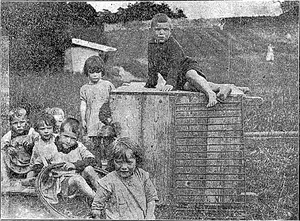
The first is a photo of children from Glenamaddy, Co. Galway, the prior location to the Children’s Home in Tuam, Co Galway in 1924, published in the Connaught Tribune on  June 21, 1924. The move to Tuam was supposed to lead to an improvement in conditions for the children. The Glenamaddy Children’s Home was declared “insanitary and unsuitable for such a purpose” by the Department of Local Government and Public Health in 1924 and the home moved to Tuam in 1925.

The second is an ad for a contract for coffins for the Children’s Home, published in the Connaught Tribune on January 30, 1932.

And the third is an article detailing how much the Galway Board of Health paid the Bon Secours nuns “per inmate”.

In Sunday’s article (not online), Ms O’Reilly reported how the mass grave was discovered by local woman Catherine Corless who compiled a list of 796 babies who died at the home.

Ms O’Reilly reported:

“With the help of the Births and Deaths Registrar in Galway, Mrs Corless researched all the children whose place of death was marked ‘Children’s Home, Tuam’. Galway County Council has all the cemetery books for Mayo and Galway and with the help of the archivist there, Mrs Corless cross-checked the names against the grave records. Mrs Corless said: ‘There was just one child who was buried in the graveyard in Tuam. That’s how I am certain there are 796 children in the mass grave. These girls were ran out of their family home and never taken back so why would they take the babies back to bury them either’.”

Blessed are the archivists.

Pics via Limerick 1914 and Shane

Screen Shot 2014-05-20 at 09.44.52

Sgt Maurice McCabe shakes Taoiseach Enda Kenny’s hand in Mullingar, Co Westmeath while Mr Kenny was canvassing on May 19. Mr Kenny did not take the opportunity to apologise to Sgt McCabe even though a week prior to their meeting, he told the Dáil he’d have no problem apologising to Sgt McCabe 

In the Dáil last night, Independent TD Mick Wallace proposed – for a second time – a bill that would, among other things, pave the way for the establishment of a Garda Síochána Independent Board and to reform the powers of the Garda Síochána Ombudsman Committee.

He also spoke about Garda whistleblower Sgt Maurice McCabe.

He said Sgt McCabe was not in work yesterday as he is still being harassed by certain colleagues and senior officers who told him he “destroyed” the force.

From Mr Wallace’s speech:

“The Bill proposes a 16-member board, to include 2 Irish Human Rights and Equality Commissioners, 4 members of the Oireachtas, the Ombudsman for Children, the Data Protection Commissioner, and the Chief Inspector of Garda Inspectorate. It is proposed that the remaining 6 members be chosen from citizen bodies, with a reserved place for the Traveller community. We believe that consideration should be given to the inclusion of 2 Garda Representatives from the low- and middle-ranks. This may go some way to improve Garda morale and to involve the Garda Siochana in the process of reform. This would allow the rank-and-file and middle-ranking Gardai more involvement and input in developing Garda policy than under the current hierarchical arrangement.”

“The Garda Inspectorate, which can look at practices, policies and procedures of the Gardai, should be answerable to the new Police Board, rather than the Minister, and should have greater powers of investigation, and its reports should be published promptly.”

“The reforms of GSOC contained in our Bill recognise that its remit was always intended to be investigatory, rather than one of review and oversight. As the United Nations Office on Drugs and Crime has pointed out, “Independent police complaints bodies must have investigative powers, be able to initiate investigations of their own accord and intervene in investigations conducted by the police”. Under current legislation, GSOC is inhibited in this regard – a shortfall which has been highlighted by UN Special Rapporteur Ms Margaret Sekaggya. The Ombudsman asked the permission of the then Fianna Fail Minister for Justice to investigate policing at Corrib under Section 106, but was refused. In 2013, we appealed to Minister Shatter again to allow GSOC to use Section 106 to look at Corrib policing, and also, the allegation of racial profiling in the Gardai at the time of the Roma Children episode. Again, the Minister for Justice refused. Section 106 of the Garda Act is amended to address this.”

“It is also crucial that any legislation put forward by government is accompanied by the political will to actually use it, otherwise there will be no change. Speaking of no change, Maurice McCabe is not at work today or yesterday. He is suffering harassment and abuse. He has been told by senior officers that he destroyed the force. He has reported the abuse through the proper channels. And there is no change. It is hard to believe that a man who has been so selfless and relentless in the pursuit of justice, could still be treated like this, given all we now know.

Read the full speech here

Previously: The Chances

The Thin Blue Line [Updated]

ih1e365qxlsolgjyh03v
Apparently, a kerning malfunction in the previous design meant that the bottom of the ‘l’ and the bottom of the ‘e’ didn’t quite line up.

To fix it, Google moved the “g” one pixel to the right and the “l” one pixel down and to the right, as spotted by the denizens of this Reddit thread, wherein it is also pointed out that you can check all previous iterations by changing the number at the end of this url.

gizmodo

Broadsheet.ie