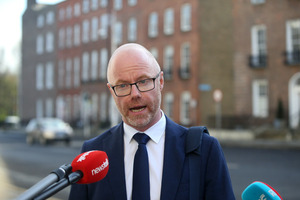
From top: a new cycle lanes taking one lane of the road from Blackrock Village through to Sandycove, county Dublin; Dan Boyle
The twentieth century, without much debate, can be considered the century of the motor car. It was probably the invention that had greatest impact on people’s lives. It undoubtedly was the most significant contributor towards greater personal autonomy for many people.
It’s greater use certainly made life easier for horses. The greater prevalence of the motor car soon challenged the transport story of the nineteenth century – the railways.
Its greater effect was on the then preferred runaround – the bicycle. In Ireland, a more slowly industrialising country, it effects for most of the twentieth century were less marked.
Flann O’Brien chronicled this relationship in The Third Policeman in developing his molecular theory positing that the molecules of cyclists became interchangeable with those of the bicycles they were riding.
As the country inched towards greater economic prosperity, the bike developed a reputation as being the poor man’s car. It was seen as something to be cast aside to achieve the status car ownership would confer.
The coming of the millennium brought the first questioning of our collective love affair with the motor car. Part has been the belated realisation that surface space is not infinite, that constant and continuing congestion is the obvious result of a growing car fleets.
The environmental effects of too many journeys in too many motor cars has also become better understood. One third of all carbon emissions come from transport, mainly from cars.
It is the economics of car usage and car ownership that is becoming focused. Our cars are parked 92% of the time. The 8% of time they are being used by us is funded by one of the biggest capital outlays many will experience in their lifetime.
The great car rethink has created an opportunity for a bike comeback. That is though more imagined than real. A back to the future revolution was bound to invite reaction
A what we have we hold attitude has developed regarding road space. Car dominance has been such, that no understanding has been fostered that there are different categories of transport users who can, and should, share the available space.
Strange alliances have been formed where the car lobby has got some pedestrians to buy into the demonisation of cyclists as kamikaze inspired mowers down of the innocent.
This urban myth is easier for some to believe due to the fact that there are some bad cyclists. They exist in a smaller proportion than bad drivers, but the fact that they do exist helps feed the myth.
Another factor that may hinder a smoother transition is battling a perception that the cycling renaissance is seen as a largely middle class activity. Something of an irony when large scale bicycle use once had been the transport of choice of the plain people of Ireland.
Encouraging less car journeys and greater use of bicycles should be a win win situation. Better use of space, better health outcomes and a much better quality of life.
It should be easier but the reluctance to change is understandable. The pop up infrastructure that has appeared over the last number of months, across the country, may help to convince.
To misquote George Orwell – Two wheels good four wheels not so good.
Dan Boyle is a former Green Party TD and Senator and serves as a Green Party councillor on Cork City Council. His column appears here every Thursday. Follow Dan on Twitter: @sendboyle
RollingNews