9032728690327284

Except Bermuda, Jersey, Isle of Man, Monaco, Malta etc.

Christian Aid Campaign Officer David Thomas outside Leinster House, Kildare Street, Dublin this morning with Denis-shaped Russian doll-style figurines representing owners of ‘phantom companies’ in ireland which allow  companies outside the country to avoid paying tax and to launder money.

Christian Aid are calling on the Government to support moves by the EU to remove the loopholes that allow this practice and will return with larger dolls if necessary.

Christian Aid

(Sam Boal/Photocall Ireland)

Lion-Cub-Growls-at-GoPro

Of this RC car/GoPro experiment in cute-baiting, Australian photographer/adventurer Chris Bray sez:

While running one of our five 2-week photo safaris to Kenya in 2014, we attached a GoPro camera to a remote control car and drove it up to a lioness with cubs, stopping at a distance where they still showed no interest, and then jiggled the car around just enough to invoke the cubs curiosity. Two of the three cubs then came over and investigated it for 20min, before growing bored and tired and falling asleep back with mum.

laughingsquid/sploid

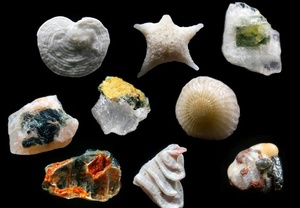
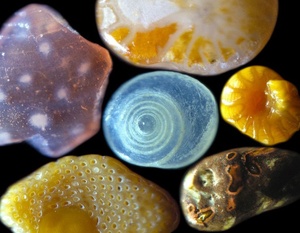
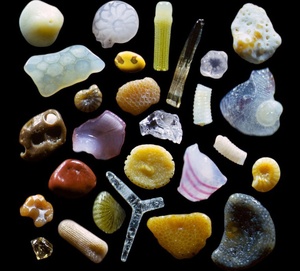
sand sand4 sand3 sand2 sand1
Filmmaker and biomedical researcher Dr Gary Greenberg not only photographed these sand particles at 300x magnification, he also invented and patented the HD 3D microscopes that made the images possible.

The composition and and appearance of sand varies depending on geographical location. These tiny beauties are most likely from the beaches of Hawaii, where Dr Greenberg lives.

boredpanda

Ciaran

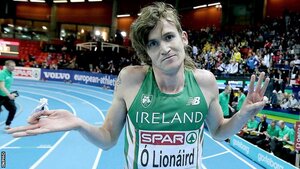
[Cork-born European Indoor 3,000m Bronze medallist Ciaran Ó Lionáird, 25, from Cork]

Ciaran Ó Lionáird writes:

“On my layover in JFK [to a training camp in Florida], I got a bit busy on Twitter in response to a feature article on fellow Irish athlete Colin Griffin in the Irish Examiner [on Saturday]. Let me preface this by saying I have a lot of respect for Colin. Anybody who knows him will agree he’s a guy who has the intellect and reasoning ability to form thoughtful and coherent dialogue relative to his sport and also think on a relative scale about the career of an athlete and what comes afterward.

I spoke out in response to the article as I felt the presence of a recurring theme in features on Irish athletes recently. Granted, there have been positive news stories too and in my haste in getting a message into 140 characters, I perhaps over-generalised in my criticism of the media for bringing a negative agenda into Irish athlete interviews. Now, with the space of this medium, I can hopefully expand a little on my thoughts and explain why I feel the way I do on this.

I am totally in favor of athletes speaking out against what they perceive as unjust. Funding and grants have always been a contentious issue as they form the backbone of an athletes preparation. Cuts to funding can leave an athlete scrambling to re-budget and the year-to-year changes make it difficult to follow-through on the 3-4 year plans necessary to build the continuity and consistency necessary to perform at a World level.

I feel that journalists sometimes play on the emotions of the athletes in order to get a quick and easy jab in at Irish Athletics. Such an act in isolation may not really do a whole deal but when it occurs again and again, it portrays the athletes as moaners and presents them as fighting not just against the system but against each other too. That certainly isn’t the case in real life but the general non-athletics fan can pick up a paper and take a glance and think “ok here we go again”.

“For the journos, it’s an easy sell. For athletes, I feel that it weakens our position in the long term as it prevents us from coming together and forming a consistent message to bring to AAI [Athletics Association of Ireland] with our concerns. Isolated attacks and digs on Twitter do not help our cause I believe.Continue reading →

it

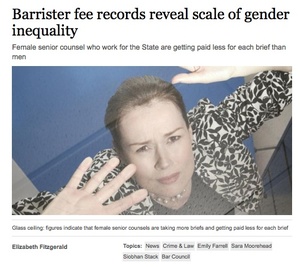
The Irish Times today reports on a fairly  dramatic, in fairness disparity between male and female barristers’ fees for State work.

We asked Legal Coffee Drinker, what’s it all about.

Broadsheet: “Legal Coffee Drinker, what’s it all about?”

Legal Coffee Drinker: “The Irish Times has obtained barrister fee payment data from the Attorney-General’s office showing an apparent disparity between male and female barristers in the divvying out of the very substantial sum expended by the State on barristers’ fees. On an average per-brief basis, female barristers earn substantially less, only 86% (Junior Counsel) and 88% (senior counsel) of the payment per brief given to male barristers.”

Broadsheet: “So why are women earning less per brief?”

LCD: “The first possibility is that they are being paid less than men for the same type of work and the second is that they are getting less complicated and lower-paying work than their male colleagues.”

Broadsheet: “That doesn’t sound fair at all.”

LCD: [pause] “It may or may not be unfair. For example, let’s take the first scenario – that women barristers are being paid less than men for the same type of work. Barristers are normally requested to give a fee quote in advance – in other words – where there are no set fee scales, they put forward their own fee. Could the explanation be that women are simply quoting more moderately than their male colleagues? And is moderate quoting a bad thing in this context?
Moving on to the second possibility, that male barristers are getting more complicated work, we again need to ascertain the reason for this. One matter in particular needs to be considered in relation to the disparity in fees and that is gradation of experience. For instance, the data cited shows that the number of female senior counsel instructed has almost doubled (9% to 15%) in the past ten years; the number of female senior counsel generally has also increased during that period. It may or may not be the case that the more complex and lengthy briefs are going to male Senior Counsels not because they are male but because of their more lengthy experience as Senior, either in respect of State work or generally.
It also takes time for cases to be heard. A substantial part of fees in relation to a case are still paid only after the case is heard. As such, increased fees arising from increased instructions may not necessarily show up in data for a number of years after the instruction. A relevant consideration would be whether or not the briefs looked at by way of comparison were completed briefs or relate to cases which are still ongoing.”

Broadsheet: “Would you say…”

LCD: [Interrupting] “One further explanation – which could apply to both Senior and Junior fee disparity – is that certain areas of law might involve higher fees than others, depending on the nature of the State work involved. A higher concentration of women seniors in an area of law with relatively low per-brief fees could be an explanation for the average per-brief disparity.”

Broadsheet: “What information would we need to know if there is actually discrimination [as between Junior and Senior Counsels]?”

LCD:
“Ideally, you would take each area of State work individually, identify the percentages of male-female seniors/juniors being instructed in respect of such work, and the extent to which these percentages have changed over the previous four years – I say four years to take into account both the delay in receiving fees for cases and also in instructing on the most complex cases. If it is an area in which there has been a significant increase in the percentage of females receiving instructions over the past four years, perhaps keep it under review and look at it again in a couple of years to see if the discrepancy has resolved itself.”
If, on the other hand, it isn’t an area where there has been a recent increase in the number of women instructed, well then this bears more detailed examination to rule out discrimination, subject to the qualification that a non-lawyer may regard a gender disparity in lawyers’ fees as one of overpayment rather than underpayment!”

Broadsheet: “Controversial….Anything else?”

LCD: “Firstly, the Irish Times says it is hard to get a gender breakdown of entrants to the profession. But the electronic list of barristers on the law library website  gives each barrister’s name, year of call to the Outer and (if appropriate) the Inner (Senior Counsel) Bar, and – in many cases – accompanying photo. It should be fairly easy, from this to work the gender breakdown of entrants to the Outer or Inner Bar in any given year. [Drains coffee].
Secondly, the data discussed in the Irish Times article was obtained from the Attorney-General’s office via a Freedom of Information request made under the Freedom of Information Act 1997. Anyone, by making a similar request, can get the same information, and analyse it themselves. The Freedom of Information facility is a great way to find out more about the workings of the State and every citizen should be aware of it. Read more about it here.”

Broadsheet: Thanks Legal Coffee Drinker. You made that understandable and reasonably ‘brief’!

LCD: “Right. Bye.”

Barrister fee records reveal scale of gender inequality (Elizabeth Fitzgerald, Irish Times)

Garda

Journalist Michael Clifford spoke to Pat Kenny on Newstalk this morning following his articles in today’s Irish Examiner about the anonymous penalty points garda whistleblower.

It has emerged that the sergeant – whom Mr Clifford describes as WB – was subjected to disciplinary action in relation to a computer suspected of containing child pornography images which was seized from a paedophile priest Michael Molloy in Kill, Co. Cavan but subsequently went missing from Bailieborough Garda Station.

This happened after he attempted to highlight what he believed was malpractice within the gardaí.

WB had nothing to do with the initial investigation and was the only officer subjected to disciplinary action in relation to the loss of the computer.

From the Pat Kenny Show:

Pat Kenny: “Listening to all of this, it leaves me with the impression, reading what you wrote this morning, and in this conversation with you, it’s kind of: ‘that’ll teach to whistleblow’.”

Michael Clifford: “You could easily..”

Kenny: “I mean that’s the conclusion that I’m left with, I may be wrong.”

Clifford: “Yeah.”

Kenny: “That’s the conclusion: that you actually stick by your colleagues, you don’t rock the boat, you don’t create scandals, you don’t damage the force and, if you do, you know, you pay a price.”

Clifford: “I’ll put it to you this way, to you Pat. In today’s piece, I quoted legal opinion that was obtained by sources, associated with the whistleblower and the legal opinion of having reviewed the case, suggested that it seems, the whole thing was connected with this man whistleblowing and it was described as shambolic.”

Meanwhile, ‘WB’ will go before the Public Accounts Committee on Thursday to discuss the amount of money he and fellow whistleblower, and former garda, John Wilson believe the State has lost as a result of the quashing of penalty points.

Last year a box of evidence was sent to PAC which apparently contains thousands of examples of multiple terminations for individuals.

Last Saturday, the Irish Independent reported that the Garda Commissioner, who will also go before PAC on Thursday, intends to refuse to answer any questions about the box of evidence.

John Wilson, Michael Clifford and John Devitt will be on TV3’s Tonight With Vincent Browne at 11.05pm tonight.

The mysterious case of the missing child-porn computer seized by Gardaí (Irish Examiner)

Gardaí took action against us because we spoke out, say whistleblowers (Irish Examiner)

Thorn in the side of the Force (Irish Exmainer)

Previously: John Wilson on Broadsheet.ie

Broadsheet.ie