
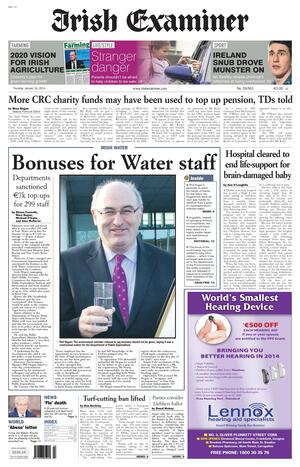


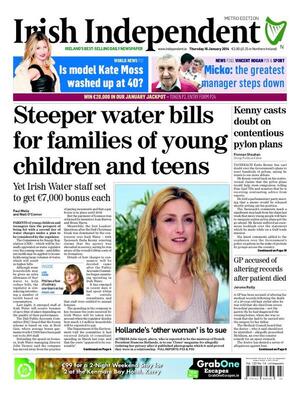


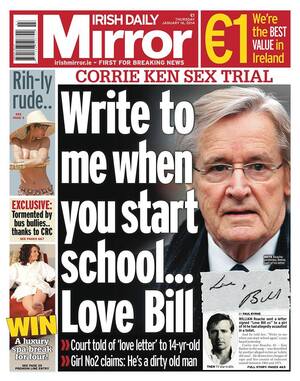

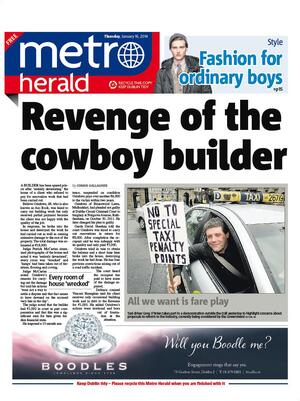
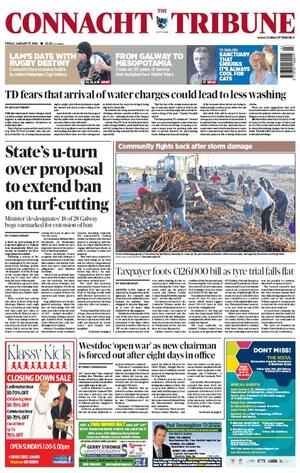
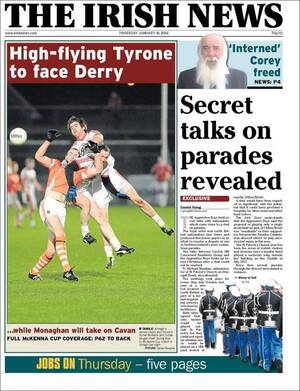


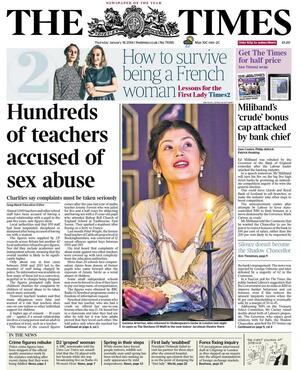


More to follow.
Covers to broadsheet@broadsheet.ie
Thanks Enda Cunningham, Iain Henderson, Brian Oliver, Paul Murphy, Meliosa Fitzgibbon and Joe Donnelly.



More to follow.
Covers to broadsheet@broadsheet.ie
Thanks Enda Cunningham, Iain Henderson, Brian Oliver, Paul Murphy, Meliosa Fitzgibbon and Joe Donnelly.
 One each so.
Mark Hennessy writes:
The ‘Wendesday’ specials at Mother Kelly’s, Talbot Street, Dublin [Tonight] giving you the choice of paying €3 or €3.50 for your lager.

Kebabs made from crickets (¥300) and skewered scorpions (¥500).
Safe to say, the most disgusting thing we’ve evNOMNONONOM
Fried Scorpion? Osaka Restaurant Serves Up Unusual Eats (Kotaku)


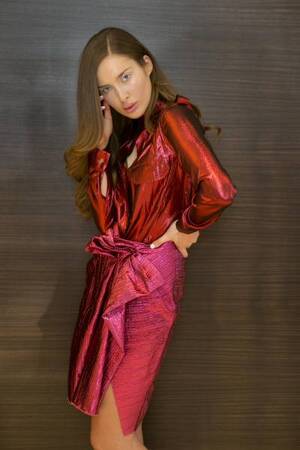
Whites, raspberries, rope heels and the controversial (often unflattering) ‘skirt/culotte’.
It’s going to be a long Spring/Summer.
The Brown Thomas Spring/Summer collection 2014 unveiled this afternoon by from top: Joanne Northey (wearing Chloe) and Roz Purcell (Victoria Beckham); Joanne (Proenza Schouler) and Roz (Lanvin); Thalia Heffernan (Lanvin); Joanne (Proenza Schouler) and Roz (Lanvin).
(Leon Farrell/Photocall ireland)

Beauty: a masterclass in subtle digital animation directed by Rino Stefano Tagliafierro who sez:
A series of well selected images from the tradition of pictorial beauty are appropriated, (from the renaissance to the symbolism of the late 1800s, through Mannerism, Pastoralism, Romanticism and Neo-classicism) with the intention of retracing the sentiment beneath the veil of appearance.
http://vimeo.com/83843825
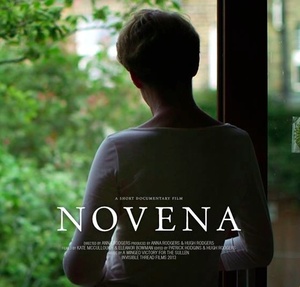
Novena.
A short Irish documentary/work in progress YOU can help finish.
Ah go on.
“Not many readers will know that a High Court case will often consist only of the Judge reading the sworn written evidence (affidavits) of both sides and judging the case on that basis alone. Significant portions of the written evidence may be drawn to his attention by the lawyers, but no witnesses will be questioned in the witness box. The number of cases being dealt with summarily is on the rise…”
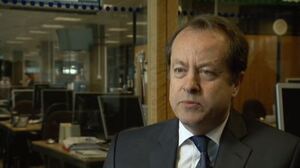
Edmund ‘Ed’ Honohan, Master of the High Court (above), in yesterday’s Irish Times on the dangers of High Court claims being struck out early without the opportunity to go to a full hearing.
We asked Legal Coffee Drinker, what’s it all about.
Broadsheet: “Legal Coffee Drinker, what’s it all about?”
LCD: “Mr Honohan is referring to the jurisdiction of the High Court to strike out proceedings. This jurisdiction is inherent in the nature of a court but is also dealt with in Order 19 Rule 28 of the Rules of the Superior Courts, which provides that the Court may order any claim to be struck out if the documents submitted stating the claim (the pleadings) disclose no reasonable cause of action or if the claim is frivolous and vexatious.”
Broadsheet: “What’s his difficulty?”
LCD: “He believes Judges are striking out cases where they don’t believe the facts as stated in pleadings.”
Broadsheet: “That sounds serious.”
LCD: “If true, this involves judges deciding on disputed questions of fact without an oral hearing.
Broadsheet: “ And is he right?
LCD: “He doesn’t give any specific examples other than informal discussions between colleagues. Of course applications to strike out are preliminary applications brought on motion and a written judgment is not always delivered in such cases. This makes it difficult to ascertain the basis on which a strike-out has occurred.”
Broadsheet: “He raises another issue and that is striking out on the basis of the facts pleaded, in circumstances where the facts as pleaded are incomplete due to lack of knowledge on the part of the witness or their lawyer. What does that even mean?
LCD:” The wording of Order 19, requires the decision to strike out to be made on the basis of the case in the pleadings. I don’t think a judge dealing with striking out proceedings can reasonably be expected to conduct an inquiry to see if there are any additional facts which might make the case a better one.. The question should be whether the facts before the court at the time of the application to strike out disclose a good cause of action and that is all.”
Broadsheet: “And why should we care?”
LCD: [pause] “Striking out of proceedings is a serious matter because it denies an individual their right to litigate. On the other hand, what has to be taken into account is that proceedings cost money to defend. Costs orders usually follow the event so that if the action fails the defendant will in theory be entitled to recoup their costs. However that’s in theory. In practice, particularly in High Court proceedings where the costs are very high, an unsuccessful plaintiff may not have enough money to pay the other side’s costs. This is a difficulty.”
Broadsheet: “I’d say!”
LCD: [Drains coffee] “In the circumstances, striking out a claim which cannot – on the facts as stated by the Plaintiff – legally succeed, would not appear to be unfair. Deciding on disputes of fact without an oral hearing would however be a different matter. If this is in fact what is happening it would indeed appear to be of concern. Striking out proceedings – denying the right to litigate, is a serious matter. Although not required by the Rules, there is an argument to be made that a a matter of practice written judgments should be given in all High Court striking-out proceedings and published on the courts.ie website. [drains coffee] This would enable monitoring of a process which, though necessary, needs to be kept under strict review if the constitutional right to litigate is to be adequately protected.”
Broadsheet: “Much to think about there. Thank You Legal Coffee Drinker. Keep us posted if you can on any developments in this matter if that suits?”
LCD: “Bye.”
(RTE)

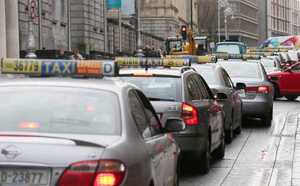
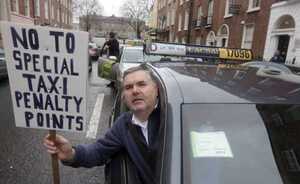
Taxi Drivers on Dawson Street, Dublin and streets surrounding the Dail this afternoon protesting against “the oversupply of taxis in the city” as well as decreased profits.
(Laura Hutton/Photocall Ireland)

A short by the hellopluto artist collective…
…about what’s inside a man’s head while going thru the “process” of ideation and creation.
