

Last night.
St Patrick’s Cathedral, Dublin
(Thanks Colum Cronin)






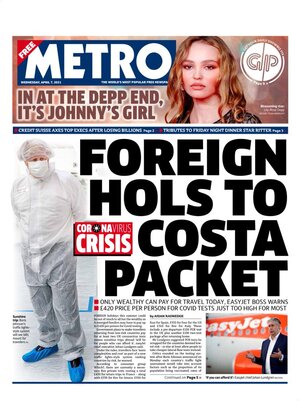


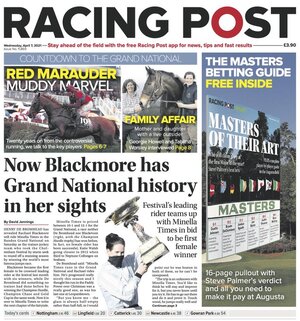

Meanwhile…
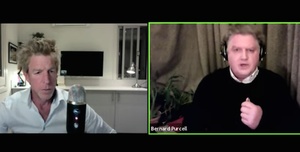
Tomorrow Tonight.
A lockdown series.
Bernard Purcell (top right), London-based editor of The Irish World, previews tomorrow’s front pages.


Behold: the Ferrari 250 Europa GT – with bodywork by Pinin Farina and a 3.0L Colombo V12 engine, it was the first Ferrari to wear the GT moniker and a rare beast indeed as only 43 were made between 1954 and 1955.
This unmodified, unrestored ‘barn find’ was originally built for Dr. Enrico Wax, the official Italian distributor of Moët & Chandon. Later sold to an American collector, it has languished in a private collection since the mid 60s and will come to auction next month.
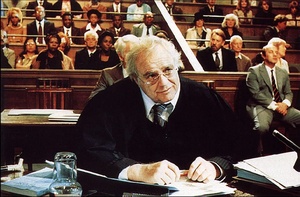
 From top Marlon Brando as South African lawyer McKenzie modelled on Sir Sidney Kentridge in A Dry White Season (1989); David Langwallner
The most famous lawyer on the planet is 98 years of age and has only recently retired. But would our internet generation know who Sir Sidney Kentridge is?
Whistle-blowing is a zeitgeist issue. It should be said one can get seduced by glamour and whistle-blowing has increasing glamour. Right up to Mr. Assange of whom more later. It has been the centrepiece of works of art from Henrik Ibsen ‘s An Enemy of The People (1882) and Halder Laxness ‘Independent People’ (1934) to the filmic whistleblowing demonstrations: Elia Kazan’s On the Waterfront (1952), Lumet’s Serpico (1973) and Erin Brockovich (2000). It is noticeable that both Ibsen and Laxness show that stubborn principle in the face of official hostility is a recipe for personal disaster as Sir Sidney and I have found out to our personal cost.
The ambivalence of whistleblowing is embodied in Kazan, who shopped his communist colleagues in the McCarthy-era and showed that not all whistle-blowing is good or motivated for the right reasons.
Journalistic whistleblowing became a phenomenon with Emile Zola, who was convicted by a French court for criminal libel for his campaign to establish the innocence of Jewish army officer in his legendary pamphlet J’ Accuse.
An excellent book by NUIG academic Kate Kenny, Whistleblowing: Towards a New Theory, 2019, Harvard University Press) makes the case, in fact, that journalists make life more difficult for whistle-blowers by spotlighting them and making them targets for scrutiny.
Ms Kenny writes:
“We see this clearly in the recent media obsession with well-known whistle-blowers such as Edward Snowden, Julian Assange and Chelsea Manning in which more attention is given to the individuals, their private selves and their personalities than to the information they report“.
Before his recent eviction and jailing for skipping bail and now presently unresolved extradition, Julian Assange was forced to seek refuge in London’s Ecuadorian embassy after facing an investigation by Swedish prosecutors into rape offences.
But, as those charges were dropped, the vengeful and hysterical US applied for his extradition for being in a conspiracy with Chelsea Manning “to commit computer intrusion” over the Collateral Murder video, the Afghanistan war logs, the Iraq war logs, and CableGate, which leaked diplomatic exchanges.
His extradition has been refused but he has been incarcerated. In fact, the judge in the Westminster Magistrates’ Court sensibly concluded that he could not be extradited to a country with scant or non-existent observance of human rights in its prison facilities, the obliquely named but utterly terrible Correctional Facilities.
Assange’s lifting from the Ecuadorian embassy after US pressure on April 11, 2019 evoked a Howard Hughes-figure: bearded, jagged, and aged, dragged in a semi-recumbent position and clearly terrified.
Meanwhile, Edward Snowden, who copied and leaked highly classified information from the National Security Agency in 2013 when he was a Central Intelligence Agency employee and contractor, has parked himself in Russia against the baying American hounds and is granted Russian citizenship.
Now Sir Sidney is well near Denning’s age but as a QC in his prime – which extended to his 90s as a commercial silk in London – he represented Mr Mandela. The South African judicial establishment forgave that but could not quite atone for compounding the sins of justice and integrity to represent the family of the murdered Mr Biko. He had to hopscotch, disbarred, to London and throw himself on the mercy of Brick Court Chambers.
So, the great hero of the legal profession was thus, in effect, disbarred, stripped of his title of QC, and run out of South Africa with a bag of clothes for de facto whistle-blowing in his representation of a black activist or being a dissident. The categories merged and were dramatised in the film, A Dry White Season (1989), where he is played by Brando.
There is a mid-1970s film by the legendary Italian film director Francesco Rossi called Illustrious Corpses. (1976). The film in effect demonstrates how many fighters against corruption in Italy, including communist judges such as Falcone became illustrious corpses.
So, Sir Sidney was a whistle-blower also in that tradition, but survived and prospered. The ludicrous Bar Council in Ireland – time surviving nonentities and beholden to a corrupt establishment – attempted to do something like this to me for blowing the whistle and engaging in legitimate anti-corruption representations.
The US has, since 1981 and now through the Sarbanes Oxley Act 2002, protected whistle-blowers. First, they are provided with double back pay, witness fees and lawyers’ fees. Employers who impose gagging orders are sanctioned and, most controversially, employees are given a financial inducement to blow the whistle – by the Securities and Exchange Commission and the IRS, among others.
However, it is noticeable that, although the US often cracks down on corporate and private whistleblowing, Mr. Assange and Mr Snowden are examples of the way the US treats state whistle-blowers. It seeks to destroy them. The Obama regime waged a state-sponsored war against any recalcitrant who blew the whistle against his government. Sir Sidney blew the whistle against the Apartheid government and just as the Americans target Assange the South Africans targeted him.
Kate Kenny notes that for the establishment whistle-blowers are usually…
“…engaging in impossible quasi psychotic speech that places them in a new category in which they are excluded and banished and not acceptable to the organisation. This primary exclusion then paves the way for a second categorisation that portrays them as viable candidates for normative violence. From the perspective of colleagues and managers then, violence against whistle-blowers is not violence because [the whistle-blower is] not valid. “
The process of demonetisation, exclusion and in effect dehumanisation of whistle-blowers mentioned by the author is in effect a product of the corporatocracy.
The Ken Kesey book leading to the famous anti-establishment film One Flew Over the Cuckoo’s Nest (1971) is in effect a last cri de coeur of the anti-establishment against oppressive statist oppression. In this respect I am all in favour of those conservatives who oppose an encroaching state and corporate fascism. As in an odd sort of way does the genuinely great Japanese documentary of relentless pursuit of a Japanese war criminal by a quasi-psychotic whistle-blower type. The Emperor’s Naked Army Marches On (1987).
And anyone who blows the whistle should contrast the image of sprightly and youthful Assange before his enforced exile with the raving husk of a human being pulled from the Ecuadorian embassy in London.
I have spoken out among others of the need for us to protect even a modicum of human rights in Ireland during this pandemic, which has reached the farcical proportions of not even allowing people go to church. Sir Sidney would I think see that as a pathfinder of civic dissidence.
The lion thus maybe in winter but the legacy stands. The line of human rights protection is now, at best, a thin, blue one and a social conscience is becoming a luxury precious few can afford.
Where the need for security will silence even the most fearless whistle-blower.
David Langwallner is a barrister specialising in public law, immigration, housing and criminal defence including miscarriages of justice. He is emeritus director of the Irish Innocence Project and was Irish Lawyer of the Year at the 2015 Irish Law Awards. His column appears here every Tuesday and Friday. Follow David on Twitter @DLangwallner
Pic: MGM/UA

O’Connell Street, Dublin yesterday
Very strange occurrence just now – out for a walk within my 5km, stop for 15 seconds at the GPO to leave a bunch of flowers on Easter Monday
Then approached by 6 Gardaí to take details and totally intimidated saying “you’re not exercising”🤷🏻♂️
— Daniel Lambert (@dlLambo) April 5, 2021
Daniel’s walking companion, historian Donal Fallon writes:
Yesterday I walked into the city ( within my 5km) and met a friend who did likewise (within his). We do this most weeks for exercise. As it was Easter we walked the city to the various sites. We decided to leave lilies, from a convenience shop on O’Connell Street, at the GPO.
Both of us were then approached by Gardai and had our details taken. We were exercising, within our 5km. People live in tiny apartments and need to get out and walk. The ability to go for walks is just about all that has kept me sane.
I’ve (mostly) supported the public health restrictions. I’ve tried my best and raised about 10k for hospitals and hospices despite my own livelihood being affected like many others. Dan likewise has done good. I’ve not seen my parents in 4 months. I’ve stayed within 5km. People are trying really hard. I see almost nobody.
Something changed in how this has all been policed since January. When you break absolutely no restrictions, but are made to feel like you have done something wrong, it is upsetting. It’s happening everyday to people.
I have tremendous respect for everyone working through this – as the son of a retired firefighter and care nurse I’m conscious of the stress all frontline workers would be under. But the atmosphere has to change. Most people are just trying their best, including us.
I think the bit that upsets me most about this is that what we did was a very simple little gesture. People are doing their best across Ireland, from care home workers to shop staff. A few lilies at the GPO just meant something would be marked even in this tough year.
Top pic: 1916 Easter Rising Tour

Wyvern Lingo – Only Love Only Light
Forever blowing bubbles.
It’s child’s play for Bray trio Wyvern Lingo in the cryptic video for the latest single to be released from their new album Awake You Lie.
The band – top from left: Caoimhe Barry, Karen Cowley and Saoirse Duane – recorded the album in Berlin.
Nick says: Bray of light.
 The votes are in.
Last Friday (the Good one), with a €50 voucher redeemable at any Golden Discs store on offer, I asked you for your favourite songs relating to sports?
You wrote in in your dozens.
But there could be only one winner.
Third Place:
Hey You Bastards I’m Still Here by Mark Kozelek & Desertshore
Fergalito writes:
“Adore this tune which mentions boxing so still counts…I listened to about five times a day for a solid week when I first heard it.”
Runner-up:
When an Old Cricketer Leaves the Crease by Roy Harper
Stephen Moran writes:
“Growing up in the ’80s and being a fan of the sound of leather on willow was akin to the love that dare not speak its name; but the sight of Marshall, Ambrose and Viv Richards (the master blaster) and Co. routinely thrashing the Sassenachs by an innings to the sound of conch shells at The Oval was worth “spending warm summers days indoors” …
“So in honour of the boys of summer, I nominate a song as beautiful and as evocative as any in the English language.”
Winner:
Long Shot Kick De Bucket by The Pioneers
F_lawless writes:
“Relating the sudden and dramatic demise of noted racehorse Long Shot at a race held at Kingston’s famed Caymanas Park, ‘Long Shot Kick The Bucket’ became one of Trojan Records’ earliest UK chart hits, with the record peaking at No.21 in the Official UK Singles Chart in 1969.”
Nick says: Thanks all.
Previously: Win Nick’s Easter Golden Discs Voucher


