Tag Archives: An Garda Síochána

guards

More than 14,500 people who were prosecuted for road traffic offences are to have their convictions quashed after gardaí admitted they made a mistake.

Assistant Commissioner in charge of policing has apologised to those who were wrongly convicted because they had either paid the fine or had not been issued with a fixed charge penalty notice.

Senior gardaí have also admitted that gardaí have been exaggerating the drink driving figures for five years up to 2016.

Almost one million cases have been identified where drink driving tests were not carried out even though they had been recorded as having been conducted.

Good times.

14,500 traffic convictions to be quashed over garda error (RTÉ)

Rollingnews

9991 Reporters_90504224

This morning.

Harcourt Square, Dublin 2

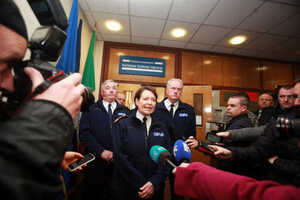
Garda Commissioner Noirin O Sullivan talking to the media before launching a dedicated 24 Hour phoneline for victims of child sex abuse at the the GardaI Command and Control Centre

Ms O’Sullivan is at the centre of a tribunal of inquiry into the alleged smearing of garda whistleblower that branded him a child sex abuser.

Good times.

Rollingnews

Update:

2/3/2017. Launch - Child Sex Abuse Phoneline. Garda Commissioner Noirin O Sullivan launching a dedicated 24 Hour phoneline for victims of child sex abuse at the Garda Command & Control Centre in Dublin this morning. Photo: Sam Boal/RollingNews.ie


YIKES!

Rollingnews


9033520216/12/2010. MacGill Forum. Eddie Molloy at the Launch of the MacGill report on economic and reform of the political system and public service today in the Royal College of Surgeons. Photograph: Sasko Lazarov/Photocall Ireland

Management consultant Eddie Molly wrote of ‘dark forces’ within An Garda Síochána

You may recall the Independent Review Panel set up by Justice Minister Frances Fitzgerald in July 2014, following the publication of the Guerin Report which looked at allegations made by Garda whistleblower Sgt Maurice McCabe.

The purpose of the panel was to investigate allegations of Garda misconduct, crime and cover-up and to ascertain if further investigations were needed. Some 322 allegations were ultimately included in the panel review.

These cases included that of Shane O’Farrell – who was killed in a hit-and-run – and the case of Cynthia Owen.

Readers will recall how both the O’Farrell family and Ms Owen received letters informing them that the Independent Panel Review found no further action should be taken in their respective cases.

Oddly, at this time, Ms Owen received her letter while still being in contact with gardai who were informing her that they were continuing to investigate her case.

In addition, one of the Senior Counsel who was appointed to the Independent Review Panel was  Conor Devally – who defended Zigimantus Gridziuska, the man who killed Shane O’Farrell.

The O’Farrell family were later told that Mr Devally wouldn’t be involved in the Shane O’Farrell case due to a conflict of interest.

However, it was also reported that Mr Devally was to receive a brief fee of €20,000 to oversee all the complaints.

In addition, a 53-page Independent Review Mechanism Overview Report – based on a paper review of the 322 allegations – was published on the Department of Justice website last year, devoid of any names or outcomes.

Further to this, and the recent controversies surrounding the gardaí, Eddie Molloy, a management consultant, (above) wrote an opinion piece in the Irish Independent, on Monday, February 20, about the Independent Review Panel, entitled Deep-rooted dark forces in Garda are intent on obstructing reform.

Following this, Mr Molloy spoke to Pat Kenny on Newstalk last Friday morning.

He spoke about a female civil servant who has told him when she was a junior civil servant, she refused “to collude with the cover-up of misappropriation of money and also the failure, as she saw it, to investigate two murders” and how her career was subsequently hampered by this refusal.

Mr Molloy also said it initially took a “monumental effort” to get her case included in the Independent Review Panel and that, in the end, the panel found no further action was required.

From the interview:

Pat Kenny: “Deep-rooted dark forces, it sounds very sinister.”

Eddie Molloy: “Well, first of all, Pat, that’s a phrase that was first used by Diarmuid Martin when he came back to Ireland and was facing into the whole child abuse era and was being resisted by the bishops. Now, if there are dark forces at work in the Catholic Church, it’s not an inappropriate term to use in relation to the guards. What prompted the [Irish Independent] article to which you refer was that, when Maurice McCabe and John Wilson began blowing the whistle, there was a spate of other complaints that came to the guards and the total number were 322 – 322 allegations of misbehaviour, malpractice were brought forward. And the Department of Justice set up a panel of five barristers to review these hundreds of cases, to see was there anything to see here and which ones were vexatious and which ones were real and which ones should be investigated further. Now, in the article I wrote, we haven’t heard from that panel since. But I’ll give you what’s happened.”

Pat Kenny: “There was a report though, wasn’t there?”

Molloy: “Well, I’ll come to the report in a second. In July 2014, a report on the Department of Justice, the Toland Report, and I’m quoting from the report, I have it in front of me here, says, in the review of the review group, that’s the Toland group, there’s a deferential relationship between the Department and An Garda with the lack of proper strategic accountability being brought to bear on them by the department. The department has adopted a passive approach to the Garda, stepping back from taking the opportunity to exercise the necessary power and influence, at its disposal, to encourage the improvement in management and discipline. In other words, the department behaviour in relation to the gardai, that it’s supposed to be overseeing, is totally to back off and say nothing.

“Now, this report on the 320 allegations follows a year later. And they open the report by saying that the Department of Justice has been seen, since the foundation of the State, as an appropriate channel, through which to make representations about bad behaviour in the guards. I mean this is a self-regarding load of rubbish, ok? They are patently not an organisation that people would have felt comfortable about, approaching, to deal with the guards, based on what I just said from Toland. The reason that people, including the case I cited in the article, the reason that people brought their case was because there was a panel of five judges, who were deemed to be somehow independent…”

Kenny: “Barristers…”

Molloy: “Barristers, sorry, barristers, independent of the guards and of the Department of Justice. But in the first page of this report, from the Department of Justice, on the 322 cases, they say: the appointment of this panel of judges [sic] was to a degree an enhancement of the function already discharged by the Department of Justice and Equality where divisions such as the Garda division reviews correspondence. So, so, I mean it doesn’t give me any pleasure to be criticising the guards or civil servants because my instinct towards them is one of respect, generally, but this report on the 322 cases is an absolute whitewash.”

Kenny: “OK, the barristers in question, and I certainly don’t want to impugn the reputation of any member of the Law Library but were they people who routinely work for the prosecution in cases…”

Molloy: “I have no idea. One of the things about this report, it has no name, names in it. The Toland report has all the names of the people who produced the report…”

Kenny: “The five barristers are not named?”

Molloy:They’re not named, there’s no names, there’s no date on the report and there’s no author of the report. This was written, patently, by an official of the Department of Justice who doesn’t seem to have read the Toland Report which was a coruscating criticism…”

Kenny: “But there’s no name of this official either?”

Molloy: “No, there’s no name of this official either…”

Kenny: “So the 322 cases. I mean, can you give us percentages, how many were found in favour of the complainant, how many were rejected out of hand?”

Molloy:This is a 57-page report and it tells you nothing about the outcomes…

Kenny: “What?”

Molloy:It tells you nothing, zero, about the outcomes of these 322 allegations. What it does is, it goes through the allegations and it has section after section after section, saying how complicated these were, they went back decades and there were various agencies involved. So, you got to understand they were telling you this wasn’t easy. Now, but they then do is, what they do is they study, they seem to study the allegations and then they make recommendations for improvements in Garda behaviour. So, the net effect is…”

Kenny: “So the complainant gets no justice?”

Molloy: “There’s no justice, there’s nothing about outcomes, the numbers who were followed through on…”

Kenny: “No disciplining of the…”

Molloy: “Nothing about, was there a pattern here? Was it the same divisions or areas? Was it Donegal or Kerry? There’s nothing in it about the behaviour of the guards which was the basis on which 322 people made…”

Kenny: “You’d think at least there would be, we found, just cause in 100 of the 322, and we rejected out of hand, 100, and then we hadn’t enough evidence or time had elapsed and…”

Molloy: “That’s right and, currently, there are six before the courts, or whatever – yeah there’s nothing like that. So, I’ll give you, I mean one of the recommendations, for example, is that gardai be trained in family liaison so that families who are, you know, have a difficult case going through, that the guards would communicate with them better about their case coming up in the court and there’s an inquest due. But here’s one: recommendation 13 [sic, 12]: ‘Furthermore, culpable delay in pursuing GSOC investigations should be specifically included as a matter of potential breach of discipline or misconduct, in the disciplinary regulations of an Garda Síochána.’ 

“Six months ago, Judge Mary Ellen Ring, who’s the chairman of GSOC, threatened to issue summons against the Garda Siochana, for their tardiness, in producing information. Now yesterday [February 19, Thursday], before the Policing Authority, and it’s all over the papers today, that the guards are vexed at the media criticism they’re getting because their hands are now tied behind their back and they’re not able to speak for themselves and the other side of the story. It’s been their form not to give the other side of the story. Their form is close ranks, cover up and hope that time will… The thing that concerns me about these 322 allegations, and I say to you there are no information in this report, my concern about it is that any progress in it will have to wait until the end of the Charleton investigation because the guards can cry, you know, it’s sub judice.”

Kenny: “We can’t say anything until…”

Molloy: “We can’t say anything until..”

Kenny: “This is all done and dusted…Now I want you to go though, to the case you referred to, in your article which concerns a young civil servant.”

Molloy: “Yeah, I, after a programme, something like this, I got a phone call from a civil servant, probably now in her early 50s, I would guess, and she told me a story and I listened to her. I met her on three occasions for two hours each and I had a third-party present at one of those meetings and she told me a story how, and I have to be careful what I say here because I don’t have her permission to take it much further than I have done. That she refused, as quite a junior person in the civil service, to collude with the cover-up of misappropriation of money and also the failure, as she saw it, to investigate two murders. Ok?”

Kenny: “So, now this was to do with the Garda Siochana.”

Molloy: “To do with the Garda Siochana and, ok, another agency. Ok. I’m not going to say what it was. Now, I listened to a harrowing story of her career being blighted and really has never made any progress in her career..”

Kenny: “She was showing moral fibre..”

Molloy: “She was showing, in my view…”

Kenny: “It’s very difficult as a junior to stand up against a senior, as she did…”

Molloy: “A woman of the highest integrity, in my view. Now, look, people have said, when they met Maurice McCabe, they found him believable. I found this woman believable and I’m highly trained, as it happens, in interviewing people. So it would be hard, I think, to pull one over on me. Ok? And it could turn out, on further investigation, she’s delusional and people cite all kinds of things when they don’t get promotion, there’s that to it. But the fact of the matter is: here’s the story in her case. She has wads of documentation, I’ve seen the documentation. Some of the documentation is incriminating with regard to the guards and civil servants. And I’ve seen that. Her case, it took a monumental effort to get her case included in the 322, that was not straight forward. She heard nothing, for a year, and eventually she gets a one-liner saying there’s nothing to see here without ever speaking to her or seeing the documentation. Now, so, this is described as an independent review mechanism, an overview report. No date and no names and that’s how they have dealt with these 322…”

Listen back in full here

Previously: Justice Denied

‘Delay, Deny, Lie Then Cover-Up’

Thanks Kim

90421170_90421170File Photo: Mr. Justice Adrian Hardiman has died suddenly. End.6/5/2009 Courts with a View. Justice Adrian Hardiman takes time before court is in session to look over the courtyard of the Four Courts in Dublin. Photo. Mark Stedman/RollingNews.ie

From top; New Gardai pass out at Templemore College; The late Justice Adrian Hardiman

Further to the fallout from the Maurice McCabe revelations….

Before his death last year, Supreme Court judge Adrian Hardiman delivered a stark assessment and warning about An Garda Síochána.

‘Legal Coffee Drinker’ writes:

In 2015, a majority of the Supreme Court in Director of Public Prosecutions Vs JC IESC 31 reversed a long standing rule of evidence prohibiting the prosecution from adducing evidence which had been obtained as a result of an unconstitutionality by the Gardai.

Examples of evidence excluded under this rule over the years have included property obtained under an unlawful search of a dwelling house or a confession made by an accused during a period of unlawful detention.

According to the majority of the court, the exclusion of unconstitutionally obtained evidence interfered with the truth-finding functions of the court and also showed a lack of regard for the constitutional rights of victims.

They felt that unconstitutionally obtained evidence should be admitted where the unconstitutionality was as a result of ‘inadvertence’.

Adrian Hardiman delivered a strong dissent, largely based on concerns regarding abuse of the investigatory process by the administration of justice.

His judgment stands as a remarkable and unprecedented criticism of the operation of the Gardai and the Department of Justice.

Not only did he state that “over the past twenty five years there had “been a considerable number of deeply disturbing developments both in relation to the Garda Síochána itself and to the arrangements for its oversight… expressly acknowledged in impressive and authoritative sources”, but he then went on detail these developments in full.

Justice Hardiman stated:

“[T]here have been two Tribunals of Inquiry, each presided over by an eminent member of the judiciary, which have each reported in a profoundly disturbing manner, The first report of the Morris Tribunal, published in 2004… related to bogus explosive finds by gardaí in County Donegal.

The report observed that garda culture: …generally militates against open and transparent cooperation with investigations both internal and external and manifests itself in a policy of ‘don’t hang your own’

This was said in a context of Gardaí “planting” explosives and then “finding” them.

This last phrase quoted “don’t hang your own” came from evidence to the Tribunal by Garda Martin Leonard, a Garda Representative Association official, who said:

“It is the nature of the gardaí, we don’t name the names – we don’t want to get anybody into trouble in the Garda Síochána internal matters… we do our best to make sure – we are not going to be hanging our people”.

Almost ten years later, in December 2013, the report of the Smithwick Tribunal stated:

“I regret to say… that there prevails in An Garda Síochána today a prioritisation of the protection of the good name of the force over the protection of those who seek to tell the truth. Loyalty is prized above honesty”.

In the next section of his judgment, headed ‘Wall of Silence’, Justice Hardiman summarised the experiences of the Morris Tribunal as follows:-

“… the Tribunal was faced with gardaí who were determined to hide the truth of what happened. They made statements to their superiors which were in many instances minimalist in their detail and failed to give a fully truthful account; in a number of instances the statements were a complete fabrication.

It was disturbing to find a deep seated reluctance to concede that a colleague had acted incorrectly or wrongfully or that the complaints made by the detainees were true – the wall of silence was maintained

.Unfortunately this approach extended to and was encouraged by senior officers in this investigation and in the overall approach adopted by An Garda Síochána to external complaints.”

He quoted further from the report of the Tribunal as follows:

“The State must act honourably and honestly in its dealing with plaintiffs in these circumstances. It cannot do so if it is told lies and half truths by the gardaí. This must stop.

Senior officers in An Garda Síochána must show leadership in this regard. The difficulties are linked to difficulties faced by ‘whistle blowers’ who wish to tell the truth but fear the consequences from their colleagues or for their careers…”

Justice Hardiman then went on to consider the 2014 report of the Smithwick Tribunal, which described itself as:

“staggered by the amount of indiscipline and insubordination it has found in the garda force. There is a small, but disproportionately influential, core of mischief making members who will not obey orders, who will not follow procedures, who will not tell the truth and have no respect for their officers.”

In particular, Justice Hardiman quoted from the Smithwick Report, regarding Tom Curran:-

“Tom Curran retired as a senior officer of An Garda Síochána, and he struck me as an officer of the utmost integrity. I would have thought he is as deserving of the support of the Garda Commissioner as any other former officer.

However, it seems to me that because he was giving evidence of which An Garda Síochána did not approve, such support was not forthcoming. I regret to say that this suggests to me that there prevails in An Garda Síochána today a prioritisation of the perfection of the good name of the force over the protection of those who seek to tell the truth. Loyalty is prized above honesty.”

He also referred to the following statement by Judge Smithwick:

“I am drawn to the conclusion that a number of the garda witnesses before this Tribunal, including former and current senior gardaí were not fully forthcoming in their evidence to me. … I accept that any individual witness may not recall, or for some reason may never have encountered, the unease to which I have referred; the evidence of any one individual witness may therefore be truthful.

What I find difficult to accept, what I cannot accept, is that so many of the garda witnesses from whom I have heard do not recall or have never encountered such unease. Regrettably, this suggests that there is an ingrained culture of prioritising loyalty to the good name of the force over the legal, moral, and ethical obligation owed to give truthful evidence to this Tribunal”.

In the next section of his judgment, headed ‘A Pot of Inquity’, HJustice referenced the case of Frank Shortt, which he described as “an appalling example of a deliberate garda conspiracy to perjure an innocent man into prison for no better reason than to enhance the careers of certain gardaí.”

Mr Shortt had been the victim of disreputable conduct and an abuse of power on the part of two garda officers, namely a superintendent and a Detective Garda.

They both engaged in a conspiracy to concoct false evidence against the plaintiff which in turn resulted in perjured garda evidence being given at his trial for allegedly permitting drugs to be sold in his licensed premises in Co. Donegal in 1992. That perjury procured his conviction by a jury.

According to Justice Hardiman:

“What followed as a consequence for the plaintiff was a tormenting saga of imprisonment, mental and physical deterioration, estrangement from family, loss of business, public and professional ignominy and despair. Furthermore, as the learned High Court Judge put it, “the plaintiff was sacrificed to assist the career ambitions of a number of members of the Garda Síochána….

….despite the injustice of his situation Mr Shortt finally obtained an order setting aside his conviction from the Court of Criminal Appeal… when the DPP, for reasons that were never disclosed to that Court, consented to such an order. Finally, in July 2002, the Court of Criminal Appeal certified that he had been the subject of a miscarriage of justice.”

Justice Hardiman shared the view previously expressed by the Court that what had happened to Mr Shortt could not be

“bracketed as a couple of bad apples in the proverbial barrel. The misconduct penetrated the system of law enforcement too deeply and persisted over too long a period to be discounted in such a fashion.

Concrete independent evidence of the wrongful conspiracy against Mr. Shortt only emerged in the course of an official garda investigation into affairs in Donegal.

The matters concerning Mr. Shortt may only have been a rather small part of that investigation but the lack of immediacy or action in response to the evidence which emerged concerning his trial does raise questions as to whether there is some complacency at different levels in An Garda Síochána with regard to the exacting standards of integrity which must at all times be observed by its members.

The cavalier manner in which those two members set about concocting evidence and subsequently persisted in trying to cover up their misdeeds, not entirely out of sight of other garda members, displayed a worrying confidence on their part that they could get away with it”.

Justice Hardiman’s particular concern was that “no steps were taken from within the Garda Síochána, or from within the broader State structures, to remedy the grave wrong done to Mr. Shortt”.

In particular, in the run up to Mr Shortt’s trial, a number of gardaí, including the Superintendent, worked at improving the statement of evidence by the Garda who was ultimately found to have given perjured evidence against Mr Shortt.

According to Justice Hardiman:

“The Superintendent wrote in his own handwriting on the draft statement various suggestions or instructions for changes, absolutely without regard to whether or not they were true…

it was a marked feature of the case that the Garda and the Superintendent were in fear of each other because each knew that the other had information which could destroy his career.

The Garda kept the original version of his statement as altered by the Superintendent and told his wife that giving him the statement with the handwriting on it was the most stupid thing the Superintendent had ever done.”

He added:

“Quite apart from the reports of the two Tribunals mentioned, there have in very recent days been a number of new and contemporary controversies affecting An Garda Síochána. Many of these arise from the revelations or allegations of a whistle blower, Sergeant Maurice McCabe. It is no exaggeration to say that, in the course of this last calendar year, Sergeant McCabe has become a household name.

There have been demands from the Garda Representative Association that these allegations should be resolved by an independent body as soon as possible because of the reputational damage that gardaí are incurring.

There has been much public debate as to whether an independent garda authority should be established to oversee the Gardaí and this matter does not appear to have been finally been decided upon as yet.”

Justice Hardiman concluded:

“it appears to me that very serious problems of garda culture and practices have been revealed by Tribunals headed by two distinguished members of the judiciary and by the garda whistleblower, and have been expressly acknowledged by members of the Government.

It would appear to me absolutely extraordinary, and very damaging to the very concept of due process of law, if, with these matters outstanding and awaiting resolution, this Court were to take a step which would considerably loosen the application of the law of the land, and indeed on the Constitution itself, to members of An Garda Síochána and to provide a positive incentive for them to ignore it…

….Against this indisputable factual background, the decision of the majority will virtually preclude judicial supervision of the force publique, will make available to public servants with enormous powers over ordinary citizens a defence of carelessness or inattention, and will exalt already empowered public officials into a virtually impregnable position.

Justice Hardiman continued to express his concerns regarding the admission of unconstitutionally obtained evidence until his death in March 2016.

DPPVs JC judgements and Determinations (Courts.ie)

Previously: How Did he Get Here? (Maurice McCabe timeline)

Rollingnews

000d930b-8001

2

3

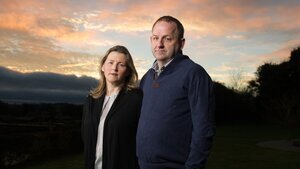
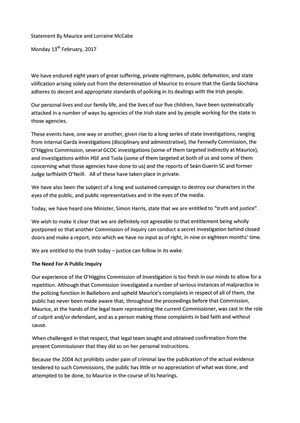
Statement released this afternoon by Lorraine and Maurice McCabe through their solicitors calling for a public inquiry into their treatment by An Garda Síochána and the government.

Earlier: Derek Mooney: Not one Crisis But Two

How Did He Get Here?

Pic By Barry Cronin via RTÉ

File photo. The Government yesterday published the details of a Commission of Inquiry into claims that senior gardai mounted a smear campaign against a whistleblower in the force. Yesterday in the Dail under privlege, the Leader of the Labour Party, Brendan Howlin said that new information had come to him regarding a smear campaign against garda whistleblower Maurice McCabe by senior gardai, and called for the Garda Commissioner, Noirin OÕSullivan, to stand aside for the duration of the Inquiry. Prominent whistleblower, Sgt Maurice McCabe has claimed he was targeted in a smear campaign by senior members of the force. He is supported in his claims by the former head of the Garda Press Office, Superintentent David Taylor. End. 30/01/2014. Garda whistleblower at PAC. Serving Garda Sergeant Maurice McCabe arrives at Leinster Hosue this afternoon to appear before the Public Account Committee to discuss penalty points cancellation and alleged corruption. Photo: Laura Hutton/RollingNews.ie

Garda Sergeant Maurice McCabe

Sergeant Maurice McCabe has been attempting to seek accountability in An Garda Síochána for more than 10 years.

His battle has spanned the tenure of four Garda Commissioners, six Ministers for Justice and five Ministers for Health.

Below is a comprehensive timeline of events – covering 2006 to the present day – charting how one man restored his good name, changed a police force forever and brought a government to the brink of collapse.

We will correct any errors.

January 2006: Sgt Maurice McCabe makes a complaint  in relation to an incident where a garda had consumed alcohol before attending the scene of a suicide. This resulted in a sanction being imposed on that colleague.

Noel Conroy is Garda Commissioner at this time. He holds the position from July 2003 until he retires in November 2007.

Michael McDowell, of the Progressive Democrats, is the Minister for Justice at this time; while Mary Harney, also of the Progressive Democrats, is the Minister for Health.

December 2006: The colleague, about whom Sgt McCabe made the complaint, makes a complaint about Sgt McCabe on behalf of the colleague’s daughter. The daughter subsequently makes a statement in which she alleges that, about ten years previously, when she was around six years old, she had been playing hide and seek with Maurice McCabe and his two eldest children at their home. She said when Sgt McCabe found her, he tickled her and pressed up against her in an inappropriate manner.

Supt Noel Cunningham, as the person in charge of the Cavan/Monaghan division, investigates this complaint.

Early 2007: After the allegation is investigated, a file is sent to the DPP with the recommendation that there is no grounds for a prosecution. The DPP directs that no prosecution should be taken – with the observation that it is doubtful the allegations should constitute a crime at all.

April 30, 2007: Taxi driver Mary Lynch is violently assaulted by Jerry McGrath in Virginia, Co. Cavan. McGrath had his zip undone as he bit her, viciously kicked her and pulled out lumps of her hair. He left her with a black eye, bruising down her side and  bruises on her neck, as he held his hands around her neck during the assault. McGrath was released on station bail of €300 the next day, before Mary Lynch gave a statement. McGrath was never questioned about details of her statement. He was charged with assault with no conditions attached to his bail.

June 14, 2007: Brian Lenihan Jnr, of Fianna Fáil, is the new Minister for Justice.

July 9, 2007: A car registered to Deputy Commissioner Martin Callinan – who was appointed to the position in January 2007 – is caught speeding on camera. His Renault Megane was caught going at a speed of 83kph in a 60kph zone. The penalty points in relation to this incident were subsequently quashed.

September 11, 2007: A man made a complaint at Bailieboro Garda station in Co Cavan that his son had been sexually abused by Fr Michael Molloy, of Kill in Cootehill, Co Cavan.

The victim told gardai that one incident of serious sexual assault involving Fr Molloy occurred in March or April 2007, following evening mass, after he had installed or updated antivirus software on a computer in the parochial house, occupied at that time by Fr Molloy. He described the computer, its operating system, and the software he installed to the gardai.

September 14, 2007: Following the complaint, and after obtaining warrants, gardai searched two properties associated with Fr Molloy. They took a number of items, including a personal computer, and brought them to Bailieboro Garda station, where Sgt Maurice McCabe was on duty that day. The items taken from Fr Molloy’s house were placed in the station’s property room. On the same day, Fr Molloy was arrested and interviewed at Bailieboro Garda station.

In a statement given by Garda Pearse O’Shannon, he stated that he found that the name of the software on the seized computer matched that given by the victim.

It subsequently turned out that the warrants, under which the computer and other items were seized, were defective.

October 2007: A file on Mary Lynch’s assault is finally sent to the DPP with a recommendation that the case be dealt with in the district court. Micheal Clifford, of the Irish Examiner, has reported that “the file came back within three weeks, upgrading the charge to Section 3, “assault causing harm” and a robbery charge. The DPP instructed that it should be dealt with by the district court only if a guilty plea was entered on both charges. Otherwise, it should go to trial in the Circuit Court.”

October 9, 2007: McGrath tried to abduct a five-year-old girl from a house which he had broken into, in Dundrum, Co Tipperary. The girl’s father managed to overpower McGrath and hold him until the gardaí arrived. McGrath was charged with assault causing harm, burglary and false imprisonment. He was held in Limerick Prison.

October 18, 2007: McGrath’s Cavan assault case involving Mary Lynch was due for a routine review of bail in Virginia District Court. McGrath’s solicitor was told McGrath didn’t need to attend the two-minute routine hearing. No objection was made at Virginia District Court to renew McGrath’s bail on the Cavan assault charge – even though it was known that McGrath was in custody for assault causing harm, burglary and false imprisonment.

October 30, 2007: An application for bail by McGrath was made in Clonmel Circuit Court on the Tipperary false imprisonment charge. Detective Sergeant John Long objected but the court was not told about the Cavan assault and McGrath was granted bail. Michael Clifford, of the Irish Examiner, has reported: “In a subsequent investigation, Sgt Long said that prior to the bail application, he had checked McGrath’s background on the garda Pulse system. (This would be second nature to any garda investigating a violent incident). On seeing an entry about Cavan, he rang an “unidentified garda” in a “Cavan station” — also unidentified — and was told that the case involved a minor assault over a taxi fare.”

November 2007: Fachtna Murphy is appointed Garda Commissioner.

December 7, 2007: McGrath murders Silvia Roche Kelly in the Clarion Hotel in Limerick.

Continue reading →

RTE-London-bureau-to-close-officesrte

rte

From top: RTÉ studios; Paul Reynolds; allegation of complicity between RTÉ and Garda HQ

An allegation of collusion between Garda HQ and RTÉ is among the terms of reference (see below) of the commission of investigation into the smearing of garda whistleblower Maurice McCabe.

On the morning of Monday, May 9, 2016, RTÉ crime correspondent Paul Reynolds appeared on Morning Ireland to reveal details of the then as yet unpublished O’Higgins report.

Mr Reynolds’ lengthy summation of the findings of the report  was markedly sympathetic to the Gardaí and, at times, contemptuous toward Sgt McCabe.

That report can be heard here (scroll down).

The O’Higgins Report, which was subsequently published on Wednesday, May 11, 2016, can be read here

Rollingnews

Meanwhile…

C4J9XicWMAMxwKi C4J9XidWMAAkx7u

Earlier: Unspeakable Allegation

Previously: ‘Something For Everyone’

Via Gavan Reilly

9043632790436325904363299043632490436321

Yesterday.

The Records Tower, Dublin Castle, Castle St, Dublin 2,

Items related to An Garda Siochana in the new interactive Garda Siochana museum .

The museum features rare and special artefacts, recreations, audio- visual elements and various model displays telling the story and history of An Garda Siochana and its fascist roots.

Name those jammers, anyone?

Garda Museum and Archive

Sam Boal/Rollingnews

90433606

90433610

Garda Commissioner Noirin O’Sullivan  at Garda HQ, Harcourt Street, Dublin 2 last night

Speaking on RTÉ’s Morning Ireland, Assistant Garda Commissioner Michael O’Sullivan said: “We had a contingency plan yesterday, which we suspended at 7am this morning, in which we had a particular deployment of personnel throughout the country, and at no stage did martial law appear in the plan at all, nor was it necessary.”

He said he did not want to discuss the negotiations with the various associations as the process is still ongoing, but he welcomed last night’s developments.

“I simply want to reassure the public that the Garda was there yesterday, there today and will be there tomorrow to protect the communities,” he added.

Right so.

Martial law was never in strike contingency plan, says Assistant Commissioner (RTÉ)

Rollingnews

90433495

‘sup?

In a statement this afternoon, the AGSI said that its negotiators have left the Labour Court and are now meeting its National Executive “to discuss issues raised during this morning’s meeting which began at 10am.

“This includes discussing a possible ballot of our members.”

The AGSI said that it is due to return to the Labour Court at 5pm.

Earlier the GRA asked 18 units, including organised crime and immigration, not to join their garda colleagues in tomorrow’s strike action.

It said this will ensure a skeletal service to protect the security of the State, prevent and detect serious crime and preserve vital evidence.

With less than 24 hours to go, tomorrow’s garda strike is still set to proceed.

More as we get it.

GRA and Dept of Justice officials summoned to Labour Court (RTÉ)

Rollingnews