Tag Archives: Asylum Seekers

CX-h0LEWEAAZjEr

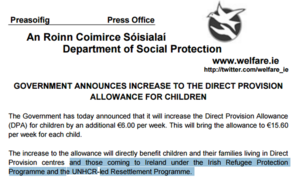
A press release published by the Department of Social Protection last night and a tweet by the Irish Refugee Council

Last night the Department of Social Protection officially announced – and published a press release – that the weekly allowance for children seeking asylum is to be raised by €6 from €9.60 to €15.60.

This has already been reported.

However, in addition to the increase benefitting young asylees – who are in the process of seeking refugee protection – the department also said that the increase will also benefit “those coming to Ireland under the Irish Refugee Protection Programme and the UNHCR-led Resettlement Programme.”

It’s understood that the people who are being relocated to Ireland under this programme – such as the group of Syrians who were brought to Clonea Strand Hotel near Dungarvan before Christmas –  have been predetermined as refugees by the UNHCR.

And once a person is recognised as a refugee in Ireland, they are entitled to apply for social welfare payments on the same basis as an Irish citizen.

Anyone?

Government announces increase to the direct provision allowance for children (Welfare.ie)

Previously: Institutionalised

A Wintry Welcome

The Institutionalisation Of 1,818 Children

Thanks Subpri.me

UPDATE:

In response to the increase…

Tanya Ward, Chief Executive of the Children’s Rights Alliance and member of the Working Group on the Protection Process, says: “As a member of the Working Group, I was deeply upset to witness first-hand the poverty that children in direct provision must endure. This increase – which will barely cover the cost of a bottle of Calpol – can only be seen as a gesture of goodwill. Our welcome is given with a strict proviso that the full increase to their payment be secured in the short-term.”

June Tinsley, Head of Advocacy at Barnardos, says, “While any increase is a move in the right direction, it is difficult to see the justification for such a paltry increase – less than a third of what the working group recommended and still far short of what they need. The direct provision system is no place for children and this increase will do precious little to change that. It must be abolished.”

Grainia Long, CEO of ISPCC, says, “ISPCC staff have worked with families in Direct Provision and seen the hardship caused by the inadequate level of financial support. We’ve heard from mothers trying to save an extra egg to bake a birthday cake for a child, and from children who have never known anything other than basic conditions in institutional settings. The modest increase from ministers is welcome, but it falls short of what children need, and will ultimately mean that children in Direct Provision remain woefully unsupported by the Irish state in 2016.”

Screen-Shot-2014-09-15-at-10.13.29

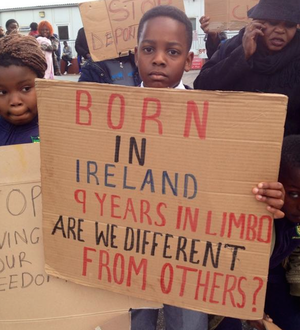
Children protest at the Kinsale Road Direct Provision Centre in Cork in September 2014

Journalist Brian O’Connell told RTÉ Radio One’s Today With Seán O’Rourke this morning that, following discussions he has had with asylum seekers, he believes fresh protests may be organised in direct provision centres across Ireland as the country starts to welcome 4,000 Syrian refugees.

It follows the publication of the Report of the Working Group on the Protection Process including Direct Provision in June – which contained 170 recommendations – many of which have yet to be implemented.

Mr O’Connell spoke with Fiona Finn, CEO of immigrant support centre NASC for the show.

During their discussion, Ms Finn agreed with Mr O’Connell’s assertion that as the 4,000 refugees arrive, tensions are likely to rise in the Direct Provision centres.

Ms Finn said:

“What we’ve actually found over the last number of weeks is that there’s an awful lot of anger and disquiet in the centres because the residents in the centres feel that nothing has been done since the publication of the [working group] report. And I think they feel very much kind of forgotten about and they feel very much left behind. And this is coming to kind of sharp focus now with the announcement that we’re going to bring 4,000 new refugees and asylum seekers in the State. And our fear is the fear that’s echoed by the residents in the centres is that a sort of two-tier system is going to emerge. So what you’re going to have is the deserving and the undeserving refugee.”

“We are getting a very clear sense of that [asylum seekers mobilising for protest]. I think the people in Direct Provision feel that they were given a glimmer of hope when the working group was established and when the recommendations came out. The hope that they had, that things would be changed, has now been extinguished.”

“We’re very disappointed that action hasn’t happened sooner [on foot of the working group report]. I think we trusted the process, as did everybody else around the table and it was our understanding that the implementation of the recommendations of the working group would happen in a very short period, post its publication, but that does not seem to be the case at the moment.”

“I think the people who are living in the centres do feel that they’ve been left behind, they’ve been forgotten about and I think whilst I think our commitment to bringing in 4,000 new refugees and asylum seekers is very, very positive and is a very good start, it can not be the reason for us not to discharge our human rights obligations and duties to those who are already waiting in our current system.”

Listen back in full here

Screen-Shot-2014-08-22-at-14.09.43-766x1024

A child at a protest over the direct provision system in Limerick last August

You may know the asylum seeker/direct provision review report is due to be published later today.

Well.

The report is expected to propose that new asylum seekers should have the right to work after nine months of seeking refugee status. At present, Ireland is one of just two EU member states with a blanket working ban on all asylum seekers.”

“Another key proposal may lead to residency for more than 3,000 asylum seekers who have spent five years waiting for their claims to be dealt with by Irish authorities. Many of the proposals hinge on the introduction of a new streamlined asylum process, aimed at processing claims within a six- to nine-month period.”

Finally?

New asylum seekers may receive right to work (Irish Times)

Previously: Shutting Out The Asylum Seekers

How The Common European Asylum System Will Work

Meanwhile In Limerick

Direct Inaction

Photocall Ireland

asylum

You’ll recall how a working group set up by the Department of Justice last August to look at reforming the direct provision system – and from which the CEO of the Irish Refugee Council Sue Conlan resigned in March – is due to deliver its report at the end of this month.

This morning, Kitty Holland, in the Irish Times, reports:

The report will recommend these [asylees’ welfare payments] be increased to €38.74 per week for adults and €29.80 for children. This would bring the rates into line with supplementary welfare allowance rates when the fact asylum seekers in direct provision are provided with food and accommodation is taken into account.”

Readers may recall  in September 2014, the RTÉ Radio One journalist, Brian O’Connell, did a series of interviews with female asylum seekers – some teenagers – who talked about engaging in prostitution in order to supplement their weekly stipend of €19.10/€9.60 a week.

After the interviews Justice Minister Frances Fitzgerald said she’d be seeking a report on this specific matter stating: ‘I will certainly be asking for a report and I would ask that anyone with information to make it available to the Gardaí.’

Was that specific report ever carried out? Or was it subsumed into this working group report?”

Anyone?

Previously: ‘I Will Certainly Be Asking For A Report’ 

“He Took Me Around Some Bushes”

‘We Do It Out Of Desperation’

uplift

Outside the Department of Justice, St Stephen’s Green, Dublin yesterday

Emily Duffy, on behalf of Uplift, a community organisation focused on ‘people powered change’ writes:

[Yesterday] we handed in a petition of over 1,200 signatures to the Minister for Justice Frances Fitzgerald to call on her to end the direct provision system for the 4,309 asylum seekers in Ireland.

We are supporting the scheme to clear the backlog of those lives stuck in direct provision, and for the Irish government to live up to its responsibility to protect the most basic rights of everyone living on this island.

Previously: Direct Provision Care Packages

Scheme To Clear Asylum Backlog (Irish Refugee Council)

Screen Shot 2014-09-25 at 02.44.45

Justice Minister Frances Fitzgerald at the citizenship ceremony in the Convention Centre in Dublin on Monday

Further to RTÉ reporter Brian O’Connell’s recent interviews with female asylum seekers who say they have turned to prostitution, to supplement the weekly €19.10 they receive from the State, Ms Fitzgerald told the Dáil yesterday:

“I do not accept it is inevitable that women in direct provision must resort to prostitution. I have asked for reports from the Garda on any harassment that might be taking place. If there is information available to show that women are being solicited or put under pressure, that must be examined and managers in local centres must be highly sensitive to it. Certainly, I do not see it as inevitable.”

And, in relation to the recent protests held by asylum seekers at different accommodation centres across the country, she said:

“Protests are taking place throughout the country at present. I appeal to people not to take part in such protests. I am of the view that the way forward is by means of legislation and through the efforts of the working group we are establishing to deal with the issues.”

I hope NGOs are not organising protests outside direct provision centres. I would be very concerned with regard to the impact of this on both the children and families of the protesters…It is one thing to draw attention to the problem. I again call on people not to protest in a way that makes it impossible to run the centres, to have them cleaned and to have food delivered to them. I am concerned with regard to what is happening. Changes can be made without the need for such protest action.”

Transcripts via Oireachtas.ie

Previously: “He Took Me Around Some Bushes”

“I Will Certainly Be Asking For A Report”

Direct Inaction

Photocall Ireland

Screen Shot 2014-09-15 at 09.28.39

Screen Shot 2014-09-15 at 10.13.29

Children protest outside the Kinsale Road Direct Provision Centre in Cork.

Brian O’Connell, of RTÉ, tweets:

Residents have been blocking access to the Kinsale Road Direct Provision Centre since 5am. Report on Today With Sean O’Rourke after 10am.

Previously: “He Took Me Around Some Bushes”

Pics: Brian O’Connell and Jonathan Healy

UPDATE:

DP

A direct provision accommodation centre for asylum seekers in Co. Westmeath

Brian O’Connell was on the Today With Seán O’Rourke show this morning talking about how some female asylum seekers – some as young as 18 or 19 and who had just completed their Leaving Certificate – are selling themselves for sex.

He did not report anyone’s name or give any location as to where this is taking place.

Some of the women are in the Direct Provision system for five, six or seven years, and did not take part in prostitution before they came to Ireland.

He said the women, who receive €19.10 from the State a week, are not allowed work or go to college, usually earn €20 or €50 for sex.

Mr O’Connell said it is mostly young single mothers who are engaging in prostitution but he said there are some married women who do this without their husband’s knowledge.

He said men usually approach the women outside the centre, on the street, with one woman telling him she was approached at the Post Office. The men also come to the direct provision centres, and don’t usually find any difficulty entering the premises, or they park outside the centres and the women go out to meet them.

Mr O’Connell spoke to one young mother about the first time she received money for sex. She was in a car on a street.

She told him:

“In myself, I had no choice, also because I know that I cannot afford anything. So I just had to do it as well.”

The woman, who is now living in her third Direct Provision centre, said it is her understanding that there are women at all the centres she has lived in taking part in prostitution.

Another mother told Mr O’Connell:

“Most of us engage ourselves in prostitution because we have no choice. Some women they are married, they are living with their husbands but they do it because they have no choice. Most people I know, a lot of people, they engage…I know most girls, some of them, they finished the Leaving Cert last year or 2012, they are there, they have nothing to do. Poor girls, they have to engage themselves into prostitution.”

“It’s not organised. It’s just, I think we do it out of desperation and some people also, they know that we are in that situation, we are in Direct Provision, they just take us for granted. They just, like where I live, it’s  along the road, people come, they park their cars outside there, we are just coming out, they’re like ‘how much?’. It’s like we have no dignity. Like we have lost ourselves in almost everything.”

Mr O’Connell also visited two centres and spoke to about a dozen male and female residents and each of them verified, independently, the fact that some women were getting paid for sex.

One woman, who spoke to Mr O’Connell along with her husband – and who does not take part in prostitution – said she believed the women sold themselves for sex because they only earn €19.10 a week. She said she herself has been stopped on the road by white men who ask her, ‘How much are you?’.

Later, Fiona Finn, CEO of Nasc Ireland, told the show that, from the group’s experience, asylum seeking women in Direct Provision centres across Ireland are engaging in prostitution to supplement the €19.10 they get a week.

Listen back here

Previously: Why All The Secrecy?

Mount Trenchard Direct Provision Centre in Co. Limerick – where up to 50 asylum seekers are believed to currently reside

You may recall a post from last Thursday about how three asylum seeker men living in the Mount Trenchard Direct Provision Centre, near Foynes in Limerick, started a hunger strike because of the long delays in the asylum system. They have all been waiting at least ten years for their applications to be processed.

A subsequent post last Friday detailed how representatives of the NGO Doras Luimní helped to negotiate talks between the residents and the owner of the centre. Minutes after the Doras Luimní representatives left – and after a later date for further talks was set – two residents, who were acting as spokespersons for those protesting, were transferred out of the centre by the Reception Integration Agency under Garda supervision, while another asylum seeker reportedly also left.

It’s understood four residents are now on hunger strike.

This morning, Brian O’Connell spoke to Seán O’Rourke about the situation and, during his segment, he played several interviews with those involved.

One of the interviews was with one of the men transferred out of the centre, Patrick, to a direct provision centre in Cork city.

Patrick told Mr O’Connell about what happened after they spoke to management and gave his feelings about the direct provision system.

“Ten minutes later, me and Ahmed, my friend from Sudan, we got transfer letters because we were the ones asked to speak…we were escorted by squad cars, they had guns with them, they were escorting us as if we were terrorists.”

“It’s [the direct provision system] very tough, it’s very tough to be honest. People are being treated inhumanely. The way we sleep in our rooms, sometimes ten people in one room.”

Mr O’Connell also spoke to another resident of the centre, Jamhal, who was also moved to Cork on Thursday. Mr O’Connell explained that it is not yet clear whether Jamhal’s transfer was voluntary or forced.

Speaking to Mr O’Connell:

Jamhal: “We are getting sick, you know, some people are, they harm themselves, some people, they kill themselves cause of this system. Like myself, I hurt myself many time, you know, you can see here.”

Brian O’Connell: “On the right hand side of your hand there are three large scars – that is as a result of…”

Jamhal: “It is a result of the system like. Holding a man for ten years who has all these ambitions and dreams and become all dark and nightmare. It’s like a nightmare, I’m living a nightmare in this system. We want to be heard by the Irish people, just when you protest about something, they just write letter from RIA and then they transfer you to another place. Just to break you and they break me.”

Meanwhile, solicitor John Gerard Cullen, who represents some of the residents in Mount Trenchard, also joined the show.

Mr Cullen told how he witnessed a ‘frightening’ incident at Mount Trenchard yesterday.

John Gerard Cullen: “Yesterday evening I called down to see a number of clients in the hostel and, in the course of one consultation, there was a very repetitive crashing sound and it was dismissed by other persons in the dining room, as simply a person fighting, it would seem, which appears to them to be quite normal. But it continued and then reports came in that somebody had broken the computer in the main hallway and then somebody broke the flat screen television and a gentleman appeared at the door of the dining room with a baseball bat. He battered the counter where food is dispensed and then he proceeded to deal with the windows, it was sort of an annex to a Georgian building and he broke pane after pane, window after window, about four windows at that stage. And then I saw some of the persons removing their cars and I said, well, you know, I really need a windscreen and so forth, so I sort of removed my car. I intended to go back but I was told that it was not really safe to go back by some of my clients who had moved up to the rooms. And I was told that up to 18 windows have been broken since, I think the gardaí eventually arrived and restrained the alleged offender. So that’s just one incident. But it was, he seemed to be, the individual seemed quite disturbed.”

Sean O’Rourke: “Well this would appear, Gerard, to bear out what we’ve been hearing from Brian, just about mental health issue at this centre.”

Cullen: “Yes it would appear that a number of persons suffer from mental health problems and, of course, that impacts very considerably on others at the centre as well because what one describes as the overcrowding and I mean I know, for example, in rooms 1 and 2, that there are apparently 12 beds. Well my instructions date from really June 2014, I was told at that stage that there were 8 persons living in those, in each of those two rooms. And so the persons who are living in those conditions, which lack privacy are obviously exposed to the kind of attacks that I’ve just described. And they told me that they can’t sleep until 3 or 4 o’clock in the morning, and that fighting is going on, and disturbances of one kind or another.”

O’Rourke: “Behaviour of that kind would obviously be very upsetting and frightening for people. What other issues have been brought to your attention at the centre?”

Cullen: “Well I suppose the transport issue is regarded as one of the major problems. Again I’m told that there are two taxis per day, that ferry people to Foynes and back which is about three miles from Mount Trenchard but those taxis can only accommodate four persons at a time so there were, in June, there were 64 persons in the hostel. So they feel themselves marooned and very geographically remote and socially remote. There’s nothing to do. There’s no intellectual stimulation, there’s no training, there’s no work, and there is this exposure to violence.”

Previously:  Meanwhile In Limerick

‘Two Residents Were Transferred’ After Speaking Out

Screen Shot 2014-08-12 at 10.35.09

Justice Minister Frances Fitzgerald

The Irish Times is reporting this morning that the Government will establish a working group next month to review Ireland’s direct provision system.

The matters to be examined will include the weekly payments (€19.10 for adults, €9.60 for children, which have remained unchanged since 2000) and access to college. Justice Minister Frances Fitzgerald also promises to introduce a system which would streamline the processing asylum applications.

It should be noted that this streamlined approach has been promised several times by several previous justice ministers.

The Irish Times article adds:

“However, [Justice Minister France Fitzgerald] ruled out extending the right to work for asylum seekers who have been in the system for long periods, due to the high level of unemployment in the State.”

Readers may recall that, although asylum seekers are banned from working under the Refugee Act 1996, there was an exception to the rule in 1999 when – following widespread calls from business groups, trade unions and advocacy groups – the Fianna Fáil/Progressive Democrats coalition allowed asylees work, under certain conditions.

The move was seen as a significant U-turn by the main government party, Fianna Fáil, as it had publically clashed with its coalition partner, the PDs, on the matter for almost a year prior to the changing of its stance on the issue.

The work initiative allowed for asylees, who had applied for protection before July 26, 1999, and who had been waiting on a decision on their application for over 12 months, to apply for work. By the end of June 2000, 1,032 out of 3,241 asylees entitled to work had either found a job or had stopped claiming social welfare.

Readers may wish to recall a few things that happened in the run-up to the work ban being lifted, albeit briefly.

In May 1998, at its annual conference, the trade union IMPACT called for asylees to be allowed work, while also calling for a Charter on Asylum Rights in Ireland.

Two months later, a campaign specifically calling for asylees to be allowed work was led by advocacy group Asylum Rights Alliance.

It was endorsed by more than 100 organisations – including ICTU and the Irish National Organisation for the Unemployed. The late former Taoiseach Garret FitzGerald, of FG, supported the campaign, calling the ban “ill-conceived” and “incomprehensible”.

In July 1998, a survey in the Irish Times showed more than 80% of people believed asylees should be allowed work while.

In November 1998, the Economic and Social Research Institute produced a report stating Ireland was facing a labour shortage and needed to find 285,000 extra employees between 1995 and 2003.

Further evidence of an economic interest in allowing asylees work came in February 1999, when the then Governor of the Bank of Ireland Howard Kilroy also called for asylees to work, in order to help meet labour shortages.

In July 1999, CSO figures showed Ireland’s unemployment figure was below 100,000 for the first time in 19 years.

In an Irish Times editorial on July 22, 1999, the work ban was branded “perverse”.

Before the ban was lifted, but reading the change in sentiment, an Irish Times editorial in 1999, foretold:

“Where humanitarian considerations failed to move the heart of this Government on the issue of asylum seekers, it seems that economic self-interest may do the job.”

In the Dàil, there were debates about the then labour shortage and desires of Ireland’s main employers’ group IBEC.

On Thursday, June 24, 1999, then Labour TD Michael D Higgins noted:

“Considerable weight has been added to the argument for allowing asylum seekers to work by the support of IBEC. The employers’ organisation has identified a skills shortage which is threatening the economy and which must be addressed. Meanwhile, a skills bank which could make a net contribution to the State lies untapped because someone decided that asylum seekers should not be allowed to work, under any circumstances, pending the determination of their applications. I understand that the ICTU has also supported the argument… Given the weight of these combined arguments, I cannot see why a decision cannot be made.”

On the same day, FF TD Marian McGennis also noted:

“Our decision should not be based on a request by IBEC or any employers’ group that because there are skills shortages, a right to work should be granted to a person to whom we would not have granted it two years ago when unemployment was at 240,000. The decision must be based on granting the right to work to asylum seekers after a certain period of time. When we have no skills shortages we may claim we will employ only our own people, and that would be racist. We should grant it because it is a human right.”

Government to review conditions for asylum seekers (Carl O’Brien, Irish Times)

Photocall Ireland