Tag Archives: Disclosures Tribunal

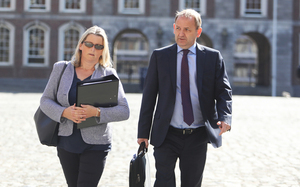
Garda Keith Harrison and Marissa Simms at the Disclosures Tribunal this morning

This afternoon.

The Disclosures Tribunal is continuing and Garda Keith Harrison is continuing to give evidence.

Garda Harrison is involved in the tribunal as he claims he has been targeted by senior officers and that Tusla social workers were “brought into the equation due to the manipulation of his situation and the extraction of an unfair and untrue series of allegations of serious domestic misconduct by his domestic partner“.

Supreme Court judge Peter Charleton, who is overseeing the proceedings, is specifically looking at the tribunal’s term of reference ‘n’ – which is “to investigate contacts between members of An Garda Siochana and TUSLA in relation to Garda Keith Harrison”.

It follows a visit made by social worker Donna McTeague in February 2014 to the home of Ms Simms and Garda Harrison in Donegal in which Ms McTeague spoke with the children in the home – a visit which the couple claims has had a profound effect on them.

Both Ms Simms and Garda Harrison have told the tribunal that they have no issue with Ms McTeague.

Further to this.

Garda Keith Harrison and Marissa Simms received a letter from Tulsa on February 2, 2014, in which Tusla requested a meeting with Ms Simms and Garda Harrison.

The couple met with Tusla members on February 7; there was a follow-up phone call on February 14 to confirm a home visit; and the home visit took place on February 19, 2014.

The events with Tusla came several weeks after Ms Simms withdrew her 38-page statement on January 11, 2014 – made to gardai during an 8.5-hour interview, on October 6, 2013 – in which it’s recorded that she said Garda Harrison threatened to burn her.

Ms Simms has since told the tribunal: “He never threatened to burn me. Ever.”

Ms Simms also told the tribunal that, when she was withdrawing her statement, Inspector Goretti Sheridan, who took Ms Simms’ statement along with Sgt Brigid McGowan, told her a story about another unnamed couple.

Ms Simms alleged: “She said, they had a row in front of their children and now social services are involved in these children’s lives and I can’t guarantee you that won’t happen to you.”

When Inspector Sheridan gave evidence in relation to this allegation, she said: “No, I did not, no way did I say that to Marissa.”

In a statement to the tribunal, about the February 2 letter, Marissa Simms said she “had no idea what this was for and assumed it was the doing of the gardaí in Letterkenny, because I took back the statement, and as suggested what would happen by Goretti Sheridan, social services were getting involved”.

When giving evidence, Ms Simms repeated that she assumed the arrival of the letter from Tusla was because she retracted her statement. So, it was suggested to her that maybe it was the case that she did know what the letter was about.

She said: “I had an idea, yes.”

In relation to the initial meeting on February 7, Ms Simms said in her statement to the tribunal: “Ms McTeague explained that she dealt with families where children were at immediate risk but was confused as to her role in this instance as the incident occurred over four months previously.”

The tribunal has heard Ms McTeague has said she was never confused and never said this.

In her statement, Ms Simms said: “Before we [Keith and Marissa] left McTeague told us she didn’t think we would hear from her again, that she would be reporting to her team leader. No further action was necessary.”

“We left with mixed emotions, relieved that because that was the end of the matter, angry we had to go through that.”

In relation to the follow-up call made by Ms McTeague to arrange a home visit, Ms Simms, in her statement, said: “I was astounded and upset when I received a call from Donna McTeague. She apologised and stated that her team leader had been contacted by the guards and, as a result, she now had to do a house visit.”

While giving evidence, Judge Charleton specifically asked Ms Simms about her claim that Ms McTeague told her on the phone that she had to do a house visit because Tusla had been contacted by the guards.

Ms Simms said: “She didn’t say directly we have been contacted by the guards, no.”

She later said: “I’m just saying that she rang and said that she would have to do a house visit because of a direction she had been given by her superior.”

Judge Charleton asked: “Nothing to do with the Gardaí?”

Ms Simms replied: “No.”

She later said it was her “assumption” that the gardai had been in contact with TUSLA after she withdrew her statement.

The tribunal heard that in a statement to the tribunal, Ms McTeague wrote:

“I did not say my team leader had been contacted by the guards and, as a result, I had to do a home visit. The decision to undertake a home visit in any case for the purposes of completing an initial assessment is based on the need to ensure children’s voices and views are sought, observed and recorded in our assessments.

“In this case, it was my view, based on the information I had at the time of meeting with Ms. Simms and Garda Harrison, that there were likely no ongoing child welfare/child protection concerns. However, I added that I may need to visit the children. Both Ms. Simms and Garda Harrison agreed. Following discussion with my team leader, it was agreed I would, in fact, complete the home visit, meet the children, and if no new issues arising, the case would be closed.”

Meanwhile.

At the Disclosures Tribunal today.

Garda Keith Harrison is continuing to give evidence.

The claims made about what Ms McTeague did or did not say have been put to him.

Judge Charleton set out three specific questions to Garda Harrison. He asked:

Was he saying that, at the end of the meeting on February 7, that, as far as everyone was concerned, a home visit was unlikely.

Garda Harrison said: Yes

Judge Charleton also asked was Garda Harrison saying that, somehow, gardai manipulated a situation that gave rise to a “change of plan” resulting in a home visit.

Garda Harrison said: Yes.

Judge Charleton also asked was Garda Harrison saying that the change in the mind of Tusla was affected by the gardai for malicious reasons against him.

Garda Harrison said: Yes.

Following on from this.

Patrick, Marrinan SC, for the tribunal, read out excerpts from an affidavit that Garda Harrison lodged in High Court on May 15, 2015, regarding claims made about Ms McTeague.

These include the claim that Ms McTeague was confused about why she was meeting with Ms Simms and Garda Harrison on February 7, 2014.

As mentioned above, the tribunal has heard Ms McTeague has said this is not true.

The affidavit also includes the claim that Ms McTeague said she might have to meet the children but that it’s unlikely – however this has also been refuted by Ms McTeague.

In relation to the claim that Ms McTeague told Ms Simms over the phone that she had to make a home visit because of contact with the gardai, Garda Harrison said he was standing by this claim.

Judge Charleton intervened to point out that, in his statement to the tribunal, Garda Harrison was ascribing words to Ms McTeague and inferring that he heard Ms McTeague say them.

He asked Garda Harrison if she said them and if she didn’t, why was he ascribing them to her.

Garda Harrison admitted that he did not speak to her directly and that this was information relayed to him by Ms Simms.

Mr Marrinan SC, for the tribunal, pointed out that, nowhere in either his statement to the tribunal or in his affidavit did he make it clear that this information came from Ms Simms and that he didn’t have direct knowledge.

Garda Harrison told the tribunal: “I am in no doubt that this was said to me.”

Mr Marrinan accused Garda Harrison of tailoring his evidence.

Garda Harrison responded: “No, I’m not tailoring anything.”

Garda Harrison has also claimed in his statement to the tribunal, and in his affidavit, that, during the home visit, Ms McTeague said her team leader Bridgeen Smyth was close to Sgt Brigid McGowan from Letterkenny Garda Station.

The tribunal has heard that Ms McTeague has said: “At no point in time did I ever make reference to any relationship or otherwise between Sgt McGowan and Bridgeen Smith in my discussions with Marissa Simms or Keith Harrison.”

She also said her belief is that their relationship is purely professional.

Garda Harrison told the tribunal that Ms Simms told him that Ms McTeague said that.

He told the tribunal: “There was certainly mention of that to Marissa. I’ve no doubt about that.”

However, he conceded he wasn’t in the presence of the two women when this allegedly discussed as they were in another room while he was with the children in the sitting room.

Asked how he could make this claim in his affidavit and statement, he said: “Because it was a result of a direct conversation I had with Marissa afterwards.”

Garda Harrison added: “I’m satisfied I was told the truth.”

The tribunal continues.

Previously: Meanwhile, At The Disclosures Tribunal

Garda Keith Harrison and Marissa Simms

This morning.

At the Disclosures Tribunal in Dublin Castle.

The partner of Garda whistleblower Keith Harrison Marissa Simms, who has claimed to have raised concerns about a garda being involved in the distribution of drugs in Athlone in 2008, is continuing to give evidence.

Once finished, Garda Harrison will give evidence.

Garda Harrison is involved in the Disclosures Tribunal as he claims he has been targeted by senior officers and that Tusla social workers were “brought into the equation due to the manipulation of his situation and the extraction of an unfair and untrue series of allegations of serious domestic misconduct by his domestic partner“.

Supreme Court judge Peter Charleton, who is overseeing the proceedings, is specifically looking at the tribunal’s term of reference ’n’ – which is “to investigate contacts between members of An Garda Siochana and TUSLA in relation to Garda Keith Harrison”.

It follows a visit made by social worker Donna McTeague in early 2014 to the home of Ms Simms and Garda Harrison in Donegal in which Ms McTeague spoke with the children in the home – a visit which the couple claims has had a profound effect on them.

Yesterday, the tribunal took a turn when it heard Ms Simms say she has no issues with Tusla or the HSE or with Ms McTeague whom, she said, acted professionally and appropriately on foot of receiving a referral from the gardai.

It was also put to Ms Simms by Desmond Dockery SC, for Inspector Goretti Sheridan and Sgt Brigid McGowan – who took a statement from Ms Simms about Garda Keith Harrison in October 2013 but which Ms Simms subsequently withdrew in January 2014 – that she has no basis for believing that gardai manipulated the HSE in relation to the referral.

Ms Simms said: “That’s correct”.

On foot of this, Mr Dockery asked Ms Simms that, if that was her position, on what grounds did she make a complaint to GSOC last year in which she alleged the gardai abused their authority and made a referral in relation to Ms Simms’ children.

Ms Simms said she based it on her thinking that it wasn’t a coincidence that soon after she withdrew her statement on January 11, 2014, she received a letter from Tusla on February 2, 2014.

Mr Dockery suggested to Ms Simms that she is someone who has “a casual regard for people’s professional reputations”.

Ms Simms replied: “Absolutely not”.

At one point, Judge Peter Charleton directly asked Ms Simms: “What are you actually saying about the Garda and the HSE?”

Ms Simms replied: “I’m not inferring anything.”

At another point, Paul Anthony McDermott SC, for Tusla, stated:

“…there is a letter written on behalf of Marisa Simms and Garda Harrison by their solicitors to Dr [Katherine] Zappone, who is the Minister for Children and Youth Affairs; in other words, my client’s Minister…it says: “The manner of intervention of Tusla in our client’s family life is a cause of concern and is by any measure an inexcusable abuse of their position.”

“It was my understanding that the reason we’re here in this module was to investigate that allegation. It appears as though it is no longer being pursued.”

For the past week, the tribunal has heard of incidents and events in 2013 that led up to Ms McTeague’s visit and claims, and counter-claims, about the same.

The incidents include:

  • Several domestic disputes between Ms Simms and Garda Harrison;
  • Visits and phone calls to garda stations by members of Marissa Simms’ family, in which allegations were made against Garda Harrison;
  • A statement made to gardai by Marissa Simms’ mother Rita McDermott about Garda Harrison on October 2, 2013 in which she said Ms Simms told her Garda Harrison threatened to burn her and the children. Last month, however, Mrs McDermott told tribunal investigators “I did not say this”. Last week she said she simply doesn’t remember saying that.
  • A 38-page statement made to gardai by Ms Simms on October 6, 2013, made during an 8.5-hour interview, in which it’s recorded that she claimed Garda Harrison threatened to burn her on September 28, 2013. Ms Simms told the tribunal yesterday: “He never threatened to burn me. Ever.”
  • Ms Simms’ statement also records her saying that Garda Harrison told her: ‘I am going to bury her [Ms Simms’ sister Paula] and you’. Ms Simms told the tribunal yesterday that Garda Harrison said he’d ‘bury’ Ms McDermott, in the sense of getting her back for not inviting him to her wedding on October 4, 2013, but inviting Ms Simms’ ex-husband.
  • Both Insp Sheridan and Sgt McGowan have told the tribunal the words contained in Ms Simms’ statement are her words.
  • Three texts sent from Ms Simms to Garda Harrison on September 29 and September 30, 2013, in which she referred to a threat made by him to burn her. Ms Simms told the tribunal yesterday that she sent them immaturely to hurt him.
  • Ms Simms’ sister Paula McDermott’s wedding on October 4, 2013 – which Garda Harrison was not invited to – something which was causing a lot of tension between Ms Simms, Garda Harrison and Ms Simms’ family.
  • Two death threats against Garda Harrison made via phone calls to garda stations on October 4 and 5, 2013.
  • The subsequent sending by gardai of Ms Simms’ and Mrs McDermott’s statements as a Section 102 referral to GSOC. This did not proceed as Section 102 referrals concern matters that indicate “the conduct of a member of the Garda Síochána may have resulted in the death of, or serious harm to, a person”. Also, on October 11, 2013 – after GSOC contacted Ms Simms to tell her they had received her statement – she told GSOC she did not wish GSOC to deal with the matter.
  • On foot of GSOC’s decision to close their file on it, the sending of a request to the Assistant Commissioner in Sligo to appoint a superintendent from outside Garda Keith Harrison’s division to investigate the matters.
  • A strategy meeting between gardai and social workers on October 21, 2013, between Sgt McGowan and social workers Donna McTeague and Brigeen Smyth.Sgt McGowan’s notes of the meeting note: “Allegation of emotional abuse. Child allegedly present during verbal altercation”.Notes of the meeting from the HSE record: “Marissa Simms made statement of complaint to Gardaí detailing incident when child/children were present. Incident was a verbal disagreement between Marisa Simms and current partner.”Ms Teague, in her notes, recorded: “The incident was reported to be a verbal disagreement between Ms Simms and Mr Harrison. Mr Harrison was reported to be under the influence of alcohol and inappropriate physical contact was made by him on Ms Simms which the children witnessed. Sergeant McGowan did not go into any additional specific details contained in Ms. Simms’ statement.”

    Ms Leader BL, for the tribunal, suggested that the HSE seem to be implying, according to what they’ve told the tribunal, that “they didn’t have appropriate information in light of what they now know about the contents of Ms Simms’ statement?”

    Sgt McGowan told the tribunal: “I am in no doubt that I told the HSE that the children were present on the 28th September when the threats were made as contained in Marisa Simms’ statement, and I told them of the threats, and I specifically remember using the words “burn and bury” during the course of that meeting.”

  • Ms Simms withdrawing her October 2013 statement on January 11, 2014.
  • Sgt McGowan saying she informed Ms McTeague that the statement had been withdrawn, but having no note of it, and the HSE saying it only became aware after it followed up the matter with Sgt McGowan.The tribunal heard a HSE note recorded at the end of January 2014: “Telephone call to Sergeant McGowan. Purpose of call to assert current status regarding Garda investigation so as to allow SWD to proceed with investigation. Sergeant McGowan advised that Marisa Simms made a second statement to Gardaí in the past fortnight in the past fortnight, advising her that while the content of the original statement was completely true, she did not want the matter investigated by Gardaí.

    “She was withdrawing her complaint. Ms. Simms is back in a relationship with Mr. Keith Harrison, the person against who original complaint was made. DSW advised that in order to progress matter report from Gardaí on specific information in original complaint will be required by SWD so as to progress SW investigation.”

    “Sergeant McGowan to forward report to DSW as soon as possible. DSW to send invite to Ms Simms and Mr Harrison in first instance. Invite to meeting to be sent to Mr Andrew Simms following receipt of report from Gardaí so as to ensure accurate information shared.”

Sgt McGowan told the tribunal earlier this week:

“The purpose of the strategy meeting on 21st October was to inform the HSE of the serious allegations that were contained in Ms Simms’ statement.

“In relation to the notes of the HSE, I can’t answer for them, but I can say that I have never been asked to forward a report of that nature in relation to any matter that I have ever dealt with the HSE.”

The tribunal also heard yesterday that, on October 7, 2013, the day after Ms Simms made her statement, she looked up safety orders on the internet.

Under direct examination from Kathleen Leader, BL, for the tribunal, Ms Simms said that the reason she did was so was because Insp Sheridan had mentioned safety orders to her during the 8.5-hour meeting in Letterkenny Garda Station and that, as she had never heard of one, she looked it up online.

It was suggested yesterday to Ms Simms that, based on what was in her statement and her texts, a cynical person might think Ms Simms is now claiming the burn threat to be something other than that recorded in her statement “because you are now in a stable relationship with him [Garda Harrison] and you don’t want any of the bad things to happen to him that you looked up on the 7th October, didn’t want him to lose his job, or be prosecuted in relation to the threats and you didn’t want a safety order any more?”

Ms Simms told the tribunal:

“I accept that, but I’m not here to defend Garda Keith Harrison. I am here because my children have Pulse IDs and they don’t deserve that.”

More to follow.

Previously: Meanwhile At The Disclosures Tribunal

Garda Keith Harrison and Marissa Simms

The Disclosures Tribunal resumed on Monday in Dublin Castle.

This section of the tribunal does not pertain to Sgt Maurice McCabe but, instead, to Garda Keith Harrison.

Readers will recall how Garda Harrison, who was previously stationed in Athlone, claims he first raised his suspicions that a garda was involved in the distribution of drugs in Athlone in November 2008 but that nothing happened on foot of making his suspicions known.

Garda Harrison later arrested this same garda for drink-driving in June 2009 and claims his working life has been made difficult ever since.

This section of the tribunal is expected to run until around October 3.

Specifically, Supreme Court judge Peter Charleton, who is overseeing the proceedings, is currently tasked with investigating the tribunal’s term of reference ’n’ – which is “to investigate contacts between members of An Garda Siochana and TUSLA in relation to Garda Keith Harrison”.

This arises out of a visit made by social worker Donna McTeague to Garda Harrison and his partner’s home in Donegal in which Ms McTeague spoke with the children in the home in early 2014.

According to the tribunal’s opening statement, Garda Harrision and his partner claim that this visit had “profound effects” on them both.

Continue Reading

Garda Keith Harrison and Marissa Simms

(Continued from this post)

The tribunal is currently hearing of events that unfolded before this meeting.

It is not within the terms of reference of the tribunal to investigate Garda Harrison’s allegations pertaining to Athlone.

Keith Harrison, originally from Galway, and Marissa McDermott, from Raphoe, Co Donegal, went out for about a year while Ms McDermott was a student at NUI Galway in the early 2000s. For a time they were engaged but, after breaking up, they lost contact and both went on to marry other people.

Ms McDermott now goes by her married name, Marissa Simms.

Some years later, after their respective marriages ended, Garda Harrison and Ms Simms rekindled their relationship and Garda Harrison got a transfer to Buncrana in Donegal in March 2011.

Ms Simms has a brother called Martin McDermott who killed 24-year-old Garda Gary McLoughlin, from Ballinamore, Co Leitrim, after he rammed a stolen car into Garda McLoughlin’s patrol car in Burt, Co Donegal in December 2009,

Mr McDermott reportedly had 91 previous convictions when he was convicted of manslaughter in July 2011.

Garda McLoughlin had been stationed at Buncrana at the time of his death and when Garda Harrison was transferred to Buncrana – just a few months before Mr McDermott’s trial – he did not disclose to anyone within the gardai that he was in a relationship with the sister of Mr McDermott.

Over the past three days, the tribunal has heard:

– Evidence related to Garda Harrison’s transfer to Buncrana;

– How it became known he was in a relationship with the sister of Martin McDermott;

– The fall-out of this becoming known;

– An anonymous letter being sent to the HSE, which was subsequently sent to gardai, about concerns for Ms Simms’ children;

– A meeting with social workers which found the allegations raised in the anonymous letter to be unsubstantiated;

– Death threats being made against Garda Harrison;

– Garda Harrison subsequently being put on “indoor duties”;

– Allegations made by members of Ms Simms’ family to gardai about Garda Harrison;

– Domestic disputes between Garda Harrison and Ms Simms;

– A report being sent to GSOC based on allegations made against Garda Harrison;

– And a statement which was made by Ms Simms but was subsequently withdrawn.

The first witness on Monday was retired chief superintendent Jim Sheridan.

Separately, readers will recall that Mr Sheridan previously appeared in the Disclosures Tribunal in relation to matters concerning Sgt Maurice McCabe.

Mr Sheridan forwarded the false rape allegation to the then Assistant Commissioner Kieran Kenny in May 2014 without acknowledging that the allegation was false – despite knowing this. Mr Kenny subsequently forwarded the incorrect referral to the office of the Garda Commissioner.

Mr Sheridan told the tribunal that, in hindsight, he should have disclosed that the allegation was incorrect.

On Monday, Mr Sheridan gave evidence in relation to the transfer of Garda Harrison from Athlone to Buncrana.

The tribunal heard that, in 2011, Mr Sheridan was the chief superintendent for Sligo-Leitrim division.

In addition, from November 2010 to August 2011 and again from February 2012 to November 2012, Mr Sheridan also had responsibility for Donegal division.

Mr Sheridan said he first learned of Garda Harrison in February 2011 when he received a phone call from Assistant Commissioner Fintan Fanning to see if he would be willing to accept Garda Harrison on transfer.

The tribunal also heard that, in the same month, Mr Sheridan received a report from the district officer in Milford that Garda Harrison had been making checks on PULSE in relation to Ms Simms.

Mr Sheridan told the tribunal that, during the phone call with Mr Fanning, he told Mr Fanning that he would take Garda Harrison in Sligo where Garda Harrison would be part of the escort unit.

Asked to explain the difference between an escort unit and ordinary policing duty, Mr Sheridan said:

“There’s a bank holding centre in Sligo where cash is retained, there’s an escort unit there who escort the bank — the movement of cash from, I think, Monday to Friday around the northwest, the west of Ireland into the midlands, and that is the duty involved.”

However, this did not occur as Garda Harrison was instead transferred to Buncrana.

Mark Harty SC, for Garda Harrison, told the tribunal that Garda Harrison had never sought a transfer to Buncrana – but only to the Donegal County division.

Mr Sheridan said he had no dealings with Garda Harrison during this transfer and had no dealings with Garda Harrison until several months later.

During cross-examination, by Mark Harty SC, for Garda Harrison, the tribunal heard that transfer attempts for Garda Harrison to other districts – specifically Limerick and Laois-Offaly divisions – had been rejected. No dates were given for these rejections.

In the case of Limerick, the tribunal heard that the Chief Supt in Limerick, in response to a transfer application, wrote to Assistant Commissioner Fanning saying:

“I am in receipt of the attached file from chief superintendent Mullingar and same is noted. I am aware of this member’s situation and transfer to Limerick would not be in his or the organisation’s best interests. It will not, in my view, alleviate any of the problems he is encountering.”

In a separate letter to Assistant Commissioner Fanning, the chief superintendent in Portlaoise wrote:

“I am unwilling to accommodate Garda Harrison in his application for a transfer to Laois-Offaly division.”

Mr Harty put it to Mr Sheridan:

“The situation then is that at the time at which Garda Harrison was seeking a transfer, he was being met with opposition and, to a certain extent, it would appear, dissent from people below the ranks to the assistant commissioner, whereby they were not willing to accommodate Garda Harrison, isn’t that correct?

Mr Sheridan responded: “Yes, that appears correct, yes.”

Mr Harty added: “And that appears to be directly related to something personal to Garda Harrison, isn’t that correct?”

Mr Sheridan replied: “It would appear so, but I’m not aware of that, to be honest, Judge.”

Mr Harty also asked Mr Sheridan about his conversation with Assistant Commissioner Fanning and asked him what information Assistant Commissioner Fanning gave Mr Sheridan.

Mr Sheridan said:

“My recollection is, there was a very brief conversation, I had a phone call from Assistant Commissioner Fanning. He did advise me that there may have been disciplinary matters. I did not go into them and to this day I do not know what they are. I said, I advised him that I would accept Garda Harrison to the escort unit in Sligo Town, and that ended the conversation, and I expected Garda Harrison to transfer to Sligo-Leitrim, to Sligo Town. I heard no more about it. The bulletin came out on the 15th March 2011, and Garda Harrison was being transferred to Buncrana Garda Station.”

Mr Sheridan said he did not call Assistant Commissoiner Fanning or anyone in Garda Human Resource Management (HRM) when he learned that Garda Harrison had been transferred to Buncrana and that although he was surprised, he accepted it.

The tribunal heard that, on May 23, 2011, an incident – the details of which were not disclosed – arose involving Ms Simms and her ex-husband in Churchill, Co Donegal.

Mr Sheridan accepted that the incident had not been caused by Garda Harrison and that, following that incident, Mr Sheridan first became aware that Ms Simms was a sister of Martin McDermott who was then waiting to be tried for the death of Garda McLoughlin.

This was brought to Mr Sheridan’s attention by Superintendent Kevin English, of Buncrana Garda Station, on May 25, 2011.

Mr Sheridan said Supt English told him that, in his view, it was no longer appropriate for Garda Harrison to serve in Buncrana and that “some of the station party were not happy in relation to it” – ‘it’ being his relationship with Ms Simms.

Several days later, a meeting was held between Mr Sheridan, Supt English and Garda Harrison in Letterkenny.

The tribunal heard that it is Garda Harrison’s view that the meeting was “fraught”.

But this account differs to that of Mr Sheridan.

Mr Sheridan told the tribunal:

“The meeting was conducted in a professional and efficient manner. I outlined at the outset the reason for the meeting and we discussed the incident in Churchill. Garda Harrison assured me that there wouldn’t be a repeat of it, that his partner and her former husband had come to an agreement in relation to matters and that there wouldn’t be a repeat of that incident. And then we discussed, obviously, his relationship, the relationship of his partner with Mr. McDermott.

“In fairness to Garda Harrison, he gave me a full rundown of his relationship going back to his college days with his partner, when they had originally met, when they had gone their separate ways and they had met up again in more recent times. He acknowledged that he hadn’t disclosed the relationship of his partner to Martin McDermott. We discussed all of those matters. He advised me that he had, since the incident in Churchill, I think on the night previously, he had informed the unit he worked with of the matter.

“He said that they had accepted it well. But he did — and that he had worked well with the unit there. But he did accept that — he fully accepted that he couldn’t continue to serve in Buncrana station.”

As Mr Sheridan gave evidence, notes of the meeting by Supt English were read out to the tribunal.

The notes said the following:

“Purpose of meeting: Explain to Garda Harrison. Garda Harrison provided personal details in relation to his partner, Marissa Simms, and their reason for moving to Donegal explained by Garda Harrison. Garda Harrison explained what happened on the 23/5/’11 re domestic incident… genuine fears for the safety of partner and two kids.”

“Garda Harrison confirmed that he met with his unit in Buncrana on the 29/5/’11, apologised and told them of his relationship with M. Simms. Garda Harrison believed unit were happy with explanation. Garda Harrison fully accepted that he should have disclosed who his partner was when he transferred to Buncrana Garda Station. Garda Harrison explained that his relationship would not cause any problem in the future and partner had little or no contact with her brother Martin.

“Superintendent English confirmed to chief [Sheridan] “that, since transferred, Garda Harrison to Buncrana there was no work-related issues and he was performing very well. Issue of transfer out of Buncrana was discussed. Garda Harrison accepted that he could not remain in Buncrana and requested to be kept anywhere within the Donegal division.

“Chief mentioned Sligo or Leitrim. Garda Harrison explained impact of not kept in Donegal Division. Garda Harrison gave assurances that there would be no further incidents with him and that he was getting his private issues sorted out. Garda Harrison stated that he would take a transfer to any other station within Donegal division. He wanted to make a new start. Chief confirmed there would be no delay in making his decision.”

Asked if these notes were accurate, Mr Sheridan said: “Absolutely, yes.”

Asked by Diarmuid McGuinness SC, for the tribunal, about Garda Harrison’s statement to the tribunal of this meeting, in which he alleges Mr Sheridan “started the meeting by accusing him of being underhanded and deceitful in keeping the relationship quiet and it showed a lack of respect in relation to his colleagues”, Mr Sheridan said:

“Those are not words that I would use. I certainly was disappointed that somebody — that a member of An Garda Síochána would not disclose that relationship, given the circumstances in which a colleague gave his life in the service of the country, and I certainly was very, very disappointed in relation to that. I was not angry. I had nothing to be angry about. I don’t do anger, to be honest.”

In addition, in relation to Garda Harrison’s statement, Mr Sheridan said:

“I’ve seen Garda Harrison’s statement. I saw it with disbelief, I have to say, Judge. I reject utterly his assertions in relation to the meeting.”

The tribunal heard that Garda Harrison claims, in his statement to the tribunal, that Mr Sheridan said: “I have good mind to send you far down the country and see how you like it then.”

When this was put to Mr Sheridan, he told the tribunal:

“Well, one is, I couldn’t say that because I didn’t have the authority to transfer him way down the country. I had the authority to transfer him back to Sligo if I wished.”

Under cross-examination from Mark Harty, SC, for Garda Harrison, Mr Sheridan said that had Garda Harrison disclosed his relationship with the sister of Martin McDermott, “we could have prevented the transfer to Buncrana” and he could have been facilitated somewhere else in Buncrana.

After the half-hour meeting, the tribunal heard that Mr Sheridan made the immediate decision to transfer Garda Harrison to Donegal Town and emailed Assistant Commissioner Fanning about the same.

During Mr Harty’s cross-examination of Mr Sheridan, Judge Charleton intervened on several occasions.

At one point, Judge Charleton said:

“As I understand from your client’s statement, which of course I have read, he is accusing Chief Superintendent Sheridan of malice, in sending him from Buncrana to Donegal Town and that hasn’t been put, and it ought to be put.”

Later Judge Charleton said:

“I am going to explore the question now, Mr. Harty. Did you maliciously transfer him from Buncrana to Donegal Town?”

Mr Sheridan responded: “Absolutely not, Judge.”

Judge Charleton then added:

“In order to inconvenience him or punish him in some way?”

Mr Sheridan responded: “Absolutely not.”

The tribunal also heard that, after the meeting between Garda Harrison, Mr Sheridan and Supt English, Mr Sheridan also wrote to the superintendent in Milford – the district in which the incident between Ms Simms and her ex-husband occurred on May 23, 2011 – in which Mr Sheridan wrote:

“If there are any further incidents, please advise this office.”

Mr Sheridan said he wrote this in light of the fact Garda Harrison gave him assurances that there would be no more incidents like that of May 23, 2011.

The tribunal heard that Mr Sheridan didn’t meet with Garda Harrison about his checking of Ms Simms on PULSE until April 24, 2012.

He said, as far as he could recall, there had been over 30 PULSE checks and at the meeting of April 24, 2012, Garda Harrison could not give him “any valid reason” for having carried out these checks.

Mr Harty, SC, for Garda Harrison told the tribunal that there had been 22 checks, from 2007.

Asked by Judge Charleton the reason why Garda Harrison had carried out so many checks, Mr Harty said Garda Harrison carried them out to see who was checking on Ms Simms’ car, as “he believed at the time that they were [both] under surveillance” by members of An Garda Siochana.

Judge Charleton asked Mr Sheridan if they were under surveillance and Mr Sheridan said “absolutely not” in respect of both Garda Harrison and Ms Simms.

Under cross-examination from Micheál O’Higgins, SC, for the Commissioner, Mr Sheridan said Garda Harrison “was not a thorn in his side” and he said, contrary to claims by Garda Harrison, Mr Sheridan is not related to Inspector Goretti Sheridan, of Letterkenny Garda Station.

Insp Sheridan was involved in a statement made by Ms Simms on October 6, 2013 which she later withdrew yet said was true. However, according to the tribunal’s opening statement, her statement of withdrawal – in which she said the claims in the original statement were true – was pre-pared by Inspector Sheridan.

In the tribunal’s opening statement, it is acknowledged that an anonymous letter was sent to the HSE in respect of Ms Simms’ children in January 2012.

Gardai in Milford were made aware of this letter on February 9, 2012 when a copy of it was handed over to Sergeant Bridget McGowan by Una Coll, of the HSE.

According to the opening statement, the anonymous letter said:

“It has come to my attention that the wellbeing of [the two children] is questionable. Their mother, Marisa Simms (nee McDermott) is having an extra-marital affair with a Garda Keith Harrison, who has a barring order against him from his estranged wife.

“She leaves and returns to the family home … on a regular basis, causing great upset to her two children, and husband, Andrew Simms obviously. Their father, Andrew Simms’ prime concern is to get his wife back, and is at breaking point. My gut feeling is that while Andrew is caring for the children physically, and working full time, he needs help. Thankfully he has the help of his mother.

“I would call you but I am aware that all calls are recorded. I have been advised not to leave myself open to Garda Harrison on any level, as I believe him to be a dangerous individual. I would fear, in his post, that he might obtain a recording of the call, and so therefore, I do not wish to put myself or my own family in danger. [One of the children] has become very withdrawn and [mentions various health issues] … I believe the stress of everything is far too much for [the child] to handle, without proper help.

“I feel it my duty to inform you of this situation, and so let you decide on what action might be taken, whether it be to inform the school, provide counselling etc. I feel that the children have suffered so much already and that maybe you are the people to help.”

The opening statement also details how, on February 10, 2012, Sgt McGowan forwarded a report to Supt Eugene McGovern, with the anonymous letter attached.

In her report, Sgt McGowan wrote:

“The matter was discussed and based on the contents, the member informed Ms. Coll that in their view there were specific concerns raised in the letter pertaining to the health and welfare of the children, in particular [one of the children], which would need to be addressed. The HSE informed me that they would call and speak to both parents of the children to ensure that the children were being adequately cared for and that they would inform me of the outcome of their enquiries.”

According to the opening statement, a meeting took place between gardai and Nora Roarty, a Social Work Team Leader, and Una Coll in which they informed Sgt McGowan that they had met with Marisa and Andrew Simms regarding the letter and discussed the welfare of the children.

After this the matter was closed as there were no further child protection concerns. According to Bridgeen Smith, social worker, there was “no information to substantiate the referral allegations”.

This meeting took place on March 14, 2012.

During Mr Sheridan’s evidence, the tribunal heard that, eight days after this meeting, on March 22, 2012, Mr Sheridan forwarded the anonymous letter to the superintendent in Letterkenny, a Superintendent O’Brien with the following note:

“The above is forwarded for your information and attention in the event of any incident being reported by Ms. Simms or Garda Harrison. The report and anonymous letter to the HSE are for your information only and not general circulation.”

The tribunal also heard of a report in relation to the inquiry into the anonymous letter sent by Sgt McGowan to Mr Sheridan on April 3, 2012.

Mr Sheridan said he couldn’t recall it but “if it’s there, I accept that it’s there, yes”.

He added: “It obviously was forwarded for my attention, or for my information, but I did not have any involvement in this or any contact with the HSE in relation to it, or anybody else.”

The tribunal has heard of instances in which members of Ms Simms family have made allegations about Garda Harrison to An Garda Siochana in relation to his treatment of her.

On Tuesday, the tribunal heard that, on the night of March 30, 2013, Ms Simms’ uncle William Bogle was at home in Raphoe, Co Donegal with his daughter Kerry Bogle and son Lee Bogle when Mr Bogle’s sister Rita McDermott – Ms Simms’ mother – telephoned saying she was concerned for Ms Simms.

The tribunal heard that on the night Ms McDermott made contact, Mr Bogle had been drinking.

It also heard that Mr Bogle’s memory is somewhat impaired as a result of a medical condition that he has suffered since 2013.

It’s unclear whether Ms McDermott called William’s phone or Kerry’s phone but she informed them that Ms Simms was “walking the roads” after an argument with Garda Harrison.

Ms McDermott was in Mayo on the night this phonecall was made.

Attempts to contact Ms Simms via phonecalls and texts were unsuccessful and so Mr Bogle – who said he knew nothing of Ms Simms and Garda Harrison’s relationship and didn’t know where they lived – telephoned Letterkenny Garda Sation.

The tribunal heard a recording of this telephone call in which Mr Bogle spoke to Garda Ian Oates telling him that “this garda is giving her grief”, “there’s kids in the house as well”, “he’s giving her awful abuse”, “he’s been very aggressive and chasing after her” and “we’re just very concerned for her”.

The telephone conversation wasn’t very clear and, in it, Garda Oates attempted to decipher who he was concerned about, where she lived and who was chasing her.

Mr Bogle also appeared to claim “he’s knocking her about”.

Kerry Bogle and Lee Bogle also spoke briefly during the telephone call.

Any difficulty in understanding what was said during the call was later made clear in the tribunal when a note of the call, made by Garda Oates, was read out.

It said:

“The caller was making allegations that Keith Harrison had kicked his sister, Rita, from out of the house and was following her in a car and flashing lights, later claimed she was assaulted also.”

Under questioning from Patrick Marrinan, SC, for the tribunal, Mr Bogle admitted that he merely concluded that Ms Simms’ children were in the house during the argument because: “I only assumed that the kids were there because I mean they would be with their mother, wouldn’t they?”

He said Ms McDermott told him that Garda Harrison was “racing after her through Letterkenny” and that he was “giving her a lot of abuse”.

After the phone call with Garda Oates, the tribunal heard that Kerry Bogle drove her father and brother in the direction of Churchill – where Garda Harrison and Ms Simms lived – in an attempt to find Ms Simms.

Unsuccessful, they then drove to Letterkenny Garda Station where William Bogle spoke to Garda Tina Fowley who was on duty that night.

The tribunal heard Mr Bogle couldn’t recall speaking to a male or female guard.

It also heard of a statement made by Garda Fowley in which she noted Mr Bogle was intoxicated.

The statement said:

“I recall two males and a female calling to the public office counter at Letterkenny Garda station during the early hours of the morning. One of the males, a Mr. William Bogle, stated he had rung earlier and expressed concerns for the safety of his niece, Marisa Simms.”

“He stated that they had been driving around Letterkenny looking for her as she was in a car being pursued by her partner.”

“He was unable to provide me with details of the vehicles involved. I asked for his niece’s address and the name of her partner. William Bogle did not know the address.”

“However, Kerry Bogle, his daughter, stated it was in the Churchill area. William Bogle was also accompanied by his son…I then explained to William Bogle that Garda Harrison was not stationed in Letterkenny but was attached to Donegal town Garda station

“William Bogle had drink consumed and was intoxicated.”

“I advised him he should speak to Marisa on the following day to establish what has occurred.”

“I also informed him that Marisa, as the injured party, would be the person who would have to make her statement of complaint in relation to the incident.”

The tribunal heard Mr Bogle’s brother died the following day and so he never asked Ms Simms about the evening.

Under cross-examination from Mark Harty, SC, for Garda Harrison, the tribunal heard that there were no children in the house that night and that Ms Simms “left of her own will in the company of a friend Mr Jim Quinn” and that there was “no incident that night which led to any act of violence on the part of Garda Harrison”.

Following questions from Judge Charleton about events of that night, Mr Harty told the tribunal that following a disagreement between Ms Simms and Garda Harrison:

“The situation is that at approximately 1:00 in the morning, Ms. Simms indicated that she wished to go back and stay in her mother’s and Garda Harrison rang Mr. Quinn because both Ms. Simms had been — had drink taken and couldn’t drive and Garda Harrison had also had some drinks at home that evening, and also couldn’t drive. So he rang Mr. Quinn and Mr. Quinn came and collected Ms. Simms and brought her, I think, to her mother’s house to stay.”

Kerry Bogle also gave evidence and said she can’t recall if the call came through to her phone, or her father’s phone, but that she spoke with Rita McDermott.

Ms Bogle said she couldn’t recall 100 per cent if Ms McDermott said Ms Simms and Garda Harrison had had an argument but that Ms Simms was “walking the streets” in her night clothes or pyjamas and that she asked if they could go and see if she was OK.

Jim Quinn, a Padre Pio faith healer, suicide counsellor and pioneer, also gave evidence about that night.

Mr Quinn, who said he knows Rita McDermott for about ten years and knows Ms Simms well, told the tribunal that he got a call from Garda Harrison, whom he didn’t know very well, on the night, and that Garda Harrison asked him if he could collect Ms Simms and give her a lift to her mother’s house as they had had a tiff.

Mr Quinn said he did drive from Letterkenny to Garda Harrison and Ms Simms’ home in Churchill about a 35-minute drive – to bring Ms Simms to Raphoe.

Recalling the night, Mr Quinn said:

“I stepped inside the door, I spoke to them as usual and I asked ‘Any chance of a cup of tea?’ and Keith said ‘Marisa will make a cup’. Marisa got up to make a cup and she kind of sat back down the seat, as if she had a couple of drinks too much. And I said to Keith ‘Maybe you should go and make the tea’ and he said ‘No, Marisa is all right’ and she got up and she did make a cup of tea, and I had a cup of tea.

“And that was that. I drunk the tea. Chatted. They said they had a wee tiff, words were exchanged. And Keith said he had drink on him, he couldn’t drive. She couldn’t definitely drive. So then I proceeded to take her home to Raphoe, to her mother’s house. Now, she was up and down the stairs, she did go up and down the stairs a few times with the phone, she was talking to somebody up at the top of the stairs, and when she got into the car to go home to Raphoe I said ‘Marisa, who were you on the phone to?’ and she says ‘Mum’. And I says ‘Why are you leaving the house? Do you think I am a taxi service?’ And she sort of, she kind of laughed, but she said ‘No, mum more or less told me to leave the house’.

“So more or less it was the mother’s instructions that she left the house. It was just a tiff. And I asked Marisa she did want to stay on. Marisa was quite willing to stay on that night, but she was under instructions, that she told me on the way up the road, that she wanted to go home, the mother told her to go home to the house.”

Mr Quinn also told the tribunal that Ms Simms told him that her mother told her that she had rung the guards.

The tribunal heard that Mr Quinn and Ms Simms spoke to Garda Oates on the phone that night – they couldn’t recall who called whom – and Garda Oates told the tribunal: “she didn’t seem distressed or anything, she seemed calm enough”.

Judge Charleton asked Hugh Hartnett, SC, for Ms Simms, about Ms Simms’ view of the evening.

Mr Hartnett said he was of the view that this matter was outside the terms of reference as it didn’t pertain to Ms Simms’ children or Tusla.

But Judge Charleton said he was not of that view and said he wished to know:

“Was there a row? How bad was the row? Does she accept what she says in the garda statement or is she giving a different narrative and if so what is that narrative?”

In addition, he asked:

“Is Marisa Simms saying that what she said to the Gardaí in October 2013 is incorrect? I suppose in what respect will become clear, if she is saying that. And, how does she explain withdrawing her statement, which is — well, it can happen in domestic violence situations, and it can be because nothing ever happened and the statement was made untruthfully, or it can be because it is simply being withdrawn because the relationship is back on an even keel. What are the circumstances under which she withdrew the statement but apparently told the Gardaí that it was true? So those are the things I need to know.”

Mr Hartnett later told the tribunal that it’s Ms Simms’ evidence that she called Mr Quinn on the night.

He also told Judge Charleton:

“There was certainly a row in the sense that there was an argument between these two people. There were –you asked the question, was Keith Harrison out of control, that is a very general term, but certainly voices were raised by both parties, and there is no doubt about that.

“You asked the question, sir, was she pulled out of bed, and my client will say that the duvet was pulled from the bed but that she wasn’t pulled out of bed. And as to whether she was pushed out in her pyjamas, she went out onto the street in her pyjamas, and a coat over them, as she awaited the arrival of Mr. Quinn, the previous witness.

“And then in relation to the question of the withdrawal of her statement, sir, you will notice that some couple of days after making that statement she was contacted by GSOC and that was her immediate reaction, to withdraw the statement, and soon after that she indicated that she wished to withdraw her statement.

“So in relation to this particular module, if I can put it that way – and the issues, the evidence that was given today, where the statement says that there was a pulling out of the bed, we say that that is incorrect.”

Mr Harty added:

“She signed that statement. But issues will arise in relation to that which, in my submission, are best dealt with by cross-examination during the hearing of viva voce evidence.”

The tribunal also heard of two further occasions where members of Ms Simms’ family contacted gardai about Garda Harrision in August 2013 and September 2013.

Detective Sergeant David Durkin told the tribunal yesterday that he got a call from Rita McDermott whom he had gotten to know when he had worked in Raphoe because of dealings with Martin McDermott when he was a minor as he sometimes had to serve summonses on Rita McDermott in respect of Mr McDermott.

Det Sgt Durkin also said he knew William Bogle as he sometimes did taxi runs for prisoners.

Det Sgt Durkin told the tribunal yesterday that, on the evening of Saturday, August 24, 2013, at around 9.40pm, he got a call from Mrs McDermott in which she alleged that on the Tuesday night prior to that, she got a call from Ms Simms at around 3am; that Garda Harrison had thrown Ms Simms out of the home and locked her out; that Mrs McDermott had to go and collect Ms Simms from the house; and that when she got to the house, Ms Simms was outside in her pyjamas.

He also said Mrs McDermott said that this was the third similar incident in three months.

Det Sgt Durkin said Mrs McDermott said there were no children present on the evening and that this allayed his fears and caused him not to contact TUSLA about the matter.

He said he advised Mrs McDermott what avenues were open to Ms Simms, under the Domestic Violence Act, if she deemed them appropriate.

He said he prepared a report for his superintendent and that he felt it was a matter for them if they wished to take if further.

Det Sgt Durkin also told the tribunal how Mrs McDermott told Set Sgt Durkin that Ms Simms didn’t know she was making this known to him and she didn’t wish Ms Simms to this find out.

Det Sgt Durkin gave further evidence about a second phone call with Mrs McDermott – specifically on September 24, 2013 – in which she again relayed her concerns about Garda Harrison.

Mrs McDermott told Det Sgt Durkin that Ms Simms had asked Garda Harrison to move out but he refused and that Ms Simms planned to remove all of Garda Harrison’s belongings from their house when he returned to work on October 2, 2013 – he had been on leave due to a road accident unrelated to work and was due back on October 2, 2013.

Mrs McDermott also informed Det Sgt Durkin that Ms Simms’ sister Paula McDermott was to get married on October 4, 2013 and that, as Garda Harrison wasn’t invited, there was some tension building up to the wedding and that Paula got correspondence that Keith was going to cause some disturbance at the wedding.

Det Sgt Durkin told the tribunal that he advised Mrs McDermott, that if Ms Simms or Paula McDermott had concerns, they should come into the station and make complaints.

Det Sgt Durkin said towards the end of this call, he believes Mrs McDermott ran out of credit and his attempts to call her back were unsuccessful as he didn’t have her correct phone number.

The tribunal heard that, on October 1, 2013, Det Sgt Durkin spoke to Mrs McDermott again and she told him that Garda Harrison’s behaviour was causing concern, that Paula McDermott had had her hen night in a hotel in Westport that that the hotel had been contacted by Garda Harrison and that he had looked for footage of the hen party in the nightclub.

Det Sgt Durkin said Mrs McDermott made it clear to him that he had made this request as a garda.

A subsequent visit to the hotel by Det Sgt Durkin found that this wasn’t true and that Garda Harrison requested the footage as it was going to be used as a gift at the wedding – on October 4 2013 – and that he didn’t make the request as a garda.

While Sgt Durkin gave evidence, the tribunal also heard that in October 2013, at around the time of the wedding of Marissa Simms’ sister Paula McDermott’s wedding, gardai received death threats concerning Garda Harrison and that, because of these threats, Garda Harrison was put on “indoor duty” under instructions from the divisional office until the threat was over.

The tribunal heard that the following May, in 2014, Garda Harrison complained that the investigation into these threats was protracted and he wanted it to cease so he could return to normal duty; and he alleged to Sgt Durkin that he felt he was subjected to harassment and bullying but that he had no issues with members in Donegal Town.

The tribunal also heard how Ms Simms’ sister Paula McDermott visited Letterkenny Garda Station, on the afternoon of September 30, 2013, and spoke with Garda Brendan Mahon, in private, telling him on the night of Saturday, September 28, 2013, Garda Harrison had threatened Ms Simms in front of one of her children and said he was going to burn her in the house with her children and bury her.

Garda Mahon told the tribunal that Paula McDermott appeared upset and had a genuine concern for her sister.

The tribunal heard that it Garda Harrison will give evidence saying that during the argument he told Ms Simms that because of the actions of her family, she would be the person getting burnt, meaning that she would suffer the consequences of these actions.

Mark Harty, SC, for Garda Harrison, said:

“So the Tribunal is aware, my client’s recollection of the night was that he advised — during the course of the row he told Ms. Simms that because of the actions of her family she was the one who was going to end up getting burnt by all of this…She is the one who would be injured by the actions of her family, etcetera.”

The tribunal also heard that later that afternoon on September 28, 2013, Garda Mahon spoke to Paula McDermott again and that she said Ms Simms would make a statement.

It also heard that Garda Mahon subsequently drew up a report on the matter for Sgt Jim Collins, of Letterkenny Garda Station.

The tribunal heard Sgt Collins, in turned, sent this report to his superiors in the district office.

He also went on to have a meeting about with Sgt Brigid McGowan on October 1, 2013, and later that evening Sgt Collins spoke to Paula McDermott on the phone.

In a report following this conversation with Ms McDermott to his superiors – Sgt Brigid McGowan, Inspector Goretti Sheridan, Inspector David Kelly and Supt Eugene McGovern – Sgt Collins noted:

“During the conversation [with Paula McDermott] it was also established that Marisa Simms called to the house at Churchill earlier today where she met with Keith Harrison. She went there to collect clothes. He asked her if she reported the alleged threats and she said no. He said he asked her that because he saw patrol cars up around the house driving slowly. He was crying and begging her not to report it.”

And:

“Paula McDaid [sic] was asked by me if her sister Marisa was going to make a statement as was intimated by Paula yesterday. During her conversation with Garda Mahon she said that she had spoken with Marisa earlier today and Marisa indicated she still wished to make the statement but outlined how she, Paula, is getting married on Friday and that Marisa would probably make it after that. It was suggested by me that when she was in Letterkenny attending the hospital tomorrow, she could call down, and I offered a number of time options and made myself available to take any statements. But Paula was adamant that this would not be made until after Friday. She again emphasised that it would be after the wedding.”

The tribunal heard that Sgt Collins’ report also stated:

“If I were a sceptical person, I may be tempted to suggest that the Gardaí are being used as a pawn in this case, as I believe that there is a fear that Keith Harrison may turn up at the wedding on Friday and cause a scene.”

Asked about this latter comment, Sgt Collins told the tribunal:

“…in my opinion, Paula McDermott was more concerned with pointing out the fact that the wedding was on the on the weekend and that she was more concerned with Garda Harrison may turn up and cause an issue. So that’s — that was basically how I formed my opinion.”

The tribunal heard Sgt Collins also wrote in his report:

“I have no doubt the threats were made but I believe that Marisa Simms is not intending to make a complaint about same and her sister is using the situation to her advantage with regard to preventing any scene/situation at her wedding.”

Sgt Collins told the tribunal that the following day, October 2, 2012, Chief Superintendent Terry McGinn gave directions to Inspector Goretti Sheridan to speak with Rita McDermott to see if she was interested in making a statement and that Sgt Collins should accompany her.

Sgt Collins told the tribunal that he wasn’t aware that Mrs McDermott had previously made representations to the gardai but, according to the his statement, he was.

Mr Marrinan, SC, for the tribunal, reminded Sgt Collins that, in his statement, he said:

“We informed her as to the purpose of our visit, which was to speak to her about her daughter, Marisa, and concerns which she had highlighted previously to Sergeant Durkin.”

Sgt Collins conceded that he must have been aware of it but can’t recall being aware of it.

Sgt Collins and Insp Sheridan spoke to Rita McDermott in her home and Insp Sheridan took a formal statement from Mrs McDermott while Sgt Collins took notes.

Sgt Collins later left a voicemail on Ms Simms’ phone explaining that he had been speaking to Mrs McDermott and that if she wished to make a statement too, she could contact him.

Mr Marrinan then read out a statement Mrs McDermott made to the tribunal in respect of this meeting, saying:

“I wish to state I felt under pressure providing that statement. The sergeant and inspector came looking for me. I did not even know Sergeant Collins. They stopped their car in front of my mum’s house.”

“And Sergeant Collins stuck his head in my car window. I had to ask him to introduce himself. I did not know who he was. He called me by my first name, but I did not know him.

Upon hearing this, Sgt Collins told Judge Charleton:

“She knew me. Do you wish me to comment on how long I know Ms. McDermott?… It may be slightly embarrassing, Judge. I’ve known her since I came there in 2005/2006…. If you wish I can certainly elaborate on how I came to know her, but that’s up to yourself.”

Judge Charleton said there was no need for him to elaborate and acknowledged there was a matter concerning her son, Martin McDermott.

But Sgt Collins said:

“This matter would have been before that, Judge, and it would have been a different matter.”

“I was involved in a lot of the community activities, including the 50th anniversary of St. Eunan’s Terrace, which is why I knew her mother lived there. Her mother is one of the longest living people there, so that is one of the places she would have known me from. Her son, I would have had reason to call a number of times, but I would have known her prior to that for another reason, Judge, that I don’t think is appropriate to address here.“

The tribunal also heard that, in her statement to the tribunal, Mrs McDermott said:

“I just felt under pressure from the pair of them because I never had Garda involvement in my life.”

Judge Charleton commented to Sgt Collins that he was raising an eyebrow to that, to which Sgt Collins said:

“It depends what you mean by “Garda involvement”, Judge….I don’t want to comment further, Judge, obviously.”

The tribunal also heard Mrs McDermott told the tribunal:

“I have been asked whether it is possible that I did state what is recorded in my statement.”

“I did not say that. I have a good memory. I know for definite that Marisa never told me anything about threatening the children.”

Mrs McDermott is giving evidence today.

Transcripts of the past three days’ proceedings can be read here

Eamonn Farrell/Rollingnews

Garda Commissioner Noirin O’Sullivan

The Disclosures Tribunal will resume in two weeks’ time on Monday, September 18 – two days before the Dáil resumes.

The tribunal is investigating claims of an orchestrated smear campaign against Garda whistleblower Sgt Maurice McCabe, by former Garda Commissioner Martin Callinan and with the knowledge of the current Garda Commissioner Noirin O’Sullivan, as alleged by the former Head of the Garda Press Office Supt Dave Taylor.

The tribunal released an opening statement in February in which it stated that, there were 15 phones which were of interest to the tribunal’s investigators but only four had been located at that point.

Further to this…

John Mooney, in yesterday’s Sunday Times, reported:

Garda Headquarters has so far been unable to account for what happened to certain phones, which the tribunal wants to have forensically examined to extract data, emails and internet browsing histories.

Charleton’s team has taken possession of at least two of the six phones once used by Callinan, who retired from his position amid controversy in 2014.

The tribunal team has yet to recover mobile phones used by O’Sullivan, who succeeded Callinan.

She used at least six mobile phones during the period under investigation. A smartphone she used while deputy commissioner in charge of operations, and which is of particular significance to the tribunal, is said to be lost.

Of 15 mobile phones the tribunal has sought, fewer than six have been located so far by gardai. Other pieces of IT hardware, including iPads used by O’Sullivan and laptop computers, have been surrendered.

In addition, Mr Mooney reported:

“The tribunal recently interviewed both civilian staff and gardai who worked at the garda press office at relevant times to ascertain if they had knowledge of any media strategy against McCabe. The witnesses have denied knowledge of any conspiracy. It is understood their evidence has been accepted by investigators working for Charleton.”

Investigators step up search for officers’ missing mobiles (John Mooney, The Sunday Times)

Previously: Absence Of Malice

How Did He Get Here?

Disclosures Tribunal timeline

The trail of allegations both contaminated and uncontaminated against Garda whistleblower Sergeant Maurice McCabe revealed during the course of the Disclosures Tribunal to date.

Anon writes:

You’re doing a terrific job reporting on and keeping track of the Disclosures Tribunal. Thanks to all involved!

I was trying to explain events to a friend the other night and came up with this timeline graph (above). Might be a handy visualization for any lost in the who’s who.

Previously: The Disclosures Tribunal on Broadsheet

Clockwise from top left: Retired Assistant Commissioner Kieran Kenny, Sgt Maurice McCabe and Inspector Noel Cunningham

Today.

At the Disclosures Tribunal.

Judge Peter Charleton made the suggestion that if there was a meeting about the Leonardo da Vinci painting the Mona Lisa, and if Leonardo Da Vinci “was around”, the person organising the meeting would likely ask Mr Da Vinci to attend.

Mr Charleton raised the suggestion while Assistant Commissioner Kieran Kenny was giving evidence about a meeting which he organised in July 2014 in Mullingar Garda Station.

This meeting took place after Mr Kenny learned, in May 2014, that a rape allegation had been wrongly made against Sgt Maurice McCabe on documentation circulating between RIAN counselling, Tusla and An Garda Siochana.

Readers will recall that it was Insp Noel Cunningham who carried out the original investigation into Ms D’s claim of inappropriate touching in 2006, it was sent to the DPP and it was dismissed.

Judge Charleton made the point about Leonarda da Vinci in an effort to get an explanation from Mr Kenny as to why he didn’t invite Inspector Noel Cunningham to the meeting.

The judge asked: “Why wasn’t Noel Cunningham contacted? I can’t understand.”

Judge Charleton described Insp Cunningham’s original investigation as “highly competent, balanced, very, very thorough”. He went on to suggest it was a “model investigation” and that nobody would have known more about the 2006/2007 investigation than Insp Cunningham.

Mr Kenny said he had not “no issue” with Insp Cunningham’s investigation.

Judge Charleton asked if Mr Cunningham was ostracised and if there was something that he [Judge Charleton] wasn’t aware of. He wanted to know why he was excluded.

Mr Kenny: said: “I didn’t exclude him, I just didn’t include him.”

Why does this matter?

Readers will note that the tribunal has heard it was Mr Kenny who, according to evidence given to date, was the final link in the chain regarding the journey of a false rape allegation against Sgt Maurice McCabe from RIAN counselling service, to Tusla, to gardai and, finally, to the then acting Garda Commissioner Noirin O’Sullivan.

Readers will recall how the tribunal has already heard how, on May 14, 2014, Chief Superintendent James (Jim) Sheridan, now retired, forwarded the incorrect Tusla referral, with the false rape allegation against Sgt McCabe – which originated out of an error made by RIAN counsellor Laura Brophy in a referral to Tusla in August 2013 – to the then Assistant Commissioner Kieran Kenny.

This was on the very same day that Ms D contacted Ms Brophy  to say she had never accused Sgt McCabe of rape.

Mr Sheridan, who had previously read the file pertaining to Sgt McCabe and Ms D’s 2006 allegation before sending it to Sean Guerin SC for his scoping exercise into allegation of Garda misconduct in Cavan/Monaghan, forwarded the referral in the full knowledge that it was incorrect and without making it known to Mr Kenny that it was incorrect.

Sgt McCabe’s file contained documentation from Supt Noel Cunningham, who carried out the original investigation and documents pertaining to Supt Cunningham’s contact with the HSE about the matter.

By way of explaining his action, Mr Sheridan told the tribunal that he was seeking to understand how the mistake happened.

In addition, Chief Supt Sheridan told the tribunal that Supt Leo McGinn had told him that Mr D said the rape allegation was incorrect before he wrote his letter on May 14, 2014. Supt McGinn told the tribunal he couldn’t recall this conversation.

In any event.

This morning.

The tribunal has heard how Mr Kenny forwarded the incorrect referral to the office of the Garda Commissioner.

At that time, Noirin O’Sullivan would have been the Acting Garda Commissioner as the previous Commissioner Martin Callinan had resigned on March 25, 2014.

The tribunal heard that, similar to Mr Sheridan, Mr Kenny became aware of the 2006/2007 investigation in March 2014, as part of the discovery of documents for the Guerin inquiry. Mr Kenny agreed that he knew the 2006/2007 investigation had nothing to do with any rape allegation.

Patrick Marrinan, SC, for the tribunal, put it to Mr Kenny that he knew the referral had an error.

Mr Marrinan asked Mr Kenny why the rape allegation in the wrong referral didn’t leap off the page at him and he didn’t think ‘no, McCabe wasn’t accused of rape’?

Mr Kenny said he wasn’t sure if the incorrect referral was in fact an extension of what had been previously alleged so he wasn’t sure if it was a new allegation. He said he wasn’t sure if it was additional information to the original allegation or not.

Mr Kenny said it appeared to be a new allegation, emanating from a counselling session, and he had to consider it in terms of the “criminal aspects” of it.

“I took it as written,” Mr Kenny said.

The tribunal heard on May 16, 2014, Mr Kenny sent a letter to the Commissioner’s office [Noirin O’Sullivan], with the wrong referral attached.

The letter included the line:

“You will note that the allegation identifies the alleged perpetrator as Maurice McCabe.”

Mr Kenny was asked, while passing the matter on to Ms O’Sullivan, if he advised her that the allegation he was sending was different to the allegation of 2006.

He said: No.

The tribunal has previously heard that Mr Sheridan received an amended referral from Tusla on May 20 and that Mr Sheridan then passed this on to Mr Kenny.

But Mr Kenny never passed this on to the Garda Commissioner Noirin O’Sullivan.

Instead, after getting the amended referral from Mr Sheridan, Mr Kenny wrote back to Mr Sheridan and said he would hold a meeting in Mullingar Garda Station with Mr Sheridan and Mr McGinn in his office on Monday, June 16, at 10am. This meeting didn’t take place until July 16, 2014.

Mr Kenny was asked about what he believed needed to be investigated at this point.

He told the tribunal that, at this point, he wanted to sit down with the officers involved – Chief Supt Sheridan and Supt McGinn – to allow them to bring him up to date on all aspects of the matter and to tease them out.

The tribunal has heard that, at this time, Mr Kenny was of the understanding that no referral had been sent to the the HSE in regards to the 2006 allegation.

Mr Kenny told the tribunal:

“I don’t believe I had knowledge that a referral had been sent to HSE at that time.”

Mr Kenny added that he was relying on information from Chief Supt Sheridan that no referral had been made.

Minutes of the meeting have already been discussed at the tribunal and it’s heard that it was decided that legal advice would be sought from the Head of Legal Affairs Ken Ruane and that contact would be made with the HSE to get a further explanation as to how the error had occurred.

But neither of these things happened.

The minutes also note:

“Assistant Commissioner Kenny outlined that he was of the view that the two issues arising are that the incident was not recorded on PULSE and there was no referral made to the HSE. What we, An Garda Síochána, now have is a referral from the HSE.

“The injured party went for counselling in August 2013 at which stage she was an adult. He outlined that no referral was made to the HSE in 2006/2007, nor did any meeting take place with the HSE in 2006/2007. If there had been a referral made on the matter in 2006/2007 we would not be getting the referral now. Chief Superintendent Sheridan raised the issue of do we need to have a meeting with the HSE now.”

“Assistant Commissioner Kenny outlined at the meeting that he had concerns that the injured party went for counselling and a referral was made to the HSE and a referral was made to the Garda Síochána. He outlined that he was of the view that this referral should be dealt with as a new referral, “that we can’t just take it at the same incident”.”

Breffni Gordon BL, for Sgt McCabe, asked Mr Kenny if this meeting was an opportunity to keep the file in existence.

Mr Kenny said: “Absolutely not.”

The tribunal heard that, in the end, Mr Kenny never told the Commissioner that this referral contained an wholly unrelated rape allegation.

It also heard, the Commissioner’s office was never sent the corrected referral.

Mr Kenny told the tribunal that, right up until he made a statement to the tribunal in May of this year, he was always under the impression that an amended notification had been sent to the Commissioner.

Readers will note that this was despite further communication between Mr Kenny and the Commissioner’s private secretary Frank Walsh about the matter.

The tribunal heard of a letter Mr Walsh sent to Mr Kenny on July 17 – a day after the meeting in Mullingar, in which Mr Walsh requested an update on his letter of May 16.

Mr Walsh said:

“I am directed by the Commissioner to refer to previous correspondence from your office on 16 May 2014, in the above and to enquire on the current status of the matter.”

Judge Peter Charleton asked what happened as a consequence of that letter.

The tribunal heard that, after the meeting in Mullingar Garda Station, Mr Kenny did write back to Supt Walsh on July 28, 2014 and outlined that there had been a meeting and, at that meeting, it was decided legal advice would be sought from the Head of Legal Affairs Ken Ruane and that contact would be made with the HSE.

The last line in the letter said: “Developments will be reported”.

However, the tribunal heard from Mr Walsh that no such developments were reported even though Mr Walsh had later written a letter to Mr Kenny stating:

I am directed by the Commissioner to refer to yours of 28 July 2014, the content of which has been noted by the Commissioner.

Please report further following consultations with the Head of Legal Affairs and the HSE.

Meanwhile…

Mr Walsh also told the tribunal the incorrect Tusla referral was still in the Garda Commissioner’s office – uncorrected – when he finished his position 12 months ago.

Similar to Mr Sheridan, Mr Kenny said he viewed the error as an error by another agency and that the onus was on either Tusla, HSE or RIAN counselling to inform Sgt McCabe of the error.

He said he expected they would investigate the matter themselves and that, after that, they’d write to McCabe and tell him about it.

Previously: Who Knew What, When?

Sam Boal/Rollingnews


From left: Sgt Maurice McCabe and retired Chief Supt Jim Sheridan arriving at the Disclosures Tribunal this morning

This afternoon.

At the Disclosures Tribunal.

Retired Chief Superintendent Jim Sheridan, former divisional officer for Cavan-Monaghan, is giving evidence.

Readers will recall how, on May 14, 2014, Ms D told RIAN counsellor Laura Brophy that there was an allegation of rape against Sgt Maurice McCabe wrongly attributed to her in a referral that was sent to the gardaí.

Ms D contacted Ms Brophy on this date after her father, Mr D, was shown the incorrect Tusla referral by Supt Leo McGinn in “early May” and was shocked by the allegations contained.

Mr D did not notify Supt McGinn that the referral was incorrect at that time, as he had yet to speak to Ms D.

Yesterday, Supt McGinn said he believed the date he showed Mr D this referral was May 8, 2014.

In relation to Chief Superintendent Jim Sheridan, the tribunal has heard that Supt McGinn received the Tusla referral – with the wrong allegation of digital penetration – on May 7 and that this was forwarded to Chief Supt Sheridan on May 8 (the same date Mr D was shown the referral).

The tribunal has also heard that Supt McGinn and Mr D had a face-to-face meeting on May 12 where Mr D informed Supt McGinn that the referral was incorrect.

Readers should note Chief Supt Sheridan was the liaison officer with responsibility for giving documents to Sean Guerin SC who was appointed, on February 25, 2014 to investigate the Sgt McCabe’s allegations of Garda malpractice in Cavan/Monaghan.

Further to this.

This afternoon.

Chief Superintendent Jim Sheridan was asked about a letter he sent to the Assistant Commissioner Kieran Kenny on May 14, 2014 – the same day Ms D informed RIAN counsellor Laura Brophy of the mistake on her Tusla referral.

On May 14, 2014, Chief Supt Sheridan knew that the referral had an incorrect allegation.

And yet.

In his letter to Assistant Commissioner Kenny, Mr Sheridan attached the referral with the unrelated digital penetration error and said the “the allegations contained in the attached referral have been the subject of a previous Garda investigation” which resulted in the DPP directing that there be no prosecution against Sgt Maurice McCabe.

He also stated that it was his understanding that Ms D had made complaints, based on the allegations set out in the attached referral, to Fianna Fail leader Micheal Martin and GSOC.

Kathleen Leader BL, for the tribunal, asked Mr Sheridan why he didn’t tell Asst Comm Kenny that the allegation in the referral was incorrect.

Mr Sheridan said he perhaps should have but he was trying to establish how the error had occurred and Supt McGinn was communicating with the HSE.

“Perhaps in hinsight, I should have,” Mr Sheridan said.

Ms Leader said surely it was “extremely important” and “of paramount importance” that he informed his superiors that those allegations were incorrect.

He said he accepted that he should have put that acknowledgement into the letter but repeated that he was trying to establish how the error got in there in the first place.

Asked, in regards to the mention of complaints to Mr Martin and GSOC, was he of the understanding that Ms D had made complaints based on the digital penetration allegation, Mr Sheridan said no, he didn’t think that.

Once again, Ms Leader asked Mr Sheridan why he didn’t state that in the letter?

Mr Sheridan accepted that, in hindsight, he should have and said that there was no malice in his actions.

Ms Leader also asked Mr Sheridan about his knowledge of the complaints to Mr Martin and GSOC.

Mr Sheridan said he knew of the complaints based on media reports and he doesn’t recollect any official notification from GSOC.

Ms Leader put it to Mr Sheridan that, on one reading of his letter to Asst Comm Kenny, it would maybe support the theory that the incorrect allegation of rape was being deployed to more senior officers at a time when his district would more than likely be subject to a commission of inquiry – due to the fact Mr Guerin’s scoping exercise of Sgt McCabe’s allegations about Garda malpractice in the area was under way.

Mr Sheridan repeated that he was trying to find out how the error occurred.

The tribunal continues.

Earlier: Disclosures, Discrepancies And Paul Williams

From top; Maurice McCabe, Journalist Paul Williams, Detective Superintendent John O’Reilly, counsellor Laura Brophy

Today.

Is day 14 of the Disclosures Tribunal.

Earlier this week, it heard evidence from Ms D – the woman who made a complaint to gardaí against Sgt Maurice McCabe in December 2006 which was investigated by the DPP – and her parents Mr and Mrs D.

Readers will recall how the tribunal has already heard that Ms D’s complaint in December 2006 came 11 months after Mr D “lost his position and was reverted to other duties” after Sgt McCabe “caused the institution of serious disciplinary procedure against” Mr D in January 2006.

After the DPP investigated Ms D’s complaint, a letter from the DPP’s office was sent to the State solicitor for Cavan Rory Hayden on April 5, 2007, which stated:

Dear Sir,

I acknowledge receipt of your letter dates 1st March 2007 together with copy Grda investigation file.

I agree with you and the Guards, that the evidence does not warrant a prosecution. There was no admission. The incident as described by the injured party is vague. It appears that it was only when she was eleven/twelve that she decided that whatever occurred was sexual in nature.

Even if there wasn’t a doubt over her credibility, the incident that she describes does not constitute a sexual assault or indeed an assault.

Further, the account given to her cousin [redacted] differs in a number of respects to that given to her parents and the Guards.

There is no basis for a prosecution.

Readers will recall how Ms D’s 2006 allegation resurfaced during a counselling session seven years later in the summer 2013, in Cavan, with RIAN counsellor Laura Brophy.

An erroneous allegation of rape against Sgt McCabe ended up being attributed to Ms D when Ms Brophy sent a botched referral to Tusla in August 2013.

The tribunal is not re-examining Ms D’s allegation of 2006 but it is examining how her allegation became conflated with the allegation of rape and how, and if, this was circulated between RIAN, Tusla and An Garda Siochana.

The examination of this matter is part of a wider investigation into allegations of a smear campaign orchestrated by former Garda Commissioner Martin Callinan with the knowledge of the current Garda Commissioner Noirin O’Sullivan – as alleged by the former head of the Garda Press Office Supt Dave Taylor.

Journalist Paul Williams – who wrote four articles about Ms D and her 2006 allegation in April and May 2014 – also gave evidence.

Mr Williams was the only journalist to write about Ms D and her then eight-year-old allegation before it became publicly known in February of this year that a counsellor [Laura Brophy] had made the error of adding an unrelated allegation of rape in a referral to Tusla.

Readers may wish to note that Mr Williams, Ms D, and Independent News and Media (INM) share the same solicitor for the tribunal – Kieran Kelly. Mr Williams told the tribunal that he suggested Mr Kelly to the D family in February of this year.

It’s also worth recalling that Ms D claimed the 2006 allegation would have been known in the Bailieboro, Virginia area while Mr D claimed it was an open secret in the gardaí.

Others to give evidence this week included Detective Superintendent John O’Reilly, who helped put Mr D and Paul Williams in touch with each other in 2014; Superintendent Noel Cunningham, who originally investigated the 2006 allegation; and Supt Leo McGinn, who inadvertently informed Mr D of the false rape allegation attached to Laura Brophy’s incorrect referral in 2013 when he showed Mr D the referral.

Further to this…

Readers may wish to note the following discrepancies – some minor, some not so minor – and some points of interest…

The tribunal has heard how Ms D took up counselling on July 24, 2013. She explained she went as her mother encouraged her to go before she returned to college in September 2013. This, she and Mr D claimed, was because she was hearing a lot about Sgt Maurice McCabe in the media around that time.

Specifically, Ms D said:

It would have been probably around May/June [2013] time that I would have began to hear Maurice McCabe’s name being mentioned. And yes, it did, it rattled me. It was upsetting me and I do believe my mother could see that it was affecting me. She was the one who asked me if I would attend counselling again, and very reluctantly, but to keep her happy, I had agreed.

Ms D’s father said:

I know the O’Mahony report into the penalty points issue was released in May or June of ’13, so there would have been mention of — Maurice McCabe’s name would have sort of come up in the media every so often, and I noticed, and especially her mum noticed, any time Ms. D would have heard it, it made her — she got upset, she got annoyed, and I remember her mother speaking to me and saying this and saying that she would like Ms. D to go maybe to see a counsellor to make sure she had dealt with all these issues before she went back in September, back to the southeast, back to college. “

But: Sgt Maurice McCabe was not named in the national press as a Garda whistleblower until January 2014.

Ms Brophy said Ms D had two counselling sessions – on July 24, 2013 and August 8, 2013, with the purpose of the second to obtain Sgt McCabe’s identity. Ms Brophy didn’t take any notes of the second session and merely added Sgt McCabe’s identity to a form she had filled out during the first session.

But: Ms D couldn’t really recall a second session.

Laura Brophy said when she met with Ms D on July 24, 2013, she gave Ms D a Confidentiality in Counselling form, which Ms D signed on that date. Ms Brophy told the tribunal that she would usually go through that document with her clients.

She said:

“I would generally go through that document. So, I’d kind of — I would explain it and then offer it to them to read through and then ask them to sign it and then I would sign it.”

Specifically, in regards to Ms D, Ms Brophy said:

“When the issue came up that there was a possible reporting issue I would have again spoken about my need, if identifying information came up, to report [an alleged abuser to Tusla].”

But: Ms D told the tribunal:

“I honestly don’t recall it being explained to me in depth. I do know I signed the confidentiality form, but no, I don’t recall it being discussed in depth with me.”

Laura Brophy said she referred the matter to Tusla in August 2013  (without realising she had included an unrelated rape allegation) because she believed there was no Tusla referral from 2006.

But: Ms D said she told Ms Brophy that the matter had already been investigated, that the DPP had ordered that there was to be no prosecution, and that Tusla were made aware of the matter in 2006. Ms D also said she couldn’t recall Ms Brophy telling her that Tusla did not have a referral from the matter in 2006.

Mr D spoke with Detective Superintendent John O’Reilly, who knew about the 2006 allegation, about journalist Paul Williams before Ms D met Mr Williams.

In a statement to the tribunal, Mr D said:

I met John and he asked me how Ms. D was getting on with all the publicity surrounding McCabe at the time. I told him she wasn’t getting on well and I told him that we had been approached by journalists but I was cautious of them.

John said to me would she talk to a journalist that was prominent in the media, such as Paul Williams. I said I wasn’t sure but it was Ms. D’s decision, I would talk to her. I ran it by Ms. D and she knew who Paul Williams was from the media and she said she didn’t want publicity, but just to give her story.”

But: Of the same meeting, Det Supt O’Reilly told the tribunal:

And at that time there was quite a lot of newspaper articles around Sergeant McCabe, and in the course of conversation I asked Mr. D how Ms. D was, and he described how she was not in good shape, and then he went on to outline that a number of journalists had called to their home….

He then asked me did I know Paul Williams — no, sorry, Chairman, he said that Ms. D wanted to give her account but she didn’t want to go public. And I — it was kind of — it was a bit of contradictory statement of sorts, I thought, but he said that they were talking about Paul Williams, and then he said to me, do you know him? And I said, I do. He said, what do you think of him? I said, any dealings that I had with him, I found him okay. He then asked me did I have a contact number for him. I checked the phone and obviously I did. He says, can I take it from you? And I gave him the number…

Paul Williams met Ms D on March 8, 2014 and interviewed her, part of which was recorded on video. During the interview recorded on video, they discussed GSOC.

The tribunal has heard that, in the video, Paul Williams said to Ms D:

“Would this involve GSOC or the Guards themselves or who would you like to investigate this? What body are you going to complain to?”

While giving evidence, Mr Williams was asked if he spoke to Ms D about GSOC before videoing the interview and he said: No.

But: Ms D told tribunal:

I recall speaking to Paul Williams and telling him that I was very unhappy with how the investigation of my complaint was handled in 2006. There was a couple of valid reasons I had for this belief, and having explained these reasons to Paul Williams he did suggest to me, and advised me, that if I had a complaint that I wished to follow that GSOC was an avenue I could go down, yes.

After his interview with Ms D, Paul Williams told the tribunal that he shared several phone calls back and forth with the then head of the Garda Press Office Supt Dave Taylor.

Mr Williams told the tribunal he asked Supt Taylor the following questions:

Did this investigation take place?

Who was involved?

What was the decision of the DPP?

Was there an arrest?

Can you confirm if it was Inspector Noel Cunningham who was involved?

Was the allegation placed on PULSE?

Mr Williams told the tribunal that Supt Taylor told him the matter had been investigated, it went to the DPP and there were no charges. He later added: “I was told there was insufficient evidence.”

But: John Ferry BL, for Supt Taylor, told the tribunal according to Supt Taylor, the nature of the call was that Mr Williams was informing him of what happened and that Mr Williams did not ask Supt Taylor to confirm anything specific or confirm or deny any facts. Mr Ferry said:

“It is our instructions that, to the best of our client’s recollection, there was only one phone call, which occurred on the Saturday Mr Williams attended at Ms D’s house.”

“Mr Williams telephoned our client and told him that he was at Ms D’s house and had interviewed her, that Maurice McCabe had destroyed this person and that he was going to write an article that was going to be very damaging to Maurice McCabe.

Asked if Supt Taylor didn’t say anything during the call, Mr Ferry said:

Well, that Superintendent Taylor will say that he took note of what you had told him and that he passed on to his superior, who was then-Commissioner Martin Callinan, and also Deputy Commissioner O’Sullivan, by way of text message.

Paul Williams’ articles are published in the Irish Independent in April/May 2014.

Mr Williams’ first article is published in the Irish Independent, dated April 12, 2014, headlined: “Girl wants new probe into alleged sex assault by Garda“.

In this article, Ms D was claiming that 2006 investigation was a farce, that it was brushed under the carpet; that she wanted it included in the cases being reviewed by Sean Guerin SC, on foot of a dossier of alleged garda malpractice compiled by whistleblowers Maurice McCabe and John Wilson; and that she wanted a meeting with Fianna Fail leader Micheal Martin.

It also said that a Garda spokesman said he could not comment.

Mr Williams’ second article is published in the Irish Independent, dated April 15, 2014, headlined: “Alleged Garda sex victim wants to meet Martin.”

A line from the article stated:

“Yesterday, contact was made with Mr. Martin’s office in order to set up a meeting with him, and she is awaiting a response.”

It also stated that a Garda spokesman had refused to comment on the woman’s claims.

But: During the tribunal, Michael McDowell, for Sgt McCabe argued:

“So on 12th you’d said that she would be seeking a meeting, and on the 15th you publish another article increasing the pressure on Mr Martin, isn’t that right, by saying that yesterday contact was made with his office and that she was awaiting a response? Do you think that is normal journalistic activity?

“It was deceiving the reader into believing that you were a journalist reporting on events when in fact you were orchestrating events, isn’t that right?”

Mr Williams said he wasn’t orchestrating events.

On April 16, 2014, Mr Williams wrote a third article, headlined: “FF leader to meet woman at centre of claims she was abused by Garda”

The article claimed Ms D had been on a downward spiral that resulted in two suicide attempts and, in describing her allegation, the article stated:

“He (the garda) was playing hide-and-seek with us, including his own children. He caught me hiding in the sitting room on my own. He closed the door and sexually assaulted me for what seemed like a long time before anyone else came into the room.”

But: The original allegation didn’t allege the closing of a door or that the sexual assualt went on for a long time.

Under cross examination, Mr McDowell put it to Sgt McCabe that gardai in the area would have known who this article was referring to; Supt Taylor would have known; members of the Government whom Mr Williams claimed were aware would have known; Detective Superintendent John O’Reilly would have known; Superintendent Leo McGinn would have known; and the station party in Bailieboro would have known.

Mr Williams argued that the article was “anonymised” but conceded: “Perhaps people close to it worked it out.”

On April 29, 2014, Ms D emailed the Garda Siochana Ombudsman Commission (GSOC) claiming her allegation of sexual assault was not properly investigated.

In her follow-up statement to GSOC on July 3, Ms D said:

“Paul Williams told me that my case had been known by a few people in senior ranks in the Gardaí and Government for some time.”

In relation to this comment, Mr Williams told the tribunal:

That, that comment came from the fact, I would have been talking to — when after I interviewed her [Ms D] I contacted Dave Taylor, told him what I was looking at, asked him questions. He made a throwaway remark that it was known in the Park, as in the Phoenix Park, and he suggested it was known in government. But it was — it was a passing comment, and I actually reported that back to her, I told her what he told me.

But: As mentioned previously, Supt Taylor has claimed there was only one phone call in relation to Ms D and the purpose of the call was for Mr Williams to inform Supt Taylor.

In addiiton, Ms D told GSOC two unsubstantiated rumours about Sgt McCabe, namely that Sgt McCabe would “hang around the girls’ secondary school in suspicious circumstances” – something Ms D told GSOC Dept Supt O’Reilly told her father, Mr D; and that a girl from Clones, Co Monaghan had made a similar allegation to Ms D, something which was told to her by Mr D.

Mr D confirmed the Clones rumour – which he said he heard from a retired garda who wasn’t named and that he “mentioned it in passing”.

But: A day after Ms D and Mr D gave evidence, Det Supt O’Reilly told the tribunal:

“The first time I was aware of this was yesterday evening, and I was absolutely flabbergasted. I neither said it nor have any knowledge about it, on a personal or any other level. I have no reason to have ever said that, because as far as I’m concerned that is not true.”

Ms D met Fianna Fail leader Micheal Martin in the Dáil on April 30, 2014 – a day after Ms D emailed GSOC and the same day Sgt McCabe’s file was “randomly” plucked from a filing cabinet in Tusla in Cavan and Laura Connolly sent a Garda notification with a false rape allegation mixed up with Ms D’s retrospective claim from 2006.

On that same day, Ms Connolly opened intake forms on four of Sgt McCabe’s children – two of whom were over the age of 18 at the time so were no longer children.

Mr Williams told the tribunal Ms D asked him to organise this meeting with Mr Martin. At different stages, he said:

“She [Ms D] asked me to make contact with Micheál Martin’s office.”

“I was asked to make the initial contact.”

“…she asked me would I set it up, and I did.”

But: Ms D told the tribunal that, while Mr Williams didn’t put her up to anything, it was Mr Williams who suggested or advised she meet Mr Martin. She said:

Paul Williams informed me that it was Micheál Martin who brought the dossier of cases that Maurice McCabe was complaining about to the attention of the Dáil, so I felt, I felt that my case was not investigated properly and I feel my case was more serious than some of the cases that were brought to the Dáil’s attention and therefore I could not understand why my case could not be included in this dossier of cases. And I was advised to meet with Micheál Martin and explain my situation with Micheál Martin and see could he perhaps get my case to be included.”

“…he said to me that it was Micheál Martin who brought Maurice McCabe’s cases to the attention of the Dáil and it would be good if you could meet with him and explain why you want your case to be included.”

“…Absolutely nobody prompted me. And I would just like to clarify that Paul did not put me up to going to speak with anyone. He suggested that it may be something that would help as I was very, very frustrated at how my case had been handled and that these were possible people that may be able to get my case to be included in the dossier of cases that were being re-examined.”

Mr Williams told the tribunal that he gave Ms D a lift from the train station to the Dail, where she met Mr Martin, and then dropped her back to the train station. He said they didn’t discuss what she would say before the interview.

But: Ms D, in her evidence, couldn’t remember Mr Williams giving her a lift.

Paul Williams’s fourth article on Ms D was published on May 3, 2014, headlined: “Kenny to set up probe into Garda sex abuse claims?”

It claimed that then Taoiseach Enda Kenny was expected to order an investigation into Ms D’s allegations.

But: Under cross examination, Mr McDowell asked Mr Williams: “Had any Taoiseach spokesman or any person told you that he was going to carry out an investigation into Ms. D’s — or an investigation into Ms. D’s allegation?”

Mr Williams replied: “Ms D was convinced from Mr Martin’s response that Enda Kenny would order an investigation into her allegations.”

On June 17, 2014, Ms D met with Fine Gael TD Alan Shatter, who had just recently stepped down from his role as Minister for Justice over the Garda controversies at the time. Readers will recall the rape error on Sgt McCabe’s file was discovered in May 2014.

Of this meeting, Paul Williams told the tribunal:

“I think in June Ms D asked me would I get in touch with Mr. Shatter. At this stage he was gone from justice, he had resigned. “

Asked why he was organising this meeting, he said:

“Because she asked me.”

But: Ms D told the tribunal:

“It was Paul Williams contacted me and told me that he had been in touch with him and that he was aware of the situation and aware that I wanted my case to be included in the Guerin Report and that he wanted to speak with me about the matter.”

And in a statement to GSOC, she said:

“Within the last two weeks Paul Williams contacted me and said that Alan Shatter had asked to meet me. Paul Williams told me that my case had been known by a few people in senior ranks in the Gardaí and Government for some time. I met Alan Shatter in the Merrion Hotel on Tuesday 17th June. He wanted to speak about my case and told me he was speaking before the Dáil on Thursday and wanted to mention my case to see if it could be fitted into the new investigation that had been conducted in cases in the Cavan-Monaghan area.”

Similar to when Ms D met Micheal Martin, the tribunal heard Mr Williams also met Ms D on the day she met Mr Shatter. Mr Williams said he couldn’t recall him and Ms D having a conversation about the matter.

On May 14, 2014: Ms D informs Laura Brophy of the mistake she made in regards to the rape allegation being added to her referral.

Laura Brophy tells the tribunal of notes of telephone calls that they shared after Ms D made her aware of the rape mistake

But: Ms D has no recollection of any phonecalls

Laura Brophy wrote a letter of apology to Ms D on May 16, 2014

But: Ms D told the tribunal she never got the letter and didn’t see it until the tribunal investigation.

Readers will recall how the tribunal has already heard how Mr D was shown the incorrect Tusla referral by Supt Leo McGinn in “early May”. He couldn’t recall the specific date.

This was his statement he gave the tribunal:

“Early May, my superintendent, Leo McGinn, asked me did I have a minute. I went into his office. He handed me a HSE referral form and asked ‘is that your lassie? I said ‘yeah, that is her’. I saw the detail of the allegation, digital penetration. I couldn’t believe it. I got a fierce shock. I couldn’t think straight. I felt had she told the counsellor this and not told us. Had this actually happened. She had maybe told the counsellor but had not told us. I was sick to my stomach. I couldn’t wait to get out of the office.”

“I didn’t say anything to Leo McGinn as I didn’t know what was going on.”

Meanwhile…

Yesterday Supt McGinn told the tribunal that when he received a notification from Tusla, on May 7, 2014, that a woman known as ‘Ms D’ had made an allegation to counsellor Laura Brophy about Sgt McCabe, he decided that the original investigation should be reviewed by someone outside the Cavan-Monaghan division.

This botched notification – with the unrelated allegation of rape – was sent by Laura Connolly after she randomly selected it from a filing cabinet on April 30, 2014.

The tribunal heard that Supt McGinn didn’t realise that the 2013 allegation was different to the 2006 allegation and that he sent a note to Chief Supt James Sheridan on the same day he received the referral.

The Irish Times reports:

He [McGinn] said he took no directions from anyone before writing his recommendation. He told Mr McGuinness [for the tribunal] that he thought it was the day afterwards that he showed the notification to the complainant’s father, ‘Mr D’.

Readers will recall that Ms Brophy made a note of a phone call that Ms D apparently made to her on May 16, 2014.

Ms D told the tribunal:

In the documents I received I can see there was a note made by her that a call was placed I believe on 16th of May, in which I informed her that Superintendent Leo McGinn had still not been informed of the error.

And Mr D told the tribunal – in response to a question about if or when he informed Supt McGinn of the mistake:

Chairman, at the time — my feelings at the time, I was so relieved that she told me that it wasn’t her and we’d said obviously this has been a mistake. Now, I don’t remember — what I recollect was that I — I would have contacted Leo McGinn and told him that this was incorrect, this referral was incorrect…

I don’t remember [when he told McGinn], and I have seen — I have seen documentation since from Laura Brophy to say that Ms. D rang her. Now, I asked Ms. D and Ms. D says she doesn’t recall it. I don’t recall saying that to Ms. D.

The tribunal also heard that on May 22, the Chief Supt Sheridan wrote a letter to Assistant Commissioner Kieran Kenny, copied to Supt McGinn, in which he said the May 7th referral contained incorrect information and that the corrected version contained no new information and therefore did not require any further action.

Yet.

On July 16, 2016 a meeting took place in Mullingar to discuss the May referral and the Tusla error. At the meeting were Assistant Commissioner Kieran Kenny, Chief Supt Sheridan and Supt Leo McGinn, from Baileboro.

Supt Noel Cunningham – who investigated the 2006 allegation at the time and who worked in same office as Chief Supt Sheridan – was not there.

At the meeting it was decided that contact with the HSE would be made and that legal advice would be taken.

Minutes of the meeting were sent to the Garda Commissioner’s office at Garda headquarters in Phoenix Park.

Today Chief Superintendent James Sheridan (retired); Inspector Pat O’Connell; Assistant Commissioner Kieran Kenny (retired); Sergeant Duffy; and Superintendent Frank Walsh will give evidence.

Related: Was whistleblower status the real reason for meeting of top brass? (Michael Clifford, Irish Examiner)

Previously: ‘That’s Not True Chairman’

‘Tearing The Garda Family Apart’

No Recollection

Another Day, Another Error

Disclosures Tribunal: At A Glance

‘There Isn’t An Error In His Favour’

Meanwhile, At Dublin Castle

DIsclosures Tribunal: Day Two

Rollingnews

From top: Garda whistleblower Sergeant Maurice McCabe with his wife Lorraine; Journalist Paul Williams (centre) arriving at the Disclosures Tribunal this morning

This morning.

At the Disclosures Tribunal in Dublin Castle.

Following on from the evidence that Ms D gave yesterday about how she had given an interview – part of which was videoed – to journalist and broadcaster Paul Williams in March 2014.

And how this interview led to a series of articles written by Mr Williams in the Irish Independent in April and May 2014.

The series of articles pertained to Ms D’s 2006 allegations but did not identify Sgt Mcabe.

At the beginning of his evidence, Mr Williams said he wasn’t aware of the rape allegation that was wrongly attributed to Sgt McCabe until February of this year.

He said he read it in the media and he didn’t see RTE’s Prime Time – which outlined the sequence of events  in February 2017 after the matter was raised in the Dáil – as he was out of the country at the time.

The tribunal heard that after Mr Williams’ interview with Ms D he was in telephone contact with the then head of the Garda Press Office Supt Dave Taylor.

Mr Williams told the tribunal that he asked Supt Taylor several questions, including:

Did this investigation take place?

Who was involved?

What was the decision of the DPP?

Was there an arrest?

Can you confirm if it was Inspector Noel Cunningham who was involved?

Was the allegation placed on PULSE?

Mr Williams explained that the question referring to Insp Cunningham was “one of the problems Ms D had”.

Mr Williams told the tribunal that Supt Taylor confirmed to him that an allegation had been made against Sgt McCabe seven years previously, an investigation had taken place and that the DPP said there was no case to answer.

Michael McDowell, SC, for Sgt McCabe, asked Mr Williams: “Did he come back to you and say the allegations didn’t constitute a sexual assault and indeed an assault at all?”

Mr Williams said: “No.”

The tribunal was then referred to a letter sent by Liz Howlin in the DPP’s office to Rory Hayden, the State Solicitor for Cavan.

The tribunal heard the letter stated:

Dear Sir,

I acknowledge receipt of your letter dates 1st March 2007 together with copy Grda investigation file.

I agree with you and the Guards, that the evidence does no warrant a prosecution There was no admission. The incident as described by the injured party is vague. It appears that it was only when she was eleven/twelve that she decided that whatever occurred was sexual in nature.

Even if there wasn’t a doubt over her credibility, the incident that she describes does not constitute a sexual assault or indeed an assault.

Further, the account given to her cousin [redacted] differs in a a number of respects to that given to her parents and the Guards.

There is no basis for a prosecution.

Yours faithfully.

Asked if he had seen this letter would it have had an affect on him, Mr Williams told the tribunal:

“It would have given a different view.”

Just before the tribunal broke for lunch.

Judge Peter Charleton – who is overseeing the proceedings – asked the legal representatives to clarify with Supt Taylor the claims made by Mr Williams.

Specifically:

1) How many calls Paul Williams and Supt Taylor shared and when?

2) What did Supt Taylor actually say to Mr Williams?

3) Why did he say what he said to Mr Williams?

After lunch, Mr Williams returned to give evidence.

And, in response to Judge Charleton’s questions, Supt Taylor’s legal representative John Ferry BL said:

“It is our instructions that, to the best of our client’s recollection, there was only one phone call, which occurred on the Saturday Mr Williams attended at Ms D’s house.”

“Mr Williams telephoned our client and told him that he was at Ms D’s house and had interviewed her, that Maurice McCabe had destroyed this person and that he was going to write an article that was going to be very damaging to Maurice McCabe.

On the claim that he only made one phone call to Supt Tyalor on the matter, Mr Williams said:

“That’s not true.”

On the claim that he told Supt Taylor he had interview Ms D, that Sgt McCabe destroyed that person and that he was going to write a damaging article, Mr Williams said:

“That’s completely untrue.”

Judge Charleton intervened and asked Mr Williams if there had been any discussion at all about Sgt McCabe destroying anybody’s lives? Mr Williams said:

“No, there was not, chairman.”

Asked if there was anything in that ballpark, Mr Williams replied:

“No.”

Mr Ferry also told the tribunal that, according to Supt Taylor, the nature of the call was that Mr Williams was informing him of what happened and that Mr Williams did not ask Supt Taylor to confirm anything specific or confirm or deny any facts.

Mr Williams said that that was “totally untrue”.

Judge Charleton then asked Supt Taylor’s legal counsel if the instructions from Supt Taylor were that he didn’t say anything to Mr Williams?

Mr Ferry said:

Well, that Superintendent Taylor will say that he took note of what you had told him and that he passed on to his superior, who was then-Commissioner Martin Callinan, and also Deputy Commissioner O’Sullivan, by way of text message.

He added:

“The instructions are that he [Paul Williams] was providing information and that information was relayed on to a superior.”

Mr Williams said he did not call Supt Williams on the same day that he met Ms D and that he had regular conversations with him after he started to make inquiries. He added:

“He suggests there that I rang him up and made a declaration or a statement to him that Maurice McCabe allegedly destroyed somebody’s life. I don’t see any logic in saying that to anybody, especially a press officer. I rang him to clarify details with him, and that’s it.”

Mr Ferry also said that Supt Taylor maintains he received no further calls from Mr Williams on the matter before an article was published on April 2 or 3 [sic].

Readers will note Mr Williams’s first article on Ms D was published on April 12, 2014.

Mr Williams said: “That’s not true, chairman.”

The tribunal continues.

Earlier: Tearing The Garda Family Apart

Meanwhile…

This morning.

Eamon Dunphy (top) and Vincent Browne (above) attending this morning’s session at the Disclosures Tribunal.

Leon Farrell/Rollingnews