
Tag Archives: Frances Fitzgerald

ocallaghanfitz

This evening.

Leinster House, Dublin 2.

Further to her meeting with Garda Commissioner Noirin O’Sullivan yesterday.

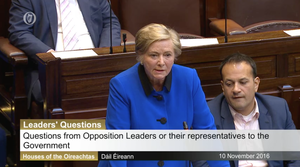
Justice Minister Frances Fitzgerald made a statement about the latest Garda controversies including the near one million breathalyser tests that gardaí claimed they carried out, but didn’t, and the 14,700 wrongful convictions for motoring offences.

During her statement, Ms Fitzgerald said “the scale and detail of these issues became apparent last week at the Garda press conference but I want to say I’m determined that all of the facts will emerge”.

She also said:

“An anonymous complaint was made to the Road Safety Authority in April 2014, outlining a number of issues which included the operation of mandatory alcohol testing, MAT, checkpoints. This complaint was referred to An Garda Síochána by the then Minister for Transport, Tourism and Sport.”

“An Garda Síochána indicated in a detailed letter to my Department in May 2014 that it had looked into the claims regarding MAT checkpoints and was satisfied that correct procedures were in place to account for MAT checkpoints that ultimately did go ahead. Every MAT checkpoint, as we know, must be authorised by an inspector.”

“In June of last year my Department was made aware that some discrepancies had been identified in respect of MAT and that An Garda Síochána was commencing a national audit. An Garda Síochána indicated in June 2016 that no issues stemmed from this audit with regard to the performance of MAT checkpoints or prosecutions arising from same. It also set out the new procedures it had already introduced to facilitate the accurate recording of breath tests and outlined that an IT solution had been developed and would be implemented towards the end of 2016.

“Following this preliminary notification to my Department last year, updates were sought from An Garda Síochána by officials in my Department on a regular basis as to the progress of the audit that was then taking place. An Garda Síochána indicated in February 2017 that it was anticipated that the national audit would be finalised in the second quarter of 2017. Although that audit has not yet been finalised, An Garda Síochána announced figures at its press conference relating to the discrepancy between the number of test conducted at MAT checkpoints as per its own records compared with the records held by the Medical Bureau of Road Safety.”

“No indication was given as to the scale of this issue at the time of the June 2016 letter and indeed, it is clear from what the Commissioner told me yesterday and from her public statements, that it was not known at that time to Garda management either. It was in order to assess the scale of the problem that the national audit of MAT was launched. I did not become aware of the huge discrepancy in the breath test figures until it was revealed at last week’s Garda press conference.

“Regarding the issue of fixed charge notices, my Department was informed in June 2016 of an error relating to summonses having been incorrectly issued to persons who should have received a fixed charge notice for the offence of not having a valid national car test, NCT, certificate, which became a fixed charge offence in December 2014. An Garda Síochána indicated that following on from those initial findings, further inquiries were being carried out relating to all summonses issued for other fixed charge offences.”

“Colleagues should note that a press statement was issued that day by An Garda Síochána about this issue. In that statement, An Garda Síochána confirmed that it had commenced a review of prosecutions relating to all fixed charge offences. The letter set out the remedial actions already taken by An Garda Síochána at that stage, which included withdrawing prosecutions in any affected cases and putting in place a short-term IT solution within four weeks while a longer-term IT solution was being developed.”

“Following the preliminary notifications of these problems to my Department last year, updates were sought on a regular basis as to the progress of the review taking place into the fixed charge processing system issues covering the period referred to in the letter from An Garda Síochána, from 1 January 2014 to 27 May 2016. The results of this review were communicated to my Department in a letter received on 14 March 2017.”

“The letter indicated that a total of 1,781 cases had been identified where persons had been convicted in situations where they had been incorrectly summonsed to court, either without first having been issued a fixed charge notice or having been issued and paid a fixed charge notice. The letter also set out – this is important – that consultation remained ongoing with the Director of Public Prosecutions, DPP, with whose office there had been ongoing consultation and the Courts Service in regard to commencing the process of setting aside the convictions in the courts. That engagement with the DPP is ongoing.”

“An Garda Síochána also advised in that letter, received recently on 14 March, that the DPP had indicated that the review should be extended to include cases before 2014 and that this process was now under way. That, of course, is why the audit was meant to be ongoing until June of this year. That was to be when I was to expect the final report. That is when I had been advised I would get the final report.”

“I became aware of the figure of some 14,700 cases where a conviction took place after an incorrect procedure when An Garda Síochána made that information public last week. It is matter of great regret to me, as I know it is to everyone in this House, that anyone should be summoned to court inadvertently, with all of the consequences that follow for individuals. It is absolutely critical now that these mistakes be resolved and that the necessary remedial actions be taken.”

“As for the fixed charge penalty notice, FCPN, at my meeting with the Commissioner yesterday she assured me that arrangements are being put in place in regard to the persons affected. All of these cases will be appealed by An Garda Síochána to ensure the courts set aside these convictions, as they have to. All fines will, of course, be reimbursed and penalties will be removed, and all of those affected will be contacted directly by An Garda Síochána. Individual letters will be sent to all the people concerned and they will begin to be issued on 3 April.”

“The Commissioner also outlined to me the IT and operational solutions that have been put in place to ensure that these practices would cease. In fact, at the ministerial meeting yesterday, which was scheduled ahead of all of this emerging, both the Minister for Transport, Tourism and Sport, Deputy Ross, and I were assured by both Professor Cusack and all the other people present that the new procedures were in place, that we could be confident about the new procedures and that there are changes being made to the machines, using GPS and further information, so the kind of mistake associated with the technical attributes of the devices can never happen again.”

“In the case of mandatory alcohol tests, An Garda Síochána initially put in place new paper-based recording and verification processes and, in November 2016, a new specific data-recording IT upgrade was installed on the Garda PULSE system.”

“The net effect of the new IT upgrade was that personnel now have to record the serial number of the device used for each breath test plus the meter reading before and after the checkpoint was concluded. This, apparently, was not being done before. It is clearly only one of the explanations for this situation. Data from the device are now used to verify the total number of breath tests conducted at each checkpoint.”

“The focus now, however, has to be on what is being done to get to the full truth of what transpired and the accountability that must be brought to bear. Clearly, there is a need for an investigation to hold responsible those people, at all levels of the Garda organisation, who allowed such large discrepancies in the breath-testing figures to arise.”

Meanwhile…

After making her statement, Ms Fitzgerald fielded questions from different politicians, including Fianna Fáil’s justice spokesman Jim O’Callaghan.

Jim O’Callaghan: “The Minister said in her statement that she became aware of the scale of the number of convictions only this month, when she was notified of it. When did she become aware in general that there were issues in respect of wrongful convictions arising from this matter?”

Frances Fitzgerald: “The answer to that is the letter that I received in June 2016 from, the department received it actually, from Michael Twomey, outlining that they were concerned about some issues. There was no figure mentioned so I was not aware of the 14,700 and I don’t believe that the gardai, at that point, were aware of it because that was an earlier stage. The audit wasn’t completed and they had put some procedures in place to make sure though, that they would not be further, there would not be further problems. But they hadn’t done a national audit at that point. So they weren’t sure about the figures. And it was only when they had the press conference last week that they did a national audit, that involved well over 100,000 and that then got to a point where it was the figure of 14,700 was arrived at. So they hadn’t done the full national audit at that point. Is my understanding. Is that right? [to assistant on her right].”

O’Callaghan: “I’m taking from your answer that you were aware from June 2016 that there was an issue in respect of wrongful convictions that had been obtained  against persons in our district courts?”

Fitzgerald: “Thank you [to assistant]. Yes, at that point, in the letter, they did of course, because they also put some solutions in place in relation to what had happened to different individuals, it was clear that they were concerned that there would be a number but they had no idea, from my understanding that there were 14,700 at that point. But they were concerned that some people would have been taken to court, summoned to court who should not have been summoned to court. And that some solutions had been put in place. They were obviously linking with the DPP and all of the relevant bodies. But that a full audit needed to be done and the figure of 14,700 emerged at the press conference just last week.”

O’Callaghan: “Tanaiste, if you were aware in June 2016 that individuals had been wrongly convicted before our courts, you were Minister for Justice at that time. What did you do about it then?”

Fitzgerald: “At that point what was being done was that the full scale of this issue was being examined to see precisely what the implications of it were. I was aware that action had been taken so that no further such mistakes could be made and I was awaiting the results of the full audit and my department was in contact with An Garda Siochana on a regular basis to ensure we would get the full audit.”

Later

O’Callaghan: “I just want to ask you another question and, before I ask you the other question, I want to just preface it by stating that, as Minister for Justice, you’ve been aware for nine months that there were wrongful convictions that took place before our district court, and, in my submission, you did nothing about it.”

“I want to now ask you about the issues in terms of breath test figures. We know that the Medical Bureau of Road  Safety raised this discrepancy with An Garda Siochana in July 2014. We know that the gardai conducted a review in the southern region in 2015. We know that they extended it out to the whole country in 2016 and we know that in November 2016, they introduced a new IT system in order to overcome the problem. I want to ask you two questions. First of all, when did you become aware of these problems with the breath test figures and, secondly, are you satisfied with the fact that An Garda Siochana, to this date, have not been able to explain to the Irish people why it is that 937,000 breath tests were falsely recorded on the PULSE system.”

Fitzgerald: “I have put it on the public record that I received a letter in June 2016 outlining that some issues had arisen and actually they were examining what they needed to do and that they were doing a full audit, that it would be completed in the second quarter of this year. That was the information that I had. And my department continued to be in contact with the gardai…”

Meanwhile….

Transcript of statement via Oireachtas.ie

C7_-c5eWkAANCj4

Fianna Fáil TDs Willie O’Dea, Jim O’Callaghan and Michael McGrath this morning

Páraic Gallagher, of Newstalk, tweetz:

Fianna Fáil’s Jim O’Callaghan says the answers for these Garda scandals have not been given and want answers from Tanaiste… The party says it’ll consider options after hearing from Tanaiste today and Commissioner attends committee on Thursday.

Meanwhile…

Leaders’ Questions begin at 2pm and can be watched live here

Previously: Clarifying Matters

Untold Damage

Evidence Within Reach

Screen Shot 2017-02-14 at 18.43.08Screen Shot 2017-02-14 at 18.41.58

Fianna Fáil justice spokesman Jim O’Callaghan and Fine Gael Minister for Justice Frances Fitzgerald in the Dáil last night

Last night.

In the Dáil.

There was a three-hour session entitled ‘Clarification of Statements made by the Taoiseach and Ministers’ in the wake of reports about the false sex abuse allegation against Sgt Maurice McCabe.

So, what was clarified?

Well.

Fianna Fáil’s justice spokesman Jim O’Callaghan and the Minister for Justice Frances Fitzgerald had this exchange at the very beginning.

Jim O’Callaghan: “Last Wednesday evening I met the Tánaiste in a quiet area of this House to tell her that I wanted the terms of reference of the proposed commission of investigation extended.”

“I told her that I had become aware, from speaking to my party leader Deputy Micheál Martin, who had spoken to Sergeant McCabe, that Sergeant McCabe had informed him that there would be a “Prime Time” programme broadcast on Thursday evening which would contain a story about a Tusla file that contained a false allegation of sexual abuse against Sergeant McCabe.”

“I told the Tánaiste that paragraph B of the terms of reference needed to be extended to cover that. The Tánaiste agrees that I asked her to extend the terms of reference. She also agrees that I asked her to extend the terms of reference because of a forthcoming “Prime Time” programme.”

“However, she denies that I told her about any Tusla file contained in that programme. If she is correct, why did she agree to consider my amendments, as she did, without asking me what the “Prime Time” programme was about?”

Frances Fitzgerald: “I got a phone call from Deputy O’Callaghan at about 6.30pm last Wednesday. He asked me if I would meet him and I left the parliamentary party meeting and went to meet him. We had a discussion for about 12 minutes. Deputy O’Callaghan informed me that there was a “Prime Time” programme the next evening. He used the word “documentary” in relation to Maurice McCabe and the allegations.”

“He said the programme would cover the smear campaign allegations that had been made against Sergeant McCabe and he said to me that I needed to look at the terms of reference because if they did not cover what emerged on the “Prime Time” programme that would not be a good place to be in and it would leave “egg on our face” in terms of the Dáil and the work we are doing.”

“He said to me that he wanted to make sure that the allegation of a smear campaign against Sergeant McCabe was covered and whether it had been carried out by the Garda Commissioner and the previous Garda Commissioner. I said to him that they were already covered in the terms of reference and the vast majority of our conversation was about the detail of the amendments and how they needed to be changed because the Deputy was concerned that the reference in relation to Superintendent Taylor was too restrictive and would mean that there was not a proper examination of the allegations.”

“For that reason, I agreed to consider how we would extend the terms of reference to make it absolutely clear that this could be covered. He also asked that Ministers would be included and I said there was no reason not to include them. I went away to do some work on the changes to the terms of reference.”

“At no time did Deputy O’Callaghan mention Tusla, and if he had, or if he had said to me he wanted a particular reference in that regard I would have included it. It would have been to my advantage to include it if I had been told about it, and if he had made it clear to me that Tusla should be included because “Prime Time” was covering it, I would have included it.”

“It would have been totally to my advantage to come back to the Dáil and insert Tusla. Deputy O’Callaghan made no mention the next day about Tusla when he made his speech.”

O’Callaghan: “I disagree with the Tánaiste. I referred to Tusla in our conversation. What the Tánaiste has said in her statement is that she was prepared to seek the amendment of important terms of reference based upon a forthcoming television programme I was telling her about.”

“At no stage is she saying that I indicated to her what the programme was about and at no stage did she ask. Is it credible that a Minister for Justice would agree to amend terms of reference of an important commission of investigation based on upon a television programme and not ask what the programme was about?”

Fitzgerald: “Deputy O’Callaghan made an extremely strong case that he felt the way the terms of reference were formulated as the judge presented them – because they were the judge’s words – regarding the allegation of a smear campaign in Superintendent Taylor’s protected disclosure was too narrow.”

“The Deputy spent most of the time talking to me about how it circumscribed the investigation too much and ought to be broader. He made his case entirely on the fact that the terms of reference were too narrow, not on the “Prime Time” programme. He made his case on the basis that the way the judge had written them made them too circumscribed. I accepted in full the Deputy’s bona fides on it.”

“He wanted the terms of reference changed so that there was no doubt whatsoever that all of those allegations could be investigated and I responded on that basis. What was in or not in the programme was not the central point. It was that the Deputy wanted clarity in respect of the allegations and that they would be fully investigated and would not be circumscribed by reference to Superintendent Taylor. That was the main point of the discussion.”

O’Callaghan: “The Tánaiste is correct in stating that most of our discussion was about paragraph (b) and I emphasised to her that it was too limited in terms of how it referred to Superintendent Taylor’s communications with the media and that it needed to be broader. However, I commenced the conversation with her by telling about the forthcoming programme which was in respect of a Tusla file. My final question for her is this. After her discussion with me, who did she contact and what did she say to them?”

Fitzgerald: “The first point I would make to Deputy O’Callaghan is that if he was so concerned about Tusla being included in the terms of reference, why did he not raise it himself? Why did he not raise it in his speech? I came in here last Thursday and asked for statements so I could take on board the point of view of everybody here. I was completely flexible in terms of what I wanted to include in terms of investigating it and getting at the truth.”

“After Deputy O’Callaghan spoke to me, I contacted the Attorney General, asked her about changing the terms of reference, told her what Deputy O’Callaghan’s formulation was and asked her whether it was legally sound and whether it was the way we should proceed.”

“I had a further discussion with Deputy O’Callaghan about how it should be changed. Deputy O’Callaghan reiterated the points made here the next day but he never mentioned Tusla. Other people mentioned different things they wanted included. Deputy O’Callaghan did not mention Tusla. I had a conversation with him primarily about making sure that the terms of reference included Government Ministers, that they included great clarity and that the commission would investigate the allegations fully.”

O’Callaghan: “Were any of the Tánaiste’s officials or Government officials aware of the Tusla allegation prior to the programme being broadcast on Thursday evening?”

Fitzgerald: “I was not aware of what was in the Tusla file prior to the programme being broadcast and neither were my officials. Nobody had brought it to my attention.”

Right so.

Transcript via Oireachtas.ie

Screen Shot 2017-02-10 at 19.38.07

Garda Commissioner Noirin O’Sullivan and Minister for Justice and Tánaiste Frances Fitzgerald

As was confirmed in a statement by the Department of Children and Youth Affairs this afternoon, Minister Zappone became aware in mid-January of an issue affecting Sgt McCabe which related to her Department.

As the statement points out Minister Zappone has taken and is taking a number of steps to deal with this matter.

She informed me in January that she intended to meet with Sgt McCabe. She of course did not inform me about any details in relation to confidential Tusla records.

The Terms of Reference of the proposed Commission put before the Oireachtas by me refer specifically to a complaint of criminal misconduct against Sgt McCabe and whether this allegation was used against him.

I have always been scrupulous to avoid any comment in the Dáil on what was at issue in the criminal complaint against Sgt. McCabe, referred to in the terms of reference.

Had I put into the public domain anything which indicated or implied the nature of the complaint against Sgt McCabe I would be rightly open to criticism.

At the heart of the issues to be examined by the Commission is whether senior Gardaí were involved in a campaign to use information to damage Sgt McCabe.

I agreed to take on board amendments designed to put beyond doubt that the examination of any smear campaign would not be confined.

Just as my colleague Minister Zappone is dealing with the serious matters relating to her area of responsibility, I am proceeding to finalise the terms of reference of the Commission of Investigation arising from Mr Justice O’Neill’s report.

A statement released this evening by Tánaiste and Minister for Justice Frances Fitzgerald.

Any excuse.

Meanwhile…

Meanwhile…

Previously: Whose Line Is It Anyway?

Rollingnews

screen-shot-2016-11-10-at-13-20-32screen-shot-2016-11-10-at-13-22-39

screen-shot-2016-11-10-at-13-30-03

Independents4Change TD Clare Daly, Ceann Comhairle Seán Ó Fearghaíl and Justice Minister Frances Fitzgerald

This morning.

During Leaders’ Questions which were held by Minister for Justice and Tánaiste Frances Fitzgerald.

Independents4Change TD Clare Daly raised the matter of Judge Iarfhlaith O’Neill’s investigation into allegations made by Garda whistleblowers – which is due to be given to Ms Fitzgerald next week – and informed the Dáil that she and fellow TD Mick Wallace have met with six new gardaí who have, or are about to, make further protected disclosures.

During their exchanges, Ceann Comhairle Seán Ó Feargháil interrupted to warn Ms Daly not to make allegations about Garda Commissioner Nóirín O’Sullivan in the Dáil, as to do so would be “inappropriate”.

Readers may recall how Judge O’Neill is investigating protected disclosures which allege that, within the gardai, there was an orchestrated campaign to destroy the reputation of whistleblower Sergeant Maurice McCabe.

Former head of the Garda press office Superintendent David Taylor was one of the people who made such a disclosure and has claimed that he was following orders from senior gardaí.

Readers may also recall how it has been reported that, in February 2015, phones and a laptop belong to Supt Taylor were seized by Garda Commissioner Noirin O’Sullivan’s husband Det Supt James McGowan – two months before Supt Taylor was arrested for allegedly leaking information to a journalist in relation to a Roma child being taken into custody.

In addition, readers may note that, last Sunday, in the Sunday Business Post, Francesa Comyn reported:

Taylor’s solicitors recently wrote to Fitzgerald and Enda Kenny highlighting the “fundamental” need for Taylor’s mobile devices to be handed over to the inquiry for an independent forensic investigation. The court heard that the government has not responded to the letter.

Further to this…

Clare Daly: “Tánaiste, five weeks ago, you referred to very serious protected disclosures from two senior gardai to a retired judge Iarlaith O’Neill for urgent inquiry. Now, the disclosures which allege that the Garda Commissioner Noirin O’Sullivan was directly involved in a systematic and organised campaign to discredit the whistleblower Maurice McCabe, with colleagues, politicians, journalist, were due to be investigated by the former judge who’s due to conclude and report back next week.”

“Now, he was given no powers of compellability, no terms of reference. Attempts made by other whistleblowers to have their cases also heard, as they too are the victims of bullying and harassment since making protected disclosures, were ignored. Despite the fact that their testimony and their experiences are current, they get to the very heart of the systemic problems inside An Garda Siochana, that what’s said in public and done privately are two entirely different things.”

“Now it was hardly an auspicious start to the inquiry, given that was its foundation and you’d be forgiven for thinking actually that it was put together as a fig leaf, maybe for you to take cover behind, for your lack of action in this regard. Now that view has been strengthened but we now we find out that, with a week to go, to the issuing of his report, the former judge has not requested any material from either of the two whistleblowers, he hasn’t met either man. He hasn’t even spoken to either man. In fact, the only interaction, about two weeks ago was a request to their legal teams to pass on the protected disclosure to the Garda Commissioner. You couldn’t make this up.”

“What sort of an inquiry do you honestly expect us to believe that this is because while this has been going on, we’ve had the Garda Commissioner appear at the justice committee, with senior officers who are at the heart of many of the protected disclosure complaints. At the same meeting, the Garda Commissioner misled the committee by stating that she wasn’t privy to information about a campaign of harassment against any member of the force when she was actually in direct receipt of 14 occurrences and letters outlining precisely that situation. She’s been the subject of a detailed section 41 complaint which she’d been briefed on. We’re awaiting the GSOC finding and she’s lost the support of the ranks of that force, by intervening in a partisan way in their legitimate pay claim with her threats of martial law.”

“So, my question to you, Tanaiste, is why have you allowed this situation to continue to the crisis point that it’s at? On what basis do you believe that you have the right to delegate, to retired judges, GSOC and to the courts, functions that are your responsibility in law, namely to hold the Commissioner to account?”

Ceann Comhairle Seán Ó Fearghaíl: “Tánaiste.”

Frances Fitzgerald: “Well I, I would have thought, deputy, that the court of appeal ruling today would have been a solid, a very intense reminder to members of this house that we should take stock and reflect before making allegations here. The good name and reputation, I would say, of all individuals deserves respect and fair procedures. You’re putting on the record various points about a report a judge is currently conducting and is due to report on, next week. You’re saying you have access to details about that. I don’t.”

“This is an independent report by a judge. And as the House is aware, I appointed Judge Iarfhlaith O’Neill to review allegations of wrongdoing set out in some protected disclosures made to me. In addition to reviewing the allegations, Justice O’Neill has been asked to report on his conclusions, it’s a preliminary report and to make any recommendations that he considers necessary in relation to any further action deemed appropriate or warranted. The report, the review has been commenced and he asked, he has been asked to report within six weeks – which will be next week – and I’ve no reason to believe that deadline will not be met. So that’s the situation we’re in. As soon as I receive that report I will consider it very carefully, examine the recommendations that have been made and the Government will decide on future action in relation to the points that you’ve made.”

“I asked Judge O’Neill to do this review because I was very concerned, as I have stated in this house previously, at the content on the material, in the material that I have received and that’s why I decided that should be done. The Garda Commissioner, for her part, has indicated publicly that An Garda Siochana will co-operate fully with any examination of these matters and, you know, how the judge conducts his business during this six weeks, is a matter for him. I would get the report, I will examine the report and will decide on action, I can assure you in relation to the issues that he’s examined. But I’d like to see his recommendations first.”

“This was a first , if you like, a first assessment that it would be extremely useful to ask a judge to examine the first instance, the material that had been, that had been given to me. Now if for any reason, he has concerns about the level of co-operation, during the six weeks, I’ve no doubt that he will make that very clear and I will certainly be reading his report with great interest when I receive it next week.”

Ceann Comhairle: “Deputy Daly, can I say that, generally speaking, it would be my desire to ensure that every leader here had an opportunity, during Leaders’ Questions, to raise matter of important public concern. And you’re doing that. We have absolute privilege here but we should be very, very careful how we use that absolute privilege. And it has been a longstanding precedent that we would not make allegations against people outside the House. You’ve referred to the protected disclosures – that certainly is a matter that is in the public media. But you have made specific allegations about a committee being misled by the Garda Commissioner – I think that’s inappropriate, I don’t think it’s something you should do – it certainly is not something you should now repeat.”

Daly: “I take my responsibility very seriously in that regard, Ceann Comhairle, I can state again very firmly that anything I said was not an allegation at all. It was not a use of privilege, it was details of facts which can be supported by evidence and I’ve no problem in standing over any of those points.”

“The Tánaiste makes the point that it’s up to the judge to carry out the inquiry, as he sees fit. He can only do that within the confines of the powers that he has. Can the Tánaiste confirm to the house that the judge has been given the authority to request the electronic information that supports the allegations at the heart of these matters? Because people’s good names are very important and at the heart of this matter is the muddying and the tarnishing of the good name of Sgt Maurice McCabe and of the horrendous nightmare that is being experiences by members of An Garda Siochana currently, who have made protected disclosures and not just the ones whose names are in the public domain but, subsequent to a lot of this happening, myself and Deputy Wallace have met with a further six serving members of An Garda Siochana who have all either made protected disclosures or are on the verge of doing so.”

“So, what I’m trying to get my head around is: what part of this do you think is normal? And is ok? We have an enormous crisis of confidence inside An Garda Siochana, primarily and largely centred in the role of the Garda Commissioner. The civilian head of An Garda Siochana, GSOC, the courts are investigating these matters – you seem to be okay with delegating your legal responsibility for doing precisely that to other and you won’t get away with it.”

Previously: ‘A Flawed Inquiry From The Very Outset’

screen-shot-2016-10-06-at-12-26-51screen-shot-2016-10-06-at-12-23-12

Minister for Justice Frances Fitzgerald and Independents 4 Change TD Mick Wallace in the Dáil

This afternoon.

During Leaders’ Questions in the Dáil.

The Garda whistleblower controversy was discussed again with Independents 4 Change TD Mick Wallace – addressing Minister for Justice Frances Fitzgerald – recalling the O’Higgins report.

Readers may recall how, during the O’Higgins’ Commission of Investigation into Sgt Maurice McCabe’s allegations, Colm Smyth, SC, initially told Judge Kevin O’Higgins that, on behalf of Ms O’Sullivan, his instructions were to “challenge the integrity of Sgt McCabe and his motivation”.

This was based on a meeting in Mullingar between Sgt McCabe and two gardaí.

Several months later, on the day Commissioner O’Sullivan was due to give evidence – by which time Sgt McCabe had produced a transcript of his meeting in Mullingar with two gardaí – Mr Smyth told Judge O’Higgins: “The position now is that his motive is under attack, credibility is under attack from the Commissioner. But not his integrity.”

Mr Wallace’s raising of the O’Higgins Report followed reports this morning that Garda whistleblowers have said they will not co-operate with a State inquiry until Commission O’Sullivan temporarily steps aside.

From Leaders’ Questions in the Dáil…

Mick Wallace: “Minister, yes Nicky Keogh did write to you four times. You replied once when he told you about the harassment that he couldn’t have been suffering without the commissioner’s knowledge. And you wrote back to him to say they were looking for an urgent report from the Garda Commissioner – that was May of this year, right? May. You say you follow up things quickly. May is a long time. It’s over years Minister that myself and Deputy Daly had been telling you about the huge problems that are not being addressed – over two years.

“How in God’s name can you say that you’re dealing with these matters. You’re talking about a rush to judgement, two years? You’re saying that claims not properly tested. Minister you have the transcript from the O’Higgins’ report hearings, in your office. Is there not enough information in that, was that not properly tested? The role that she played in trying to undermine the credibility of Maurice McCabe, is there not enough in that for you? You talk about people disposing the laws of the land? God bless us, Minister. What arrived on your desk last Monday, oh god, look it, if half of it, if any of it is true, how bad is it? I’m not easily shocked. I’ve spent my life living in the real world. And I know how bad things can be out there. I haven’t seen the like of it. It’s horrific. It’s mind numbing.

“Myself and Clare Daly have met the two senior gardaí who have made the protected disclosures and we haven’t briefed the protected disclosures but Minister sitting down listening to it, face to face, oh my God. I’m not…I don’t want to talk about it anymore, right? Listen, Minister, you’re talking about another inquiry, another judge. You talk about the new broom you brought in. Nothing has changed, Minister. Nothing. And we marked our cards for you on your legislation on GSOC and on the Policing Authority. We’ve have [Judge] Mary Ellen Ring and Jospehine Feehily stressing the lack of authority that they have through legislation to do their jobs properly.

“The gardai, minister, are in turmoil. There’s a split in it. There’s two camps. She has promoted a ring around her. It’s corrosive. She is doing so much damage to An Garda Siochana, there are so many good gardai, minister, that are shocked at how she is operating. You cannot leave her in position and Minister, the idea that there will be an investigation while she was in place, is nuts.”

Frances Fitzgerald: “Well, deputy, you’ve made a number of comments there, I will repeat what I said, that I believe, you may not, but I believe that due process is important. I believe that the law, should be used carefully in these circumstances. I don’t believe in making a decision before the evidence has been heard. What we have is a body of allegations that we brought forward and I have said to the House, that I believe that they are serious and that they ought to be investigated. And I will ensure that that happens. And I will ensure that there is follow-up, depending on the outcome and the output from that investigation. Of course, I will. That would be my job and that’s what I would do.

“Quite a number of things have changed. For the first time, we have independent oversight. We have the Police Authority where the public with the public meetings can see An Garda Siochana be accountable to a new policing authority, being chaired by Jospehine Feehily and a very, very competent and serious board who are totally committed to their task. That’s different, that’s changed.

“GSOC have been given new powers and I’m perfectly prepared to meet both chairs to discuss further changes that are necessary to the legislation. You’ve made a number of points about investigations going on over a period of time. And yes, investigations do take time. There are procedures to be followed. And let me make the point, in relation to the disclosures that were made some time ago. And what’s been happening. And without commentating in any way on the disclosures, who has made disclosures, or the disclosures themselves, I can tell the House that I am extremely concerned about matters which have been raised in relation to policing in Athlone. And by the way, deputy, I wrote to you and I haven’t received a reply.”

“I have sought and received a number of requests form the Garda authorities about this matter. These indicate that a series of investigations have been taking place into the complex issues involved, including criminal investigations, disciplinary investigations and investigations by the Garda Siochana Ombudsman (GSOC). Not all of these are yet completed, I am monitoring the situation closely and I expect further reports from An Garda Siochana about these matters and I do want to make it very clear, as I’ve already said, that should the present investigations not succeed in fully addressing matters of public concerns which have arisen, and I’m talking about the investigations that are being under way, I’m not talking about the more recent protected disclosures which only arrived on Monday, which I am currently considering.

“I will have no hesitation, in establishing some other form of inquiry, but I will wait for due process to take its place and to continue. And I won’t act precipitously either in relation to that investigation, or indeed the recent protected disclosures, but I will follow the letter of the law and I will follow the legislation that was passed in this house where people have a right to confidentiality and people have a right to due process. And I wouldn’t be doing my job, as Minister for Justice, if I didn’t follow due process and the law which has been laid down which we have all agreed to be following in relation to protected disclosures. And we are the first Government, as has been said already and has been spoken about for many years, we’re the first Government to actually bring in law to deal with the issue of protected disclosures.”

Wallace: “Well it doesn’t seem to be working then. Minister, you’re talking about returning letters. I wrote to you a year ago and I gave you evidence of the massaging of crime figures in the same place, I asked you about the report yesterday. A year ago? My god, and why is the fella on the promotion list? Number 14? Why? You tell me. And there’s another guy that was reported by the whistleblower down there and he got promotion, but you know what? The people that stood by that man in that station, they didn’t get promotion.

“The commissioner said in a statement yesterday that she wishes to reiterate that any employees in An Garda Siochana will forward any concerns or issues they might have, will be taken seriously ad the matters examined. Well, my god. People can’t believe what this woman is saying. Minister, what she says in public and what she does privately is 100% different. You can say that you don’t have enough evidence, Minister, and you want due process, right?

“Was the O’Higgins report not enough for you in the first place? So let’s forget about what you got on your desk last week, was that not enough for you? The dogs on the street can see that there was a deliberate effort on her part to undermine the credibility of Maurice McCabe. How in god’s name can you leave her in position after that? I tell you what minister, as long as you leave her in position, there will be allegations coming in against that commissioner and, you know what, it’s only going to get worse, Ministier.”

Fitzgerald: “Yes, I did receive a letter from you. To which I replied. I have the letter here. And I went back to and I asked you to give me some detail that was important in relation to protected disclosures, if I was to follow up the points that you made. You didn’t respond to me.”

Wallace: [barely audible as microphone was off] “I didn’t get it.”

Fitzgerald: “Well, it was sent to you here, in Dail Eireann. Ok…I didn’t get a reply from you for the information that I asked from you. I’ll send it to you again….”

Meanwhile…

In The Irish Times, Fiach Kelly, a journalist,  writes :

Knee-jerk calls for resignations and blanket condemnations lead to a demeaning of the political system and erode trust in politics.

…Dáil privilege is nowadays often used to air serious allegations that have been investigated thoroughly elsewhere.

…The latest claims are contained in protected disclosures currently in Ms Fitzgerald’s possession, and have led to calls for the immediate resignation of Ms O’Sullivan.

It is undoubtedly the case that some whistleblowers, such as Sgt McCabe, were poorly treated but it is equally unacceptable for people to call for resignations, on foot of serious allegations that have not yet been tested.

...there have been substantial efforts to reform the justice system in order to increase public confidence in it and to help improve the culture of An Garda Síochána to make it a more open place for those with dissenting views and concerns about how the force is being run.

These reforms have yet to be completed and are still being bedded in.

Uncanny.

Knee-jerk calls for O’Sullivan to resign erode trust in politics (Fiach Kelly, Irish Times)

fitzgerald

Splutter!

Presumptive Fine Gael leader Justice Minister Frances Fitzgerald ‘listening’ to former Us Secretary of State Madeleine Albright (on stage, above) at the US Democrat Party Convention in Philadelphia and beset by ‘erb propaganda online.

Frances Fitzgerald

90423951

Minister for Justice Frances Fitzgerald arriving at government buildings this morning.

Tánaiste Frances Fitzgerald is to seek Cabinet approval today for new legislation to allow gardaí to intercept the emails and social media accounts of criminal suspects.

Ms Fitzgerald is expected to request consent to make a number of announcements in the area of organised crime.

The Minister for Justice is to update and expand two outstanding Acts to give the Garda new powers.

Under the proposed amendments, gardaí will be allowed to intercept the emails, social media and instant messages of suspected terrorists and organised criminals.

The proposed legislation will stretch to WhatsApp, Viber, Facebook and emails.

Frances Fitzgerald targets suspects’ social media, emails (Irish Times)

Louis writes:

Would you trust the Guards with these new powers to look at our emails, Facebook and what’s app? I suspect they’re already doing this. But of course, where do you draw the line and once given these powers they’re almost impossible to row back on.

Anyone?

Rollingnews

Screen Shot 2016-06-08 at 17.11.24

Garda Commissioner Nóirín O’Sullivan and Justice Minister Frances Fitzgerald at the passing out ceremony for new gardaí in Templemore Garda College earlier today

From today you have full Garda powers. With such powers comes the great responsibility to use them appropriately, respecting the dignity of all persons you encounter in the course of carrying out your duties.

You have completed the first stage of what is a challenging and rigorous training programme and I congratulate you on that achievement. There is still much learning ahead of you before you are awarded your BA in Applied Police Studies.

In two weeks you will take up your assignments in Garda stations around the country. And I urge you to listen and learn from your tutors, assimilate their knowledge and experience, and use it to good effect as you serve local communities across this country.

Earlier I reminded myself of the principles of this great institution which has protected peace and security since the foundation of this State.

Honesty, accountability, respect and professionalism.

Principles are constant, they underpin everything you will do. But new ideas are the fuel that ensure these principles will continue to live and thrive and adapt to the realities of modern policing, an evolving police force, and a changing country.

So I urge you to bring your own fresh perspective and to share your ideas with your new colleagues across the Force.

The bond between An Garda Síochána and the community depends on trust and confidence. Public trust is earned by honesty, accountability, respect and professionalism. That is what the community expects from An Garda Síochána.

You will play an important role in your community and it is precisely because the service you will provide is so vital, so important to the well being of every citizen and our society as a whole, that you must ensure it is delivered to the very highest of standards.

The Report of the O’Higgins Commission of Inquiry identifies cases where standards were not met, where victims of crime were failed by An Garda Síochána.

That is as unacceptable as it is disheartening and we must take all actions open to us to ensure that these shortcomings are not repeated.

Victims must be at the heart of the Garda service.

In the past the needs of victims of crime have sometimes been overshadowed by a focus on apprehending and prosecuting perpetrators. We must ensure that our response to criminal behaviour is a comprehensive one while putting the needs of victims at the forefront.

I ask every one of you to think about what you can do to re-establish that trust and to ensure that victims of crime are well served when they come seeking your assistance and protection.

The Government is focused on bringing about improvements that will make An Garda Síochána the world class policing service that we all want it to be. To achieve this goal a number of reforms have taken place together with significant investment in resources.

Most significantly the new independent Policing Authority has been established to oversee the performance by An Garda Síochána of its functions relating to policing services. I look forward to the Authority playing an important part in the ongoing reform process.

Another important reform is in the law protecting whistleblowers. The Protected Disclosures Act 2014 ensures that there is a range of options open to those who want to report wrong doing. Now any Garda can have their complaints independently examined by the Garda Síochána Ombudsman Commission.

These are just two examples of important reforms that have taken place. As I have said on many occasions, there is no end to reform for any organisation. Reform is an ongoing journey of practical and cultural change that can never cease. As members, you must be open to new thinking and embrace change.

From a speech given by Justice Minister Frances Fitzgerald at the passing out ceremony in Templemore earlier today.

Read the speech in full here

Previously: Maurice McCabe And The Plastic Rat

‘Nothing Has Changed’

Eamonn Farrell/Rollingnews