
Tag Archives: Greece

90369404

Taoiseach Enda Kenny at Government buildings yesterday

Ger writes:

Enda Kenny goes to Brussels today to meet European leaders . He is “not expected to use the meetings to plead for Irish debt renegotiation” despite this being the perfect time and opportunity.

But he is “expected to strongly defend Ireland’s corporate tax regime at a meeting with Mr [Jean Claude] Juncker”.  Good times.

Kenny not expected to follow Greece in debt relief demands (Suzanne Lynch, Irish Times)

Earlier: Making A Drachma Out Of A Crisis

(Sam Boal/Photocall Ireland)

B8ctZVrIAAEQW5J

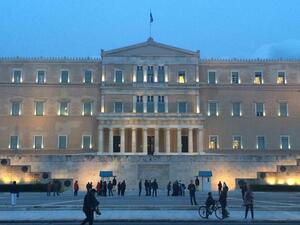
photoAnna Christofides (above) and barrier-free Greek Parliament last night

So…Greece.

How’s that going?

Athens-based, Galway-born political scientist Anna Christofides writes:

Despite threats and scaremongering from the EU, Greek voters have spoken; “no more austerity” and “no more EU imposed governments”. The message is loud and clear, the task is less so.

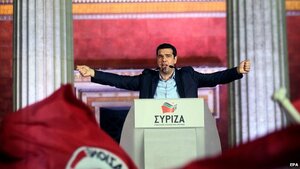
It is early days for Syriza and the new Greek government and Greeks are nervous. Many believe that change will not come fast enough or be radical enough. However, the streets of Athens are already showing signs of change. The gradual militarisation which had taken hold of Athens’ city centre has been rolled back since the new Prime Minister, Alexis Tsipras, took office on Monday.

The barriers in front of the parliament have been removed and the buses of riot polices have disappeared from the streets. Just as a palpable feeling of depression and desperation descended on the city following the Troika bailout deals in 2010, now there is a tangible feeling of hope and cautious optimism.

Nonetheless, Syriza must tread carefully. Though they have been elected with a political mandate for change and to put an end to austerity, the reality is, their first battle may lie closer to home than with their European aggravators. The fact remains that the country is deeply divided. Though Syriza won the elections by a clear majority, 6% of the population continue to support the neo-nazi Golden Dawn party and 34% continue to support the parties that signed the memorandums and implemented devastating austerity measures which have left more than half of the country’s youth unemployed. Representing and satisfying such a conflicted and confused society is no mean feat.

Moreover, the country’s state institutions have traditionally supported and implemented the policies of Right and far Right governments. In turn, they themselves are supported by the country’s oligarchy, who, up until now, have proved untouchable. Syriza is well aware of this. It is no coincidence that they contacted the leaders of the Army and Police within one hour of the release of the first exit polls on Sunday evening, to confirm their trust for both of these institutions. Despite this, election statistics indicate that, once again, police were amongst the staunchest supporters of Golden Dawn.

In addition to the immediate domestic challenges there is extreme pressure from the European Left. The political investment in Syriza is collossal, the future of the entire European radical Left relies on their ability to demonstrate that a valid, political, alternative to the current neo-liberal status quo exists. With so much pressure there is no margin of error for Syrzia.

For those of us that long for a radical redistribution of power and wealth and fairer society for all, let us hope that they get it right.

Thanks Bewildered Student

Meanwhile…
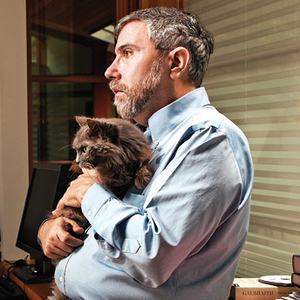
KrugNobel cat-loving Economist Paul Krugman

…So now that [Alex] Tsipras [leader of Syriza] has won, European officials would be well advised to skip the lectures calling on him to act responsibly and to go along with their programme. The fact is they have no credibility; the programme they imposed on Greece never made sense. It had no chance of working.

If anything, the problem with Syriza’s plans may be that they’re not radical enough. But it’s not clear what more any Greek government can do unless it’s prepared to abandon the euro, and the Greek public isn’t ready for that.

Still, in calling for a major change, Tsipras is being far more realistic than officials who want the beatings to continue until morale improves. The rest of Europe should give him a chance to end his country’s nightmare.

Paul Krugman: Syriza should ignore calls to be responsible (Irish Times)

cnn

Call Team America.

Gerry writes:

That was quick. Are we going to bomb Athens? Hummus eating surrender monkeys….

ψikęs.

Add this to Greece’s list of problems: It’s an emerging hub for terrorists (CNN)

Earlier: Greece Is The Word, Is The Place, Is The Motion

Meanwhile…

demis

Jumbo-sized cape-wearing Greek vocal god Demis Roussos.

Demised.

Demis Roussos Dies Aged 69 (BBC)

proxyB8QmedgCUAEz4R_

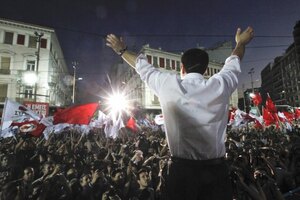
Alexis Tsipras of Syrzia on the cover of  Greece’s’ Ta Nea newspaper (above) this morning and Syrzia supporters (top) in Athens in the early hours.

The headline reads: ‘Greece starts new chapter’

In a functional market economy, the classic couple in a posh restaurant are young and close in age. In my travels through the eurocrisis – from Dublin to Athens – I have noticed that the classic couple in a dysfunctional economy is a grey-haired man with a twentysomething woman. It becomes a story of old men with oligarchic power flaunting their wealth and influence without opprobrium.

The youth are usurped when oligarchy, corruption and elite politics stifle meritocracy. The sudden emergence of small centrist parties led by charismatic young professionals in Greece is testimony that this generation has had enough. But by the time they got their act together, Tsipras was already there.

From outside, Greece looks like a giant negative: but what lies beneath the rise of the radical left is the emergence of positive new values – among a layer of young people much wider than Syriza’s natural support base. These are the classic values of the networked generation: self-reliance, creativity, the willingness to treat life as a social experiment, a global outlook.

Greece shows what can happen when the young revolt against corrupt elites (Paul Mason, Guardian)

Greece Chooses Anti-Austerity Party in Major Shift (New York Times)

People walk past a banner with an image of Tsipras at the party's pre-election kiosk in Athens

A sign for for anti-bailout party Syrzia in Athens, Greece yesterday

Ahead of elections in Greece this Sunday.

(which may see the country exiting the Euro).

Greg Palast writes:

The euro is simply the deutschmark with little stars on it. Greece cannot adopt Germany’s currency without adopting Germany’s finance minister, Wolfgang Schäuble, as its own.

And Schäuble has determined that Greece must be punished. As my homey Paul Krugman points out, there is no credible economic theory that says that austerity—that is, cutting government spending, cutting wages, cutting consumer demand—can in any way help a nation in recession, in deflation. That’s why, in 2009, Obama ordered up stimulus, not a sleeping pill.

But austerity has nothing to do with economics. It is religion: the belief by the stern Lutheran Germans that Greeks have had too much fun, spent too much money, and spent too much lazy time in the sun—and now Greeks must pay a price for their sins.

Oddly, I hear this self-flagellating nonsense from Greeks themselves: we are lazy. We deserve our punishment. Nonsense. The average Greek works more hours in a year than any other worker in the 34 nations of the OECD; Germans the least.

Trojan Hearse: Greek Elections and the Euro Leper Colony (Greg Palast, Dissident Voice)

Greece Election 2015: the politics and economics in numbers (Guardian)

(Reuters)

greece euro

If Greece goes.

Can we be far behind?

RUN!

Economist Roger Bootle writes:

…the real risk for the eurozone, though, is that Greek default and euro departure go relatively well, and after a year or so Greece is beginning a vigorous recovery on the back of a weak drachma. In that case, the people of Italy, Spain and Portugal would ask: “if Greece can do it that way then why can’t we?” And there wouldn’t be a good answer. The euro-zone would do the splits as soon as you could say Jean-Claude Juncker.

Of course, virtually no one in the Greek establishment wants Greece to leave the euro. Yet the country desperately needs decent economic growth. An end to austerity and a debt write-off would only do half the job. The other half is improved competitiveness. Achieving that through sustained deflation would be slow and painful, and would intensify the debt problem all over again.

It is not unusual for governments to cling on to what is the source and origin of a painful economic predicament. This is a version of what is known in the psychological world as Stockholm Syndrome, when prisoners become emotionally dependent upon their captors and do not want to escape.

Don’t believe the scaremongering: Greece leaving the euro would be no disaster (Roger Bootle, The Telegraph)

‘Grexit’ Could Happen By Accident (Wall Street Journal)

Alternatively: No Exit For Greece (Josef Joffe, New York Times)

Pic: Business Insider