Tag Archives: Leo Varadkar

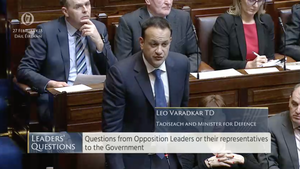
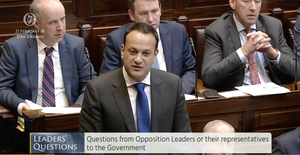
Fianna Fail leader Michaél Martin in the Dáil this afternoon

This afternoon

Leaders Questions in the Dail

Mr Martin said revelations under the Freedom of Information showed how €180 million of advertising revenue would be channelled through the Taoiseach’s office, giving enormous leverage with the media industry

…Mr Martin said there was a “party political dimension” to the recent advertorials at the centre of the row, adding that four marginal consitituenciues just happened to have Fine Gael candidates “emblazoned across paid ads, paid for by the taxpayer”.

Sinn Féin leader Mary Lou McDonald said that in Budget 2018 the SCU was allocated €5m – one third of the additional money promised for mental health.

She said the SCU is now “mired in scandal” and that the “spin unit has followed a strategy to promote Fine Gael in a very underhand and unprincipled way by directing editors to present paid for political advertising as regular news articles.”

Varadkar again criticised in Dáil over role of SCU (, RTÉ)

Pic: RTÉ

Earlier: Bin Unit

A tweet on Saturday From Dubin Fire Brigade about the Taoiseach’s visit to North Strand 


Derek Mooney writes:

It’s not that Leo Varadkar’s Strategic Communications Unit has “blurred” the lines between governmental and political, between the State and FG… it has demolished them completely.

Fine Gael spin is compromising State agencies who are just trying to do their best.

Earlier: Tony Groves: The Original Strategic Communications Unit

Taoiseach Leo Varadkar and Times Ireland edition journalist Ellen Coyne and a tweet by Ms Coyne last night

This afternoon.

On RTE Radio One’s The Gathering

Ellen Coyne, of The Times Ireland edition, took presenter Sean O’Rourke through the events of the week concerning her reporting of Leo Varadkar’s Strategic Communications Unit…

And how, using taxpayers’  money, paid for Government advertorials in regional newspapers and used an agency which specifically requested that the material didn’t appear as advertorial.

“The Ireland edition of The Times reported on Monday that with Ireland 2040 and with a similar advertising campaign for Creative Ireland, regional newspapers were instructed by an agency, commissioned by the Government to make publicly funded advertisements, promoting the Government, look like organic, independent news stories.

“So we reported that story on Monday, the initial reaction from Leo Varadkar was to claim that my story and similar reporting by Justine McCarthy in The Sunday Times was inaccurate.

That led to a very heated exchange in the Dail during Leaders’ Questions on Tuesday and up to the unbelievable moment on Wednesday when Leo Varadkar went into the Dail and said on the public record that, actually, my story had been filled with anonymous sources who were secretly Fianna Fail candidates which is completely untrue.

“We kept reporting this story, I think the public got angrier, the Opposition were furious.

“And then that lead up to, yesterday, Independent Government ministers pulling Leo Varadkar to explain they were extremely unhappy with this – leading to, basically, an announcement last night that, from now on, the Strategic Communications Unit is going to be issued with clear guidelines, that means that if the Government is paying for ads that appear in your local paper or national paper, it’s going to be very, very clearly marked when it is an advertorial.”

“…The Taoiseach has been blue in the face all week saying that the Irish public deserves to know what the Government is doing with its money. That’s all the Ireland edition of The Times has been doing this week – making it clear to the public what this €1.5million advertising campaign is being used for…”

Listen back in full here

Previously: “Part Of Our Deal Is That We Don’t Have Any Moniker Such As ‘Advertorial”

Earlier: Frilly Keane: Bought And Sold

Meanwhile…

Good times.

From top: Noel Rock TD; Ellen Coyne of The Times Ireland edition; Taoiseach Leo Varadkar in the Dáil on Tuesday and a segment of an email from Mediaforce Ireland to certain newspapers

Readers may know that The Times Ireland edition has been highlighting how the government’s  Strategic Communication Unit’s promotional campaign for Project Ireland 2040 – involved paying for editorial content in local, regional and national newspapers.

The SCU was set up by Taoiseach Leo Varadkar, after he was elected leader of Fine Gael and became Taoiseach last year.

It employs 15 people and is led by John Concannon, former head of Creative Ireland. The Government has budgeted the SCU will cost €5million this year.

Times reporter Ellen Coyne is reporting that ad agency Mediaforce Ireland, on behalf of the unit, advised newspapers not to mark the content as advertorial.

And they made the same demands during a similar campaign last summer for Creative Ireland.

Ms Coyne has tweeted a segment of an email sent  to newspapers by Mediaforce Ireland, on behalf of the Strategic Communications Unit.

It states

“Part of our deal is that we won’t have any moniker such as ‘advertorial’ or ‘special feature’ or anything like that – it simply runs as normal editorial.”

Ms Coyne has further tweeted that the bold and red highlighted sections in the twee (see above) were exactly how they were presented in emails to newspapers.

During Leader’s Questions on Tuesday, Taoiseach leo Vardkar told the Dáil:

“We have already explained how this [the paid content] works. The communications unit entered into media partnerships with media organisations. What happens there is that those organisations have editorial control over content.

Meanwhile….

Readers may recall last Monday’s Today With Sean O’Rourke, when  Fine Gael TD Noel Rock had the following exchange.

Noel Rock: “They’re [the paid content] clearly identified, from the reader’s perspective. I mean, I’ve yet to see a single example of one that hasn’t been clearly identified. All I’ve seen so far are the ones in the [Irish] Independent, in The Herald, on the Journal, which said at the top and the tail ‘sponsored content’.”

Sean O’Rourke: “Maybe if we had a copy of one of those 15 regional print and online news titles, you’d get a different impression.”

Rock: Perhaps but they have yet to be produced. All I’ve seen is a trumped-up charge and a press release.”

O’Rourke: “Oh, hold on now. Trumped-up charge. That’s a pretty loaded statement. I mean you’re suggesting that there’s fake news on the front of the Times Ireland edition today?”

Rock: “What I’m saying is there’s a complaint been made to the ASA about legal, decent, honest and truthful standards in advertising. And I’ve yet to see any proof whatsoever in that regard…”

Oh.

Meanwhile…

Ministers demand to meet Varadkar over Ireland 2040 (Ellen Coyne, The Times Ireland edition)

Lessons to learn (Editorial, The Times Ireland edition)

Previously: ‘You Don’t Want People To Hear About The Government’s Vision’

Meanwhile…

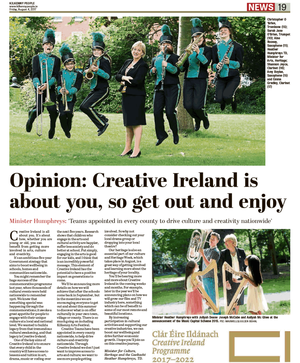
Some articles which ran in regional newspapers last August about Creative Ireland…

Donegal News

Meath Chronicle

Leinster Leader

Kilkenny People

Donegal Democrat

Anglo-Celt

Leitrim Observer

This afternoon.

In the Dáil.

During Leader’s Questions.

Fianna Fáil leader Micheál Martin raised the Strategic Communications Unit, the controversial advertorials placed in newspapers in relation to National Development Plan, Project Ireland 2040.

Mr Martin claimed Taoiseach Leo Varadkar was going down a “dangerous route” with the SCU while Mr Varadkar claimed the Fianna Fáil leader just didn’t want to talk about Fine Gael’s initiatives.

Mr Martin and Taoiseach Leo Varadkar had the following exchange, before Mr Varadkar held up previous newspaper articles containing material about Fianna Fáil.

Things got heated prompting Ceann Comhairle Sean Ó Fearghaíl to rise to his feet.

Michael Martin: “The role of the Strategic Communications Unit which you established, whose head [John Colcannon] you selected must come under the closest of scrutiny and most comprehensive of reviews. Because the SCU-directed campaign, in my view, either advertently or inadvertently has politicised elements of the civil service whether we like it or care to admit it or not.

This campaign represents an abuse of taxpayers’ money, I genuinely believe that.

“That Government advertisements, or funding of the media, should in my view be at arm’s length and not used for party political or party electoral objectives.

“The civil service code in this regard, in my view, as a result of this campaign, has been breached.

“If you read the Longford Leader, the Limerick Leader, the Roscommon Herald, for example, you will see so-called advertisements masquerading as news articles with Fine Gael candidates, prominent in those ads. Not members of Government, in some cases, not even members of the Oireachtas, but Fine Gael election candidates prominent in those advertisements.

“The Sunday World double-spread features [Athlone-based] Senator Gabrielle McFadden with a large emphasis on Athlone. Boxer [Athlone-based Independent junior OPW minister Kevin ‘Boxer’ Moran] gets in but not to the same degree.

“And again, it’s a clear electoral pitch by any yardstick. And if you look at it and this is meant to be an ad informing the public about information around the actual, the national planning framework or the national development plan itself. In essence it’s using taxpayers’ money to advance or promote Fine Gael election candidates.

“And you can see the same trend in other constituencies as well in terms of trying to identify key marginals and so on and promoting issues around those marginals, constituencies.

“We have an independent media, thanks be to god, which is essential to the health of our democracy and speaking truth to power is an essential pre-requisite for that. The media needs revenue and we’ve no difficulty with advertisements that are clearly identified as advertisements.

“Media content partnerships between the Government at the media should be fully transparent so in that context, one local editor told the Times Ireland that, “this is fake news, newspapers are struggling and the Government know that so they’ve got us by the – ” I’m not going to finish for parliamentary decency.

“Regional newspapers were instructed to make Government advertorials to look like independent stories and in some cases part of the normal news cycle. So Taoiseach, some basic questions. Last week you were asked what’s the estimate for the cost of this particular campaign? I would ask you if you could outline to the house how much it has cost and the overall estimate for it is. Do you accept that there’s been a blurring of the lines in how all of this has transpired?

“That it involves a politicisation of the staff in the SCU, the Strategic Communications Unit, and that essentially the entire promotion has been about Fine Gael’s electoral advancement?”

Leo Varadkar: “First of all, it is at arm’s length, deputy. The communications unit operates at arm’s length from me and from the rest of the Government. It is a civil service-staffed entity and it operates at arm’s length and does so in accordance with the civil service code.

“And that is the case. Your assertion that it’s the most expensive public information campaign run by Government is absolutely not the case. From the records that I have, the most expensive one was one that was run by the Fianna Fail/Green coalition which was the change campaign – around the Government’s Climate Change agenda – that cost €15million. The one around Transport 21 – which was the public information campaign around Transport 21, again which you’ll remember cost €3million.

“This campaign will cost around €1.5million which is half the cost of the Transport 21 campaign. And a tenth of the cost of the Change campaign so those are the facts in relation to the cost.

“It is my view, it is my view, and I’ve said it before and I’ll say it again, that good communications is a virtue. That good communications is a virtue. It’s right and proper that the Government should be able to inform the public, what it’s doing, what is happening, how public money is being spent and how it’s acting in their interest and I often meet people that say to me that ‘the government isn’t communicating right’, it isn’t getting its message across and I believe we need to do more in that field to make sure that people are fully aware of what Government is doing.

“But I also know what you’re doing, deputy. You don’t want people to talk about Project Ireland 2040.

“You don’t want people to talk about the good plan that we’ve published to improve our country, to upgrade our infrastructure in the coming years.

“What we’ve produced is a plan for the next 20 years, backed up by a 10-year infrastructure investment plan, running to €116bn and last week, you didn’t want to talk about it, you wanted to talk about process and procedure, this week you want to talk about the public information campaign.

“Because you don’t want people to hear about the plan, you don’t want people to hear about the Government’s vision to make our country a better place.

“You don’t want to hear about the €116bn that’s being invested and this is a government that’s delivering on infrastructure.

“Yesterday Minister [Simon] Harris opened two new primary care centres in Coolock and in Co Kildare. There are 110 primary care centres now, there were only 40 when the party which I lead came to office.

“This morning, on the way to work, I passed the paediatric unit, at the Connolly Hospital, which is now in its third storey and within the next couple of weeks, the new Luas trams will arrive, making them longer.

“So what this is about, from your point of view, is pure politics. We produced a plan Project Ireland 2040 – a €116bn plan to invest in and improve our infrastructure, roads, rails, healthcare, housing, transport, all of those really important things.

“Last week you want to talk about process, this week you want to talk about the public information campaign.

“The one thing you don’t want to do is actually talk about the issues.”

Micheál Martin: “I asked very straight questions and have been asking them of the Taoiseach for the past three to four months, long before the publication of any national development plan. The strategic communications unit is about the promotion of the Taoiseach’s good self and his party. That is the point. It is unprecedented. There are 15 staff in the unit. I asked the Taoiseach a very simple question about Fine Gael election candidates appearing in Government advertisements paid for by the taxpayer. It is about the ethics of it. Will he, please, answer that question?”

Leo Varadkar: “What is the question?”

Micheál Martin:
“It is about time the Taoiseach faced up to that. He has blurred the lines and is going down a dangerous route which has, ultimately, the potential to corrupt our democratic process itself. It is about time he saw that.

Leo Varadkar::The answer to the Deputy’s question is ‘No’. We have already explained how this works. The communications unit entered into media partnerships with media organisations. What happens there is that…

Micheál Martin: “Have the terms been published?”

Leo Varadkar: “Those organisations have editorial control over content. Nobody in the unit suggested any particular person should be interviewed and nobody in the unit had any editorial sign off on the articles before they were published. Those were done by the media.”

Leo Varadkar: “It is one thing to be getting a lecture from Fianna Fáil about this sort of thing. I refer to the national development plan advertisement.”

Micheál Martin: “It is an advertisement.”

Timmy Dooley
[FF]: “It is an advertisement. It says “commercial feature”.

Leo Varadkar: “It does not say “commercial feature”. It says “public information”.

Micheál Martin: “No, no.”

Leo Varadkar: “What we have is a banner on the top saying “national development plan”, just like we had for Project Ireland 2040.”

Ceann Comhairle: “Time is up.”

Leo Varadkar: “It does not mention the Government of Ireland whatsoever. The first thing is a big feature, an opinion editorial with a picture of Mr Brian Cowen. In the corner, we have a nice little picture of Deputy Micheál Martin…”

Robert Troy [FF]: “It was in the Roscommon newspapers.”

Ceann Comhairle: “The Taoiseach is not in order.”

Leo Varadkar:
“…and on the next page we have a picture of Mr. Bertie Ahern. In the one from The Irish Times, it is the same thing again…”

Ceann Comhairle:
“Can the Taoiseach restrain himself from…”

Leo Varadkar: “There is another opinion editorial with Mr. Brian Cowen’s picture and an even bigger picture of Deputy Micheál Martin. This is from The Limerick Chronicle.”


Leo Varadkar:
“Again, it says “public information” and “national development plan”. There is nothing about the Government of Ireland whatsoever.”

Ceann Comhairle: “Please.”

Leo Varadkar: “On the back of this we have an article from the…

Ceann Comhairle:
“No. Sorry, Taoiseach…”

Leo Varadkar: “There are quotes from third parties…”

Ceann Comhairle: “Taoiseach, please.”

Micheál Martin: “Check the line, Taoiseach.

Leo Varadkar: “The Deputy is not in a position to be giving lectures.

Ceann Comhairle: :The rules of the House apply to the Taoiseach and Deputy Micheál Martin equally, so please respect…”

More to follow

Meanwhile…

From top: Propoganda for one of the Soviet Union’s Five Year Plans; Cabinet members at the Project Ireland 2040 launch at the Institute of Technology, Sligo last week

Eamonn Kelly writes:

The five-year plans of the Bolsheviks were partly designed to deflect criticism from the ruling party. Later Stalin finessed this by simply killing the critics.

To introduce a 20-year development plan as Fine Gael have done is partly genius, since many of the present critics of the party’s policies are likely to be either dead or in nursing homes by the time the 20 years rolls around and everyone is finally permitted to say, “Well, that didn’t work!”

The idea combines early Bolshevik thinking of using the long-term plan to deflect criticism, but by extending the term of the plan it also gives a nod to Stalin’s propensity for silencing criticism, but with a more civilized approach by arranging for the passage of great swaths of time itself to be the executioner of opposing voices.

I know it’s a bit strange to be lumping Fine Gael in with the Bolsheviks, especially given the taoiseach’s contempt for what he calls hard-left politics, but these are strange times and everything is not always as it seems.

Because what Varadkar’s Fine Gael and the Bolsheviks have in common is a propensity to engage in wide-ranging officially sanctioned deceits designed to mislead the public.

In the Bolshevik’s case this was done to ward off a counter-revolution, in the Fine Gael case it is being done simply to ward off criticism that might undermine their hold on power. In Russia it was called censorship, in Fine Gael it’s called “controlling negative narratives”.

The thinking behind all this may be sincere. Perhaps the taoiseach genuinely believes that he is tackling head-on the native Irish propensity for negative thinking by trying to push through more positive thinking models, marrying positive thinking with economics, like they do in the US.

But you have only to look at the US to know that while positive thinking economics might be good for certain sectors of the economy, the top 1% for instance, it tends not to be so great or positive for blue-collar workers, most while collars workers, the poor, the destitute and everybody else really who isn’t either a tech billionaire or a movie star.

But whatever the degree of the taoiseach’s sincerity on the subject of positive thinking as a generator of economic recovery, the fact remains that, like the Bolsheviks, Fine Gael are investing public money in a team to control the news and the perception of the government, in order to hold onto power. And like the Bolsheviks are using the concept of a long-term economic plan to deflect criticism.

Varadkar has also to date targeted a minority social group for scapegoat treatment through the welfare cheats campaign, which he personally led, voluntarily making himself the official face of intolerance of the poor in direct contravention of an EU directive which his party have failed to implement: namely, to add discrimination on grounds of socio-economic status as a protection during austerity.

But if this right were implemented, the smirking minister with the welfare cheats sign would be on the wrong side of the law, as would the entire JobPath employment activation programme, which is predicated precisely on discrimination against those on welfare, or the poor, or those of low socio-economic status; something the then minister for social protection, now taoiseach, was fully aware of when he set out to pit low-paid worker against the unemployed, by scapegoating the latter as the cause of high taxation.

The number of artists who were also transferred into the JobPath system could also be viewed as a direct attack on the imagination of the culture, the system essentially degrading artists into a pool of menial labour from which two private companies hoped to profit.

This is not quite the gulags of the Soviet Union, but the results in silencing oppositional viewpoints are very similar, and much easier to defend, since the economic argument can always be raised as a justification for silencing art in the name of recovery.

What joins Fine Gael and the Bolsheviks is naked political power and the willingness to bend laws or neglect their implementation to retain power. The use of the long-term economic plan seals the similarity, despite the politics being, on the face of it, on the opposite sides of the spectrum.

There is little difference between Varadkar’s PR team running paid “advertorials” in the national press in order to combat what it terms “negative narratives”, and the Bolshevik’s all-encompassing control of the news in the soviet states, except in terms of degree.

Both are ultimately concerned with silencing opposition, and both justify repressive actions on the grounds of economic progress.

While Fine Gael’s form of control is not bare-faced censorship, they are quite open about their intention to silence dissent as being merely “negative”, and government control of the main organs of news creates a form of censorship by omission, with the concept of “advertorials” now merely adding to the flavour of a government-controlled Tass-like Agency in our midst.

The Fine Gael party’s secret weapons are “progressive” Varadkar as their public face, and the “religion” of positive thinking, which they hope will be enough to appeal to a majority of the electorate, enough to consolidate their grip on power. The twenty-year plan is perhaps a direct appeal to millennials.

But the wild introduction of that 20-year plan also seems to suggest that Fine Gael are not at all confident of success in the next election, where arguably all their focus truly lays, despite all the bumph of 2040. In other words, Fine Gael appear to be privately entertaining a few negative narratives of their own.

Eamonn Kelly is a freelance writer

In today’s Irish Independent.

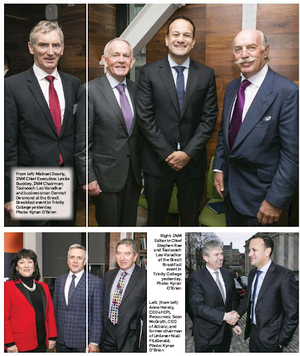
Pictures from yesterday’s Independent News and Media-organised Brexit Breakfast at Trinity College Dublin…

Including INM Editor-in-Chief Stephen Rae and Taoiseach Leo Varadkar (bottom right).

In today’s Irish Times.

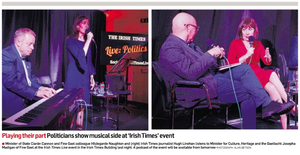
Pictures from an Irish Times Live event at the newspaper’s office on Tara Street last night…

Including Fine Gael TDs Ciaran Cannon and Hildegarde Naughton (left) and Minister for Culture, Heritage and the Gaeltacht Josepha Madigan speaking with Irish Times journalist Hugh Linehan.

Oh.

Earlier: “The Taoiseach Has Said He Wanted To Get The Media To Run Fewer Negative Stories”

The Daily News

Taoiseach Leo Varadkar

On Wednesday.

In the Dail.

Taoiseach Leo Varadkar answered questions related to the Strategic spin Communications Unit – which was established by Mr Varadkar when he was elected leader of Fine Gael and became Taoiseach.

Specifically, Mr Varadkar was asked about the promotion of the recently announced National Development Plan through the unit, in which there are 15 people now working, and the cost of the same.

Advertorials published in the Irish Independent and The Irish Times were also raised in the Dail exchange.

From the Dail exchange:

Leo Varadkar:The remit of the strategic communications unit is to bring consistency, clarity and professionalism to all Government communications. Its focus is to treat communications as a whole-of-Government activity and to speak to our citizens in a way that they understand and so they can be aware of the Government services available to them and the actions that Government is taking on their behalf.

The focus of the work of the SCU comprises three work streams: first, streamlining communications to the citizen, including the roll-out of a single unified Government of Ireland identity programme and the migration to the consolidated Government platform of gov.ie, which will produce financial savings in the medium term; second, running and supporting cross-Government priority information campaigns; and, third, implementing a capacity-building professional development programme for officials working in communications across the Civil Service. Staff in the unit share responsibilities across these three work streams to deliver on the unit’s work programme.

At present, there are 15 staff working in the unit: one director, who is paid at assistant secretary level, one principal officer, four assistant principal officers, two higher executive officers, three administrative officers, three communications and media assistants and one executive officer. The former MerrionStreet, or Government information service, GIS, function has been integrated into this new structure. The Government press office continues to operate as before in dealing with day-to-day media queries under the direction of the Government press secretary, Nick Miller. The salaries of the staff in the SCU are met from my Department’s administrative salary budget, which was reduced in 2018.

As I have already stated to the House, a research tender with an estimated cost of €130,000, excluding VAT, was published on 18 September 2017 to commission an initial report of the Government and its services and a rolling tracker of attitudes towards it. The tender was awarded to Behaviour & Attitudes and the final results are expected to be available in late spring. These results will be published.

All media, both traditional and social, are utilised in the course of the delivery of campaigns by the unit. The choice of media is informed by the nature, subject and reach of the campaign. In some cases, media content partnerships with national and local media form part of campaigns in order to fully explain to citizens the various Government initiatives and actions and how they will impact their lives.

Joan Burton: “I thank the Taoiseach for his answer. He said “all media”. We heard yesterday that his Government is running advertising in cinemas, presumably directed largely at younger audiences. Does this mean that some of the advertising will also go to TV and radio? We need a clear answer on this because the concern, I think, of all Opposition Members is that the distinction between a party in government, or a governing party, and the Government is very clear in our Constitution. We asked the Taoiseach about this yesterday. He seems to be hell-bent on blurring the distinction between the two, and Fine Gael as a political party gets funding both in terms of the leader’s allowance and the payments made to the party. I said to him yesterday this is a fundamental issue for our democracy and our Constitution, and the fudging in the end will not do anyone any good.

The Taoiseach’s press releases are no longer published on his Department website. Why is this? He has told us he is very interested in direct communication through social media, which is fair enough, but I think there is also a requirement for the text of what the Taoiseach is saying to be available. Will he also tell us about the outcome of the tender for the market research element of the contracts he advised us of last week and in earlier weeks? When will he publish the results? We are aware that Behaviour & Attitudes have apparently won the contract and we know about a number of other contracts that were won, including the one concerning the identity research to which his Government has committed and which he has not quite explained to us yet. Is this just classification of segments into different age groups?

An Ceann Comhairle Seán Ó Fearghaíl: “We need to move on.”

Burton:What is involved is incredibly similar to political deep-market background research, which includes the use of panels and survey groups.”

Ó Fearghaíl: “If we do not conclude the questions we will not have time for the answers.”

Micheál Martin: “Yesterday’s conversation on the marketing unit was helpful because it allowed time to fact-check some of the Government’s statements. Approximately €340,000 was the amount spent on the launch of the 2007 plan. I checked a parliamentary question tabled at the time by Ruairí Quinn. This does not compare with the amount spent on Friday’s launch, which was by far the most expensive and extensive ever by a Government.”

In the context of the relationship with the media and the matter of the unit’s political activity, the national development plan was formally adopted by the Government last Friday but sectoral groups were fully briefed on Thursday. When it was announced, Fine Gael put up a new website with enormous detail of the plan, including exact wording and a county-by-county list of promises not published by the Government. This can only have come from direct political engagement with the unit. How does that fit with the Civil Service code?

“On the media content partnership, the Taoiseach must accept that there is something ethically dubious at the very least about one arm of the his Department seeking coverage for so-called exclusives about the plan while another is discussing major advertising spending with the same media outlets.

The Taoiseach has said he wanted to get the media to run fewer negative stories. If we look at pages 24 and 25 of the Irish Independent – the position is the same in the The Irish Times – we can see articles marked as being in partnership with the Government. They are presented as articles but should we take it that they are actually advertisements?

I have no issue with the Government advertising services in the media but these are political advertisements. They are articles placing the Government in a good light in terms of these issues. Every regional newspaper will have the biggest advertisement it has received in many years, block booked well in advance.

“This is saturation of good news stories presented in that manner by the media. There is an issue in terms of the health of our democracy and the ethical nature of the engagement of the Taoiseach and the Department in all of this. The blurring of the lines is genuinely very worrying from the point of view of parliamentary democracy. The Taoiseach will say that he is promoting the Government, but the dogs in the street know he is using taxpayers’ money to promote Fine Gael politically. That is the end of the story.

Pearse Doherty: “There is a very fine line in all of this and it is clear that the Government has stepped over it. There are probably legal issues in terms of a Government of Ireland initiative, and some of them actually require the approval of the Dáil. The question that arises relates to whose initiative is this really.

These issues were dealt with at length yesterday and I do not want to rehash what was said. In the context of the budget set aside for the advertisements on the national development plan, we know they are running across various media, including radio, print, online and in cinemas. There is a valid debate to be had in respect of whether the advertisements are about making the Government look good – in my view, this is what they are – or whether they are about public information. Ultimately, public money is being spent and clarity is required and would be welcomed. How much money has been approved for these advertisements under the national development plan? It is important that this information is put on the table.

Varadkar: “People of all age groups attend the cinema. When I go to the cinema, I see people of all age groups, although I suppose it depends on what movie one goes to see. I imagine that younger people attend different movies to middle-aged people and older people. It is a good way to speak to a broad section of the community.

“To clarify, I do not have any role in designing any advertisements or deciding which medium is used and I am not consulted on this. I have asked not to be constructed on it. I have also asked not to see any advertisements before they are placed and I do not see them before they are placed.

Martin: “That was not the question.”

Varadkar: “I am not aware of any plans to use television advertising. There is, of course, no mention of political parties in any of these advertisements. In fact, there is no mention of the political parties in the Constitution. I note Deputy Burton spoke about the Constitution having a distinction between Oireachtas, Government and political parties. An interesting point about Bunreacht na hÉireann is that it does not acknowledge the existence of political parties, but that is an aside. Certainly, any advertising or information campaign material will not mention any political parties, groups of Independents or particular Independents and it certainly will not involve any call to vote in a particular way. This is in full respect of the McKenna judgment.

Research will be published after it has been completed and it will be up to the director and the Secretary General to do this once it is done . There should not be any undue delay in publishing it once it is available.”

“Deputy Micheál Martin mentioned the function on the Fine Gael website, which is very good. I would certainly encourage people to take a look at it and see how Project Ireland 2040 will impact on their counties. People can scroll down, choose their counties and see a full breakdown of how the plan will they will be affected. I encourage people to look at it.”

Martin: “That was not the question.”

Varadkar: “To answer the question, there is no contact between civil servants in the unit or any part of my Department and party officials, and nor should there be.”

Martin:So they just magic it up.”

Varadkar: “Of course, there is contact between serving politicians and their parties. I speak to Fine Gael and I do so very regularly, as do special advisers. The total budget for the unit is €5 million for this year and it is up to the directors to determine how it is best spent and spread across the various campaigns.”

Ó Fearghaíl: “That concludes questions to the Taoiseach.”

Doherty: “The Taoiseach did not give an answer on the national development plan promotion.”

Martin:Will the Taoiseach give us a report on the media content partnership in a fully transparent manner? Will he give me a paper on it?

Varadkar: “I do not have it.”

Martin: “Of course the Taoiseach has it. The information in his Department.”

Doherty: “Can we get an answer to the question? If the information is not available, will it be submitted—–”

Varadkar: “If Deputy Micheál Martin writes to the Secretary General, I am sure he will give it to him.”

Martin: “That is not the answer.”

Varadkar: “I will have to see the information first.”

Martin:This is a parliamentary democracy. I am asking a question and the media partnership is something on which we should get an answer. That is all. What is the nature of the partnership and how does it work?

Ó Fearghaíl: “Will the Taoiseach see if he can respond?”

Varadkar: “I do not even know if it exists.”

Doherty:I asked a specific question and I understand the Taoiseach does not have the specific answer. Will he furnish the information to us? The question relates to the cost of the promotion of the national development plan through the unit.”

Varadkar: “That will not be known until the campaign is finished.”

Martin: “Stop, this is outrageous.”

Doherty: “A budget will have been approved for it and that is the information we require.”

Burton: “The Taoiseach should be able to tell us the cost—–”

 Ó Fearghaíl: “We have concluded questions.”

Burton: ” —–of the cinema advertisements and the other advertisements.”

Ó Fearghaíl: “Please Deputies, we have concluded questions.”

Martin: “The Taoiseach has information on all the costs because the deed has been done. A person would not get into the cinema without paying his or her money upfront.”

Ó Fearghaíl: “Please.”

Varadkar: “I will be happy to provide it.”

Martin: “I thank the Taoiseach.”

Transcript via Oireachtas.ie

Related: Government ‘paid for good news stories’ over Ireland 2040 plan (Ellen Coyne, The Times Ireland edition)