








 Thanks Mike Hogan 4FM and Joe Donnelly
Monthly Archives: April 2013

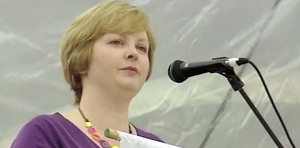
Former Master of Holles Street Hospital in Dublin, Dr Peter Boylan, top, and Breda O’Brien, above, a patron of Iona Institute and Irish Times columnist, were among the guests on RTÉ’s Marian Finucane this morning.
They spoke about the death and subsequent inquest of Savita Halappanavar.
During their discussion, Dr Boylan accused Ms O’Brien of revising history.
Here’s how it unfolded:
Marian Finucane: “Explain how you got involved in the hearings in Galway, last week.”
Dr Peter Boylan: “The coroner wrote to me and asked me would I review the notes and the statements and issue a report to him, so that’s it basically.”
Finucane: “And that was it. And were you there for the whole thing?”
Boylan: “No, I got the transcripts every night but I wasn’t present. I only went down to give my expert evidence on Thursday.”
Finucane: “Right. And your conclusions?”
Boylan: “My conclusions are that if she’d had a termination on the Monday or the Tuesday, she would now be alive. That by the time…”
Finucane: “This is Savita. Just to…”
Boylan: “Yes. By the time a termination became legally realistic prospect, she was becoming seriously ill. And even if they’d started a termination on the morning of the Wednesday that it was too late at that stage. I did identify a number of deficiencies in the care but none of them individually contributed to her death, in my opinion. And, the question of a surgical termination was brought up in some of the media, during the course of discussions since the finish of the inquest. And I don’t want to be graphic about what a surgical termination means at 17 weeks for the live foetus but there’s a very high likelihood that she would have died as a consequence of having had a surgical termination at that stage because…”
Finucane: “On the Monday or the Tuesday?”
Boylan: “No. On the Wednesday.”
Finucane: “No.”
Boylan: “You couldn’t do a termination on the Monday or the Tuesday in this country. It’s just, it was not legal.”
Finucane: “Yeah, I must have misheard, I thought I heard people, on both sides, saying that if a miscarriage was inevitable that then there would…”
Boylan: “The clinical circumstances in which she was, with ruptured membranes at 17 weeks, the chances of survival for that baby were absolutely very small, less than 10%. There are incidences however, well-recognised in this country and internationally where babies in those circumstances can survive. They get to 34 weeks maybe or even later…”
Finucane: “34? Yeah but she was 17?”
Boylan: “She was 17. Yes but a pregnancy, even with ruptured membranes, can continue. It’s highly unlikely. It’s not inevitable that she would have a miscarriage. Now what would have happened in another country is that on the ward round, when she ruptured her membranes, the dismal outlook for the baby would have been discussed with her. And her input into the management, and her husband’s input into the management, would have been taken into account. We can’t do that here. And what would have happened is she would have said one of two things. One: ‘I’d like this pregnancy to continue as long as possible as I dearly want a baby and we want to do everything possible’. That might be say in the circumstances where the mother is in her late 30s/40s, it’s an IVF pregnancy and so on. Not very much different. Or she might, she could said ‘Look no, the outlook is so dismal, I’d like just to have, get this pregnancy over with, in other words terminate it, and then move on and perhaps get pregnant again soon. Her wishes would have been taken into account in any other country. Now what would have happened then is that they would have said to her ‘Look, have a think about this because these are very big decisions.”
Finucane: “Sure are.”
Boylan: “And they would have come back to her the next day, or later the same day, or they might be absolutely certain what they wanted to do. And then, whatever it is that they wished would be undertaken. In any other country.”
Finucane: “Again, just listening to the, to the evidence, I presume every person operates to the guidelines, you know, according to the law.”
Boylan: “We have to.”
Finucane: “Yeah, yes, yeah. But the notion of percentages.”
Boylan: “Yes.”
Finucane: “Of, will you die, won’t you die…”
Boylan: “Yes.”
Finucane: “Does that happen? A lot?”
Boylan: “No. And we cannot, as doctors, be expected to do our ward rounds with a calculator in one hand and the law in another hand. We have to be given the liberty to do what we feel is best for a patient and in this…These circumstances are the only circumstances in obstetric care where a woman’s wishes are not taken into account. Where she has no input into her care. Now if you think of any other sort of situation like that you end up talking about the Taliban. Where else are women denied an input into their care? In what other clinical situation? I can’t identify any. Women are very much involved in their care in obstetrics, in decisions to induce labour, decisions about Caesarian sections, decisions about all sorts of things. And that’s how it should be. But in this circumstances, they are not allowed. And that’s the law.”
Finucane: “Breda, how did, how did we end up here?”
Breda O’Brien: “I’m really alarmed at a couple of things that Peter has said. First of all that the law would not have allowed intervention on Monday because John Bonner, who would be universally acknowledged to be deeply conservative on this, said he would have gone, he would have been in there like a light.”
Boylan: “That’s incorrect.”
O’Brien: “Em. He’s not present to..what he..this is..”
Boylan: “I was on Prime Time with him there last night I think it was…”
O’Brien: “What he said was…”
Boylan: “Friday night. And that’s not correct what he said. He said he would wait until she was ill and then he would have no hesitation in intervening.”
O’Brien: “Can I clarify, Peter?”
Boylan: “He was very clear about that because I picked him up on that.”
O’Brien: “Can I clarify, Peter? When I said he would have been in like a light I was talking about in terms of the care. The care is the crucial issue here. I spoke to three obstetricians over the week, two in person and one by email to clarify this point.”
Finucane: “I should clarify that you yourself are a patron of Iona, just for the record.”
Wingnut
at
Insane BASE jumper and wingsuit flier Alexander Polli attempts a tactical high-speed flight through a tiny opening in a mountain ridge in El Mont Serrat, Spain.
Perspective
at
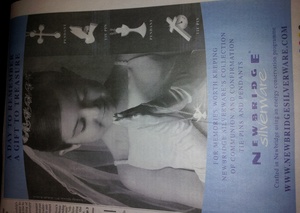
Hey, it’s not Christmas.
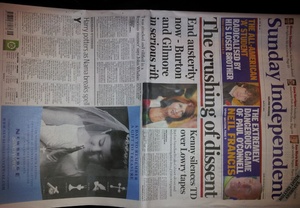
First Holy Communion pendants and tie-pins ad, tomorrow’s Sunday Independent front page.
Not even remotely odd.

Rob Nolan tweetz:
“FOUND: Siberian Husky, female, grey and white with brown eyes. Kells Co. Meath area. no m/chip.”


This is the flat-out maddest thing you’ll see today.
A bizarre, screamy, insanely violent and utterly brilliant animation by Felix Colgrave.
Watch it. Then watch it again. Then have a lie down.



 (Pix (top to bottom): Kepler-22b, Kepler-62e, Kepler-62f and Kepler-69c)
NASA’s planet-hunting Kepler spacecraft, has already discovered more than 100 planets outside our solar system in the first four years of its mission, including, last year, a possible ‘ocean world’ called Kepler-22b.
Lately, its deep space telescope has identified three exoplanets of similar size to Earth which appear to have the right temperatures to sustain life. Two of them (Kepler-62e and Kepler-62f) orbit the Kepler-62 star 1200 light years from Earth with estimated surface temperatures of -3°C and -65°C respectively (though the chilliness may be tempered by the blanketing effect of as-yet-unknown atmospheres.)
The third planet, Kepler-69c, orbiting a different star, has a balmy estimated surface temperature of 27°C. Scientists also speculate that it could be covered with liquid, but not necessarily water.
We want to believe.
Three New Exoplanets Might Have Right Temperature for Life (Wired)




 Slovenian photographer Matej Pelijhan’s recent collaboration with 12 year-old Luka, whose mobility is limited by muscular dystrophy to operating the joystick of his electric wheelchair.
Pelijhan’s photo series, shot from above (and in the style of Adele Enerson’s baby dioramas from 2010) without digital manipulation, depicts the young chap engaged in all manner of physical feats.