http://www.youtube.com/watch?v=IfIIHs3r9TI
Dad catches son attempting to eat popsicles for breakfast.
Son manipulates situation to his adorable advantage.



http://www.youtube.com/watch?v=IfIIHs3r9TI
Dad catches son attempting to eat popsicles for breakfast.
Son manipulates situation to his adorable advantage.

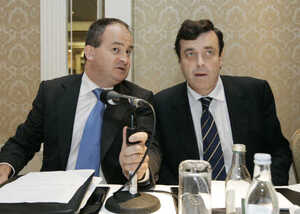 (Dr Julien Mercille, top, and Marc Coleman above with Brian Lenihan at a Confidence In Media conference, 2010)
You may recall UCD lecturer Dr Julien Mercille’s analysis of how the Irish media handled the housing bubble.
Among those Dr Mercille singled out for specific attention was Marc Coleman as he was economics editor of the Irish Times during the latter part of the boom
Mr Coleman responded on twitter that he had warned of an impending crisis and evidence of this was available if we had “bothered to check” the archives. He sent on this correspondence (a letter to the editor the Sunday Tribune in 2010), in which he defends his record as a commentator and analyst during the housing bubble.
Dr Mercille writes:
In April, Broadsheet.ie published articles about some work I have been doing on the media’s coverage of the housing bubble in Ireland, here and here. My point was that the Irish media supported the hype about the housing market and contributed to inflating the bubble that collapsed a few years ago, leading the country into a deep economic crisis.
One media commentator, Marc Coleman, formerly Economics editor at the Irish Times and now running his own radio show on Newstalk, wasn’t so happy about it, and responded to Broadsheet.ie (see above)
I decided to examine Coleman’s record on the housing bubble in more detail, and so I took a look at all the newspaper articles on the property market he has written since 2004 as well as his two books, The Best Is Yet To Come (2007) and Back from the Brink (2009).
Perhaps the clearest examples of how wrong he has been come from the following pieces. In September 2007, he attacked those who warned of a housing collapse like David McWilliams as ‘careless talkers’ who make meaningless ‘simplifications and generalisations’ and threaten to ‘run down our economy’.
Coleman claimed that ‘Far from an economic storm—or a property shock—Ireland’s economy is set to rock and roll into the century’. He thought the economy was so strong that he wrote that ‘Ireland enters the 21st Century in a position of awesome power’, which ‘promises a future more flourishing than ever before; a future that will turn economic prosperity from a statistical fact to a reality’.
Apparently, the country was doing so well that worldwide, ‘hundreds of millions of people are one the move, looking for a country like Ireland to make their home’. After all, ‘Far from collapsing, our economy and property prices will do more than hold up’. Supposedly, all we needed to do to protect ourselves against a crisis was not to talk about it, because ‘unless we talk ourselves into one, an economic storm is not going to happen.’ All we had to do is proceed as if there was no problem at all: ‘If we keep our eyes fixed forward and our heads cool, then the best is yet to come’.
Also, in March 2007, just as the housing bubble reached its peak, he wrote confidently that ‘Nothing exciting is in prospect for the market over the next two or three years, but nothing dangerous is in prospect either’. Later that month, he wrote that ‘some commentators on the property market… are predicting the downfall of the market, the collapse of the economy and the sky falling on our heads’. He said that those people were ‘talking nonsense’, and ‘dangerous nonsense at that’. He continued: ‘Doom merchants and indulgent parents are bad for the market’. He didn’t like those ‘irrational predictions of doom’ because he said ‘the market is correcting, not collapsing’ and in any case we shouldn’t worry because there is only a ‘modest amount of overvaluation in the market’ and ‘the safety nets for house price levels in 2008 are effectively already in place’.
But those are not his only contributions. He wrote a number of articles over the years that reinforced the notion that house prices were set to climb higher or, at worst, would gently stabilise in a ‘soft landing’. For example, he penned articles entitled ‘Housing Demand Set To Stay Strong’ (Irish Times, 28 September 2005), ‘Risk From Collapse in House Prices “Has Receded”’ (Irish Times, 2 November 2005) and ‘House Prices “Set for Soft Landing”’ (Irish Times, 22 November 2005). In another article, entitled ‘“Ryanair” effect adds to confidence in housing market’, he wrote that ‘The Irish housing market will experience another strong year, due in part to Ryanair making Ireland a more accessible place to work, according to Irish Intercontinental Bank (IIB) chief economist Austin Hughes’ (Irish Times, 25 January 2006). He presented another entertaining thesis in an article entitled ‘Legalisation of Contraception a “Major Factor” in House Price Rise’, reporting on a study entitled ‘Condoms and House Prices’ by Alan Ahearne of NUI Galway and Robert Martin of the US Federal Reserve Board (Irish Times, 1 May 2006). Another piece, entitled ‘Economists Forecast 15 More Years of Strong Growth’ (Irish Times, 23 March 2006), stated that ‘As a result of population growth, the number of houses is expected to continue growing by around 65,000 units a year until at least 2020’.
Later, he wrote an article entitled ‘Housing Market Set for “Soft Landing”’ (Irish Times, 28 February 2007) and stated reassuringly that ‘Negative equity is here—but only for a tiny percentage of the market’ (Irish Times, 14 June 2007). One could say that some of those articles were merely news stories and that Coleman was only reporting the opinion of others, but that confirms my point: he chose to report the views of those property ‘experts’ who were cheerleaders for the market, but ignored those who warned that it was in bubble territory, such as Morgan Kelly, David McWilliams, or The Economist magazine.
In January 2006, in the Irish Times’ Property section, Coleman advised his readers on how to buy property overseas. The article started thus: ‘Thinking of investing abroad? Don’t just check out the bars and the beach—research the economy of the country you’re buying in if you want it to be a good long-term prospect. Economics Editor Marc Coleman shows you how’. For example, he wrote that ‘The absence of serious political discord in a country is a necessary if insufficient condition to making a sound investment, in that it helps underpin confidence in the property market’.
In August 2006, he wrote the introduction to a Daft.ie report on the property market. In it, he claimed that the housing market’s ‘price resurgence is “fundamental” in nature’ and thus that it was ‘unlikely’ that ‘a downturn in the market [was] going to happen’.
In January 2008, Coleman encouraged his readers to buy property, writing that ‘provided you are not paying 2007 prices, 2008 could be an excellent year in which to buy’. Some might have wondered whether ‘you should wait until 2009 before buying a house?’ But Coleman said assertively that ‘that idea is nonsense’—as such, ‘many will this year have perfectly good reasons to buy houses in 2008 and—provided they pay 2006 prices—they should go ahead in confidence’. He believed that the property market would ‘bear out my prediction of a quick correction in 2008 followed by resumed growth’.
In March 2008, he wrote another piece entitled ‘Property: bottoming out—so it’s time to spend’. He minimised any worries about the market: ‘Less about a boom and bust, Ireland’s current economic story is more like a property bulge passing through the gullet of our economy’. He thought that by early 2009, ‘at the very latest, house price growth should turn very modestly positive’.
In October 2008, he attacked those who suffer from ‘illiterate panic-mongering’ and talk down the property market and who ‘with no quantitative discipline to back their statements, tell us that house prices are going to fall by another 40 per cent’—well, they’ve actually fallen by about 45% since then.
His optimism was displayed again in a January 2010 article entitled ‘All Signs Indicate We Are Turning the Corner on to Recovery’ (Sunday Independent, 10 January 2010) and in another one entitled ‘It’s Not “Hype”, the Worst Really Is Over’ (Sunday Independent, 7 February 2010) in which he wrote that ‘The armageddon brigade may argue otherwise, but the evidence suggests we are on the slow road to recovery’ and that ‘the signs of recovery are everywhere’.
A few of Coleman’s articles may appear to have warned against a housing crash, such as one entitled ‘Economy Vulnerable to Housing Crash’ (Irish Times, 4 March 2006), but in fact when one reads them, they turn out to have been reassuring about such an event, stating that ‘The good news is that, although possible, a crash is not yet probable’.
Coleman tried to defend his record in an article in the Sunday Independent in 2010, in which he gave examples of articles written by himself that purport to demonstrate that he had, in fact, warned us all about the impending collapse of the economy. However, none of his examples prove anything of the sort. All one can find are a few sentences saying that growth may not be sustainable, that credit is growing too fast, that the construction sector is a very large part of the economy, that the financial sector could be better regulated, etc. For instance, he says that ‘On March 31st 2006 in a piece that began “Stop the economy I want to get off” I warned that financial regulation had broken down’. The piece says that the economy is overheating, but doesn’t warn about a housing bubble.
Coleman also wrote a book entitled The Best Is Yet To Come, published in November 2007. It makes a number of economic assumptions that are simply wrong or irrelevant, such as arguing that a country’s climate and a coastal location help its economic performance: ‘Situated on the temperate if rainy north-west fringe of Europe, Ireland has one of the world’s most fortunate locations’ (pp.11-12). Another one is the book’s main argument, that population growth will stimulate economic growth in Ireland. As Colm McCarthy and Dan O’Brien have noted in their reviews of the book, that doesn’t make any sense, as on that count sub-Saharan Africa, India and other poor countries should be rich. To grow an economy, you need the right policies.
The book presents a very optimistic picture of the Irish economy. Coleman finished writing it in early October 2007, and by that time, signs of an economic slowdown were apparent. For example, he wrote that ‘At the time of writing, latest forecasts from the ESRI indicate that the so-called Celtic Tiger would expire in 2008’ and that housing construction would decrease.
But Coleman saw that as a mere ‘pause for breath’ on the part of the economy. In other words: ‘Ireland’s economic miracle is far from over. As anxiety mounts about the end of Ireland’s boom, The Best is Yet to Come argues that Ireland is not experiencing the beginning of the end, but rather the end of the beginning’, as stated on the book’s back cover.
There’s one line of defence that Coleman may use, and it goes something like this: ‘My predictions were conditional on the government doing this and that, and it didn’t do it, so I can’t be proven wrong’.
For example, in many of his articles and in his 2009 book, entitled Back from the Brink: Ireland’s Road to Recovery, he kept predicting that house prices wouldn’t fall too much or would stabilise soon, only to be constantly proven wrong by further falls in house prices.
But he then says that his predictions were conditional on the government cutting stamp duty or enacting some reforms. He even said that his predictions would materialise provided ‘the kamikaze commentators stop killing confidence’ (p.75). But that line of defence is worthless.
Anybody can predict anything and then blame the government or anybody else for not having done this or that, or not enough of this or that, or having done this or that, but not at the right time, or having done this or that, but not well enough, etc.
Julien Mercille is lecturer at UCD, and author of the forthcoming book, The Media and the Irish Economic Crisis: A Political Economy (Routledge).
Previously: For Those Who Shouted Stop He Salutes You
I Never Promised You A Rose Garden
(Mark Stedman/Photocall Ireland)
Update:
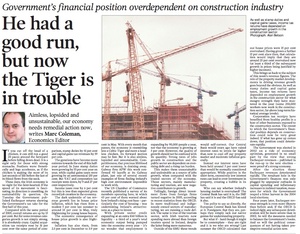 Marc Coleman has defended his record on twitter, challenged Dr Mercille to a debate and has asked us to reprint this article from the Irish Times of July 6, 2006, which we are happy to do. Larger version here.

We need leaders who will speak sense,
When current affairs grow this tense,
But how long must we wait,
In this banking debate,
For Jim Higgins to get off the fence?
John Moynes
 Maximum Jefferson writes:
Our wifi list today. They’ve got a plan so cunning, you could put a tail on it and call it a weasel.

(A Pro-Life ad truck parked near the Dail last week)
A reader writes:
I am a 30-year-old Irish woman and two and a half years ago I travelled to England to have an abortion.
My ex-boyfriend and I had been together seven years when it happened. We hadn’t been stupid, just very unlucky.We were both from a small village. A couple, most of the neighbours had written off for marriage, and a happy ever after.
Both of us had been to university, together, in Dublin, and found good jobs almost immediately afterwards. For a while it looked like we were destined for great things. However, after the economic crash, we found ourselves unemployed and living at home.
I had a much more staunch Catholic upbringing than him…His parents were the local “hippies”. Though I consider myself intelligent, well versed, and liberal, I have certain fundamentals ingrained in me, since I was a child…The nuns will do that to you. So, when I found out I was pregnant, there was a certain responsibility that fell on my shoulders.
I have been pro choice since I was old enough to think properly (16), but I felt that we were in a loving relationship and owed to the child to keep it…He was of another train of thought. With a cold stoicism, I never knew he had, he explained to me that it was a financial burden that in reality we could not take on. So we went and went for “a little break” and “had it seen to”.
In England I mentally couldn’t get around the idea of having a physical abortion so I took the tablets that induce a miscarriage. It was difficult and painful but, I was fine. The problems only began when we got home. Firstly, the depression was unexpected and extensive. I came home stigmatized. There was no one to talk to, I had no idea where I could get counselling. I had never felt so alone in my life.
Bottling my emotions inside while putting on a brave face and acting like nothing had happened. However I’ve seen the posters that say ‘abortion shatters her life’ and I would like to state that this is not true. Though having one is most definitely an unforgettable event in a woman’s life.
It’s a hard decision for anyone to make. As your body returns to a pre- pregnant state, your hormones are everywhere and it is paramount, that the woman has someone who is trained, to help her deal with the aftermath from this decision. Those who say that if abortion is legalized it will ‘open the floodgates’ to abortion on demand, obviously, have never had one. Trust me, no woman could possible see this as a form of contraception. It is a difficult choice to make and a draining traumatic experience that necessitates firm resolve, courage and mental strength.
Secondly It was the infection I got. The one that made me collapse in my home. He [partner] didn’t know what to do. The local doctor would probably have tried to have me arrested instead of helping me, so he did nothing. The next day I drove myself to the family planning clinic in the closest big town and they got me the help I needed. There they told me it was caused by too much physical strain after the procedure. But I had been unaware that I was meant to be taking it easy for six weeks after the abortion. I had been helping on the farm because I didn’t know any better. Again this could have been avoided if I had been able to speak to a trained medical professional about my condition,
You see taking the abortion pill isn’t at all like a surgical abortion. If you take the pill you go through an induced miscarriage. After a ‘normal’ abortion a woman usually bleeds for about a week or so, as much of the lining of the womb is cleared during the procedure. However, if a woman uses the pill, all the lining, including the actual pregnancy, has to pass naturally, and in my case, I still had very heavy bleeding a month after our trip to England. My infection was very easily avoidable, but I didn’t listen to my body and spent all my energy acting like nothing was wayward with me. Instead of taking it easy, I was out doing strenuous exercise every day. That, coupled with such a heavy flow allowed for the perfect environment for bacteria.
When I saw the doctor at the woman’s health clinic, she had never even heard of the abortion pill, and before she examined me, she insisted on me taking a pregnancy test, to make sure I wasn’t still with child.
What a pertinent example of how uneducated we Irish are, when it comes to this medical procedure. Obviously, I wasn’t still pregnant, though my cervices were inflamed and I had an infection present. I didn’t even merit a hospital visit; a course of strong antibiotics and an iron supplement coupled with a week of bed rest had me back up on my feet.
Now, I have to be very honest here, and say that I’ve never been back to a doctor, to have a check up or an examination since. Stupid! I know, but I’m just so typically Irish. Once I felt OK again I just didn’t see the point of revisiting this experience with a doctor’s appointment. I just kept finding excuses not to go, and here I am two years on, thinking it’s definitely an appointment I should make but in reality I probably never will.
I’m very aware that the abortion pill has become increasingly popular in Ireland, as it is much less expensive than a trip to England. So ladies, please be informed. Afterwards, take it as easy as you can, for at least, three weeks. This method is physically exhausting. Though it’s the only option open to so many of us.
For the ‘pro-lifers’ reading this and thinking I got what I deserved. Shame on you. I really am one of the nicest girls you will ever meet. Chances are I’ve given you my seat on the bus, helped you across the road with your shopping or simply listened to your stories with a smile on my face and engagement in my voice.
About 4 months later I emigrated. To a country that is less judgemental and unemotional than Ireland. I’ve never looked back. Two years on, I can say it definitely was the right decision to make. Here, I have a good job wonderful friends and a life I could only imagine back on the island. I am happier than I have ever been. I am a productive member of society.
So, why am I sitting here rehashing such a difficult chapter of my life?? I’m only writing this for the girls who have recently gone through this experience and who have been left down by our silly spineless politicians.
Let me take this chance to say to you: everything will be all right, It might seem like the end of the world right now but it’s not. You’re going to be OK. Trust me and trust in yourself. If you can go and get counselling it will make everything much easier. Please don’t be afraid to talk about it like I was. Ignore the idiotic idea in Ireland that you’ve done something wrong. You haven’t. You are braver than all those dogmatic fools put together. And you will come out of this experience stronger and wiser than ever before. It just takes some time.
And to the cowardly bunch of idiots in the Dáil I would like to say this: You are a disgrace. The whole debate on these cases has been bulldozed by a certain fanatic few. Your job should have been to create a framework of support for people like me. You, who destroyed the economy with the property bubble, have created a country where now, more than ever women find themselves in the predicament where they simply can’t afford a child. Are you so detached from reality?
Why do you keep sending your problem to England? It’s a shambles, that you have bowed your heads to old bitter people who can only fathom hate. Democracy is meant to benefit the welfare of the people, not court the Roman Catholic Church. Please stop this childish refrain of “Abortion in the case of foetal abnormalities or suicide”.
For once, can the county make an adult decision. Abortion is necessary in modern society. I reiterate, it is a life-changing decision for any woman to make. But it is her right to decide. We don’t need your opinions, we need support readily available, so that we can recover from the experience and move on with life.
As for me I’ll never be back. Only at Christmas to see the family. And trust me you lost a good one when you lost me! And though, I long to write this letter with my name, I’m afraid I can’t, because it would kill the mammy if she knew what I had done. She’d think I’m damned to hell…
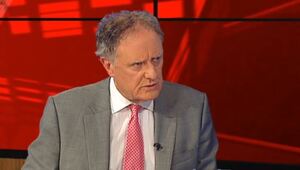
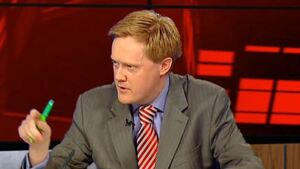 Political editor of the Irish Independent Fionnan Sheahan appeared on Vincent Browne, alongside Constantin Gurdgiev, finance lecturer at Trinity College and Ian Kehoe, assistant editor of the Sunday Business Post, last night to speak about the Anglo Tapes.
But first there was some ‘sickening’ bias’ business to deal with.
Vincent Browne: “Fionnan, let’s talk a bit about the tapes and their provenance. I gather that you had the tapes, or Independent Newspapers, had the tapes for quite a while before you published them?”
Fionnan Sheahan: “Yeah, we’ve had them for a while. Obviously you’d put a lot of research into a story like this Vincent before putting it out there. That’s normal journalistic practice.”
Browne: “And how long did you have them?”
Sheahan: “For a while.”
Browne: “Can you tell us how long?”
Sheahan: “No.”
Browne: “Why not?”
Sheahan: “Why should I?”
Browne: “Because I’m asking you. And I’m sure…”
Sheahan: “We’ve had them for a while Vincent. And we were using the time, within which to actually, to actually gather information about this, about the significance of it and so on and so forth, and get photographs.”
Browne: “But I’m just asking you ‘how long’, you don’t have to tell us the exact number of days but all right, OK. OK, like if politicians behaved like that…we don’t.”
Sheahan: “No Vincent, you spend so much time showing your bias towards Independent Newspapers, it’s getting sickening at this point.”
Browne: “All right.”
Sheahan: “Can you not just acknowledge it’s a good story and move on. Is that too much for you, is it?”
Browne: “Of course it is a good story.”
Sheahan: “Yeah, right, I didn’t hear you say it.”
Browne: “No, I didn’t say it because it’s not…I don’t have to say it.”
Sheahan: “I’m sick, I’m sick of your attitude towards the Irish Independent.”
Browne: “Do you have a problem?”
Sheahan: “I do, I do Vincent. I do have a problem.”
Browne: “You do?”
Sheahan: “I do, when you bring a colleague of mine in here a couple of weeks ago and just kick him around for your fun. So can you not just acknowledge in this case Vincent, it’s a perfectly good story and let’s talk about it.”
Browne: “Let’s get on with it. And let’s get rid of this problem that you have, or rather let’s ignore it.”
Sheahan: “It’s not a problem I have.”
Browne: “Ignore the problem, let’s get on with it.”
Sheahan: “It’s a problem you have with the Irish Independent.”
Watch here

 205 GTi: Peugeot’s high-performance 205 GTi helped coin the term ‘hot hatch’ during the 1980s. Production began in 1984 and offered a 1.6 and 1.9 version, the latter including all-round disc brakes. Production ended for the 1.6 in 1992 due to emission regulation though the 1.9 continued for a short while after, albeit with reduced power output due to a catalytic converter. This 1993 model is one such though it is still in impeccable condition.
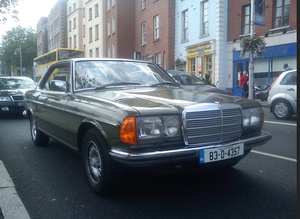
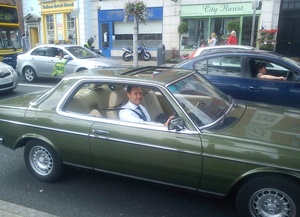 Mercedes W123 Series: Although the W123 series is not the rarest of Mercedes’ classic cars, this version is a pillarless coupe model. You will notice that there is no pillar separating the front window from the rear. This is a 280CE version if I recall correctly.” (I asked the owner if he minded me taking the snaps and he was more than happy to allow them)

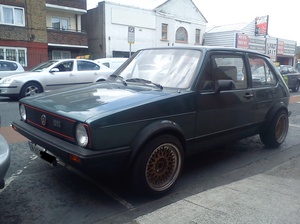 Golf GTi: The 205 (top)’s German rival from Volkswagen: the Golf GTi. It was marketed at the VW Rabbit in the US and this left-hand drive version seems to have been labelled as such, though it has European plates. This example has been lowered in classic VW fashion and boasts some nice alloys.
Pics and text: Patrick ‘Carspotter’ Cummins.


A few words of advice from Tom Lyons, author of The FitzPatrick Tapes, Fingers and deputy business editor at the Sunday Independent.
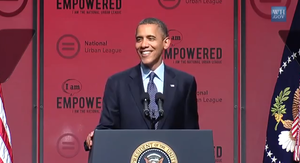
Barack Obama sings the hit of the summer.
Stay tuned for Clare Daly’s version of Blurred Lines.
Previously: Barack Knows You’re Beautiful