
Yearly Archives: 2014


eamon

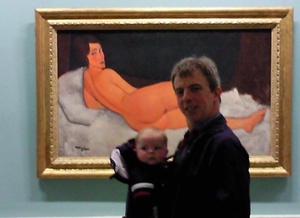
[Eamon Delaney with his son Ciaran and a Modigliani]

Fine Gael Minister Frances Fitzgerald’s proposal to split the current standard State maternity benefit of 26 weeks between both partners is welcome, writes Eamon Delaney.

Sometimes it’s as if nothing has changed. When did you last read an article or survey asking if men are ‘helping out with the housework’? Or posing a question in relation to a father’s ‘involvement’ in the lives of his children? Not very long ago, I’d guess. Like the father was some kind of fire brigade service, only needed in emergencies, rather than a full time presence, doing every bit as much as the mother does. For this, surely, is what most parenting actually amounts to in the modern era: a 50/50 split between two partners. Indeed, any man not fully sharing the housework nowadays should be shown the door.

….I would be a good example of this family ‘work set-up. I work from home as a freelance writer, while my wife has two separate job assignments, in film and social media, that require her to leave the house for two or three days a week. If I have to go to a radio or TV station, she can be at home. We have two children, a five-year-old who has started school and a three-year-old still at home, so we see a lot of the kids, which is fantastic and, far from disturbing our work, it benefits both our parenting lives and our work lives.

When the kids were born, there is no doubt that both of us could have done with parental leave had we been in full-time jobs. Most of the follow-up demands of parenthood are suffered (if that is the word) equally, by both parents – sleep deprivation, general disruption and full-on child maintenance.”

“…Currently, some 23,000 women take maternity leave every year at a cost of €300 million to the State. But the reality is that many women do not feel that they need the full amount of leave and are, in fact, anxious to get back to work. Many feel indeed that such a long period of leave can also act as an inducement to stay away from the workplace altogether, reinforcing that old fashioned concept of atending to ‘motherly duties.’”

“…But Minister Fitzgerald’s proposal would have a wider societal significance since it would challenge the idea of the mother as principal child-raiser, which is quite simply now an outdated idea, plainly unfair, and still holding women back. Some employers discriminate against women in job interviews because of fears that six months of maternity leave will at some stage become a reality. So the Minister’s proposal has an obvious benefit – employers would view prospective workers equally, irrespective of gender, as male and female workers would get equal access to leave.”

Need it be said….FIGHT!

Giving maternity leave to both parents would empower both and recognise reality (Eamon Delaney)

Leee

The River Lee bursts its bank in Cork city this morning.

Damian Ó Laocha

Youghal

John Finn tweetz:

What remained of Youghal’s boardwalk [in east Cork] has been pummelled by the sea this morning. Very sad.

Trampic
Tramore this morning by Brendan St John. Via Gavan Drohan

Tramoree

Tramore Tourism writes:

John Crowley just sent Tramore Tourism this amazing photo of a giant wave hitting the Pier in Tramore. The pier storm wall is 30ft high so you can call a height on it yourself. Answers on a post card please…. What height is this wave?

Tramorre

Tramore Tourism writes:

Storm is surging over Tramore Promenade. Please everyone stay well clear of the beach area this morning. Do not attempt to drive anywhere along the beach front! The tide is dropping but the swell & wind is still increasing. Big thanks to Tony Power for this amazing photo. Stay safe out there people.

Tramoremark

Beautiful Ireland Photography writes:

A wall of water going up then the wind takes over and it crashes back to earth with a big splash flooding all around it. Amazing sight. Nature at its best but you got to be at your most careful. Tramore County Waterford [last night].

MizenHead

Best Photo’s of Baltimore writes this morning:

A calm day at the Mizen Head the other day! 50ft swell expected to hit the coast here later and I hear An Siopa in Cape Clear has already lost its windows and is flooded. Be safe everyone.

Picture by Pierce Higgins


display display2
https://www.youtube.com/watch?v=Iz6KvO-Gvcc

Electronics giant Samsung’s vision of a future where everyone is connected via interactive displays.

Debuted at a recent investor conference, this rather idealistic promo showcases a day in the life of a tech-linked Korean family.

Coffee cup interface. Now that’s the future right there.

pocketlint

village

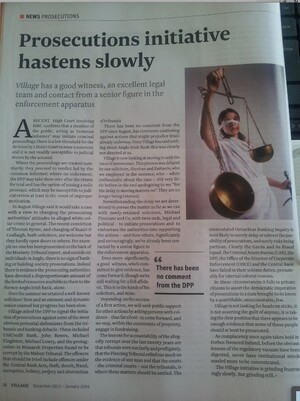
[From the current issue of Village magazine]

Village magazine’s struggle for accountability in a world gone unnaccountable continues at a somewhat frustrating pace.

We asked Legal Coffee Drinker what it’s all about.

Broadsheet: “Legal Coffee Drinker, what’s it all about?”

Legal Coffee Drinker: “The right of private prosecution is a common law right which traditionally gave a private individual the right to initiate a criminal prosecution and continue that prosecution up to a certain stage in the criminal process, at which point the Director of Public Prosecutions (DPP for short) could decide whether or not to continue.”

Broadsheet: “Up to what stage, exactly?”

LCD: “Well, traditionally, indictable offences (offences capable of being tried by jury, which are really the only ones anyone is interested in for the purposes of white-collar prosecution) were subject to an initial preliminary examination in the District Court for the purpose of deciding whether or not there was an adequate case to return for trial. The private prosecutor got to continue the prosecution up to the very end of the preliminary examination process – giving them the chance to put evidence forward as part of this preliminary examination which might pressure the DPP into continuing with the prosecution.”
As stated by the Supreme Court (O’Dalaigh CJ) in State (Ennis) v Farrell [1966] “[a] private prosecutor who had adduced sufficient evidence to effect a return for trial might, as a general rule, rest assured that the Attorney General would thereafter carry the case to trial before judge and jury”.

Broadsheet: “So what happened if the DPP didn’t agree that the case should proceed? Could the judge send it through nonetheless?”

LCD: “No. However the private prosecutor could, in such circumstances, apply to the High Court to compel the DPP to move the case forward, by way of an application for judicial review of the DPP’s decision. To succeed it would have to be shown that one or more of the grounds for judicial review was present: that the DPP was acting unreasonably (the standard of proof here is very high), had ignored relevant considerations or had taken into account irrelevant considerations; had failed to act in accordance with fair procedures, with the evidence adduced at preliminary examination being put before the court as part of this review.”

Broadsheet: “And is this still the case?”

LCD: “No. The difficulty currently faced by private prosecutions is that the preliminary examination procedure in the case of indictable offences has been abolished by the Criminal Justice Act 1999. In Kelly v Ryan [2013], the case involving a private prosecution of IRBC officials referred to in the Village article, it was argued that this removed the right of private prosecution in the case of indictable offences, by effectively rendering such right redundant – the private prosecutor no longer had the opportunity in preliminary examination to put evidence before the court which could either pressure the DPP into continuing with the prosecution or show her decision not to prosecute was unreasonable or based on an irrelevancy.”

Broadsheet: “And did this argument succeed?”

LCD: “No. The High Court judge hearing the case, Judge Hogan, took the view that the right of private prosecution survived the coming into effect of the 1999 Act – at least in theory. He pointed out that the Supreme Court in Ennis had held that the right could only be abolished by clear language and there is no express statement in the 1999 Act regarding its abolition. Accordingly it must be taken to still subsist.”

Broadsheet: “Wonderful. Full steam ahead for private prosecutions then?”

LCD: “Not that simple [Drains coffee] Judge Hogan’s judgment – which is under appeal to the Supreme Court – accepts that the right of private prosecution still exists in theory. However in practice its significance has been reduced by the 1999 Act. The abolition of the preliminary examination procedure reduces the ability of the private prosecutor to put forward a case strong enough to publicly pressure the DPP into continuing with the case and/or make her decision not to do so judicially reviewable.”
“Judge Hogan’s decision confirms that there remains a right of private prosecution in respect of indictable offences. What still has to be determined is the value of that right in the absence of a preliminary examination process. We’re unlikely to find this out for some time since the effect of the pending Supreme Court appeal against Kelly Vs Ryan is to effectively put all private prosecutions on hold for the time being. As mentioned in a previous post, Supreme Court appeals are currently taking some time to be heard. [Drains coffee].”

Broadsheet: “It sounds like another case of ‘justice delayed is justice denied’ as the old saying has it?”

LCD: “Are we done?”

Broadsheet: “We are. Thank you Legal Coffee Drinker. Happy new year from all of us at Broadsheet.”

LCD: “Right bye.

 Previously: Village Vs State

Village magazine

thomas helenjoe john

From top: Thomas & Helen, John and Joe.

Further to Donal Moloney’s series on the homeless in Dublin.

Donal writes:

Thomas and Helen are both travellers. They met two weeks ago shortly after Thomas had been released from prison for being drunken & disorderly. Thomas says: “We just clicked”. . Thomas is 32 but says he feels “60”. He has 6 brothers and 5 sisters. He has been sleeping in the doorway [top] with Helen since his release 2 weeks ago. He has been homeless for 9 years. He expects to serve another short prison sentence in the near future on other charges of being drunken and disorderly. Helen is 25 and was made homeless more recently
Joe [above] is a heroin addict and homeless many years. He has been married twice and has a few kids. As a teenager he moved to New York and became a carpenter. He was a heavy drinker and consumed “3 bottles of whiskey a day”. He loves to read as does his mate John [middle] (20 yards down the street). It takes them “away from the day”.

Donal Moloney

Previously: Caring For The Pigeons