

Stout loving Seoull Korea tourism student Byeongyoon beseeches interested parties to help make his Irish dream come true.
Mmf.
Anyone?
Thanks Donie O’Sullivan
Meanwhile…

An illustrated Irish plea from Korea.



Stout loving Seoull Korea tourism student Byeongyoon beseeches interested parties to help make his Irish dream come true.
Mmf.
Anyone?
Thanks Donie O’Sullivan
Meanwhile…
An illustrated Irish plea from Korea.

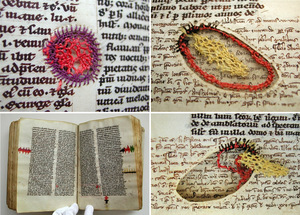
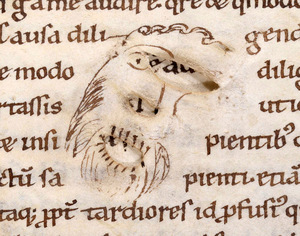

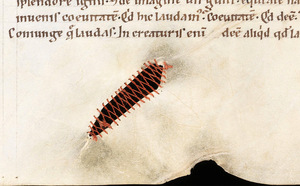

Investigations by Dutch book historian Erik Kwakkel into the art of creative parchment repair in the Dark and Middle Ages by scribes who – in order to deal with blemishes in the costly cow and sheepskin membranes they worked on – used cheeky doodles and imaginative embroidery to incorporate them into the texts in a style similar to the Japanese restoration art of kintsugi.
MORE: The Skinny On Bad Parchment (Erik Kwakel, Medieval Books)
Previously: Colours Of 1692

This afternoon.
Barney and Bob the Builder outside Tesco, Bailieborough, Co. Cavan.
Julie writes
Barney looking very pleased for himself. A possible explanation may be illustrated on the glass behind him. Every little helps…
Splutter.

Guts.
A bimonthly magazine of confessional writing, personal essays and internal organ spilling published in tactile PRINT form.
Nialler9 writes:
Guts is a new magazine filled with confessional essays and fiction from Irish writers like Maeve Higgins, Eithne Shortall, Neil Watkins, Laurence Mackin, Megan Nolan, Daniel Gray, Padraic E Moore and me put together by Roisin Agnew. Issue 1 with the theme The Heart Is a Lonely Hunter features artwork from Mick Minogue and design by Shane McKenna. There’s a Kickstarter to raise all the funds for printing with decent rewards that’s got off to a good start…

Ah here.
President Michael D Higgins at the Lilongwe University of Agriculture and Natural Resources in Malawi, where he delivered a keynote address titled ‘Ireland and Malawi: Working Together to Achieve Food Security’ on the eleventh day of the President’s 22 day official visit to Ethiopia, Malawi and South Africa.
(Aras/Photocall Ireland)


Interim Garda Commissioner Noirin O’Sullivan (centre), with, from left, Cyril Dunne, Chief Administrative Officer An Garda Siochana, and Acting Commissioner Dublin Metropolitan Region John Twomy at the Dublin Metropolitan Region Area Office, Harcourt Square, Dublin yesterday.
Bodger has just finished the door stopping Garda Inspectorate report on the investigation of crime in Ireland.
Herewith Bodger’s ‘At A Glance’ guide:
More than 1,000 garda staff and members were interviewed
Around 1,500 PULSE crime and incident records were examined.
Some 158 calls for service, made by members of the public, were randomly selected. All information on the 158 calls was requested and the full process of crime investigation over 12 months, from reporting, to recording, to investigation, to prosecution was tracked.
44 of the 158 calls reviewed were not recorded on PULSE.
Based on a sampling of 500 PULSE crime records, the Inspectorate found 30%
to be incorrectly classified and insufficient detail in 16% of cases to determine
if the classification was correct;
Of the 158 Volume Case Reviews, 114 were recorded on PULSE, of which 90
were designated as a crime;
• The Inspectorate disagreed with 32% of the classifications shown on PULSE.
There was insufficient detail to make a determination in 6% of cases;
• Assaults had lower rates of correct classification (38%);
Approximately 420,000 Review/Clarifications issued to members by GISC staff
seeking further information, or in some cases clarifying crime classification,
are outstanding;
8.5% of all crimes recorded on PULSE were reclassified over seventeen month
period from January 2011 to May 2012;
• Inspectorate selected eight crime categories and examined 2,372 crimes
reclassified between January 2011 and May 2012 in the seven divisions visited;
• Six of the eight categories significantly moved to a lesser crime type;
• In 83% of cases, reclassification resulted in a crime moving to a less serious
offence;
• The greatest percentage movement to a lesser crime took place in the categories
of burglary, robbery and assault harm;
In focus groups with members, it was highlighted that crimes are sometimes
reclassified incorrectly or changed to a non-crime category;
• PULSE records were viewed by the Inspectorate in which gardaí had recorded
on PULSE that they had reclassified a crime as a result of directions from a
supervisor;
The Inspectorate directly accessed the PULSE system and sampled 393
reclassified incidents from live PULSE incident records. A database was created
with detailed information from each record:
• Inspectorate found 71% of crimes incorrectly reclassified with insufficient
information to make a determination in 11% of the cases;
• No recorded rationale to explain the reclassification in many cases;
• In the majority of cases the initial classification was correct;
There are approximately 700 untrained detectives;
Some detectives investigated 100 crimes a year and some less than ten crimes
per year;
In 43% of the cases that were investigated by the gardaí, there were no updates
on PULSE in the twelve months following the creation of the record;
Since 2005, approximately 5,000 gardaí have joined the Garda Síochána and a
large majority of those gardaí have not received any or appropriate interview
techniques training;
Only 45% of fingerprints were taken in 2012/13 for those detained in garda
stations who should have had fingerprints taken;
• In 2013, of all persons who should have had fingerprints taken, 66% were not
taken
The Inspectorate requested detection data from the Garda Síochána in the form of a PULSE search of key volume crime areas in a three month period in 2012 of the seven districts visited:
• Of 2,195 crimes reported, 946 were recorded on PULSE as detected, resulting
in a detection rate of 43%; only 390 of the total detections had a charge or a
summons attached to the PULSE incident. On examination, the Inspectorate’s
view is the correct detection rate is 26%
• Inspectorate examined 318 of the 556 PULSE incidents where there was no
charge or summons recorded.
RUN!
(Mark Stedman/Photocall Ireland)

Roselawn Cemetery and Crematorium, outside Belfast

Almost two tonnes of metal has been collected from the ashes of cremated bodies in Northern Ireland over the last four years as part of a recycling scheme, but bereaved families were not told, The Detail can reveal.
Precious metals including jewellery, gold teeth and fillings, as well as metal hips and nails from coffins are routinely collected from the site of Northern Ireland’s only crematorium in a process that began in 2010.
The materials are shipped to the Netherlands where a specialist company sorts the metals, with some being re-used in the construction of objects as diverse as road signs and aircraft engines.
Recycled material, it’s all relative.™


Created as a promo for the release of A Walk Among The Tombstones, The Liam Neeson Kill map charts the filmic trail of slaughter left behind by He Of A Certain Set Of Skills.
Giant version here.

The second series of acclaimed TG4 drama Corp + Anam.
With a poster designed by Annie Atkins , the Dubliner responsible for The Grand Budapest Hotel (2013) posterage.
Joanne writes:
The second series of TG4’s award winning drama Corp + Anam starring Diarmuid de Faoite and Maria Doyle Kennedy returns on Thursday, November 27 at 9.30pm. Produced by Galway based production company Magamedia, this second series has recently been nominated for the highly prestigious Prix Europa TV Awards held later this month in Berlin.
Corp + Anam is TV crime drama, with a heart of darkness. In series 2, dogged TV crime correspondent Cathal Mac Iarnáin (Diarmuid de Faoite), buries himself in his investigative journalism and launches a personal crusade against the Irish judiciary, while his marriage to his solicitor wife Mairead (Maria Doyle Kennedy) flounders. This hard hitting new series shines a light on one of the darkest corners of our society – the deep-rooted corruption of the Irish legal system. Series 2 is sure to ruffle feathers as it pulls no punches with the legal eagles…
Troid!
