


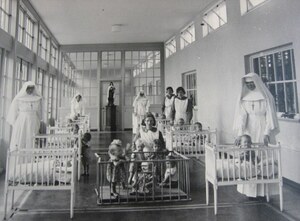
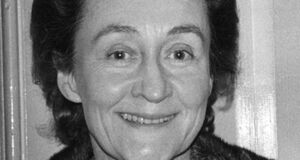

Mother and Baby home (top); Professor Irene Hillary of UCD and Glaxo SmithKline logo
Guess what?
Everyone lied.
Via Conall Ó Fátharta in The irish Examiner:
A previously unknown fifth vaccine trial was carried out by Glaxo Laboratories on more than 30 young children here in the 1960s. The pharmaceutical giant GlaxoSmithKline (GSK), has previously stated only four trials were carried out in the 1960s and 1970s. These trials were carried out by the Wellcome Foundation — a GSK “heritage” company. However, documents uncovered by Michael Dwyer of UCC’s School of History, shows that a fifth trial of a measles vaccine on 34 children took place in 1965. It was carried out by Irene Hillary and Patrick Meenan of UCD’s microbiology department and AJ Beale of Glaxo Laboratories.
Fifth Vaccine Trial Exposed (irish Examiner)
The revelation of a fifth vaccine trial casts a new light on the statements and denials over the years from GlaxoSmithKline (and before that Wellcome), the Department of Health/HSE and the two UCD medics responsible for administering the vaccines, Patrick Meenan and Irene Hillary
Herewith then an updated timeline of the known medical trials conducted on children in Mother and baby homes in Ireland, the response of successive health ministers and the contemporaneous expansion and investment in Ireland of the medical companies involved in those trials.
1930-5: Burroughs-Wellcome trials (“the 1930-35 trials”) of the APT (Alum-Precipitated Toxoid) vaccine for diphtheria carried out on 2000 children in residential institutions. Stage 1 of the trials took place in 1930 and include 405 children in residential institutions in Cork City, most likely the St Joseph’s Industrial School for Boys, run by the Presentation Brothers, and St Finbarr’s Industrial School for Girls, run by the Sisters of the Good Shepherd. Children taking part in Stage 1 suffer severe adverse reactions. Stage 2 of the trials takes place in 1934 and includes 320 children from residential institutions. Again adverse reactions are recorded. Stage 3 takes place in 1934 and involved 250 children from an unidentified institution for boys and Stage 4 takes place in 1935 and involves 360 children from St Vincent’s Industrial School, Goldenbridge, St Joseph’s School for Deaf Boys, Cabra, and St Saviours’s Dominican Orphanage, Lower Dominic Street.
1961: Burroughs-Wellcome trial (“the 1961 trial”) of the effectiveness of the polio vaccine when added to the three-in-one (whooping cough, diphtheria and tetanus) vaccine carried out by Prof Patrick N Meenan and Dr Irene B Hillary (“Meenan and Hillary”) of University College Dublin on 58 children in residential institutions only one of which (Bessborough, Co Cork) is identified. 28 of these children receive the proposed quadruple vaccine, with 30 getting the separate three-in-one and polio vaccines. The study concludes that there is a lower polio antibody response in those given the quadruple vaccine, and that it may, therefore, be less effective. Sixteen of 25 infants from one home develop vomiting, diarrhoea and fever after their second immunisation. Their symptoms last a few days before complete recovery. Some 36 infants from both groups are subsequently identified as having an inadequate polio antibody response, and receive booster doses. There is no further follow-up of the children involved.
1964-5: A further Burroughs-Wellcome trial of a measles vaccine (“the first 1965 trial”) is carried out by Meenan and Hillary on 12 infants aged between nine and 19 months in the Sean Ross Abbey mother-and-baby home in Tipperary.
The same year, another trial of a measles vaccine (“the second 1965 trial”) was carried out by Meenan and Hillary in conjunction with another pharmaceutical company, Glaxo, on 34 children aged between 8 months and just over 2 years. Although the location of the second 1965 trial is not known, its description in the Lancet (August 1965) indicates that it took place in a controlled institutional environment.
It appears that at least one further vaccine trial (“the third 1965 trial”) also took place in 1965. The medical records of Philip Delaney at Bessborough Mother and Baby Home, Cork, note a ‘five in one’ vaccine having been administered to him that year, as part of a vaccine trial.
1971: Burroughs-Wellcome trial (“the 1971 trial”) of intra-nasally injected rubella vaccine carried out by Burroughs Wellcome on 69 children in unidentified residential institutions. 11 children with no rubella antibodies and one with receive the intra-nasal vaccine, while six others without antibodies are used to monitor whether the vaccine virus was transmitted. There is no follow-up.
1973: Burroughs-Wellcome trial (“the 1973 trial”) of a modified three-in-one (diphtheria, whooping cough and tetanus) vaccine is carried out on 53 children (including mentally and physically handicapped children) in residential institutions in Dublin (St Patrick’s Home, Madonna House, the Cottage Home, the Bird’s Nest and Bohernabreena), all of whom receive the modified vaccine. The trial also includes 65 children living at home, 61 of whom receive the original vaccine. Some of the residential institutions mistakenly believe that their residents are getting the original vaccine.
1977-1984: Following concerns as to the safety of the three-in-one vaccine generally, then Health Minister Michael Woods sets up an Expert Medical Group (“the Expert Medical Group”) to deal with applications by persons alleging to have been brain damaged by the three-in-one vaccine. There are 93 applicants, 16 of which were offered ex gratis payments with 77 applications being declined. It is not known whether or not any of the applicants included children who had formed part of the 1973 trial or indeed whether or not the Expert Medical Group considered the 1973 trial at all.
1979: Construction of new £1.25 million Wellcome Ireland Limited factory in Tallaght commences.
1981: The Irish Times reports that since 1975 the Wellcome Foundation has donated £240,000 to Irish veterinary research.
1992: Supreme Court decision in Best v Wellcome, a case successfully brought by Kenneth Best for brain damage caused by a batch of the original three-in-one vaccine. Chief Justice Liam Hamilton found Burroughs-Wellcome to have been negligent and awarded Best £2.75 million.Continue reading →


