
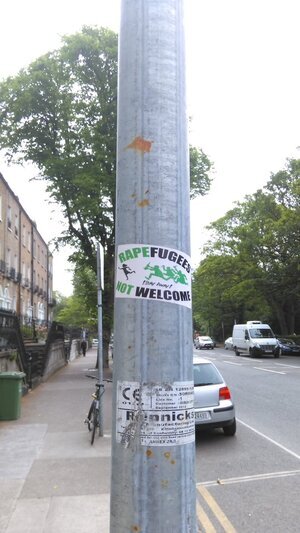

This morning.
Before and after.
Thanks Mark Maguire



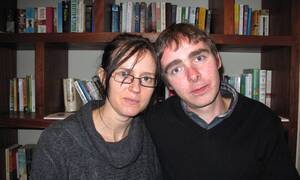
UN logo; Amanda Mellet and her husband James Burke
The United Nations Human Rights Office of the High Commissioner writes:
A woman in Ireland [Amanda Mellet] who was forced to choose between carrying her foetus to term, knowing it would not survive, or seeking an abortion abroad was subjected to discrimination and cruel, inhuman or degrading treatment as a result of Ireland’s legal prohibition of abortion, UN experts have found.
The independent experts, from the Geneva-based Human Rights Committee, issued their findings after considering a complaint by the woman, AM, who was told in November 2011 when she was in the 21st week of pregnancy that her foetus had congenital defects, which meant it would die in the womb or shortly after birth.
This meant she had to choose “between continuing her non-viable pregnancy or travelling to another country while carrying a dying foetus, at personal expense and separated from the support of her family, and to return while not fully recovered,” the Committee said.
AM decided to travel to the UK for a termination and returned 12 hours after the procedure as she could not afford to stay longer. The UK hospital did not provide any options regarding the foetus’s remains and she had to leave them behind. The ashes were unexpectedly delivered to her three weeks later by courier.
In Ireland, she was denied the bereavement counselling and medical care available to women who miscarry. Such differential treatment, the Committee noted, failed to take into account her medical needs and socio-economic circumstances and constituted discrimination.
“Many of the negative experiences she went through could have been avoided if (she) had not been prohibited from terminating her pregnancy in the familiar environment of her own country and under the care of health professionals whom she knew and trusted,” the Committee wrote in its findings.
The Committee said that, in addition to the shame and stigma associated with the criminalization of abortion of a fatally ill foetus, AM’s suffering was aggravated by the obstacles she faced in getting information about the appropriate medical options.
Ireland’s Abortion Information Act allows healthcare providers to give patients information about abortion, including the circumstances under which abortion services can be available in Ireland or overseas.
But under the law they are prohibited from, and could be sanctioned for, behaviour that could be interpreted as advocating or promoting the termination of pregnancy. This, according to the Committee, has a chilling effect on health-care providers, who struggle to distinguish “supporting” a woman who has decided to terminate a pregnancy from “advocating” or “promoting” abortion.
Ireland, which is a State party to the International Covenant on Civil and Political Rights (ICCPR), is obliged to provide AM with an effective remedy, including adequate compensation and psychological treatment she may need, the Committee said. Ireland is also obliged to prevent similar violations from occurring.
“To this end, the State party should amend its law on voluntary termination of pregnancy, including if necessary its Constitution, to ensure compliance with the Covenant, including effective, timely and accessible procedures for pregnancy termination in Ireland, and take measures to ensure that health-care providers are in a position to supply full information on safe abortion services without fearing being subjected to criminal sanctions,” the Committee’s findings said.
In its observations to the Committee on AM’s claims, Ireland said that the country’s constitutional and legislative framework reflected “the nuanced and proportionate approach to the considered views of the Irish Electorate on the profound moral question of the extent to which the right to life of the foetus should be protected and balanced against the rights of the woman.”
The Human Rights Committee considered this case under the First Optional Protocol to the ICCPR Covenant which gives the Committee competence to examine individual complaints.
Read the UN’s findings in full here
Related: Ireland abortion laws breach human rights, rules UN (The Times Ireland edition)
Previously: Another Victory For ‘Balance’
‘It’s A Sensitive Issue That Must Be Teased Out Very Carefully’

I’m baffled, outraged and perplexed
To read that young Irish folk sext
When I was a lad
We did nothing bad
Whatever will they think of next?
John Moynes

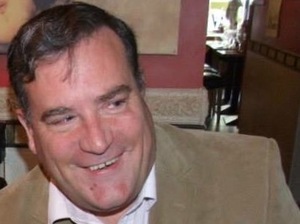
From top: Green Party leader and Minister for the Environment John Gormley following the result of the secend Lisbon Treaty referendum, September, 2009; Dan Boyle
The author examines his own voting record on Europe integration and argues that it was never based on opposition to the idea of a European Union or the need to detach ourselves from it.
Dan Boyle writes:
I was nine years old when Ireland voted to become what was then known as the European Economic Community. I had barely been in the country for a year, my family having moved from the United States to my mother’s hometown of Cork.
Even at that stage I had been socially conditioned enough to realise that you should not tilt against the crowd. The message was simple – Yes to joining was good; No to not joining was bad.
The Labour Party offered what passed for opposition to that proposal then. They and the trade unions also spoke then with the same voice. A neighbour identified himself as a No voter. I thought him mad. In the end less than one in five of those who came out to vote voted No.
The government and the political establishment were pleased with the outcome. They presumed that having voted the people would never have to vote again, the issue having once and finally been decided.
Fourteen years later that establishment reckoned without the dogged determination of Raymond Crotty, who won an important Supreme Court decision that any change to the Treaty of Rome would also be a change to the Irish Constitution, which would always require a referendum of the Irish people.
By then I had reached the physical age (if not the emotional maturity) of being an adult. I got to vote in the referendum on the Single European Act. I voted No.
Labour now in government sought a Yes vote. Of all the political parties represented then in Dáil Éireann, only The Workers Party articulated a No position.
In the subsequent referenda – Maastricht, Amsterdam and Nice (twice), along with The Greens, I continued to vote No. The reasons were many, and to my mind still quite valid.
What they were never was based on opposition to the idea of a European Union or the need to detach ourselves from it.
There was, and continues to be a fear about some nations within the Union being seen as more equal than others. More than a concern of the existence of a democratic deficit.
A headlong rush into aspects of becoming a single unitary state such as a single currency or the idea of a common army; that were either ill thought out or were never necessary, brought about obvious concerns and doubts.
By the time the Treaty of Lisbon required ratification The Greens were in government in Ireland. It caused considerable debate within the party.
I rationalised a Yes vote on the basis that Lisbon at least corrected some of the worst aspects of Nice. I also voted Yes to the Fiscal Treaty. This was despite having voted against Maastricht because of the way a single currency was being introduced in such an unthought through way.
In 2012 we hadn’t a choice to change course.
Having established residence in Wales to participate in the Welsh Assembly election, I find myself now entitled to vote in the Brexit referendum there.
Unlike all the Irish referenda, Brexit isn’t about a better Europe.
It’s about a mythical Britain. It isn’t about protecting or enhancing the role of nation states. It’s about pandering to bitter isolationists whose superior sense of being can’t abide a World where nations need to co-operate with each other.
My having a vote in this referendum may be a quirk, but this is one windmill I will enjoy tilting at.
Dan Boyle is a former Green Party TD and Senator. Follow Dan on Twitter: @sendboyle


Niall Gubbins writes:
Spotted in Fields Supervalu in Skibb at the weekend. The dancing in the music video is only glorious.







MORE to folly.

Taoiseach Enda Kenny speaking about the 8th amendment in the Dáil last week
You may recall Taoiseach Enda Kenny’s comments about the 8th amendment last week.
And the subsequent appeal for him to correct the Dáil record.
Earlier today, during Order of Business, the opportunity for him to correct the record arose when Social Democrat TD Catherine Murphy raised the matter.
Catherine Murphy: “Will the Taoiseach confirm that the Cabinet discussed the preparation of legislation for the IBRC Cregan inquiry? Is there a timeline for that and the changing of the terms of reference for the inquiry?”
“The €12 million diverted from mental health appears now to have been, more or less, put back into the mental health area. It was diverted, we were told, because there was insufficient time to recruit the staff. Is it envisaged that the money will be diverted for the recruitment of staff and is there some sort of a changed mechanism for doing that?”
“The other day in a debate, the Taoiseach made some erroneous points relating to the eighth amendment to the Constitution, particularly that there had been several referenda about the eighth amendment. Will he take the opportunity to correct the record on that particular issue? We have not had a referendum on it for 30 years and there are different elements.”
Enda Kenny: “Following the meeting I had with the Deputy and other parties last week, I can confirm that this morning the Government approved the drafting of a Bill in respect of the general scheme of the commissions of investigation dealing with IBRC.”
“That was the approval of the urgent drafting of legislation to enhance the powers of the commission of investigation into IBRC along the lines of a general scheme that we discussed, together with all the consequent challenges that lie therein. Second, the Government noted the approach proposed regarding the revision of the terms of reference for the commission of investigation into the Irish Bank Resolution Corporation following consultations by me and Ministers with members of the Opposition parties.”
“We discussed the drafting of legislation to allow for this in modular form, to have terms of reference to allow an investigation into the Siteserv issue, which is a matter of public concern raised here on many occasions, and the allowing of future modules to be inserted into that, if necessary. Approval was given for that this morning.”
Ceann Comhairle Seán Ó Fearghaíl: “There are two other matters.”
Kenny: “The Minister for Health met representatives of the Psychiatric Nurses Association of Ireland last Friday. The money has been restored in full for what was originally intended for mental health and the Minister of State, Deputy McEntee, will outline the details of how it is to be spent. With regard to recruitment, there will be a focus on attracting psychiatric nurses back to Ireland and more places for psychiatric nursing training.”
“I answered a question to Deputy Bríd Smith last week on the eighth amendment. This was put into the Constitution in 1983 and in February 1992 there was a Supreme Court judgment in the X case.”
“In 1992, there was also a referendum to reverse the X case judgment and that referendum was defeated, and there was also a referendum on the right to travel, which was passed.”
“In the same year there was a referendum on the right to information, which was also passed. In 2002, there was a referendum to reverse the X case judgment and that was narrowly defeated. I am just getting the chronological sequence right.”
“Although I know it is not the Deputy’s intention to have this treated in any way as a political football, it is a sensitive and profound issue that must be teased out very carefully with regard to action that might be taken by the people.”
“There would be a citizens’ assembly and the Dáil process to establish it if there is a consensus for change. That is very necessary and what I intend to do.”
Ruth Coppinger: “Is that the Taoiseach correcting the record?”
Michael Healy-Rae: “Taoiseach – turf.”
Micheál Martin: “Turf, is it?”
Healy-Rae: “Is it fair to say that the last Government made a grave error in banning farmers from cutting turf in certain bogs? I am referring to the priority legislation, the wildlife (amendment) Bill. Is it factual to say the last Government made a grave error in stopping farmers from cutting turf on certain bogs?”…
Previously: ReferEnda
‘The People Decided To Keep That Reference In The Constitution’
Transcript via Oireachtas.ie

Garda Commissioner Nóirín O’Sullivan and Justice Minister Frances Fitzgerald at the passing out ceremony for new gardaí in Templemore Garda College earlier today
From today you have full Garda powers. With such powers comes the great responsibility to use them appropriately, respecting the dignity of all persons you encounter in the course of carrying out your duties.
You have completed the first stage of what is a challenging and rigorous training programme and I congratulate you on that achievement. There is still much learning ahead of you before you are awarded your BA in Applied Police Studies.
In two weeks you will take up your assignments in Garda stations around the country. And I urge you to listen and learn from your tutors, assimilate their knowledge and experience, and use it to good effect as you serve local communities across this country.
Earlier I reminded myself of the principles of this great institution which has protected peace and security since the foundation of this State.
Honesty, accountability, respect and professionalism.
Principles are constant, they underpin everything you will do. But new ideas are the fuel that ensure these principles will continue to live and thrive and adapt to the realities of modern policing, an evolving police force, and a changing country.
So I urge you to bring your own fresh perspective and to share your ideas with your new colleagues across the Force.
The bond between An Garda Síochána and the community depends on trust and confidence. Public trust is earned by honesty, accountability, respect and professionalism. That is what the community expects from An Garda Síochána.
You will play an important role in your community and it is precisely because the service you will provide is so vital, so important to the well being of every citizen and our society as a whole, that you must ensure it is delivered to the very highest of standards.
The Report of the O’Higgins Commission of Inquiry identifies cases where standards were not met, where victims of crime were failed by An Garda Síochána.
That is as unacceptable as it is disheartening and we must take all actions open to us to ensure that these shortcomings are not repeated.
Victims must be at the heart of the Garda service.
In the past the needs of victims of crime have sometimes been overshadowed by a focus on apprehending and prosecuting perpetrators. We must ensure that our response to criminal behaviour is a comprehensive one while putting the needs of victims at the forefront.
I ask every one of you to think about what you can do to re-establish that trust and to ensure that victims of crime are well served when they come seeking your assistance and protection.
The Government is focused on bringing about improvements that will make An Garda Síochána the world class policing service that we all want it to be. To achieve this goal a number of reforms have taken place together with significant investment in resources.
Most significantly the new independent Policing Authority has been established to oversee the performance by An Garda Síochána of its functions relating to policing services. I look forward to the Authority playing an important part in the ongoing reform process.
Another important reform is in the law protecting whistleblowers. The Protected Disclosures Act 2014 ensures that there is a range of options open to those who want to report wrong doing. Now any Garda can have their complaints independently examined by the Garda Síochána Ombudsman Commission.
These are just two examples of important reforms that have taken place. As I have said on many occasions, there is no end to reform for any organisation. Reform is an ongoing journey of practical and cultural change that can never cease. As members, you must be open to new thinking and embrace change.
From a speech given by Justice Minister Frances Fitzgerald at the passing out ceremony in Templemore earlier today.
Read the speech in full here
Previously: Maurice McCabe And The Plastic Rat
Eamonn Farrell/Rollingnews

Finance Minister Michael Noonan
The Irish Times reports:
Minister for Finance Michael Noonan and Ryanair chief executive Michael O’Leary will both attend this year’s secretive Bilderberg conference which begins in Dresden, Germany on Thursday.
They will feature among a list of leading names in global politics and industry at the three day event where a number of topics are up for discussion including China, European migration, the Middle East, Russia and the US “political landscape”.
See full list of expected attendees here.
Michael Noonan to attend Bilderberg conference in Germany (Irish Times)
Rollingnews
