
Yearly Archives: 2016

90410131Julien-Mercille-hi-res-233x300

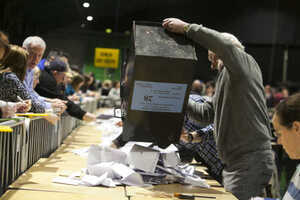
From top: The RDS count centre on Saturday; Dr Julien Mercille

Elections are exciting but real democracy happens between them.

Dr Julien Mercille writes:

Election talk has dominated the airwaves over the last few weeks. Left parties like Sinn Féin and the Anti-Austerity Alliance-People Before Profit have made important gains. Progressive Independents like Clare Daly and Mick Wallace have kept their seats.

So there is cause to celebrate…but not so fast.

Many commentators have declared that this is “democracy in action” and how beautiful it all was. The people have spoken and, allegedly, this is what democracy is all about, holding our politicians to account.

Yet, it is important to remember that electoral democracy is so shallow as to be somewhat irrelevant.

Voting once every four or five years and doing nothing in between is actually a way to protect the establishment from being really challenged. It is a way to keep the population out of all sorts of important decisions for the country and that will affect each one of us.

In other words, we need to deepen democracy.

I take “democracy” here to mean simply the condition in which people are able to decide over what matters in their lives, as opposed to having decisions imposed on them by those in power.

Significantly, deep democracy means cooperation among ordinary people, because that’s essential to becoming more free. We can’t increase our opportunities and expand our horizons without the assistance of others and without collaboration at the community and national levels, and beyond.

If we become atomised and individualistic, our opportunities will shrink and we will have to satisfy ourselves with a very limited existence.

This means that whatever the election results are, we must continue to extend democracy to the many areas where it is either non-existent or too shallow—and there isn’t a shortage of those in Ireland.

The objective is to give as much control as possible to people over their lives and to organise the economic, political and social spheres in a way that we can benefit as much as possible.

Deep democracy therefore includes:

Economic democracy: This involves a redistribution of resources so as to reduce inequalities and so that the products of work do not go disproportionately to a small corporate elite. It also involves giving those who work the right to decide about what goes on in the workplace, instead of being told what to do by their bosses and managers. We’re not cogs in a machine, we’re creative beings.

Social democracy: This means the right of everybody to decent housing and a decent education without discrimination based on religion or ethnicity or socio-economic class. It’s also about the right to quality health care whenever needed. So far, those services are organised to cater to the needs of the well off more than anybody else.

Gender democracy: This means giving women the possibility of making decisions over their own bodies. In Ireland, this means giving them the possibility to make their own choices about abortion. It also means doing away with all sorts of gender discrimination in the economic, cultural and political spheres which are too many to enumerate here.

But the fact is that very few of those will be won in the Dáil.

Parliaments mostly rubber-stamp legislation once people have organised and campaigned for it. Politicians need to be pressurised until it becomes too costly politically for them to ignore people’s wishes. As the saying goes, rights are not granted, they are won.

Therefore, when looking at the election, it will be easy to identify a number of progressive candidates who should have been elected but didn’t make it. Either they never came close to making it, or they lost in the very last rounds by a few dozen votes.

It’s disappointing, but one way to look at it positively is that those who didn’t achieve their electoral goals have not really lost.

They will continue to create very significant change outside Parliament, and that may sometimes actually turn out to be more useful than parliamentary work. Combining that to agenda-setting speeches in the Dáil by those who got in should make us hopeful.

So let’s get to work.

Julien Mercille is a lecturer at University College Dublin. Follow him on Twitter: @JulienMercille

Screen Shot 2016-02-29 at 12.54.28

A Slate Video compilation of some of the finest mots justes, acid quips and withering put-downs delivered by Dame Maggie Smith’s Dowager Countess of Grantham over the course of the Downton Abbey series.

laughingsquid

CcVYEKkW4AATcQl

How pro-life candidates fared in the election, so far, compiled by Fintan O’Toolbox

But what now?

Stephanie Lord writes:

Labour might have been confident that they could deliver a referendum on the eighth amendment, but pro-choice activists of all political stripes and none haven’t forgotten that they delivered legislation on X to allow for abortion where a woman would be a risk of dying that contained a 14-year jail sentence penalty for inducing a miscarriage.

And the horrifying case of teenage refugee pregnant as a result of rape enduring what was ostensibly a forced c-section at 25 weeks, despite medical professionals acknowledging that she was suicidal.

The #Repealthe8th campaign exists in spite of Labour, not because of it. Perhaps Labour in government after #ge16 would have delivered a referendum, but what would that have looked like?

Besides, Labour aren’t in government now, and unless there’s some kind of divine intervention over the next 12 hours it doesn’t look like they will be. They had five years to work to hold a referendum and didn’t.

We can acknowledge that Labour were in government when the Marriage Equality referendum happened but it was won because people mobilised and worked their rocks off to get it passed; People who were never involved in politics before came out alongside grassroots groups and got Ireland to a place where it said yes to valuing people as equals.

So instead of throwing the toys out of the pram and acting all hard done by, Labour activists would do better to channel their energies into the pro-choice campaign and work for a repeal of these laws.

There is nothing to be gained by trying to undermine the positivity of pro-choice campaigners by getting in a huff, throwing hands in the air and saying we should all just forget it now.

That said, it is difficult to ascertain just how much of a deciding factor abortion was in this general election given the number of Fianna Fail TDs that have been returned and their unwillingness to commit to a referendum – but there have been huge returns for independents and political parties who are very much in favour of holding a referendum.

The people of Dublin Bay South waved goodbye to Lucinda Creighton, one of the most staunch anti-abortion voices in the Dáil and while this is to be welcomed, this is not a time for pro-choice activists to rest on our laurels.

Clare Daly has championed reproductive justice and been returned to the Dáil alongside Joan Collins. Ruth Coppinger, Paul Murphy, Richard Boyd Barrett and Gino Kenny are all pro-choice.

Sinn Féin have a policy in favour of repeal the eighth. There is a recognition, even amongst conservatives such as Leo Varadkar and Frances Fitzgerald that a referendum is inevitable.

It is easier now to be pro-choice than it ever has been before and thanks to the work of pro-choice activists and an increase in public support, the stigma surrounding the subject is ebbing away.

Now is the time to send a clear message to the returned members of the new Dáil that a commitment to repeal the eighth amendment must form a part of any new Programme for Government.

Women must no longer be blocked from accessing appropriate healthcare. Public opinion on the need to repeal the law and provide legal abortion for women is far more progressive than what is represented in the Dáil now, even with the addition of the large range of socialist, republican and left of centre voices. This public opinion needs to be converted into action on the ground.

After #ge16, what now for #repealthe8th? (Stephanie Lord, Feministire)

Image: Fintan O’Toolbox

gettyimages-512945848

What you may need to know:

1. Huge congratulations to Benjamin Cleary who bagged the golden naked guy statue for Best Live Action Short with Stutterer.

2. Sadly Lenny Abrahamson, Ed Guiney, Saoirse Ronan, Michael Fassbender and Emma Donoghue all lost out in their respective categories, but the attention can only benefit the Irish film industry. And sure it’s an honour just to be nominated. *Unclenches teeth*

3. George Miller’s Mad Max: Fury Road was last night’s big winner with 6 wins. Alejandro González Iñárritu made it a double for The Revenant, but Tom McCarthy’s Spotlight bagged best picture.

4. The last time the Academy split the Best Picture/Director combo was in 2005 when Ang Lee’s Brokeback Mountain lost out to Mike Figgis’ Crash.

5.
The big surprise was Sylvester Stallone losing Best Supporting Actor to Mark Rylance. On the other hand, DiCaprio was practically on his way to collect the Best Actor statue before Julianne Moore had opened the envelope.

6. The official theme of this year’s ceremony was “We all dream in gold.” Unofficially, it was “The inherent racism of Hollywood.” Academy president Cheryl Boone Isaacs gave a “mea culpa” speech promising how things will be different next year

7. And host Chris Rock’s (above) opening monologue practically wrote itself (highlights included “If they nominated hosts, I wouldn’t even get this job”). Cue shots of the audience looking more uncomfortable than a scout troop at the taping of the 1975 Jim’ll Fix It Christmas Special.

8. Louis CK gave the best presenting speech for Documentary Short (“This Oscar’s going home in a Honda Civic”).

9. Weirdest moment: Sadly no John Travolta or Terence Howard Lady Gaga dressed as Vegas comeback special Elvis was as weird at it got.

10. Thank you count – Spouses/parents: 19. Agents: 3. George Miller was this year’s Wes Anderson with 6, and Ennio Morricone gave Harvey Weinstein a shout out, ensuring no PAs were hurt and restoring balance to the universe.

11. The Hollywood Reporter’s Brutally Honest Oscar Voter Ballot proved that academy members continue to vote in categories without watching all the nominated movies (Daniel Berger’s response is worth a look), and that nobody knows the difference between sound editing and sound mixing.

12. Broadsheet Verdict: A bit safe really. But at least there wasn’t a song-and-dance number.

Highlights of the 88th Academy Awards are on RTÉ2 tonight at 9pm.

This Trailer Park special was brought to you in association with the Angelus and Kissable Fierce by Katie Price – “a perfume for the evening”.

(Mark writes about film, TV and other stuff at WhyBother.ie)

Dáil_ChamberScreen Shot 2016-02-29 at 10.58.46

Make up of new Dáil seats as of 11am

Ten Dáil seats remain to be filled as several recounts get under way this morning.

The blue carpets will obviously have to go.

But how else would you like the new Dáil to look?

Pic: RTÉ

Extra Fox

Extra Fox – Lunar Float

Here’s what you may need to know…

01. Extra Fox is the nom-de-plume of Dubliner Neil Adams, formerly of many outfits, most notably the at-one-time much-fancied The Cast of Cheers.

02. Last week saw the release via Soundcloud of new single Lunar Float (streaming above), a beatsy track that plays with acoustic strings, handclaps, and an array of synths in looping, building fashion.

03. The project had its live debut last year, with support slots for fellow Cast of Cheers spinoff All Tvvins and Dublin outfit Sleep Thieves occurring after a string of singles going up on his Soundcloud.

04. It’s a tad more restrained than previous single Palm of Gold, mastered by Mati Schwarz (All Tvvins among others), an upbeat piece that marries a definite pop sensibility with biting vintage synth sounds.

Verdict: There’s much here to love for fans of electronica and Adams’ previous projects, but also taps into a rich vein of pop sensibility, providing further intrigue for math-rock nerds and casual listeners alike.

Extra Fox

0223varoufakis

Yanis Varoufakis

Sky News reports:

Former Greek finance minister Yanis Varoufakis has won a new role advising Jeremy Corbyn’s Labour Party.

Mr Varoufakis quit the Greek government in July last year after refusing to accept the terms of a third bailout, which imposed further austerity measures on the debt-stricken country.

Mr Corbyn says Mr Varoufakis has recently met shadow chancellor John McDonnell and will advise Labour in “some capacity”.

“Varoufakis is interesting because he has obviously been through all the negotiations (with the ECB, European Commission and International Monetary Fund),” he told his local newspaper the Islington Tribune.

“I think the way Greece has been treated is terrible and we should reach out to them.”

Ex-Greek Minister Varoufakis To Advise Corbyn (Sky News)

Related: Fintan O’Toole: The winner is social democracy (Irish Times)