From the Irish Fiscal Advisory Council’s latest report
The Irish Fiscal Advisory Council has released its latest report.
In its summary assessment, it warns:
“Successive governments have achieved considerable success in stabilising the public finances since the crisis. Following this, a new budgetary framework has been put in place to help to re-build the capacity to withstand future shocks, and to ensure that the economy does not overheat.
Strong adherence to the new framework is essential to avoid repeats of the policy mistakes that contributed to multiple economic crises in recent decades.
A strong cyclical rebound in the economy looks set to continue in the near term, suggesting that a further stimulus from fiscal policy is unwarranted.
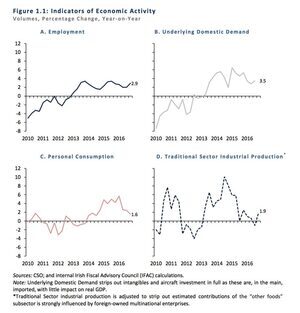
Looking further ahead, fiscal policy should be cautious reflecting still high debt levels and risks to long-term revenue and growth. A range of measures suggest that a sharp recovery in domestic output and the labour market continued throughout 2016 and into this year.
Although a “hard Brexit” is now considered the central scenario in the Stability Programme Update (SPU) 2017 – having previously been considered a risk – the timing and severity of its impact on the Irish economy could be greater than assumed.
This suggests that setting fiscal policy on the basis that sustainable annual growth in revenues might be lower than previously assumed over the long run would be appropriate.
In the coming years, fiscal policy may have to play an important role in leaning against the wind should the domestic economy begin to overheat.
The proposed “Rainy Day Fund” could be a useful tool for reacting to changing circumstances. While there is much uncertainty over the exact cyclical position of the economy, it is likely to be close to its potential level of output and relatively strong growth is forecast for the coming years.
There is a possibility that overheating could occur, especially as the construction sector responds to persistent supply shortfalls. In order to support countercyclical policy, the Department of Finance should more fully develop and communicate its views on the cyclical position of the economy as signs of overheating may be missed if it continues to overly rely on the Commonly Agreed Methodology (CAM) which has limited applicability to a small open economy.
The Council welcomes the Department’s commitment to develop an alternative for medium-term forecasts in the coming months, alongside continuing to produce the CAM estimates to meet legal requirements.
With government debt levels still high, it would be appropriate to refrain from spending unexpected revenue gains, and to maintain a steady pace of deficit and debt reduction. This would be consistent with full compliance with the fiscal rules, while still allowing spending to increase at a relatively modest pace.
The central scenario in SPU 2017 is one in which government net debt levels fall steadily from a high level of €175 billion (2.4 times total revenue). Fiscal policy should be cautious given the need to reduce debt to safer levels in a phased manner while steering through risks such as those posed by a hard Brexit and potential revenue volatility arising from international tax developments.
Recent distortions to GDP mean that targeting a 45 per cent debt-to-GDP ratio in the medium term risks complacency, given that this figure is equivalent to a 65 per cent ratio when the effect of methodological issues is taken into account and when using a hybrid measure that more appropriately captures fiscal capacity for Ireland.
A 45 per cent ratio should therefore not necessarily be considered a low or prudent debt burden, and needs to be considered alongside a number of other factors, including long-term pension commitments and spending pressures.
Since a deficit of less than 3 per cent of GDP was achieved in 2015, improvements in the primary balance, excluding one-off items, have slowed. This is partly due to insufficiently ambitious budget plans, combined with a number of within-year increases in expenditure, and has contributed to limited compliance with the fiscal rules.
Though individually small, in-year increases like those for 2015 and 2016 raise the base level of spending for future years. If repeated, these would leave the public finances more exposed to risks relative to earlier plans, and would further jeopardise compliance with the fiscal rules in later years. These increases are especially risky when the source of the additional revenue is, to a large extent, Corporation Tax, given its high volatility and concentration.
The new budgetary framework can help the Government to navigate policy prudently in future years. So far, Ireland has shown a minimalist approach to compliance with the fiscal rules in the first two years of the new budgetary framework, resulting in a breach in 2016 and a planned breach for 2017, the combination of which risks a triggering of sanctions.
Ireland now falls under the Budgetary Rule requirements of the domestic Fiscal Responsibility Act 2012 and the EU Preventive Arm, representing a core part of Ireland’s new budgetary framework. The rules help to limit the risk of cyclical or other transitory revenue gains being used to fund permanent increases in expenditure, while allowing for additional expenditure only if it is funded by sustainable revenues.
Compliance with the letter and spirit of the domestic and EU fiscal rules for 2016 and 2017 has been insufficient. For 2016, within-year increases in expenditure contributed to a breach in the first pillar of the fiscal rules, the structural balance.
Had a temporary, one-off conversion of State-owned AIB preference shares not boosted expenditure in 2015, the second pillar would also have been breached.
For 2017, official projections show further non-compliance, suggesting that expenditure should be managed carefully as the room for manoeuvre under current plans is very limited. Breaches of the rules have not been sufficient to trigger potential sanctions thus far (entailing “broadly compliant” EU assessments); however, a stated policy of minimum compliance is inherently risky, especially when within-year spending increases are introduced, or when overruns or unexpected changes to the rules (both through historical inputs and parameters) can occur.
Looking ahead to the period beyond 2018, there is more scope under the rules for government expenditure to expand in line with the economy’s sustainable pace of growth, while gradually reducing debt levels.
Continuing to adhere to the Expenditure Benchmark after the Medium-Term Objective of a 0.5 per cent of GDP structural deficit has been achieved – a position that goes beyond the formal requirements of the SGP – would go some way towards avoiding a fiscal policy that aggravates the boom-bust cycle. To assess compliance with the fiscal rules, future budget and SPU
documents should publish information on outturns for previous years and information on one-offs.”
Read the report in full here
Fiscal watchdog warns housing boom may overheat economy (The Irish Times)