



Yearly Archives: 2017

Further to Garda Commissioner Nóirín O’Sullivan ‘mislaying’ her phone…Patsy Murphy Etc phones it in.
Thanks Alvagh Cronin
Earlier: The Smoking Phone


The covers of fictional self help books and other therapeutic objects by Copenhagen based artist and practising psychotherapist Johan Deckmann.


Last night.
In Cork.
During the fourth and final Fine Gael leadership hustings, a man called Joseph (top) asked about direct provision. He said thousands of Irish people can see the direct provision system is an act of disrespect to humanity.
He then asked how either Simon Coveney or Leo Varadkar would address this, if they became Taoiseach.
He also said:
“The [Bryan] McMahon Report recommends safeguards to ensure that no one is left in the asylum system longer than five years. What are your intentions regarding the people who have been in the asylum system for over five years, especially those who are not eligible to have the single application accessed under the new single procedure or people who are on deportation orders?”
From their responses:
Simon Coveney said:
“First of all, in relation to people who’ve been here for many years and who are essentially in limbo, because they are, because for many people, it’s actually almost impossible for the Department of Justice to establish a number of the facts that they’re trying to establish around people who are here as to whether they should be eligible for asylum or not.
“And so people just are here in that state of unknowing what the future holds and I do think if we advocate, as we do, for undocumented Irish in the US, to have a path to be able to regularise their own position. I believe, also in Ireland, we should allow for an opportunity for people to regularise their position over time if they’ve been here for many years.
“I also think that it is no way to actually cater for people who are waiting for asylum decisions here, beyond a certain period of time, for people to be in direct provision. People who want to make a contribution, people who are essentially living with very small amounts of money per week and with the State subsidising their lives, but really unable to make any positive contribution to society for various different reasons in terms of barriers that are put in place.
“And I do think we need to move away from that. In a way, of course those, that ensures that we make decisions firmly and fairly in relation to asylum applications and of applications in relation to refugees.
“But I do think what we have at the moment is a system that takes far too long to make decisions and therefore we’re asking families and individuals to stay in conditions which are not conducive to contributing in a positive way to society. And I know Joseph well, he’s a great guy. But there is change in this area that’s needed and of course that puts more pressure on a minister like me, in terms of social housing provision which is why we’ve committed €5.5billion to a social housing build programme that’s going to add 47,000 social houses.”
Leo Varadkar said:
“I suppose the idea of direct provision, when it was first established, I think it was probably back in the 1990s at this stage, was that people would be in direct provision for a couple of months while their applications for asylum or refugee status would be decided on and if they got status, they would then leave direct provision. If they didn’t, then they’d obviously would have to leave the country if they were found not to be eligible for refugee status or asylum status.
“The real problem is that people are now staying so long in direct provision. And there actually are people who have status, who’ve been given leave to remain, who’ve been given refugee status, but are still living in direct provision because there is no housing available for them. That’s a terrible situation to be in for people, they are still living in Mosney for example, the old Butlin’s camp, who have been given status but there is no homes for them to go to and I think that’s really, really difficult for us as a society to stand over.
“I do think things will improve. We brought through new legislation, Minister [Frances] Fitzgerald, the Minister for Justice, has finally, after a lot of hard work, successfully brought through the International Protection Act. And that’s going to change things, cause at the moment you can apply for different statuses, you can apply for different types of statuses at different times. And under the new rules, you’ll apply for all types of status on day one.
“So, at the moment, you might apply for refugee status, not get that, apply for leave to remain, then not get that, then judicial review it, she’s going to streamline that whole process so decisions are going to be made a lot quicker and I think that’s a real step forward and it’s a tribute to her and Dave Stanton, in fact, for getting through that legislation.
“One thing I’d like to see examined. I haven’t studied it in detail myself so I don’t want to make a definite commitment on it but I do think people who are in the country for a long period of time, whose status hasn’t been decided on, we should consider giving them the right to work. It must be a very frustrating thing to be in a country, you’re waiting on a decision, you want to work, you want to contribute, you want to make money for your family, you want to give something to the society you’re now living in and I think that’s something we need to take a long, hard look at.”
Earlier: A Bad Dream

The charming Brian Shaw, crowned world’s strongest man in 2011, 2012, 2015 and 2016, requires 12,000 calories a day to fuel his training regime.
Twelve thousand.
Let’s PREP!

Garda Commissioner Noirin O’Sullivan at the Policing Authority last November
You may recall the Disclosures Tribunal, led by Supreme Court judge Peter Charleton, which is investigating allegations of a smear campaign against Sgt Maurice McCabe and claims made by Garda Keith Harrison.
In yesterday’s The Sunday Times. John Mooney reported that a phone used by Garda Commissioner Nóirín O’Sullivan – during 2013/2014, the time of the alleged smear campaign against Sgt Maurice McCabe – has gone missing.
Mr Mooney reported:
It was one of a number of smartphones sought by Peter Charleton, the Supreme Court judge who is investigating whether there was a conspiracy among senior gardai to smear McCabe after he exposed abuse of the penalty-points system and raised concerns about policing in Cavan/Monaghan.
A phone used at the time by Martin Callinan, the former commissioner, has also gone missing as have mobile handsets used by other garda witnesses.
Charleton sought possession of the phones in an order his tribunal served on Garda headquarters. The judge also sought possession of Sim cards, copies of call logs and data, text messages, emails and all documents concerning a number of garda whistleblower controversies.
The missing mobile phones and Sims are unlikely to be found, according to sources in Garda headquarters.
“No one knows what became of them,” one source said. “There is no record or log to clarify if they were destroyed, recycled or fitted with new Sim cards and given to other officers. There is no central log showing what becomes of official phones.”
Emails that O’Sullivan would have sent from her phone using a private Gmail account would have been automatically deleted every 30 days, and so no record of them is likely to be found either….
Garda chief’s phone missing in smear probe (John Mooney, The Sunday Times)
In addition.
Readers may recall a report about Garda Keith Harrison by RTÉ’s This Week two weeks ago.
It reported that Garda Harrison only recently became aware that gardaí had created a Garda “profile” report on him – shortly after he raised concerns about Garda management.
This came to light after Garda Harrison’s legal team was sent a large volume of documents, following a data protection request by his team.
The tranche of documents that Garda Harrison’s team received did not include the actual profile but it included a heavily redacted email from September 1, 2014, which was sent to a series of gardaí, up to and including one at the rank of chief superintendent. Their names were all redacted.
The only unredacted line in the email stated: “I refer to meeting on 18 August … I now attach profile concerning Garda Keith Harrison” while at attachment was named ‘keith harrison profile.doc’.
Further to this.
Francesca Comyn, in yesterday’s Sunday Business Post, reported that the High Court has ordered Garda Commissioner Nóirín O’Sullivan to release the suspected surveillance profile on Garda Harrison following further discovery sought by Garda Harrison’s solicitor Trevor Collins.
Ms Comyn reported:
The court order is in itself unusual in that it requires an affidavit of compliance to be personally sworn by Garda Commissioner Nóirín O’Sullivan, rather than another member of the force. O’Sullivan has been given ten weeks to comply with the ruling, which seeks a number of further records.
Gardaí created ‘profile’ report into whistleblower, new documents reveal (RTE, May 14, 2017)
Meanwhile…
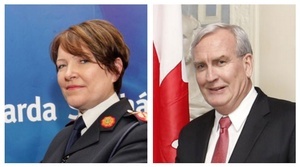
Commissioner O’Sullivan and Canadian ambassador to Ireland Kevin Vickers
In yesterday’s Irish Mail on Sunday.
Sam Smyth, in his column, hinted that Ms O’Sullivan might be headed for Canada…
He wrote:
The Mounties in the Rockies are calling Nóirín O’Sullivan to Canada, I’m told. Word is the embattled Garda Commissioner may be taking up a position there; both academia and security have been mentioned.
The Canadian ambassador to Ireland, Kevin Vickers, is understood to been helpful through her recent crisis – and other friends think Nóirín would be well advised to quit before a new taoiseach is in place.
Hmm.
Rollingnews

They’re back.
With serious hooch.
Are Ya Havin That writes:
Leather Jacket Guy and JohnnyBs taste test ‘Absinthe’ for the first time!! – (110% Proof)


St Vincent’s Chief Operating Officer Kay Connolly, Minister for Health Simon Harris and Dr Rhona Mahony, Master at Holles Street
The Religious Sisters of Charity will end our involvement in St Vincent’s Healthcare Group and will not be involved in the ownership or management of the new National Maternity Hospital.
For the last two years we have been actively working to find the best way to relinquish our shareholding of the St Vincent’s Healthcare Group (SVHG). It includes three hospitals: St Vincent’s University Hospital, St Vincent’s Private Hospital and St Michael’s Hospital, Dun Laoghaire.
Although the Sisters of Charity no longer have any direct involvement in the provision of healthcare services we remain dedicated to preserving the legacy of Mary Aikenhead, whose mission in life was to heal and care for the sick and poor.
We believe that the future continued success of SVHG can best be ensured by our transferring ownership of the group to a newly formed company with charitable status to be called “St Vincent’s”.
The Religious Sisters of Charity will have no involvement in this new company.
Upon completion of this proposed transaction, the requirement set out in the SVHG Constitution, to conduct and maintain the SVHG facilities in accordance with The Religious Sisters of Charity Health Service Philosophy and Ethical Code, will be amended and replaced to reflect compliance with national and international best practice guidelines on medical ethics and the laws of the Republic of Ireland.
The SVHG Board, management and staff will continue to provide acute healthcare services that foster Mary Aikenhead’s core values of dignity, compassion, justice, quality and advocacy.
They will ensure that the three hospitals in SVHG can continue to meet the need of their patients and families, so that every individual can always access the care and treatment they need to achieve health and well-being.
“St. Vincent’s” will replace the Sisters of Charity as the shareholders in SVHG and will meet the following criteria:
- The shares in SVHG will be transferred to St. Vincent’s for a nominal/”peppercorn” consideration in return.
- Consistent with the transfer of ownership, the Religious Sisters of Charity will no longer have a right to appoint Directors to the Board of SVHG, and the present two Sister Directors will resign from the Board with immediate effect.
- “St. Vincent’s” will not be subject to undue influence by individuals or from any source.
- “St. Vincent’s” will not seek to generate any profit or surplus, or to remunerate Directors for their work.
- “St. Vincent’s” Directors will have required skillsets in law, finance, healthcare and social care. They will be true to the values of our Foundress, recognising the right of everyone to access the care and treatment they need to achieve the best possible health care outcomes, regardless of race, ethnicity, religion, gender or personal means.
- In the event of the liquidation or wind-up of St. Vincent’s at any time in the future, any surplus assets arising therefrom will be vested with the Charitable Regulator and utilised for healthcare purposes and facilities with similar values. This is in accordance with the provisions of the RSC Constitution.
Just as our Founder Mary Aikenhead saw the need in 1834 to establish a hospital to meet the needs of the sick and poor, we believe that it is in the best interests of the patients and children born in the National Maternity Hospital today that they be provided with modern maternity and neonatal services that are women and infant-centred and integrated within the Elm Park campus.
It is now time for us to relinquish completely our involvement in SVHG. We are confident that the Board, management and staff of SVHG will continue to maintain a steadfast dedication to providing the best possible acute healthcare to patients and their families in line with the values espoused by Mary Aikenhead.
This proposal has the full support of the Board of SVHG. It is subject to implementation of all necessary legal, financial and regulatory matters.
A statement released this morning by Sr Mary Christian, congregational leader of the Religious Sisters of Charity.
Previously: Taking On Church And State
UPDATE:
By forming charitable company, SVHG erases Magdalene past, sells its property to the state at ‘commercial rates’ instead of paying redress.
— Mairead Enright (@maireadenright) May 29, 2017
Marked Van
at
Along the quays in Dublin.
Cleary writes:
Are they bullet holes?!
Anyone?