Yearly Archives: 2019

https://www.youtube.com/watch?v=lTr03b_L30s&feature=youtu.be

Last night.

John Gallen writes:

Should a woman who runs a waxing service for women be told she must handle male genitalia?

This is what the British Columbia Human Rights are now conducting 16 cases on, cases brought by Canada-born transgender Jessica Yaniv (top).

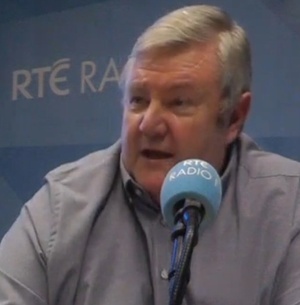
Niall Boylan, of Classic Hits had Jessica on the radio last night….

Jessica Yaniv

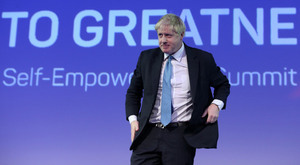
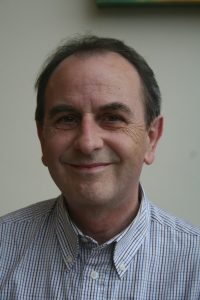
 From top: Boris Johnson at the Pendulum Summit  in Dublin last January; Derek Mooney.

So, it’s Boris. I suppose, if I want to be true to the spirit of Boris Johnson, I should have written two columns on the outcome of the Tory leadership election and not just one.

One for if he wins. One for if he loses. Both claiming with equal and absolute certainty that I knew this would be the outcome.

Instead, I have opted to do it the old-fashioned way and write just the one piece after the result was confirmed.

Today’s selection of Boris Johnson, by 66.4 per cent on an almost 90% turnout of the Tory party membership, as the new leader and next prime minister is hardly surprising. At least has not been that surprising since round one of the MPs vote to pick the two final candidates.

His confirmation as Prime Minister of the slowly disuniting Kingdom of Great Britain and parts of Northern Ireland tomorrow afternoon will at the same time, paradoxically, change nothing and everything on Brexit.

It changes nothing in terms of the actualité, none of the details of Brexit have changed. The EU 27 remain as committed to the letter and spirit of the Withdrawal Agreement negotiated with Teresa May’s government as they have ever been.

The EU 27 has repeatedly said clearly and unambiguously that they are not willing to re open any of the issues agreed in the divorce arrangements, most especially the Irish Backstop.

Johnson’s hope that the issue of the Irish Border (and the Backstop) might be put on hold and shifted from the Phase I negotiations on the divorce to the phase II talks on the future trading arrangements will not be entertained.

The EU has already made this abundantly clear.

It has been listening to what Johnson and Hunt have been saying during their leadership bids and it can see that neither has said anything to suggest a readiness on the part of the UK to make serious proposals to break the logjam and avoid a no-deal Brexit.

But they also know that this change of leadership in Britain is still a major political moment.

While the dismissal by many of Johnson’s rival, Jeremy Hunt, as just being continuity Teresa May, was cruel there was more than a little truth to it.

The election of Boris Johnson is in some ways a repudiation by the Tory membership of Teresa May, though perhaps more of her style than her substance.

Johnson is the antithesis of his predecessor. Where she was assiduous and sharply focused on detail, Johnson is a broad strokes guy, whose disdain for consistency is only surpassed by his passion for and belief in the power and force of rhetoric.

Johnson understands the theatricality of politics better than almost anyone else in British politics. He has shown considerable skills at both playing and using the media to pursue his ambitions. Across his political career he has sought to at all times portray himself as the person he thought the majority of voters wanted.

He has the classic politician’s need to please and be liked. The tool he uses to achieve this is himself: his personality, his persona, his humour and above all his rhetoric. Here I refer to classic rhetoric.

Aristotle defined it as “the faculty of discovering, in any particular case, all of the available means of persuasion” while Plato described it as “the art of enchanting the soul.”

We saw a short burst of this in Boris’s remarks upon being declared elected this morning. He spoke of energising Britain, of getting Brexit done on Oct 31st, of returning the spirit of can do and of pinging away the guide ropes of self-doubt and negativity.

It was Obama meets Trump: part Yes We Can, part Make Britain Great Again.

But the future of Boris Johnson entirely hinges on delivering a Brexit that works.

And this is where the opportunity lies. The new leader with his command of language and the power of rhetoric now has a moment, that is rare in politics, where he can take the lead and do something his predecessor serially failed to do and that is to define Brexit in terms that are deliverable.

He can use the occasion and power of coming days to define Brexit in a way that allows him to eventually get the Withdrawal Agreement passed and move the focus of his negotiations with the EU27 to the political declaration that accompanies the withdrawal agreement.

That is where he has scope for setting out the shape and nature of Britain’s future trading, security and political relationship with the European Union.

As a historian, a rhetorician and above all as a devotee and biographer of the great British political rhetorician of the 20th century Winston Churchill, Johnson will know the potential power of this moment.

He has a chance to exit the morass that May allowed to develop around Brexit and to use his mandate from the membership to direct their attention to a place where a workable Brexit can be delivered.

If he signals that he is willing to seize the moment – and it is a very big if – then the EU27 can respond by moving its focus to the political declaration and moving the agenda forward to how it sees its long-term relationship with the UK.

Indeed it did so this morning via a tweet from {Eu Brexit negotiator] Michel Barnier, saying:

We are ready also to rework the agreed Declaration on a new partnership in line with #EUCO guidelines.

But the ball still lies firmly in Boris’s court.

To his credit, the Tánaiste, Simon Coveney, also sent an early signal on last Sunday’s Andrew Marr show.

There he explained that the Backstop is an insurance policy which we all hope will never have to be drawn down and which can be replaced by the alternative arrangements the Brits want, just once they can be shown to work in practise.

The next few days will tell a lot.

Derek Mooney is a communications and public affairs consultant. He previously served as a Ministerial Adviser to the Fianna Fáil-led government 2004 – 2010.  Follow Derek on Twitter: @dsmooney

Rollingnews
Earlier: Shoo-In

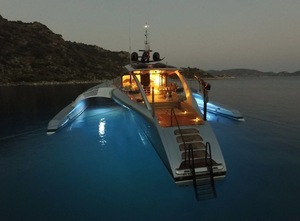
Behold: Adastra – a luxury 43 meter trimaran originally commissioned by Hong Kong-based businessman Antony Marden from UK based builders Shuttleworth Design.

The stripped-down, lightweight carbon fibre and kevlar cruiser has a full-width master ensuite bedroom, two guest cabins, a massive 1,150 bhp Caterpillar C18 engine with a top speed of 23 knots and a 10-knot cruising range of 10,000 nautical miles.

Yours for a knockdown €10,700,000 ono.

uncrate

https://www.youtube.com/watch?v=siyW0GOBtbo

This afternoon.

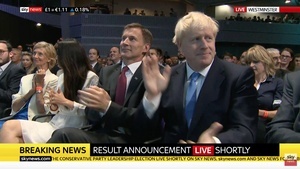
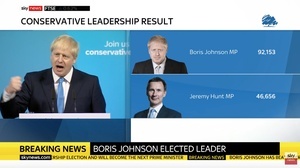
Boris Johnson has been elected as the new Conservative leader with 92,153 votes compared to Jeremy Hunt’s 46,656.

After he was announced as the winner of the leadership contest, Mr Johnson said:

“I say to all the doubters: Dude, we are going to energise the country, we’re going to get Brexit done on October 31. We’re going to take advantage of all the opportunities that it will bring in a new spirit of ‘can do’ and we’re, once again, going to believe in ourselves and what we can achieve.

“And like some slumbering giant, we’re going to rise and ping off the guy-ropes of self-doubt and negativity with better education, better infrastructure, more police, fantastic full-fibre broadband sprouting in every household. We are going to unite this amazing country and we’re going to take it forward. I thank you all very much for the incredible honour that you’ve just done me.

“I will work flat out from now on with my team that I will build, I hope, in the next few days…the campaign is over and the work begins.”

LIVE: Boris Johnson wins race to become next PM (Sky News)

Earlier:

Simon Coveney with then British Secretary of State for Foreign Affairs and the Commonwealth Affairs Boris Johnson in the Department of Foreign Affairs and Trade, in Dublin, November 2017

This morning.

The outcome of the ballot of about 160,000 Tory members will be revealed at just before midday in London with the victor officially becoming prime minister on Wednesday.

Jeremy Hunt was in a positive mood when he arrived home from a run this morning despite Boris Johnson remaining the clear favourite to take over from Theresa May.

A Johnson win could spark more government resignations after Sir Alan Duncan quit as Foreign Office minister on Monday in protest at his expected victory, predicting a “crisis of government”.

Chancellor Philip Hammond and justice secretary David Gauke have given notice that they will resign rather than serve under Johnson.

Tory leadership Contest Live (The Guardian)

Rollingnews
From top:  Kate Bush fans in Fairview Park, Dublin last weekend  celebrating ‘The Most Wuthering Heights Day Ever’. Eamonn Kelly.

David Attenborough told the UK parliament that radical thinking was needed to tackle climate change. Unfortunately, most people don’t do radical thinking.

They do safe thinking. They do thinking as it has always been done, and then they vote for politicians who do the same and then you end up with an imagined future world of private electric cars, a slight tweak on the present scenario because most people don’t do radical thinking.

Artists do radical thinking. That’s what makes them artists. That’s what makes them outsiders, and that’s what makes them in the present system “worthless”, because the non-radical thinkers can’t put a price on what they do.

Some argue that it was radical thinkers; artists, creatives, who created all the goodies that the non-radical thinkers now squabble about. I believe this.

And for every invention created by a radical thinker, you can be certain that a majority laughed and scorned and called the inventor “mad”. That’s the bulk of humanity, now swanning around empowered by the inventions of “mad” radical thinkers.

Everyone agrees that radical thinking is needed to tackle climate change, but unfortunately, the world is ruled by safe people who don’t do radical thinking. They do the opposite. They do safe thinking. They think what has already been thought.

I believe it was Edward de Bono who said that companies have two states: the initial creative state that establishes the company, and then the maintenance state that keeps the company going.

The people who create and establish the company generally move on and create something else, because that’s what they do; they make things.

The people who maintain the company are generally seen as a safe pair of hands. The main thing is that they don’t change anything, because if they do the company might collapse. Their role is to maintain the thing. They are generally not radical thinkers. They don’t make things. Their strength is maintenance.

Capitalism is a kind of company. It served everyone at one stage but has now become stagnant because it is run as it was always run, by the functionaries, despite the fact that it is in dire need of radical thinking to adapt to change.

But it can’t do that.

The great machine lumbers on, oblivious to the destruction it is causing to people and to the environment. It is run by people who don’t do radical thinking and so they can’t see the problem.

That’s why David Attenborough told the UK parliament that climate change needs radical thinking.

But the problem is not a shortage of radical thinkers. The problem is an abundance of safe thinkers occupying powerful positions and actively blocking the emergence of radical thinkers, even though everyone professes awareness that radical thinking is needed now more than ever.

By chance I caught a video of hundreds of people dancing to Kate Bush’s Wuthering Heights. A celebration, a commemoration of the artistry of the record and the dance that went with it.

This is done all over the world. This one was being done in Fairview Park in Dublin.

But the interviewer seemed intent on mining for Kate Bush’s oddity as a person. She was a “bit special”, he says at one point, a term that is often used to kindly remark on a person’s perceived mental deficiencies.

Later he observes “She’s kind of kooky though, isn’t she?” As if this were a problem to be shied away from, to be managed. Something questionable.

This is a wonderful example of a righteous square attempting to label a creative mind, a radical thinker, as odd and mad and ultimately pointless.

And the square’s righteousness is validated by faith in the economy and the great capitalist machine run by squares with eyes fixed on the bottom line who believe that radical thinking is “mad”.

Though everyone agrees that radical thinking is needed to tackle climate change.

Radical thinking is a wasted resource, its value unrecognized by the safe thinkers that run the world and who, by their lack of imagination and vision, risk running the whole planet into the ground.

That’s your future, my future and everyone’s future. End of story, game over.

Simply because some safe thinkers in power are blocking the human ingenuity required to modify the great machine of capitalism, designed by radical thinkers, which has served us so well but which now needs modification, because the damn thing is running wild, driven by people who can’t see the damage in their wake.

Radical thinking is needed to tackle climate change, but conservative non-thinking freezes in resistance, because it finds radical thinking a bit “odd”. The truth is, it finds creative thinking a bit challenging. A danger to their power base.

The ethos of the normalton also skews the definition of work into a kind of hard graft slavery, achieving little or no end – except perhaps a perceived statistical improvement to the abstract “economy” – while thinking and creativity, the very activities at the root of human progress, are generally regarded as being out of touch with reality.

Though everyone is agreed that radical thinking is needed to tackle climate change.

The problem is that so many people not only don’t get radical thinking, they think there is nothing to get. That radical thinking is simply a “madness”.

That’s the difference between the person dancing in Fairview Park to Kate Bush’s Wuthering Heights, and the interviewer trying to tarnish the artist as a freak. The dancers get it, though they admit they can’t do it.

The interviewer, on the other hand, seems to believe that there is nothing to get, and seems determined to get the dancers to admit to the perceived “nothing” of it all. To prove that the artist and the artist’s followers are all equally “mad”.

Though everyone is generally agreed that radical thinking is needed to tackle climate change.

Eamonn Kelly is a freelance Writer and Playwright.

Rollingnews