
Author Archives: Admin

90422026rory

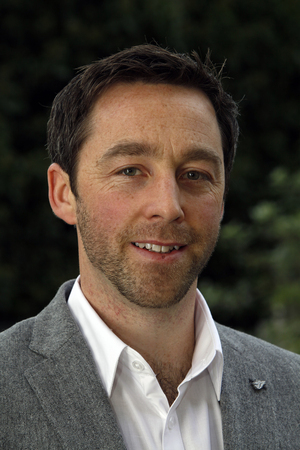
From top: the Committee on Housing and Homelessness launching the Report of the Committee on Housing and Homelessness in Leinster House today; Dr Rory Hearne

Further to Nama Wine Lake’s analysis last night.

While the focus is on an ‘off-balance’ sheet mechanism to fund social housing we could be facing a situation where there are over 3,000 homeless by this time next year.

Dr Rory Hearne writes:

There is a lot of criticism of the political system in Ireland, and particularly the elected TDs and how the Dáil goes about its business, for being ineffective and a waste of time.

The newly formed Committee on Housing and Homelessness has shown what politicians can achieve. The committee was only set up two months ago, in April, “to review the implications of the problems of housing and homelessness, and to make recommendations in that regard”.

And this is vital and urgent work. The Dublin Regional Homeless Executive provides regular updates of the homeless figures in Dublin and the most recent ones from April show this crisis is just getting worse.

Their infographic below reveals that in April, there were 888 families with 1,786 children in homeless accommodation in Dublin. The number of children is almost double what it was just a year earlier.

homelessapril16

At this rate of increase in homelessness we could be facing a situation where there are over 3,000 homeless by this time next year. A shocking prospect.

The Committee on Housing and Homelessness has had presentations over the last two months from a broad range of organisations, groups and individuals involved in housing.

These included the housing charities (Peter McVerry Trust, Focus Ireland, Simon Communities of Ireland, Threshold), also representatives of excluded groups (Irish Refugee Council, Pavee Point), the Irish Mortgage Holders Organisation, the Residents of Tyrellstown affected by evictions from the vulture funds.

The policy decision makers and funders also presented including the National Treasury Management Agency (NTMA), the Department of Finance, NAMA, the Housing Finance Agency, the Minister for Housing and the Minister for Finance, and the Irish Property Owners Association, the Irish League of Credit Unions and the Construction Industry Federation.

Interesting individual experts such as  the Master of the High Court Edmund Honohan, Professor PJ Drudy, and the Mercy Law Resource Centre also presented.

There are groups who are very active at a grassroots level – such as Housing Action Now and the Irish Housing Network – who do not appear to have presented to the committee which is unfortunate given their ‘on-the-ground’ experience of supporting those most affected by the crisis and their innovative ideas on potential solutions.

The quality of debate at the committee meetings was very high and there was a substantial amount of really important information provided on the facts about the housing crisis, the different groups affected and potential solutions to the crisis.

All the submissions and the discussions at the committee are very interesting and you can read them all on the Oireachtas website here.

For example, during its hearing on May 31, the NTMA and the Department of Finance made a presentation on the issue of our ability to borrow (while staying within the EU fiscal rules) in order fund the provision of much-needed social housing.

The NTMA (the National Treasury Management Agency) manages our National Debt and various funds such as the Infrastructure Investment Ireland Fund (which is what used to be the National Pension Reserve Fund) and borrows on behalf of the Government.

The NTMA explained that Ireland’s debt levels (the debt to GDP ratio) have fallen from 120% to 94% but our absolute level of debt, at over €200 billion, is four times what it was in 2007.

And the annual interest that we must pay on this debt is close to €7 billion (which was just €2 billion in 2007).

European fiscal rules require Ireland to reduce the debt-to-GDP ratio by roughly 5% per annum.

But due to our economic growth rates we are achieving this and therefore, there is ‘fiscal space under the debt-reduction rule’ that could allow us borrow more while staying within the EU rules.

But the debt is only one of three rules.

The other two relate to government expenditure benchmark and the ‘balanced budget’ rule. This means that if we borrow to spend or invest directly by the government (or local authority which is considered a state agency), for example in social housing, it affects our public spending limits.

But if we borrow and invest it through a non-government body on a commercial basis it does not affect public spending limits as it is considered by EUROSTAT (the European agency that defines if we are breaking the rules or not) to be ‘off-balance-sheet’ spending.

This is why pretty much the sole focus of the Department of Housing, Finance and Government has been trying to find ‘off-balance’ sheet mechanisms that allow investment not affect the rules.

But there is a very obvious issue here that requires clarification. If you increase spending on an area, like social housing, and fund this through an equivalent increase in taxation, then surely nothing changes in terms of the budget deficit?

Now if the planned abolition of the USC was going to cost us approximately €4bn then surely that could be paused which would then leaves a number of billions that could be invested in social housing provision and not require borrowing or lead to a breaching of EU rules?

The committee will present its final report today.

It will be well worth a read to see what’s in it.

Dr Rory Hearne is a policy analyst, academc, social justice campaigner. He writes here in a personal capacity. Follow Rory on Twitter: @roryhearne

Yesterday Nama Winer Lake Writes

Screen Shot 2016-06-17 at 09.18.05

Taoiseach Enda Kenny at the opening of a new €150million data centre at Google’s offices in Dublin yesterday

Dara Doyle and Stephanie Bodoni, of Bloomberg, report:

Near the top of the agenda [in Brussels] for investors continues to be the European Commission’s probe into Apple Inc.’s tax arrangements in Ireland, with both the company and the Irish authorities bracing for a decision that the Irish provided the iPhone maker with illegal state aid through a sweetheart deal.

In the first clues to a firm timeline for a decision on a probe which opened in 2014, Irish Finance Minister Michael Noonan told Bloomberg on Thursday in Luxembourg that the commission may publish a decision sometime in July, though “we don’t know that with certainty.”

…There’s a range of estimates out there. In a worst-case scenario, Apple may face a $19 billion bill if the government ultimately loses and is forced to recoup tax from the company, according to JPMorgan Chase & Co. analyst Rod Hall. Matt Larson of Bloomberg Intelligence puts the figure at more than $8 billion.

…Who gets the cash? Notionally, Ireland, even though the government says it doesn’t want it.

Why doesn’t Ireland want the cash, which after all could be equivalent to about all of the nation’s corporate tax last year? There’s a bigger picture, here, according to briefing notes provided to the incoming finance minister last month; a negative decision would hurt the country’s reputation and create uncertainty around it’s tax offering, which has been a key factor in drawing companies like Alphabet Inc.’s Google and Facebook Inc. to Dublin.

Ireland and Apple Brace for the Worst as Tax Endgame Nears (Bloomberg)

Rollingnews

Storks

What you may need to know:

1. Storks stop delivering babies and start delivering packages for a massive online retailer instead. *Cough* Amazon.

2. Other multinational online retail monopolies are available.

3. Storks is the first animated movie from Nicholas Stoller, director of Forgetting Sarah Marshall (yay), The Muppets (double yay) and Bad Neighbours (oh).

4. With Andy Samberg, Kelsey Grammer, Jennifer Aniston, Key and Peele.

5. Broadsheet prognosis: Pregxit, stage left.

Release Date: October 14.

(Mark writes about film and TV at ScreenTime.ie)

Screen Shot 2016-06-16 at 16.59.16

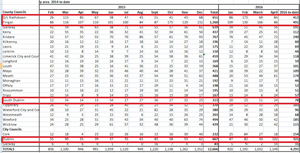
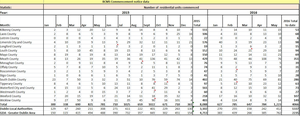
Table of new house completions released by the Department of Housing, Planning and Local Government this afternoon

What’s the news today?

The Department of Housing, Planning and Local Government (which used to be called the Department of the Environment) has published housing completion and commencement statistics for the month of April 2016.

In addition, it has published commencement statistics only for the month of May 2016.

In the month of April 2016, 1,149 residences were completed nationwide, of which 296 are in Dublin. Completions are measured by reference to first connection to the ESB.

In the month of April 2016, commencement notices for 784 residences nationwide were filed, of which 242 are in Dublin.

In the month of May 2016, commencement notice for 1,223 residences nationwide were filed, of which 412 are in Dublin.

When you want to start building a residence, you need to notify the Building Control Authority in your local council 14-28 days before you actually start building, and building needs to commence within 28 days of providing the notification.

It takes 3-6 months typically to build a residence, so commencement statistics give a forward-looking indication of future housing supply.

Screen Shot 2016-06-16 at 17.02.49
How many new residences do we need a year?

There are different views. In 2014, the ESRI estimated we need 25,000 new residences a year up to 2030. Government departments have adopted this research by the ESRI’s David Duffy, and it represents the official position.

However

(1) if annual housing need isn’t met in any year, then the shortfall will be passed on to the following year and in 2014, we completed just 11,016 residences and, in 2015, we completed 12,666 units.

If you accept the ESRI analysis, then in 2016, we started with a 27,000 deficit from the previous two years before consideration of the 25,000 units we need for new demand in 2016.

and

(2) there are other views as to how many units we need annually. Based on the assumption that Irish households are shrinking by 0.04 a year (there were 2.68 people in the average Irish household in Census 2011, but the number has been declining by an average of around 0.04 a year over the past two decades, as we near the European norm of around 2.4 people per household), we need around 17,000 units a year for fragmenting households.

We also need units to replace obsolete stock. The ESRI estimate obsolete replacement need at 5,000 units a year (that’s included in their 25,000 analysis). Other sources suggest international obsolescence rates are 0.5%, which would equate to 10,000 units a year in Ireland, which had, according to Census 2011, 2m residential units.

And, based on April 2015 population estimates compared with April 2014 (the latest available), and assuming 2.52 people per household, the annual housing need is closer to 50,000 units, of which 23,000 would be in Dublin.

NAMA, for instance has told an Oireachtas committee that over 20,000 units a year are needed in Dublin alone.

So, what do today’s published figures mean for the housing crisis?

With 25,000 units needed a year, according to the official position, equivalent to 2,087 a month, and with just 1,149 completed, it means the housing crisis has gotten worse to the tune of 938 in the month of April 2016.

With 10,000 units needed in Dublin, according to the official position, equivalent to 866 a month and with just 296 completed, it means the housing crisis in Dublin has gotten worse to the tune of 570 in the month of April 2016.

The housing crisis got crisisier in the month of April 2016.

Do today’s figures give any guidance about the future?

Yes, the commencement statistics should point to completions in 3-6 months time.

Alas, assuming the average commencement-to-completion duration is 6 months, the commencements indicate that in 2016, just 8,514 residences will be completed in the first 11 months of 2016, or which 3,193 will be in Dublin.

Screen Shot 2016-06-16 at 17.10.04

If the housing crisis is getting worse, what does that mean?

More people won’t be able to live in suitable accommodation in their preferred location and a greater proportion of household income will be spent on rent or house purchase.

The number in emergency accommodation (hotels, hostels, B&Bs) will increase. There were 6,100 in such accommodation at the end of April 2016, of which 2,100 were children.

The numbers sleeping rough on the street, in parks or in cars will increase.

The hidden homeless sofa surfing or staying in unsuitable or cramped accommodation will increase.

The 130,000 households on the waiting list for social housing will have to wait longer. Last Monday night, Vincent Browne estimated that these households equate to around 500,000 people.

Rents inflation (presently running at 9% per annum, and 20% per 24-month period) will continue to outstrip general inflation (presently 0.0%) and wage increases (presently 1.1%) and that will lead to lower disposable household income for renters.

From November 2016, there will be substantial number of tenancies each month which are subjected to a 24-month rent review and the trend in rent inflation suggests reviews will be in the 20-25% range, that is, a €1,500 monthly rent will be increased by €300-375.

Basic supply and demand principles will keep house price inflation elevated above general inflation.

Were it not for the mortgage rules, residential inflation would probably be 10-15% per annum, but even with mortgage rules, residential inflation is 7% for the 12 months to April 2016.

There will be lower disposable income for house buyers.

Thanks Nama Wine Lake

ClFJ0Z1WQAE2kV6

Tom Tuite tweetz:

Comedian David McSavage has been convicted and fined for not paying TV licence arrears after slating RTE’s output.

Yikes.

David McSavage convicted and fined over TV licence arrears (Tom Tuite, Irish Independent)

Previously: RTÉ Needs To Stop Embarrassing Us

Photo 1 by Iza Szczutkowska 2014

Sky, Horse and Death – debut album released last week

What you may need to know…

01. Sky, Horse and Death is an outfit for Altered Hours guitarist Kevin Terry and collaborators’ sonic investigations into the paranormal.

02. Debut album Music for Karla Turner is a tribute to the late academic, author and (alleged) abductee.

03. Streaming above is the album in its entirety, available now online via KantCope records.

04. Cassettes also available, as with all KantCope releases, from their Bandcamp and instore at PLUGD Records.

Verdict: Intense stuff to say the least, but another reason to pay attention to Cork music’s fertile and wildly imaginative outer reaches at present.

Sky, Horse and Death