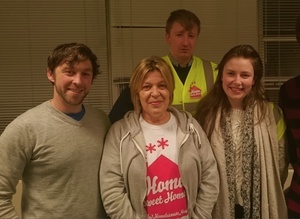
Rory Hearne (left) with Apollo volunteers Anne Farrelly, Emily Duffy, Tommy Gavin (back)
Keep her lit.
Dr Rory Hearne writes:
The Apollo House occupation has achieved significant commitments from the Minister for Housing, Simon Coveney, to improve homelessness services and provide decent accommodation for Apollo residents
These achievements show that the Apollo House occupation has been an incredible victory for citizen’s power.
The Home Sweet Home campaign has lit a new flame of hope in Ireland that everyone can and should have the right to an affordable and secure home.
Apollo House marks the point at which ordinary citizens have said ‘no more’ and ‘enough’ of this shameful housing crisis.
The citizens have declared that the homelessness crisis is not acceptable and it is a national emergency.
Home Sweet Home, through the Apollo House action, have mobilised the support of the majority of people of Ireland, to state clearly to the government and Dublin City Council – that they are not doing enough and that citizens are going to take direct action where the state fails – and that citizens will monitor and pressure the Government until everyone has the dignity of a home.
Specifically, the Home Sweet Home campaign has secured accommodation for its homeless residents and that “the short, medium and long term needs, including care plans for all current Apollo House residents, will be met according to their needs”.
They also secured the commitment by Government of the provision of two new additional facilities addressing the homelessness emergency (at an investment of €4million).
Importantly, they have also raised the bar “on the agreed minimum standards” for emergency accommodation as these facilities, the campaign states, “will include residents having their “own key” to a place they can call home”.
This minimum standard will also be achieved “with the direct participation of residents” and include units suitable for single persons and couples”.
Dublin City Council and the Peter McVerry Trust have told Home Sweet Home that the extra beds in new hostels are now six-month beds with 24-hour access as a result of the campaign.
The Minister for Housing has also guaranteed that there will be no families in commercial accommodation (hotels or B&Bs) by 1st July 2017.
They also achieved the rollout of community-based homeless services which can address the major challenges faced by families facing homelessness and lack of services in local communities.
As the campaign explains,
“Home Sweet Home has achieved an enormous amount in a very short period of time. This is down to the profound outpouring of public support for the campaign with more than 2,500 people volunteering their time and services along with donations of food, clothing, beds and more than €160,000 in funds. It has facilitated the assessment of 72 individuals by homeless services with 42 people moving into six-month beds…and helped more than 200 people to access a secure bed through the homeless Freephone number.”
Speaking at the Home Sweet Home press conference yesterday – where these achievements were outlined – spokesperson Aisling Hedderman explained how Apollo House has given homeless people a sense of dignity and raised the bar of what is acceptable in terms of emergency accommodation.
She said:
“The Home Sweet Home intervention allowed the homeless to have their voices heard and it allowed the public backing of them…it has given them a new chance at life…The homeless in Apollo have smiles on their faces. They are different people – accessing education and looking to get jobs. They have been given a chance. They thought that society had forgotten about them but the campaign showed that we haven’t forgotten about them.”
Aisling explained that she has been a housing activist with the North Dublin Bay Housing group where they had “screamed and shouted and occupied and had sit-ins to try have the voices of the most vulnerable heard – because they are not heard in public policy”.
But Apollo House has achieved a “victory” as “their voices are being heard”.
At the press conference Home Sweet Home spokesperson Brendan Ogle explained that Apollo House “is just the beginning” as Home Sweet Home “will be a permanent intervention in the nation’s housing policy and discussion”.
To do this, they are opening a permanent Dublin support, advice and activist centre assisting people with their housing information needs. The campaign is also taking a legal challenge arguing that the 1937 Constitution contains within it a right to housing.
They are going to have regular monthly meetings with Dublin City Council and other local authorities to review and assess housing and homelessness policies, particularly the issues of “hidden homelessness”.
The other really vital achievement of Home Sweet Home is the highlighting of NAMA’s role in worsening the crisis and its potential role in addressing it.
The campaign still awaits a response to their letter from the Minister for Finance where they called on the Minister to prioritise NAMA’s social mandate over its mandate to “maximise financial return” and to use NAMA’s land and buildings to address the crisis.
NAMA’s end-of-year review, released last week, again showed the potential role that NAMA could be playing in providing affordable housing (it showed NAMA has €2billion in cash reserves and will be building the 20,000 houses on a “commercial” basis, i.e. pushing up prices to sell to vultures) but because it is focused on maximising a commercial return it is selling its land and property assets to vulture funds and property investors.
After Apollo ends, it is vital to keep the focus on NAMA and the fact that it still can play a major role in addressing the crisis by using its land and cash reserves to build upwards of 20,000 social and affordable housing – not selling it to the vultures and property investors.
This year NAMA expects to build 3,500 houses – these should all be sold for social and affordable housing to local authorities and housing associations. This needs to be monitored closely.
The continuation and expansion of Home Sweet Home is essential because the harsh reality is that the housing crisis is going to worsen.
The homelessness crisis is just the tip of the iceberg of a wider housing crisis where hundreds of thousands of families and individuals are in circumstances of housing distress – unable to afford their mortgage or rent and facing potential eviction and repossession.
Vulture funds are circling – as the RTE documentary The Great Irish Sell Off showed last night, they have bought up 90,000 properties and are holding almost €10.3billion worth of assets in Ireland.
They will evict to get in higher paying tenants or repossess and sell houses in mortgage arrears.
There are 90,000 households on social housing waiting lists and 35,000 families in two years or more of arrears on their mortgage.
And, alongside this, we have the Government consistently refusing to act in ways that could address the crisis – by providing proper security of tenure for private tenants, by funding the construction of social and affordable housing on a massive scale and by stopping NAMA selling its land and property to vulture funds and using it instead to provide social and affordable housing.
There is, as Fr Peter McVerry has said before, “a tsunami of homelessness” on its way.
And it needs to be remembered. We have been here before with this, and other, governments making big promises to solve the homelessness and housing crisis.
But the Government and Irish state should not see the ending of the Apollo House occupation as a signal to ‘return to business as usual’, ignoring the humanitarian crisis and focusing on rising property prises and subsidising private investment.
The Apollo occupation and Home Sweet Home mark a very significant transformation in the politics of housing in Ireland. Prior to this it was housing charities, NGOs and a small number of housing activist groups, academics and politicians that were raising the severity of the housing crisis.
Home Sweet Home has brought it to another political level – the majority of the Irish people have been mobilised in support behind a new coalition of activists, trade unions and artists who are espousing the need to deliver a right to a home for all.
As Brendan Ogle explained, there has been a realisation amongst people that “all of us have to step out of our silos and work in a unified way”.
And the groups and individuals involved are no longer just pointing to someone else and saying ‘that is your job to solve the crisis’ – they are now stepping up and seeing that it is all our job to take action.
Ogle highlighted that “we as a nation had crossed the threshold of decency and we had gone too far” and the Home Sweet Home campaign “has shown that it has a power to force change in the area of housing and homelessness”.
It is this power – the power of direct citizen-led action of practical humanitarian solidarity with the homeless (not just protesting but actually stepping in and providing a solution), and the unprecedented public mobilisation of support behind it, that is at the heart of why the Apollo House action and the Home Sweet Home campaign has been so successful – and why it is so vital to be continued in various forms in the coming months and years.
It was only such a high-profile action undertaken by this broad societal coalition that managed to raise sufficient awareness and focus public and political attention on this unprecedented housing crisis.
And that broad coalition has the potential to end homelessness and the broader housing crisis – by extending to every corner and community of Ireland – by mobilising every citizen affected and every citizen who cares, and bringing it together into a mass movement of community and solidarity demanding the right to a home for all.
Home Sweet Home has started the movement.
They have lit the flame.
It’s up to all of us to take up that flame for a right to a decent and affordable home for all and carry it forward – in our homes, families, in our communities, our workplaces, our towns and cities and make it real. It is possible.
We are the only limitation to its achievement. We can do it. Just imagine it – if Ireland was known around the world – as the country that actually delivered a human right to a home for all its people.
Wouldn’t it be incredible?
The country that emerged from famine and evictions – that resisted through peasants’ land leagues and revolution – only to collapse, over a hundred years later, back into evictions, homelessness and a new form of colonialism, the takeover by speculative vulture funds.
Imagine this little country finally managing to realise its people’s long-held historical dream for justice and equality.
Apollo has begun that journey of moving from the dream of a right to a home for all – towards achieving the reality.
As Aisling Hedderman so eloquently put it: “We can do this – we can continue this. It’s only the start. It’s not the end. Apollo house is only a building but Home Sweet Home is a community. It’s a community that we want to see in all our communities – we want our voices heard and we will continue to do so.”
Home Sweet Home are inviting the public to join them at 12 noon tomorrow at Apollo House for a ‘Victory March’ “to celebrate our first step towards ending homelessness. Everyone that has been involved and that supported us in this movement, join us on the streets to help celebrate a victory we all should be proud of. Solidarity marches will take place in Kildare and Belfast at noon and Cork at 10am.
Dr Rory Hearne is a policy analyst, academc, social justice campaigner. He writes here in a personal capacity. Follow Rory on Twitter: @roryhearne
Rollingnews