Author Archives: Bodger

O’Connell Street, Dublin 1

“Walked through Dublin city centre earlier this evening. I was having a few medical tests done earlier in the day. Sadly the town I’ve known and loved all my life has been reduced these past few years to a horrible, intimidating drug-infested kip of a place.

And it keeps getting worse. There’s still a handful of great pubs where you can enjoy a pint (albeit in some places at exhorbitant prices – €5.90 for a pint of stout ffs in one place we called into! So I don’t go to too many of them lately.)

But the city is now becoming more sinister and more nasty than I’ve ever known it to be in the past. Sadly this city I once loved is now controlled by gangs. It wasn’t how I knew it to be years ago, as I walked back to where we were staying tonight with some food from a local takeaway.

Even a young garda asked me if I knew exactly where I was going. I agreed with him when he described the city centre as an incurable kip. He looked no more than twenty. When I was twenty, this city was a great place. Sadly that’s not the case anymore. But we still had a great evening and thankfully the weather was beautiful.”

Broadcaster Gareth O’Callaghan, yesterday.

Spaghetti Hoop writes:

Is Gareth’s mournful outpouring simply a reaction to a bad night in the city and a bit Brennan’s Bread with its, ‘ah it’s not like the good ole days’, or has our capital city declined in cultural value, safety and general conviviality because of increased crime and addicts?

 A close relative of mine, more Dub than I, can’t wait to get out of the place due to the ubiquity of addicts where he works in Dublin 1.

I know several people agree with him, but triple that who don’t and who left their Dublin roots for the commuter belt semi-ds in Meath and Kildare during the housing boom, craving to come back now that the kids are teens and they have more social time.

Tourism Ireland reports that 11.2 million overseas visitors came to Ireland in 2018, an increase of 6% from 2017 and many of them spent at least two days in Dublin. Which means we are top providers of a cultural experience and a pleasing gateway to the rest that the country has to offer.

The swarms of hen and stag parties that visit Temple Bar during the spring and summer season contributes to a healthy tourism industry and they don’t cause any grief except push the pint price up in those contained zones – which Dubs nimbly avoid and proceed to their prized spots.

Most Dubliners wouldn’t dream of living anywhere else in the country, even for the four bedrooms, horse stables, chicken coop and hectare of landscaped garden they could gain in exchange for their city crib.

There’s a buzz in town, and you get used to its traffic and rough neck and enjoy its village-like eccentricity.

Granted I’m a twice returned emigrant so without lyrical-waxing about it I still think the city rocks from a global perspective because of its small size, recreational offerings and touch of madness.The diversity of pursuits at the weekend for beach, city culture and mountain walks would want you wish for more weekends.

So I am curious; is Gareth right about Dublin being a kip or just doesn’t get the joys of city life? And if you do think it’s a kip, to paraphrase Junker to Farage in the EU Parliament in 2016, “Why are you here?”.

Anyone?

Tonight.

City Assembly House, Dublin.

Actor Stephen Rea launches Journalist Frank Connolly‘s novel A Conspiracy Of Lies, a thriller set amid The Troubles and the cultural and political landscape of Dublin in the 1970s.

A Conspiracy Of Lies (Mercier Press)

Sam Boal/RollingNews

Messers.

This afternoon.

Stephen’s Green, Dublin 2

The launch Carlow Arts Festival, the “first big cultural event of the Irish Summer”, are acrobats Ronan Brady and Aisling Ní Cheallaig (centre pic) and,  above from left:  Jo Mangan, Director of Carlow Arts Festival; Bryan Quinn from the Horsebox Theatre; and Irish National Opera soprano Amy Ní Feharraigh.

The festival celebrates its 40th anniversary this year on June 4-9 with over 80% of the events ‘free to attend’ alongside a ‘Pick Your Price’ scheme for some select events.

In fairness

Carlow Arts Festival

Leon Farrell/Photocall Ireland

This afternoon.

Nick’s Coffee Shop, Ranelagh, Dublin 6

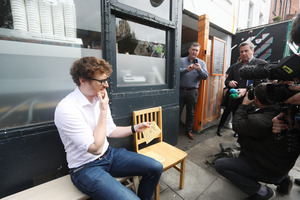
Web Summit founder Paddy Cosgrave talking to RTÉ’s Philip Boucher Hayes and addressing media about his role in a campaign that anonymously targeted European Facebook users in 10 countries with advertisements about Ireland’s corporate tax system saying it was his ‘patriotic duty’.

Web Summit founder Paddy Cosgrave has spent what he described “a very small amount” of about €20,000 on Facebook ads highlighting Ireland’s corporation tax regime.

He said he would not be taking any more measures to highlight the country’s tax regime, adding that he thinks “the game is up” and that Ireland should “start to close down all of these things.”

…In respect of his own company Amaranthine, a San Francisco-based venture capital fund, which is incorporated in Delaware, Mr Cosgrave said

“it is more tax efficient to incorporate out of Ireland, but that fund is operated out of the United States…it is the standard procedure for venture capital funds [to set up there].”

20k.

What we wouldn’t do.

Cosgrave spent €20,000 on ads highlighting corporation tax regime (Independent.ie)

Leah Farrell/RollingNews

Meanwhile…

Meanwhile..

Prints of unseen Liberties by Maxi

Ruth Keating writes

Tonight Jam Art Factory are hosting an exhibition in Lucky’s bar on Meath Street, Dublin 8. We will be presenting a new series of work by the super talented illustrator Maxi.

The pieces are all limited edition, giclée prints and are based on the loved and unseen buildings of the Liberties area.

Kicking off from 6.30/7pm with a limited amount of free drinks provided by the good folks at Teelings Whiskey.

Hic.

Maxi at Lucky’s Bar (Facebook)

This afternoon

In the Dáil.

Speaker of the US House of Representatives Nancy Pelosi is addressing both houses of the Oireachtas and Bono.

Said Ms Pelosi:

“This month we mark the anniversary of one of the greatest achievements of that spirit of hope and a faith that a better future is possible.

The signing of the Good Friday accords in 1998, ending centuries of conflict. On that holy day, the world saw the dawn of peace in Northern Ireland, which few had ever dared to dream.

With the diplomatic leadership of President Bill Clinton who sends you his regards, when he found we were coming….”

FIGHT!

Pics: Maxwell

UPDATE:


From left: Ali Hewson, Bono, Nancy Pelosi and Ceann Comhairle Seán Ó Fearghaíl in Leinster House.

Ms Pelosi said of Bono:

“In modern times, another purveyor of the word from Ireland, Bono and U2 – one of Ireland’s most beloved exports, whose music and mission [applause] – [looks up at Bono in the gallery] oh, there you are, I’m not finished – whose music and mission of advocacy stirs the spirit of the world, while embracing the pride of the Irish…

“We’ve learned so much at U2 concerts about what’s going on in Ireland. And we were delighted to see Bono in the gallows of the GPO last night – a picture of David Trimble and John Hume at a U2 concert in Belfast in 1998.

“Bono is here with his wife Ali Hewson, who is there. Thank you both for being here [applause].

“I take pride in saying that I’m one of the members of Congress who’s been to more of Bono’s, U2’s concerts than anyone.

“Now, he’s in the audience. Thank you Ali, and thank you Bono, for being here, and give my regards to the rest of U2, The Edge and others.

“Something I learned from my children, from Michael Keneally and then my grandchildren, we all know, I usually do not intrude on music of my children. That does not apply to U2.”

Watch live here.

UPDATE:

Meanwhile…

Ms Pelosi exits from Cats hair salon, Dublin.

Garda Commissioner Drew Harris addressing the conference of the Association of Garda Sergeants and Inspectors in Cavan yesterday

This morning.

RTÉ’s Morning Ireland broadcast an interview its crime correspondent Paul Reynolds carried out with the Garda Commissioner Drew Harris at the AGSI conference in Cavan.

It followed Mr Reynolds reporting that one of An Garda Síochána’s members is being investigated by the National Bureau of Criminal Investigations for allegedly engaging in “outside security work”, which is not permitted.

Mr Reynolds previously reported that false alarms were allegedly set off at a business and these were responded to by gardaí, in patrol cars, and these false alarms were then reported on the Garda PULSE system.

Mr Harris said he couldn’t speak of the specifics of the case as the matter is being investigated.

Mr Reynolds put it to Mr Harris:

“But you are known and have taken a very strong stand on discipline. I mean, and there has been criticisms of your stance at this conference [AGSI] of the fact that even though allegations have been levelled against individuals, that have not been proven, you have prevented people from being promoted.”

Mr Harris said each case is examined on its merits and he’s examined a number of cases and people have been promoted.

He said others have been delayed until he has received more facts.

Meanwhile, separately…

Anyone?

Listen back in full here

Yesterday: Malingering Odours

Previously: “False Alarms”

The publication this morning of a report into burial arrangements at Mother and Baby Homes includes a chapter on the transfer of the remains of children and adults who died at the institutions to medical schools for “anatomical study”.

The commission found evidence that children’s remains were studied in Dublin and Galway medical schools but not Cork medical schools.

The report explains that it was legal, under the Anatomy Act 1832, for unclaimed remains to be used in this way, at this time.

But it noted:

“The burials of the anatomical subjects used by the Dublin Medical Schools are properly recorded in Glasnevin Cemetery.

“It has not been possible to establish anything about the burials of the child anatomical subjects used in the Galway Medical School as their names are not known.”

Between January 1920 and October 1977, the bodies of more than 950 children who died in the Dublin Union, and associated institutions, including Pellestown, were sent to medical schools in UCD, Trinity College Dublin and the Royal College of Surgeons in Ireland.

All but 18 of the 950-plus children were “illegitimate” children and aged between 10 minutes and 15 years at the time of their death, while 27 additional stillborn infants were also sent to the Dublin Medical Schools.

The report found:

“Not all deserted or abandoned children who died in Dublin Union institutions were sent for anatomical studies. There is no information available about the criteria (if any) used to choose which children’s bodies were sent.”

The remains of the children examined in the Dublin schools were later buried in the Poor Ground section of Glasnevin Cemetery.

The commission found:

“They were buried in individual burial plots that were located next to those used for ordinary child and adult burials. The usual practice in Glasnevin Cemetery was for the remains of a number of anatomical subjects to be collectively buried in the same plot on the same day.”

It disturbingly adds:

“It is unknown if the remains of individual bodies used for anatomical studies were placed in separate coffins for burial in Glasnevin. A meeting of the Dublin Board of Guardians in 1907 heard accusations that in the medical schools, coffins were not being used for one body alone, but that the practice was simply to fill up a coffin with various body parts from various individuals who had been dissected.”

The commission’s report states that, under the Dublin Cemeteries Act 1964 and bye-laws under that act, if the remains of more than one person were to be put in a coffin, an application had to be made.

The Glasnevin Trust told the commission: “There are no annotations within the burial registers showing that permission was granted…to allow more than one set of remains per coffin.”

However the commission later notes:

“The Glasnevin Trust told the Commission that, while each burial was required to be witnessed by a designated member of staff, the staff did not inspect coffins internally.”

In Galway, the commission found that the Galway Medical School Anatomical Register records that, between 1909 and 1997, the remains of around 690 adults were transferred to the School of Anatomy, Galway Medical School, for anatomical study.

They were transferred from South Dublin Union, Ballinasloe Mental Asylum, Castlebar Mental Hospital, Ennis Mental Hospital and Galway Central Hospital/ Galway Regional Hospital.

The register contains no mention of any children’s remains of having been transferred but the commission states: “evidence exists that children’s bodies were sent to the medical school”.

Of the evidence that shows children’s remains were sent, the commission found:

“In every instance, the body or bodies were supplied by a porter at the Central Hospital/Regional Hospital Galway. In every instance the infant remains were received by the head of the School of Medicine and Anatomy Department, University College Galway.

He paid the porter 10/- for every infant body received. It appears that between April 1949 and November 1964, he received and paid for 35 infant anatomical subjects. None of these infants is recorded in the Galway Anatomical Register.

Unfortunately, no records survive which name the children whose bodies were sold. It is
possible that some of the bodies were stillbirths which, at the time, could not have been registered.”

The report explains that, under the Anatomy Act 1832, a person with “lawful possession” of a dead person could allow for an anatomical examination to take place – unless the person had expressly stated, while alive, that they did not wish this to happen.

This had to be expressed in writing or orally in the presence of at least two witnesses, and bodies could not be sent to schools until at least 48 hours after death.

The report notes:

“In the case of deserted or abandoned children who died in these institutions, there was no one with the legal capacity to object to the bodies being sent for anatomical studies.

“The bodies of “illegitimate” children that were unclaimed by the mother or any other relative, could similarly be used for anatomical studies.

“It is not known, but it seems unlikely, that the mothers concerned were made aware of the existence or requirements of the Anatomy Act at any stage during their stay in any of the institutions being investigated.”

Under the act, the medical schools were legally obliged to ensure that the remains of people used in these studies were “decently interred in consecrated ground” and that a certificate of interment be given to the inspector of the district within six weeks of receiving the remains.

The schools were also legally obliged to maintain registers of bodies received.

However, the commission found that the 48-hour rule and six-week limit “were not implemented in practice”.

It found:

“The Commission has since established that a number of children were transferred for anatomical studies from Dublin Union institutions before the 48 hour period for claiming the body was over. In general, burial took place two to three years after the death.”

The commission also recalls a letter written by the Chief Medical Office of Galway County [not named] to the Department of Health in January 1961, complaining about the size and cost of burial spaces for the remains of those whose bodies were studied.

The office wrote:

“A problem has arisen regarding the interment of such remains of bodies following their use for anatomical dissection.

“According to the Rules applicable to burial grounds for every person over 12 years of
age a burial space of 9ft. x 4 ft. must be provided.

“This would mean that if the remnants of ten cadavers were to be interred, ten graves should be provided, ten graves which would prove very costly and indeed wasteful of graveyard space.

“The remains of a cadaver after dissection consists of dismembered bones, perhaps some
entrails and muscles which could be easily accommodated in a coffin 3’ x 12” x 9”, and if placed vertically in the grave four such coffins could be accommodated in the space above prescribed.

“Markers, of course, would be placed over each coffin.

“There would be no intermixing of corpses. I understand that this procedure is adopted for other anatomical schools. I request a direction if the procedure suggested above would be allowed and approved of by your Department.”

The suggestion was rejected, the commission found.

But, it noted:

“…a civil servant’s note on the file states that ‘… it might be said that these rules are not always (or even usually) strictly observed throughout the country’.”

The report can be read in full here

Earlier: Bessborough: ‘There Are 900 Bodies After Going Missing’

Death In Tuam

Grainne Griffin, Ailbhe Smyth and Orla O’Connor by Ruth Negga (Time)