
Author Archives: Bodger

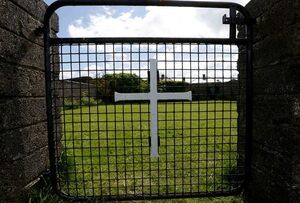
Bessborough Mother and Baby Home; the ‘Little Angels’ plot on the grounds of Bessborough House in Blackrock, Cork

The publication this morning of a report into burial arrangements at Mother and Baby homes includes a section on the former Bessborough Mother and Baby Home in Cork which was opened in 1922 and owned and run by the Congregation of the Sacred Hearts of Jesus and Mary.

More than 900 children who were born in, or admitted to, Bessborough died in infancy or early childhood.

The report states it had been “assumed by former residents and advocacy groups” that the children who died in the home were buried in a small burial ground on the grounds of Bessborough.

But, the commission said, from “an early stage”, the commission believed this was unlikely – as the area wasn’t big enough and because it was unlikely the children would be buried in the same burial ground as the congregation.

It has since only been able to establish that just one child was buried in the congregation’s burial ground.

After examining burial records of separate burial grounds in Cork city, the commission also established that, between 1922 and 1929, 54 children who died in Bessborough were buried in St Joseph’s Cemetery on the Tory Top Road in Cork; two infants who lived in Bessborough were buried in St Michael’s Cemetery in Blackrock, Cork in 1958 and 1986; at least one child was buried in Cork District Cemeteray, Carr’s Hill; and four children who had an association with Bessborough were buried in St Finbarr’s Cemetery in Cork.

This morning, on RTÉ’s Today with Seán O’Rourke, Paul Redmond, of the Coalition of Mother and Baby Homes, said:

“The really big headline report here is the fact that the entire Bessborough angels’ plot seems to have gone missing. What we’ve always thought of as the angels’ plot and there is a marker there for it – a little memorial mentioning the babies – the report is basically saying ‘there are no babies buried there’ or there might be one or two.

“But they don’t know where they are. Literally there are 900 bodies after going missing because of this report. It’s quite stunning.”

This morning’s report also found that, between 1927 and 1985, 12 adult women, who were former residents of Bessborough and whose deaths were not childbirth related, were buried in St Joseph’s Cemetery.

One of these women entered Bessborough in 1922 at the age of 20 and remained there until she died in 1984. Another of the women started living in Bessborough, aged 21, in 1924 and remained there until her death in 1985.

The commission also identified the deaths of 14 mothers who lived in Bessborough – nine of whom died of pregnancy or childbirth-related reasons. However the commission was unable to established the burial place of these 14 women.

The commission asked the Congregation of the Sacred Hearts of Jesus and Mary about the burial arrangements but the congregation “said it had very little information as the records compiled in the institution were held by the Child and Family Agency (TUSLA) and it did not have access to these records”.

However the commission explained there is “no information about burials in these records”.

It found:

“A number of members of the congregation provided affidavits and/or oral evidence to the Commission. They were able to provide remarkably little evidence about burial arrangements.

“The congregation told the Commission that the burial ground in Bessborough was opened in 1956 for deceased members of the congregation and the congregation does not know where the vast majority of the children who died in Bessborough are buried.

“The Commission has not seen any evidence that the approval of the Minister for Local Government for the opening of this burial ground was sought or granted as required by the Local Government (Sanitary Services) Act 1948.

“A member of the congregation who was in Bessborough for most of the period 1948-1998 told the Commission that she did not remember any child deaths during her time there but she implied that the children who did die there were buried in the congregation burial ground.

“In the years 1950-1960 (inclusive), 31 children died in Bessborough so it is rather surprising that she does not remember any deaths.

“Another congregation member who was in Bessborough from 1978-1985 told the Commission that one baby died during her time there. She said that the manager of the maternity hospital (who was also a member of the congregation) “took over the arrangements for the burial”.

“She “vaguely remembered” that the mother wanted the baby buried in St Michael’s Cemetery but she did not know where the baby was actually buried.

“The Commission has established that there is no record of this baby in St Michael’s burial records. She did not remember if the mother’s family was involved in the burial arrangements but she was clear that the congregation had bought the coffin for the baby.

“In evidence to the Commission, a member of the congregation who was there in the 1980s said that there were two children buried in the burial ground during her time there and a third was disinterred elsewhere and reinterred in this ground.

“Another member of the congregation who was in Bessborough for a period in 1971 and again between 1975 and 1981 swore an affidavit in which she said that she remembered one child who died and was buried in the congregation’s plot in the grounds.

“The recollections of these two congregation members seem to be incorrect In fact, it would appear that there is only one child buried in the congregation’s burial ground and that burial took place in 1994.

“The burial ground has some individual memorials to other children who died in Bessborough but it is unlikely that they are buried in this plot.

“It is possible that children who died in Bessborough were buried within the grounds. However, to date, the Commission has found no physical or documentary evidence which indicates that this occurred.”

In relation to the commission’s efforts to establish if there are other burial grounds on the Bessborough site, the report found:

“The Commission engaged forensic archaeologists to carry out a cartographic and landscape assessment of possible unrecorded burial arrangements in the Bessborough grounds.

“As already stated, the grounds measure approximately 60 acres. It is also possible that burials took place in the grounds that no longer form part of the Bessborough estate, that is, a total area of 200 acres.

“The forensic archaeologists and the Commission’s researchers reviewed all available cartographic sources and aerial images in order to identify possible burials within the
grounds of Bessborough. A site survey was also conducted.

“It is clear that there are a number of locations within the grounds where burials could have taken place. However, there is no significant surface evidence of systematic burial anywhere except for the congregation burial ground.”

The report also examined aerial photography taken in 1951. It states:

“The Commission examined vertical aerial photography taken by the Irish Air Corps in 1951. This series includes high resolution aerial photography of the Bessborough Estate.

“The majority of child deaths at Bessborough occurred before 1951 (over 700 and it would be reasonable to expect that, if there were burials there, an aerial photograph taken in February 1951 would show up some ground disturbance, or anomaly on the landscape.

“If over 700 children were buried on the Bessborough Estate before 1951 the aerial photograph would be expected to give some indication of where the remains are located.

“The aerial photographs of the Bessborough site were examined by forensic archaeologists who determined that no visible features on the Bessborough landscape were indicative of any obvious site hosting the remains of such a large number of children.”

It later states:

“…as no physical evidence of possible locations was found, the Commission did not consider it feasible to excavate 60 acres not to mention the rest of the former 200 acre estate.”

The report states that records of admissions, births, discharges and deaths were compiled by the congregation and given to the HSE in 2011 who subsequently gave them to TUSLA in 2013.

Read the 96-page report in full here

Earlier: Death In Tuam

Burials As Late As 1990

The Meet Your Maker podcast.

On gamers with hattitude.

Host Liam Geraghty writes:

Twice a week, people from all over Ireland role play online as Gardaí….We meet the members of Irish Emergency Services RPC – a GTA V role playing community based off of An Garda Siochana and Ireland’s Emergency Services, focusing on Cork. You can listen to Meet Your Maker on iTunes, Spotify, Stitcher or anywhere you get your podcasts.

Meet Your Maker

From top: The Transvaal Pharmacy in The Hague, Netherlands; Vera Twomey and Luke Ming Flanagan MEP

This morning, Taoiseach Leo Varadkar re-affirmed the position held recently by his Minister for  Health Simon Harris that the…

“…lack of availability of cannabis products in Ireland remains the most critical barrier to full implementation” of the [medicinal cannabis access programme] scheme”.

Mr Harris had added:

“Full establishment is dependent on the commercial operators making these products available in Ireland.”

Veteran legalise cannabis campaigner Luke ‘Ming Flanagan MEP responds:

This statement does not add up. The experience of Vera Twomey has not been that there is a problem of availability. The problem is one of importation and delivery.

As most people know Vera Twomey has acquired a license for medical cannabis for her daughter Ava. In order for Vera to get the cannabis based medicine either herself or her husband must travel six times per year to the Transvaal clinic in The Hague.

The journey involves an early morning flight from Cork to Amsterdam followed by a train journey to their destination city. The schedules mean hanging around for hours on end waiting for the return flight home.

Not the end of the world you might say. True. Far better than having no access to the medicine. Very true. Are these journey really necessary though? Definitely not. Surely the medicine can be delivered to their local pharmacy.

Well anyone who knows Vera will know that if there is a route to make this happen then she will find it.

I regularly talk to Vera on the phone. I got a phone call from her in the last fortnight. She rang me to inform me that there is already someone getting delivery to the Island of Ireland from the Transvaal clinic in The Hague.

As always with Vera she used this information to unlock a solution to her own particular situation. She established that a pharmaceutical distribution company are already bringing it here. I say here rather loosely. It is being delivered to Northern Ireland.

She has contacted the company in question and asked could they the provide the same service into the Republic of Ireland. No problem was the answer. However it would have to be agreed to by the HSE. Simple. Well so it should be.

However rather than helping her they are in fact stonewalling her. She is waiting and waiting to hear what action the HSE have taken to facilitate the medicines delivery.

Why does the state allow this to happen?

Why when there is simple solution at hand do the HSE not act upon it?

If the people involved in taking care of our health administration don’t care about the well being of those they get paid to take care of then they shouldn’t be let near the job.

I have three daughters myself. As anyone knows raising children is hard work. When one parent has to go away for the day it becomes a little bit more challenging. When one has a child with special needs that challenge is even greater. The state needs to get its act together now.

Deliver the medicine. It’s not rocket science. Minister Harris needs to stop hiding behind the “lack of availability”. It’s simple not true.’

Luke ‘Ming’ Flanagan

Previously: Vera Twomey on Broadsheet

The former Mother and baby Home in Tuam, County Galway; Map showing full extent of burial ground by Galway County Council in 1970

The publication this morning of a report into burial arrangements at Mother and baby homes was compiled by a commission of investigation formed after historian Catherine Corless’ revelations at the site of the former Mother and baby Home in Tuam (above).

Concerning Tuam, the commission writes:

Two structures were discovered. The location of the first structure discovered corresponds with the location of what is described as the “Sewage Tank” on the older Ordnance Survey and title maps.

This structure had at some point been deliberately filled with a large deposit of stones, almost to the upper edges…

The second structure discovered proved to be of greater significance. It is a long structure built within the boundaries of the old sewage tank.

It is divided into 20 chambers. Initially, a structure with two lids was discovered. One of the lids was completely intact and the other was partly broken.

These lids were carefully removed and were found to have covered a chamber with a small division between two sections of the chamber.

Human skeletal remains were immediately visible. Further excavations revealed more lids and, when they were removed, more human skeletal remains were found in the chambers underneath.

Samples of the remains were retrieved from within the chambers using customised telescopic equipment from the surface openings.

The Commission did not consider physically entering the individual chambers because the size of the surface access points was very confined, there was a danger that any attempt at physical entry would have compromised the many skeletal remains and entry was, in any event, not considered to be safe.

An archaeologist on the team appointed by the Commission considers that the logical intended use of the first structure discovered (described in the reports as “cesspool” or “sewage tank”) was to receive sewage from the culverts and pipes found coming from the direction of the former Home.

…Without a full excavation it is not possible to conclusively say what was the exact engineering purpose of the structures but the Commission considers that it is very likely that it was sewerage related. This view is corroborated by some of the scientific testing carried out at the request of the Commission and described below.

‘The Commission has established that a total of 973 children from the Children’s Home died either in Glenamaddy [nearby workhouse] in the Tuam Home itself or in a hospital or institution soon after they were transferred there from Tuam.

Of these, 79 children died in Glenamaddy. The Glenamaddy workhouse had its own burial ground so it is likely that the children who died there are buried in that burial ground. However, there is no burial register available for the period in question so this cannot be verified.

The vast majority, 802, died in the Tuam Home itself.

This number includes a significant number of “legitimate” children who are within the Commission’s Terms of Reference because they were not accompanied by a parent and a small number of “legitimate” children who are outside the Commission’s Terms of Reference because they were accompanied by a parent. (The children who were accompanied by a parent are less likely to be buried in the Tuam burial ground and are more likely to have been buried by their parents.)

The details of the deaths of the children were established by the Commission from the records compiled in the Home and from a list provided by the General Register Office (GRO) and already in the public domain.

There are six children whose deaths are recorded in the records compiled within the Home and who are not on the GRO list. The Commission has been unable to find any mention in the Tuam Home records of six children who are included in the GRO list.

When analysing the records, the Commission noted that a significant number of children who were resident in the Tuam Children’s Home were transferred to the Central Hospital, Galway when they became seriously ill.

The Commission checked the Register of Deaths and found that 86 children who had been transferred there died soon after the transfer.

Six other children died soon after leaving the Tuam Home: two children died in the County Home, Castlebar; one died in Crumlin Children’s Hospital; one in St Bridgid’s Industrial School for Girls, Loughrea; one in Clifden District Hospital and one died at home.

The old Galway workhouse became the Galway Central Hospital in the period 1922 – 1924. It was subsequently rebuilt and renamed the Regional Hospital. It is now the Galway University Hospital.

The Commission has found burial records for 50 of the children who died in the Central Hospital, Galway – they are recorded as being buried in Bohermore Cemetery.

Twelve mothers who were resident in the Tuam Home died, the majority from complications of childbirth; some died in the Home itself and some in the Central Hospital, Galway. It is not known who took responsibility for the burial of these mothers.

If the Central Hospital took responsibility for the burials it would be expected that they would be recorded in Bohermore cemetery but the Commission did not find any record of these burials there.’

More as we get it.

Earlier: Mother And Baby And Burials

This morning.

Minister for Children and Youth Affairs, Katherine Zappone has published the Fifth Interim Report from the Commission of Investigation into Mother and Baby Homes.

The report examines the burial arrangements at institutions including the Tuam Mother and Baby Home.

Via The Department of Children and Youth Affairs:


The Commission has stated that it will include an analysis of the causes of deaths and the registration of deaths [at Tuam] in its final report which is due by February 2020.

The report makes a number of findings in relation to the burials at Tuam:

The Commission states that it is clear that many of the children who died in the Tuam Home are buried in the underground chambers.

The report states that these chambers were not a recognised burial ground or purpose built burial chamber and that it did not provide for the dignified interment of human remains.

The Commission concludes that there is little basis for the theory that rather than having died, the children were ‘sold’ to America.

The report makes no specific recommendations but calls on anyone who may have information relating to the Tuam site to come forward and speak with them.

The report also examines the burial practices in a number of other institutions including Bessborough, Bethany Home, Castlepollard and Sean Ross Abbey.

In the case of Bessborough, the Commission found no physical or documentary evidence of systematic burials within the grounds, but considers that it is highly likely that burials took place there.

The Commission did not consider it feasible to excavate the full 60 acres involved, let alone the rest of the 200-acre estate on which the there has been extensive building work since the institution closed.

In Sean Ross Abbey there is a designated child burial ground in the grounds of the institution. The Commission has undertaken a geophysical study and subsequently a test excavation of the site and the results of this excavation are currently being examined. The Commission will report on this in their final report.

More as we get it.

Read full report here.

Thanks Bebe

Minister for Finance, Public Expenditure and Reform Paschal O Donohue TD and Chief Economist John Mcarthy presenting revised macroeconomic and fiscal forecasts for the period 2019-2023

This afternoon.

Government Buildings, Dublin 2

The revisions reflect a deterioration in the main markets that Irish firms export to, particularly the UK due in large part to Brexit uncertainty and the euro area where the economic cycle has peaked sooner-than-expected.

It also points to a softening in US growth in the short-term as the impact of fiscal stimulus there fades.

Some domestic indicators have also moderated in recent months, it says.

Government cuts economic growth forecast for this year (RTÉ)

Sam Boal/RollingNews

Minister for Children and Youth Affairs Katherine Zappone

This afternoon.

Minister for Children and Youth Affair Katherine Zappone has announced a series of measures in response to a report of the Collaborative Forum for Former Residents of Mother and Baby Homes and Related Institutions.

These will include much sought-after amendments to the Adoption (Information and Tracing) Bill.

Via The Department of Children Affairs:

The Minister has secured Government approval to amend provisions of the Adoption (Information and Tracing) Bill to provide for the greatest possible release of birth information to adopted persons and to other relevant persons, consistent with the legal and constitutional framework.

Amendments to the provisions of the Bill dealing with the privacy of birth parents are currently being drafted which will seek to remove the requirement for an undertaking to be signed by the person seeking their birth information.

The Minister also intends to bring forward amendments at Committee Stage in Seanad Éireann to provide a copy of the birth cert, where this is available on the files in State custody, to an applicant.

The Minister will develop a series of measures including the establishment of a scheme to fund permanent memorials in the locality of mother and baby institutions, provision of financial support to survivor-led groups for annual commemoration events, and a working group to develop a national memorial that commemorates, respects and honours mothers and children held in these Institutions.

A living memorial in digital, audio or visual presentation of information and individual narratives, will be developed to serve to support the historic preservation of this long episode in our country‘s history.

Language and terminology is important, and the Forum recommended the establishment of an expert group which would help replace the often derogatory labels which stigmatised those affected. The Minister will consult the Irish Research Council on how best to put together an appropriate research group for this purpose.

Previously: Betrayed Again

Thanks Bebe

Stop that.

Special Forces: Ultimate Hell week on RTÉ2

Fergus McCormack writes:

24 civilian recruits take part in a gruelling selection course designed by former members of Ireland’s elite Special Forces unit (“Ireland’s SAS”), the Army Ranger Wing (ARW). Welcome to Hell.

Gulp.

Ultimate Hell Week Begins Thursday, April 24 at 9.30pm on RTÉ2

There you go now.

Related: National Broadband Plan may cost more than €3 billion (Pat Leahy, The Irish Times, October 26, 2018)

Watch live here

Minister for Sport Shane Ross; letter from FAI to Mr Ross

Minister for Sport Shane Ross is currently addressing the Oireachtas sports committee.

He’s just said the entire FAI board is to step down.

He said:

“This move is to be welcomed and it is hopefully the first step on the road to rebuilding trust in this important NGB. Considering the issues over which most of this board has presided and those issues being obvious even before the various investigations have started, it is clearly time for a regime change.”

He also said no new capital payments will be made to the FAI until he is satisfied with the new measures put in place.

UPDATE:

Deloitte audit of FAI; chair of the committee Fergus O’Dowd, CEO of Sport Ireland John Treacy, Social Democrats TD Catherine Murphy

UPDATE:

Mr Treacy tells the committee that no other organisation that receives grant funding from Sport Ireland has had a form H4 filed against them to the CRO.

In response to a question about this from Fine Gael TD Noel Rock, Mr Treacy said:

“Not that we’re aware of. Never heard of it before. So we’re hearing about this for the first time. We heard about it this morning.”

UPDATE:

Asked if funding will be restored to the FAI before the year is out, Mr Treacy said: “Well, there’s a lot of work to be done.”

He said there is a mechanism to fund on a monthly basis “but that’s an issue when all the various bits and pieces have been done”.

Watch live in link above

Pic (letter): Ruth Coppinger

Pic (audit): Gavan Reilly

Meanwhile…