


Yesterday.
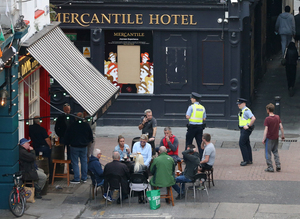
South William Street, Dublin 2.
Diners and pets eat al fresco as indoor dining become restricted under Level 3 regulations in Dublin.



Yesterday.
South William Street, Dublin 2.
Diners and pets eat al fresco as indoor dining become restricted under Level 3 regulations in Dublin.

Pandemic < spooky season pic.twitter.com/S7TvgkA1Vj
— Aísling Kavanagh (@aiskavanaghx) September 21, 2020
YIKES!

“We know it is not working” – Niamh Horan on #CBLive @NiamhHoran speaks about her frustration in relation to the new covid regulations. pic.twitter.com/RVBiai024h
— Claire Byrne Live (@ClaireByrneLive) September 21, 2020
Last night.
Claire Byrne Live on RTÉ One
Sunday Independent journalist Niamh Horan scolds the rona ‘plan’.
FIGHT!
Meanwhile…
RTE could have asked Carl Heneghan or other doctors to debate the science of lockdown on #cblive. They asked Niamh Horan instead so that social media would lose the rag. Don't play their cynical game.
— Eilis O'Hanlon (@EilisOHanIon) September 21, 2020

This afternoon.
Unidentified location, Dublin.
Thanks Ciarán


This afternoon.
Dame Court, Dublin 2.
On a day that wet pubs all over the country are allowed to reopen, except in Dubin which is under Level 3 restrictions, a group of diners at the Dame Tavern enjoy, what we must assume, are post-meal or pre-meal pints. The food not only soaking up the alcohol but scaring off the rona, according to experts.
Earlier: Wet Your Whistle
Update:

“Well, they smell of food.”
Tense moments as Gardai pass by.
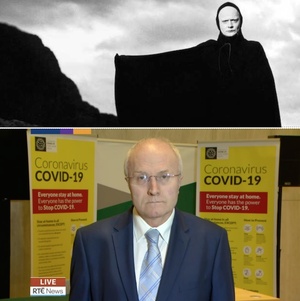
From top: ‘Death’ from Ingmar Bergman’s The Seventh Seal (1957); RTÉ News Health Correspondent Feargal Bowers
Uncanny.
Frank Armstrong, writing In CassandraVoices [full article at link below
The Irish public service broadcaster RTÉ says that ‘nine out of ten people in Ireland say RTÉ has been their main media source for accessing information on Covid-19.’
The broadcaster recently launched an initiative against fake news entitled: ‘The truth matters at RTÉ – here’s why,’ claiming:
‘Now that society is grappling with the challenges of a pandemic, and the inescapable anxiety that comes with it, the potential for manipulation of the facts is huge.’
But RTÉ has at times provided an unreliable account of the danger posed by Covid-19 to the Irish public.
Throughout the pandemic RTÉ’s Health Correspondent Feargal Bowers has pointed to the exceptional danger posed by Covid-19, which fits within what Nancy Tomes has called the “killer germ genre of journalism”.
Bower’s describes a Grim Reaper that is redolent of the character of Death from Ingmar Bergman’s Seventh Seal:
‘This virus could visit any of us, at any time, in our homes, or in work.’
‘It does not make an appointment. ‘
‘Going outside involves a certain roll of the dice.’
‘Inside you may also encounter this intruder.’
‘Like any lottery, there are things people can do to improve their chances.’
‘And hold onto the most valuable prize of all – your life.’
In fact, we are dealing with a virus with an infection fatality rate below 1% according to Nature magazine, or ‘possibly as low as 0.2% or 0.3%,’ according to Lone Simonsen, a professor of population health sciences at Roskilde University in Denmark who has worked at the CDC and National Institutes of Health in the U.S.; others such as Professor Johan Gisecke, a member of the WHO’s Strategic and Technical Advisory Group for Infectious Hazards (STAG-IH) previously suggested a figure as low as 0.1%. The IFR has varied from region to region, with New York, Madrid, London and Lombardy particularly badly hit, but in Africa, as indicated, the IFR appears to be exceptionally low.
With better treatments – especially the use of the generic drug Dexamethasone – and protection of vulnerable groups, chances of survival have improved since the early stages of the pandemic.
This seems evident from the relatively low death toll currently witnessed across Europe, including in Ireland, despite rising case numbers. Many of us also harbour T-cell immunity from other coronaviruses.
Yet Bowers has continued to make factually incorrect claims in a succession of articles, including on September 5, which stated:
‘The World Health Organization says data to date suggests 80% of Covid-19 infections are mild or asymptomatic, 15% are severe infection, requiring oxygen and 5% are critical, requiring ventilation.’
Ventilators are now used sparingly in the treatment of Covid-19, and large orders were cancelled in April. Remarkably, Bowers seems to have copy and pasted that information from a WHO Situation Report from March 6, stating:
‘…data to date suggest that 80% of infections are mild or asymptomatic, 15% are severe infection, requiring oxygen and 5% are critical infections, requiring ventilation.’
The continued use of data from March undermines RTÉ’s credibility and should be a source of embarrassment.
Covid-19 in Ireland: Elusive Facts (Frank Armstrong, CassandraVoices)
Getty/RTÉ
Meanwhile…
#Covid19 – #Germany – Strategy of the Federal Ministry of the Interior to #terrorise the population
Prof. Dr. #KarinaReiss pic.twitter.com/JjPnySh0VN
— Tomas (@coady327) September 21, 2020
Oh.
Meanwhile…
https://t.co/IUaeNcoHFQ pic.twitter.com/Rv99NzoZE5
— Oh boy what a shot (@ohboywhatashot) September 21, 2020
Ah.
Meanwhile…
https://t.co/r0r16qyNGm pic.twitter.com/FWI7JLogDG
— Oh boy what a shot (@ohboywhatashot) September 21, 2020
Stop it.
Meanwhile..
To prevent the spread of the coronavirus the Irish government have recruited some celebrities- none more famous and successful and hygienic as actor Aidan Gillen. pic.twitter.com/4RF1CamxwC
— Michael Fry (@BigDirtyFry) September 21, 2020
Uncanny.


Snug.
This afternoon.
Newbridge, County Kildare.
Friends Brendan Brogan and Dan Ryan (pic 3) and Tom Smith and Pat King (above) enjoy drinks served by manager Chris Moore (pic 2) in McDonnell’s as wet pubs are allowed to reopen outside Dublin, for the first time since the Covid-19 Lockdown in March.

Need a distraction?
Stephen McBride writes:
Hi Broadsheet, just a quick one to say your readers might enjoy the podcast series Coastal Stories from author Charlie Connolly – in particular the episodes about the Ouzal Galley and another one about Eddie Heron.
Both fascinating stories of Irish interest and told against the calming audio backdrop of gently breaking waves. A welcome break from all the relentless covid news we are barraged with every day.


Norway-born singer and horse lover Kristin Vollset (above) wants to save Molyneux yard (aka “the Lane”) in The Liberties, Dublin 8
This afternoon.
You may recall Kristin Vollset, who lived and sang among the horse community of The Liberties., Dublin 8 in 2016 and penned the soulful protest song No Plan.
Kirstin writes:
A few weeks ago I got the devastating news that 5 of the horse yards in the very laneway, Molyneux yard, where I kept my horse – are to be demolished to make way for the SECOND enormous hotel in a very small residential area.
The horse community of the Liberties, along with many other residents and supporters, are devestated. Molyneux yard (aka “the Lane”) means so much to so many people.
It has always been the central meeting place for the horse community in the Liberties, and people have kept horses there for generations. So destroying the Lane is an attack on the very heart of the community.
We have now sent in appeals and observations on the planning permission to An Bord Pleanála, and are expecting a final decision within the next 2-3 months.
Gentrification is destroying the Liberties, and this is just one out of many examples, where the government and developers invade local communities without any consultancy or care for their history, culture or daily lives.
Petition here
Previously: Wolves At Molyneux
Pics via Kirstin


