Author Archives: Bodger

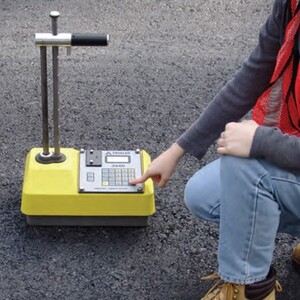
A Troxler Nuclear Moisture Density Gauge

STOP!

It’s a Troxler, you damn fool.

This afternoon.

Via RTÉ

A nuclear gauge containing a radioactive source is among a number of items stolen from a van in Drogheda, Co Louth.

The van was parked in The Downs, Highlands, and the items were stolen sometime between 6pm yesterday and 6.30am today.

A Troxler Nuclear Moisture Density Gauge containing a radioactive source was taken. The device is used by engineers to measure density and moisture content in construction materials.

The Environmental Protection Agency said there is a potential risk of exposure to radiation, particularly if the case is opened and the equipment is activated.

Great.

That’s all we need now.

Radioactive device stolen from van in Co Louth (RTE)

Pic via Troxler Labs

This afternoon.

Take that, keyboard warriors.

Also: please don’t join the Azovs.

FIGHT!

Thanks Stephen Moran

Meanwhile…

The Ukraine or simply Ukraine?

Anne Marie Devlin, of University College Cork, writes:

The word Ukraine may be understood in a particular way which can have a profound impact on how the country itself is viewed. For many Russian speakers, the word Ukraine is transparently broken down into two main parts or morphemes.

They are ‘u’ and ‘krai’. ‘U’ can roughly be translated as ‘at’ in English. ‘Krai’ means ‘edge’. As a result, the word ‘Ukraine’ may conjure up an image, not of an independent nation, but of a region at the edge of a sovereign country, which presumably is Russia.

This mental image of a region on the edge of a country was further solidified in Russian and Ukrainian by the preposition which traditionally accompanied the country’s name; and in English by the use of the definite article (The Ukraine).

The word Ukraine had been collocated with the preposition ‘na’ (on) instead of the more common ‘v’ (in) in both Russian and Ukrainian despite the fact that ‘na’ (on) is more commonly used for regions and ‘v’ for countries.

This may seem superficial. After all, it’s only a preposition, but feelings around it run extremely high. In 1993, the Ukrainian government formally requested that the Russian government change the preposition from ‘na’ to ‘v’ in official documentation with the aim of receiving ‘linguistic confirmation of its status as a sovereign state’. While the Russian state reacted nonchalantly, over time, the new linguistic form was adopted by many people.

However, in a 2016 study I conducted into the weaponization of the use of prepositions in Russian social media during the Crimean crisis, results strongly suggest that the use of ‘na’ vs ‘v’ was deliberately used by many people as a political football to demarcate political and ethnic faultlines.

In short people intentionally used ‘na’ to position themselves as pro-Kremlin, thus denying the sovereignty of Ukraine; and ‘v’ to position themselves as anti-Kremlin and to acknowledge Ukraine as an independent nation.

‘na’?

Or ‘V’?

You must decide.

Kyiv vs Kiev: why the right names matter in Ukraine (RTE)

This afternoon.

St Canice’s Hall, Finglas, Dublin 11

Minister for Housing, Local Government and Heritage Darragh O’Brien at the launch of a new development of 32 homes through Co-operative Housing Ireland (CHI), an Approved Housing Body (AHB).

Minister O’Brien said AHBs are expected to provide over 40% of the newly built social housing this year provide housing through home-ownership, shared ownership and social rented co-operatives.

AHBs to provide 40% of social housing this year – O’Brien (RTE)

Leah Farrell/RollingNews

Ah here.

This afternoon.

The Royal Canal.

Lockkeepers Cottage, Strand Road, North Strand, Dublin 3.

Jdawg writes:

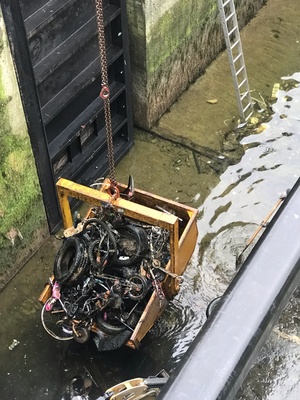
In a short while I saw 3 microwaves, at least 10 kids scooters, 4 bikes and a bunch of tyres picked up between two lock gates at Lock 1 North Strand. Was chit chatting and was told this is just the last skip load. There were several more taken out.

Last night.

US State of the Union.

Happy out.

Meanwhile…

Fair enough.

Meanwhile…

Seems to have gone well.

Landscape architect Peter Donegan and his design for the Museum of the Great War in Péronne, northern France

This afternoon

In celebration of the 30th anniversary of The Historial de la Grande Guerre (Museum of the Great War), Europe’s largest war museum embedded within the 13th Century Chateau de Peronne in the Somme region of northern France, Irish Landscape Architect Peter Donegan has been commissioned to design a new garden for the castle.

This is Peter’s second time to design at the location. Peter’s peace garden, Jardin Eutychia (after the Greek Goddess of Happiness) was realised in the Chateau’s dried up moat in 2018.

On this occasion the new landscape will be realised within the medieval building’s internal courtyard and officially inaugurated on June 25.

Peter, who is is the series garden designer for DIY SOS The Big Build for RTÉ, says:

“it is harrowing of the past when I consider the ultimate catalyst behind this garden, and my return to Péronne. On the other hand, how humbling is it to be invited again and relocate to design in a place I love so dearly

“At first glance the garden is a visitors most beautiful welcome, but it contains also a herbarium of world war medicinal plants, virtual reality story telling and a full size Panzer tank, within a town’s castle that has fallen three times.“

Previously: Some Corner Of A Foreign Field

This morning.

Have we lost the true meaning of Lent?

Via Irish Times letters:

When I was a small child, the season of Lent was a time of strict fasting, sacrifice and reflection. While not being subjected to rigorous adherence of the more harsh deprivations associated with Lent, we children were encouraged to decide on the making of at least one sacrifice for the six weeks or so, as much as a means of instilling a habit of discipline as a religious endeavour.

My sister and I generally settled on giving up sweets as our nod to the more straitened Lenten hardships endured by our elders. The eschewing of sweets for six long weeks (excluding the break for St Patrick’s Day) was a trying time for two young girls.

One year, we devised a plan. What if we still bought our usual ration of sweets each week with our pocket money? To our minds, it wouldn’t be cheating. It was merely an efficient way of saving money. After all, the price of sweets might have gone up by the end of Lent.

Whenever we were afflicted by a moment of weakness and the thought of breaking our fast, we stole a peep into the sweet box and were usually sated at the sight of the growing pile, not to mention the aroma.

Our precious stash survived that Lent, and so successful was our endeavour that by Lent the next year, we had sold our idea to other kids on the road – with varying degrees of success!

Anne O’Neill, Dublin 6w

Irish Times letters

This morning.

Dublin 2.

Members of the Ukrainian community in Ireland protest at the Headquarters of Google and Facebook (Meta) calling on the tech giants to remove all Russian state-backed accounts. They delivered an open letter urging the leadership and employees to do “all in their power” to delete Kremlin-backed accounts.

Leah Farrell/RollingNews