


The extraordinary work of miniaturist Chris Toledo.



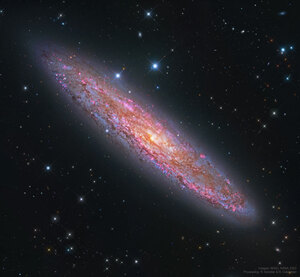
Behold: NGC 253, otherwise known as the ’Silver Coin Galaxy’ – one of the brightest visible spiral galaxies and also the dustiest. To wit:
…it is more formally known as the Sculptor Galaxy for its location within the boundaries of the southern constellation Sculptor. Discovered in 1783 by mathematician and astronomer Caroline Herschel, the dusty island universe lies a mere 10 million light-years away. About 70 thousand light-years across, NGC 253, pictured, is the largest member of the Sculptor Group of Galaxies, the nearest to our own Local Group of galaxies. In addition to its spiral dust lanes, tendrils of dust seem to be rising from a galactic disk laced with young star clusters and star forming regions in this sharp colour image. The high dust content accompanies frantic star formation, earning NGC 253 the designation of a starburst galaxy. NGC 253 is also known to be a strong source of high-energy x-rays and gamma rays, likely due to massive black holes near the galaxy’s centre.
(Image: NAOJ: Subaru, NASA & ESA: Hubble, ESO: VLT & Danish 1.5-m; Processing & Copyright: Robert Gendler & Roberto Colombari)


https://www.youtube.com/watch?v=-BFQdVCord0
A typography-filled 2014 adaptation of Sergei Prokofiev’s ‘Peter And The Wolf’ by Gordon (Thierry Guernet), Pierre-Emmanuel Lyet, and Corentin Leconte of Camera Lucida for Radio France, featuring the National Orchestra of France, conducted by the maestro Daniele Gatti.

Pfft.
Here at BS Towers, it’s a combination of 8-track and Aertel.
How COVID-19 Has Impacted Media Consumption, by Generation (Visual Capitalist)
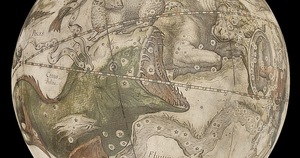

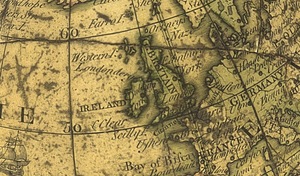
The British Museum has digitised many of its 17th and 18th century globes into spinnable zoomable 3D models for your perusal. To wit:
During the so-called ‘Age of Exploration’, expanding European geographical and astronomical knowledge fuelled the demand for maps and sea charts. It also inspired experimentation in the art of globe-making, and the first half of the 16th century saw the production of several models, both hand-painted and printed. Printing made it possible to produce globes in greater numbers at lower cost so they could be more widely distributed. The printed globe, terrestrial and celestial, soon became established as the standard type of globe, sometimes called the ‘common’ globe, and the methods of manufacture changed surprisingly little from the mid-16th century until the 20th century.
Explore them here.
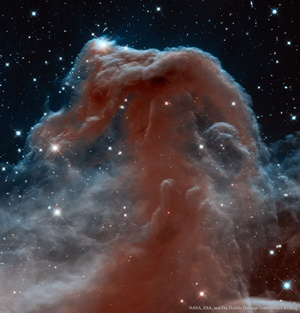
Behold: the magnificent interstellar dust cloud of the Horsehead nebula in the vast constellation of Orion. Sculpted by stellar winds and radiation into an equine pareidolia that will not last forever. To wit:
A potentially rewarding but difficult object to view personally with a small telescope, the above gorgeously detailed image was taken in 2013 in infrared light by the orbiting Hubble Space Telescope in honour of the 23rd anniversary of Hubble‘s launch. The dark molecular cloud, roughly 1,500 light years distant, is cataloged as Barnard 33 and is seen above primarily because it is backlit by the nearby massive star Sigma Orionis. The Horsehead Nebula will slowly shift its apparent shape over the next few million years and will eventually be destroyed by the high energy starlight.


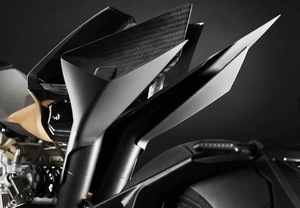

Behold: the Vyrus Alyen 988 – a futuristic carbon-fibre clad custom hog powered by a six speed, 202bhp 1,285cc Ducati L-Twin.
Rawr.
Yours for five as-yet undisclosed figures.