
Author Archives: Chompsky

Oh wait now, it is. In a way.

This dark spot on the surface of Jupiter is the shadow of its most volcanic moon, Io. To wit:

Since Jupiter shines predominantly by reflected sunlight, anything that blocks that light leaves a shadow. If you could somehow be in that shadow, you would see a total eclipse of the Sun by IoIo‘s shadow is about 3600 kilometres across, roughly the same size as Io itself — and only slightly larger than Earth’s Moon. The featuredimage was taken last month by NASA’s robotic Juno spacecraft currently orbiting Jupiter. About every two months, Juno swoops close by Jupiter, takes a lot of data and snaps a series of images — some of which are made intoa video. Among many other things, Juno has been measuring Jupiter’s gravitational field, finding surprising evidence that Jupiter may be mostly a liquid. Under unexpectedly thick clouds, the Jovian giant may house a massive liquid hydrogen region that extends all the way to the centre.

Full sized (original horizontal) image here.

(ImageNASA/JPL-Caltech/SwRI/MSSS; Processing: Kevin M. Gill)

apod

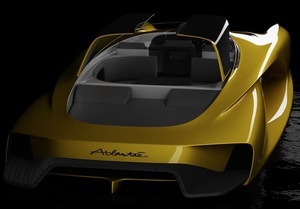
Behold: the Atlantic – a sleek and powerful 12m long sports tender from former Bugatti auto designer Etienne Salomé.

Powered by twin 440hp Volvo engines, capable of a wave-slicing 60 knots and inspired by the Bugatti Type 57SC, the Atlantic has enough space for nine people – their insufferable faces peering smugly out of the Garmin glass cockpit as your pathetic dingy is swamped in their wake.

Price on application.

uncrate

An excerpt from an interview recorded in 2010 with the late great Alan Rickman in which he gives his take on the importance of listening – essential for actors and just about everyone else. To wit:

What you have to say is completely incidental. All I want to see from an actor is the intensity and accuracy of their listening. And then what you have to say will become automatic.

kottke

Behold: the Horsehead Nebula – the most famous (and beloved) interstellar cloud in the sky. To wit:

It is visible as the dark indentation to the red emission nebula in the centre of the above photograph. The horse-head feature is dark because it is really an opaque dust cloud that lies in front of the bright red emission nebula. Like clouds in Earth’s atmosphere, this cosmic cloud has assumed a recognisable shape by chance. After many thousands of years, the internal motions of the cloud will surely alter its appearance. The emission nebula‘s red colour is caused by electrons recombining with protons to form hydrogen atoms. On the image left is the Flame Nebula, an orange-tinged nebula that also contains filaments of dark dust. Just to the lower left of the Horsehead nebula featured picture is a blueish reflection nebulae that preferentially reflects the blue light from nearby stars.

(Image: José Jiménez Priego)

apod