This morning.
Coffee Angel, Pembroke Road, Dublin 2
Weezer writes:
Only commentary for Hillary’s based on husbands’ actions so?
Fight!
Earlier: You Take The Low Road
Meanwhile…

Gulp.
This morning’s New York Post



This morning.
Coffee Angel, Pembroke Road, Dublin 2
Weezer writes:
Only commentary for Hillary’s based on husbands’ actions so?
Fight!
Earlier: You Take The Low Road
Meanwhile…
Gulp.
This morning’s New York Post
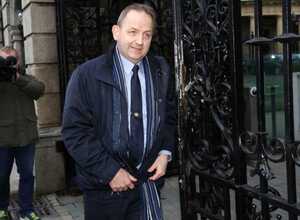
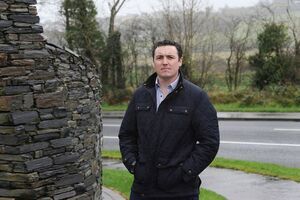
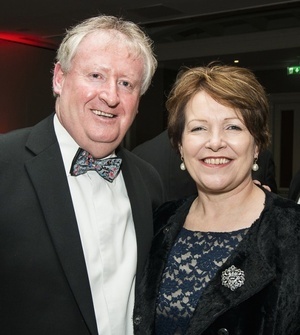
From top: Maurice McCabe; Keith Harrison; Garda Commissioner Noirin O’Sullivan and her husband Chief Superintendent James McGowan
Yo may recall the two recent protected disclosures sent to the Tanaiste and Minister for Justice Frances Fitzgerald.
They were reportedly sent by Sgt Maurice McCabe and Supt Dave Taylor, former head of the Garda Press Office – with Supt Taylor stating he was instrumental in the campaign to discredit Sgt McCabe.
Yesterday, Philip Ryan, on Independent.ie, reported on a meeting that took place between the two gardai in which Supt Taylor told Sgt McCabe about the campaign.
Mr Ryan reported:
Taylor said three phones, which are currently in garda custody as part of the investigation into leaks, held the evidence to back up his claims.
He said the phones contained chains of text messages outlining the plot to target McCabe by spreading vicious lies about the whistleblower and his family.
The texts were sent to senior gardai, members of the media, and prominent politicians.
The allegations could never be printed due to the defamatory nature of the claims, but they spread like wildfire in political and garda circles.
No matter how many times independent investigations proved McCabe’s claims were correct, there was always a cloud over his reputation.
Taylor told McCabe he regretted the role he played in spreading the rumours but insisted he was acting under instruction.
He claimed former garda commissioner Martin Callinan knew what was going on, as did his successor Noirin O’Sullivan, who was then a deputy commissioner.
It was further reported that, in February 2015, Ms O’Sullivan’s husband Det Supt James McGowan seized Supt Taylor’s phone and laptop two months before Supt Taylor was arrested for allegedly leaking information to a journalist in relation to a Roma child being taken into custody over fears she had been kidnapped.
On Friday, Minister for Justice Frances Fitzgerald appointed former High Court judge Justice Iarlaith O’Neill to review Sgt McCabe and Supt Taylor’s claims.
Further to this, the solicitor of fellow Garda whistleblower Keith Harrison, Trevor Collins spoke to Cathal MacCoille on RTE’s Morning Ireland this morning.
It came after Colm Burke, on yesterday’s This Week, reported on a letter Mr Collins sent to Ms Fitzgerald, on behalf of Mr Harrison, following the appointment of Justice O’Neill.
During the Morning Ireland interview, Mr Collins raised concerns about the scope of the new inquiry.
Cathal MacCoille: “I asked him [Trevor Collins] to outline what his client Keith Harrison’s objections to the review as proposed.”
Trevor Collins: “Well my client, two and a half years ago, Cathal, made a disclosure, a protected disclosure to, at that time, the Confidential Recipient which was later referred to GSOC and, following on from that, my client has had to endure a campaign that has been orchestrated, we believe, senior members of An Garda Siochana – the sole purpose of which has been to undermine his credibility and effectively destroy his reputation and this campaign has been endured by my client. We have made known to the minister and Tanaiste that this has been ongoing and that we’ve called upon her to take action.
“My client was astounded to learn, on Friday evening, the terms of references as they have been established in circumstances where, if you take it that, all week, the allegations that were before the Dail and that are on the Dail record that there appears to be a deliberate and high-level smear campaign against whistleblowers within An Garda Siochana, we took it that the Tanaiste would take the necessary steps to inquire into these very serious issues of public concern and it is disappointing to learn that she has chosen to, effectively, cherrypick and base any inquiry solely upon the disclosures of Sgt McCabe and Superintendent [Dave] Taylor rather than the other whistleblowers who have suffered similar treatment at the hands of An Garda Siochana.”
MacCoille: “And I know that you’ve put that view in a letter to the Minister on the 8th of October, seeking a wider review than that established – have you got any response?”
Collins: “As yet, no.”
MacCoille: “What do you make of the limitation of this inquiry, as set up by the Minister to the two protected disclosures made to her as Minister for Justice? That’s not including, obviously a disclosure from your client, Keith Harrison. Is that not a… why is that not a fair enough thing to do. If it’s on her desk, formally, a protected disclosure, why is it not reasonable for her to limit the inquiry purely to those two disclosures?”
Collins: “Well, the issue here is that, as An Tanaiste’s press release states, in her own words, she states it is vitally important that the claims that people make in disclosures are properly addressed and she states that they should be proper, just and fair to all and the rights of everyone, to fair and proper procedures have to be vindicated – these are her words. And my submission is that while we are a whistleblower and my client had made known to the Minister the serious issues that are, that he has suffered and the victimisation, the intimidation, the ostracization that is ongoing. I have outlined to her, in no uncertain terms the issues that I believe are of public concern and they have been on her desk since May, at the very least. This is the fourth or fifth time that I’ve written to the minister on this matter and to simply ignore these issues and leave my client in limbo does not vindicate his rights.”
MacCoille: “Can you give us some more detail on, without naming people obviously, on the kind of pressure you say Keith Harrison, your client, has undergone because of being a whistleblower?”
Collins: “Well what I can say, without going into detail, is he has been the subject of surveillance, he has suffered victimisation, bullying harassment, as has his family. There has been a dissemination of rumour and innuendo which has been solely designed to undermine his credibility and that has been circulated within certain members of the media, certain politicians and his Garda colleagues. And, furthermore, there’s been a deliberate frustration of GSOC’s investigations of his disclosures. The whole campaign and operation here is designed to frustrate any investigation into my client’s disclosures, to discredit him and to destroy his reputation. So that if any findings are made, that his credibility and integrity is in his question.”
MacCoille: “And it’s his belief, is it, that all of this dates back, or starts with the time in 2009 when he stopped a Garda colleague for drink driving – a charge which was subsequently dismissed in the court?”
Collins: “There was particular issues that relate from 2009 to 2014. But they are being dealt with in a separate forum. The issues that we have put before the Minister relate to the period after his disclosure, his protected disclosure became known and, following on from that, the treatment he has suffered is what has caused us serious concern. And this treatment has been dished out effectively by An Garda Siochana.”
MacCoille: “How sure can he be, given what we’ve heard several times from the Garda Commissioner [Noirin O’Sullivan] that she supports whistleblowers and would not support any campaign against him and how sure can Keith Harrison be that this was organised at a senior level, as he alleges?”
Collins: “Recently, we’ve learned of an instance where certain issues were disseminated from Garda Headquarters to members of the media. This has confirmed what…this is one of the issues, this is one of the facts that have been confirmed to our client and this is confirmed to him that what he believed to be the case is in fact true.”
MacCoille: “Confirmed by a journalist?”
Collins: “I cannot go into it any further than that, Cathal, but what I can say is that the similarities as between the whistleblowers and so far as what has been reported and the treatment, it’s, you’re talking about whistleblowers from different divisions but they’re suffering the same type of treatment.”
Later
Collins: “This appears to be a flawed inquiry from the very outset. If Mr Justice O’Neill is unable to deal with and look into whistleblowers and their treatment, from the outset, rather than having it done in a piecemeal fashion where you’re dealing with Sgt McCabe and Supt Taylor, and their disclosures, and effectively leaving aside and not vindicating the rights of the other whistleblowers, in so far as the complaints and issues they brought to the attention of the minister.”
Listen back in full here


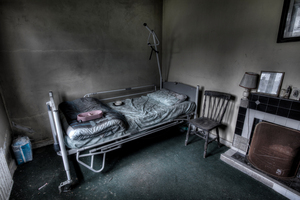
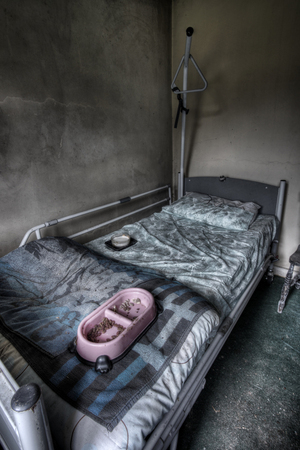


Donal Moloney writes:
Few things are certain in life, for everything else there is an insurance policy. House, car, life, health, pet, travel . Every angle of our mortal existence is covered. Life is sorted and all at a premium. Or so it seems.
A short drive from one of our major cities is a small cluster of rural houses. Most of the residents have been lifelong neighbours. They farm together, they pray together, some have worked the railway together.
But that’s often where the familiarity ends and the isolation begins. Behind closed doors just like any neighbourhood is a story of love, loss, neglect and speculation. A whole world of uncertainty.
In the autumn of his life now, the owner of this house is no longer able to care for himself following a car accident. He left the priesthood to become a garda, never married and grew up surrounded by other males, namely his father and brother.
Locals say a visit to the house would be greeted with the front door being opened just a crack, just enough to have a quick chat and no more.
These men protected each other and showed little interest in widening their circle of friends. A day out was a dinner downtown followed by people watching from the side of the road as cars travelled back and forth to the nearby racetrack.
Yet despite this impenetrable defence, the selflessness of a few of the locals has brought glimpses of human warmth and kindness into their lives. Christmas dinners were prepared by neighbours wives and delivered year after year to the three men. The cats who still occupy the house are checked on and fed by a local lady.
The same lady who helped the current owner and last remaining son carry out basic day to day chores before he eventually went into care. She continues to bring him on weekly outings from the care home and takes him back to the house once in a while to check things over. She too is approaching the autumn of her years.
Nothing it seems is ever certain no matter how over insured and risk adverse we become but we can nevertheless make a few assumptions. Nature abhors a vacuum and will quickly rush in to fill in the gaps.
And love, no matter how we resist and protect ourselves against it, will wangle it’s way in and around us, embracing us and connecting us to the most basic but beautiful risk of all. LIFE.

An infuriating, depressingly revealing, occasionally rewarding quiz in which you predict the autocompletes of Google search queries.
Play it here.
(H/T: Harry Molloy)
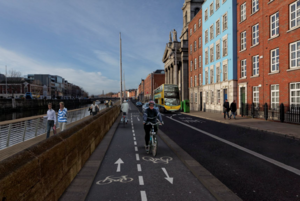
A mock-up of a two-way cycle route along Dublin’s north quays proposed by Dublin City Council last year
About this time last year I was taken to hospital following a cycling accident. It was assumed that I had been hit by a motor vehicle.
After emergency surgery, my ankle was put back together as well as could be expected given the injury I sustained.
Unfortunately, I require further surgery in the hope of keeping arthritis at bay, followed by the inevitable complete replacement of the ankle joint in the years to come.
All of which means I experience daily discomfort and impaired movement. The cause of this accident was another cyclist.
My commute to work is a relatively simple 40-minute cycle, consisting of a short meander through suburban roads, then the rest on a dedicated cycle path. My bike is old and sturdy and I am adorned in day-glo and of course wear a helmet.
After the collision, my helmet was split open, my bike battered, and laptop bent! And I realised I was unable to walk. As I stood, leaning on my bike, a lycra-clad cyclist proceeded to shout at me and made to move off. Despite my protestations that I could not walk, he left the scene.
In my moment of need, a member of the fire brigade, caught in the morning traffic, came to my aid.
Due to the severity of my injury, I reported the incident to the Garda. Despite following up with local traffic cameras and the on-board cameras on Dublin Bus, no evidence was forthcoming to identify the cyclist. This is key, as one cannot then pursue any form of compensation.
If I had the misfortune of being hit by a motor vehicle, then at least there is a fund (managed by the Motor Insurers Bureau of Ireland) that could be availed of.
I, however, am left with no recompense for any and all future implications of the accident.
Are cyclists inherently unsafe, uninsurable, unethical and uncared for?
David Jennings,
Blackrock,
Co Dublin.
Cyclists and insurance (Irish Times letters page)
Pic: Cycle Dublin
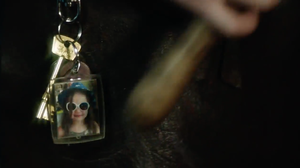
These Little Things.
A one-minute cinema ad for the Peter McVerry Trust in collaboration with Wide Eye Media, IAPI, Pull the Trigger and Havas Dublin.
Further to this.
On Wednesday night, at 8.56pm, a three-minute ad of the same vein will be broadcast simultaneously on RTE One and RTE Two.
Laura Halpin and Ronán Jennings, of Havas Dublin, wrote the script; it was directed by Kieron J Whelan and it involved Oscar winning director Lenny Abrahamson.
RTÉ Television to Celebrate Irish Creativity (RTÉ)
Thanks John Gallen
https://www.youtube.com/watch?v=xlbBK4uwDng
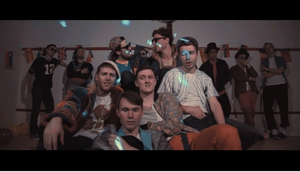
Neil Dunne, of Trinity College Dublin’s all-male a capella choir Trinitones, writes:
We’ve just launched our music video of R. Kelly’s “Ignition (Remix)”. The audio was recorded in Windmill Lane and we did the video with Christian Tierney who has recorded Gavin James, James Bay, Macklemore, The Staves and many more.
Previously: You May Like This


From top: Minister for Finance Michael Noonan, and Dr Rory Hearne
There’s been a rise in the number of people who, having experienced years of austerity, are demanding a more central role for the State and protective public services. This should be reflected in tomorrow’s budget.
Dr Rory Hearne writes:
Another opinion poll, this latest one from the Irish Times/Ipsos MRBI, shows that “a large majority of voters favour increasing spending on public services and welfare ahead of reducing taxes and charges”.
Tomorrow’s Budget should reflect this public mood and provide a very significant increase in investment in key public services and infrastructure, particularly housing, a reversal of regressive austerity measures and outline a plan for the restructuring of the Irish economy away from failed neoliberalism towards a more social economy model of development.
According to this latest poll in the Irish Times, when offered a menu of choices between tax reductions and spending increases and asked to pick one priority, “voters overwhelmingly prefer spending increases in a variety of areas, with by far the biggest preference being for increasing spending on healthcare”.
The aggregate support for tax cuts was only 19 per cent (including income tax at just 7 per cent and the reduction or abolition of the USC at 10 per cent). While support for increased public spending was over three times that, at 72 per cent (with healthcare the highest at 29 per cent and housing and homelessness next, at 14 per cent).
So this shows support for increased spending on healthcare is four times greater than that for cuts to income taxes and support for investment in housing is double that for cuts to income tax.
The most significant aspect of this poll is that it confirms a trend of the changing attitude amongst a majority of the Irish public towards our economy and the role of the state, expressed through attitudes to public services.
It shows that a new popular ‘common sense’ has emerged in Ireland where a majority of people, having experienced the harsh reality of crisis, austerity and a laissez-faire economy, are demanding a more central role for the state and protective public services.
For example, an opinion poll commissioned by TASC in June 2015 showed that 70% of people felt the government should prioritise investing in public services rather than spending money to cut income taxes (this poll also found that 50% of respondents were willing to pay higher taxes to improve public services, and 63% supported an increase in the tax rate for high earners (over €100,000 per annum).
Furthermore, a recent Eurobarometer poll, showed that the issues of main concern to the public in Ireland are housing (34%), health and social security (29%) and unemployment (32%) in contrast to tax (at just 9%).
The trend in these polls, expressed also as a key message from the public in February’s General election, is that the Irish people increasingly want to see accessible and high quality universal public services (particularly health care and housing) and they see investment in these as a priority over tax cuts.
These views are even more significant when we consider the lack of comprehensive, well-funded and universal public services in Ireland and the growing drive toward privatisation and commercialisation.
We have some excellent quality public services – in education, transport, areas of the health service and local authorities, and semi-state agencies such as the ESB.
But many citizens also have negative experiences of long waiting times to access these services (hospitals) or are excluded from them (e.g. social and affordable housing).
This is because we have the lowest level of public expenditure as a proportion of GDP in the entire EU. We also have the lowest level of investment in infrastructure in the history of the state.
And this public opinion is being formed in spite of the mainstream media, economics and government policy continuing to promote the Celtic Tiger obsession with ‘tax cuts’ and a ‘low tax’ economy as part of a laissez-faire, neoliberal, economic policies.
These espouse private market solutions, privatisation, minimising investment and underfunding of basic services, and promoting the monetisation and financialisation of public services by facilitating and supporting the ‘for-profit’ commercial private sector through PPPs and other mechanisms.
These policies have contributed to the multiple social and economic crises our citizens face such as rising poverty and deprivation, our housing crisis, lack of health care, unaffordable childcare, regional underdevelopment (through lack of public investment in infrastructure) and a lack of state investment in research and development and support for indigenous sustainable businesses (rather than an over reliance on foreign investment).
Budget 2017 is being introduced at a time of rising inequality in Ireland despite the so-called ‘recovery’, the legacy of the recession and austerity years (visible in 29% of the population suffering deprivation – with lone parent households, at 58.7% and children at 36.1%, most affected), a cost of living 25% above the EU average, a national housing emergency, precarious work, unemployment, and regional underdevelopment.
This Budget therefore, should reflect the public’s very sensible demand for greater investment in public services, and provide a ‘new deal’ for Ireland with a large scale public investment plan, beyond anything currently being considered, such as TASC has proposed in A Time for Ambition: Ensuring prosperity through investment.
This should go considerably beyond the narrowly defined (and misleading) ‘fiscal space’.
Restrictions of budgetary discussions to what is possible within the defined ‘fiscal space’ has foreclosed the discussion of the many real and viable alternative approaches to fiscal and budgetary policy that are available to the government beyond the fiscal space.
For example, we could substantially increase investment beyond the €1.2bn ‘fiscal space’ if the decision was made to retain the USC, or to introduce a wealth tax, close the tax reliefs that benefit the better off, raise employer’s PRSI, if the decision was taken to borrow for investment or use funding returning from the banks for public investment instead of debt repayments.
Flexibility on EU fiscal rules could be sought (and more are likely to be achieved given the post-Brexit and European and global economic crisis – see below) to facilitate this investment, if necessary.
There is growing support at European and indeed, global, level favouring such radical public investment plans to address the twin crises of stagnant growth and rising inequality.
This perspective was provided in the Financial Times recently. Firstly, a former US Treasury secretary wrote that,
“After seven years of economic over-optimism there is a growing awareness that challenges are not so much a legacy of the financial crisis as of deep structural changes in the global economy…concretely, this means rejecting austerity economics in favour of investment economics…Enhancing infrastructure investment in the public and private sector should be a fiscal policy priority…And the focus of international economic co-operation more generally needs to shift from opportunities for capital to better outcomes for labour.”
While, Wolfgang Münchau, the FT associate editor wrote:
“From an economic point of view there is nothing extreme in the argument for large investment programmes, especially after years of fiscal consolidation….the overwhelming consensus in favour of centrist libertarian economic polities is breaking down.”
Furthermore, public investment (and the necessary taxation to fund it) is not, as it is often portrayed, a ‘cost’ or ‘unaffordable’ as it provides many multiples of return on its investment (through various multipliers particularly in areas of housing, childcare, etc).
Public services such as health care, education, and welfare, along with public investment in infrastructure such as housing, water, and transport play a vital role in addressing inequality in society and are a key mechanism by which to achieve sustainable and socially inclusive economic development.
This Budget should, therefore, be used as an opportunity to change our dominant economic and fiscal policy which is worsening economic inequality and move it closer to that of countries such as Sweden and Denmark, that have substantially higher levels of investment in public services, and, as a result, have more stable economic growth, are much more equal and have less social problems.
Dr Rory Hearne is a Senior Policy Analyst with TASC and co-author of Cherishing All Equally 2016: Economic Inequality in Ireland
Rollingnews