
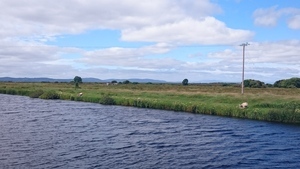

A back for your rod and you.
John Gallen writes:
How’s the fishin’ up your side? Two armchairs on the banks of the river Clare, Headford Rd, Galway :)



A back for your rod and you.
John Gallen writes:
How’s the fishin’ up your side? Two armchairs on the banks of the river Clare, Headford Rd, Galway :)

Alan O’Regan writes:
He/she must be roasting today.
Meanwhile, Met Éireann writes:
Today will be very warm and mostly sunny. This evening, heavy or thundery showers will develop in parts of north Connacht and west Ulster. Cloud will increase near the south coast with some showery rain developing by nightfall. Highest temperatures of 24 to 29 degrees, warmest in the midlands and Connacht.
Meanwhile…

‘sup?

Protesters outside the Dáil calling for a statutory inquiry into Mother and Baby Homes in the 2014
You may recall how, in December, representatives from the Coalition of Mother and Baby Home Survivors delivered a letter to the offices of the Commission of Investigation into Mother and Baby Homes, at 73 Lower Baggot Street, Dublin 2.
The letter was addressed to the chair of the investigation, Judge Yvonne Murphy and, in it, CMABS called for the commission’s terms of reference to be widened.
Paul Redmond, of CMABS, said at the time:
Only about one third of the entire total of people who were separated as single mothers and children are being included in this inquiry.
Further to this…
The Coalition of Mother And Baby Home Survivors (CMABS) writes:
Survivors from Mother and Baby Homes, and other institutions and homes associated with forced and illegal adoptions, will picket the official Inquiry into such homes [today at 1.30pm] for refusing to include ALL survivors.
The survivor community has been sliced in two by the Terms of Reference for the Inquiry and thousands have been excluded. This wanton discrimination and exclusion is insulting and deeply hurtful to our ageing survivor community.
Despite a formal meeting with the Inquiry and the presentation of irrefutable and conclusive evidence that it would be in the public interest, as well as morally and legally necessary to include all survivors, the Inquiry has stalled and fobbed off our community for nearly 18 months.
The indisputable fact remains that the Inquiry’s own Terms of Reference allow it recommend to the Minister for Children and the Government that its terms be expanded to include all survivors. The Inquiry has refused to make such a recommendation without even giving a credible explanation.
The Inquiry has refused to include all survivors despite the fact that the excluded survivors have no other means of legal remedy, meaning the Inquiry itself – as well as the Government – is now in breach of European human rights laws.
Illegally adopted people are now formally denied justice in Ireland, as are many elderly survivors who happen to have been born in places or situations outside the named Mother and Baby Homes.
Survivors are dying without seeing justice and are profoundly wounded and injured by the discrimination the Government and the Inquiry are implementing on a daily basis.
The Coalition of Mother And Baby home Survivors (CMABS) will lodge a formal complaint and objection to the Inquiry today at 1.30pm. We will be publishing the complaint shortly afterwards in a press release.
CMABS is also seeking a pro bono legal team to challenge the continued exclusion and discrimination against an elderly survivor community who are dying by the hundreds and thousands every year. Thousands have already been denied justice and an apology in this life.
CMABS has offered the Inquiry a low-cost and speedy method to include all survivors but this has been ignored.
Some of our activist comrades who have recently passed away are named and remembered in our complaint. How many more of us will join them in the grave while this Inquiry drags on and the Government hides behind it?
CMABS demands an immediate Acknowledgment, Apology and Redress from this Government while there is still time. Many groups have the evidence to conclusively prove their cases now. Why are they being ignored? Deny ’til they die? “To add the halfpence to the pence”, in the centenary year of the 1916 Rising?
Previously: The Sin Of Omission
Sam Boal/Rollingnews
Thanks Paul Redmond

Fine Gael Minister for Housing Simon Coveney
For the day that’s in it.
The team behind the building and construction forum BRegs Blog writes:
The Government’s Housing Action Plan is due to be published today, All eyes will be focused on what the Minister for Housing, Simon Coveney T.D. proposes to resolve Ireland’s chronic housing problem.
The programme for Government undertook to prepare a response to the housing shortage within 100 days which will be achieved. On 14 April 2016, the Dáil agreed to establish a Special Committee – the Committee on Housing and Homelessness – to review the implications of the problems of housing and homelessness and to make recommendations in that regard.
The Committee had its first meeting on 20 April 2016 and launched its final report to the Dáil on 17 June 2016. It will be interesting to see which recommendations survive in the Housing Minister’s Plan (very few it seems judging by the kite flying in the leaked report last week).
Will it be more pandering to vested interests in the construction sector that seem to have a huge influence on Department officials at the Custom House?
At this stage, 18 months after the housing crisis went mainstream there is a very informed media waiting to judge the new Housing Minister. If Minister Coveney thought the heat might be off him by launching the plan during the traditional annual builders’ holiday period, when most of the construction professionals also take leave, he may be disappointed. All media eyes seem to be clearly trained today on examining what these proposals are.
On what looks to be the hottest day of the year and possibly a record breaker in temperatures reached it seems the heat’s on for the Housing Minister!
We wish Minister Coveney all the best and hope that he can come up with the goods today. As always we would like to receive your feedback on the Housing Plan as published to: bregsforum@gmail.com
The Heat’s On – Housing Action Plan Published Today (BRegs Forum)
Meanwhile, in today’s Herald…

Via BRegs Blog
Rollingnews
UPDATE:
Watch Minister Coveney deliver his proposals live in the link above.

Kevin B writes:
I took a taxi from outside the Mater private hospital to Holles Street [Dublin 2] yesterday afternoon. I placed my Donegal sports bag in the back seat, sat in the front seat. When I got out of the taxi, after paying the taxi man, I completely forgot about my bag and the taxi drove off.
Nothing of any real value was in it – just my washbag, some clothes and a couple of accountancy books which I need for upcoming exams.
It is a bag of the 2008 to 2010 era. “Abbey Hotel” is stitched into the short side of it while it says “Dun na nGall” on the two long sides of the bag. It had a large green strap with the “GAA” logo (above) appearing multiple times on the strap. Bag is predominantly navy…
Anyone?
UPDATE:
F writes:
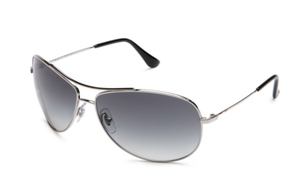
A pair of Ray-Ban sunglasses (in a case and belonging to a friend) fell out of my jacket pocket when getting out of a taxi on Friday night. I got the taxi from the Samuel Beckett Bridge at 11.30pm and went to Bettystown, Co Meath. The glasses were in my pocket, on getting into the taxi, but not on getting out. They must have come out of my breast pocket when I was taking out my wallet (I kept both in same pocket). The taxi, which was a silver car and driven by a Dublin taxi driver, would have gone back to Dublin at around 12.30am – 12.45am.
If the next customer of that taxi picked up the glasses, I would be very grateful if they could make contact.
Anyone?


From top: Cycling in Copenhagen, Denmark, Michaerl Taft
There’s something rotten here.
Only the poorer Mediterranean countries spend less on public services.
Michael Taft writes:
One of the impacts of the CSO’s recent National Accounts data – the one that shows the economy growing by 26 percent – is that all our main economic measurements are practically useless.
It’s not that we didn’t have trouble before last week.
Using GDP was always fraught, given multi-national accounting practices. But at least we could fall back on GNP or GNI or the Irish Fiscal Council’s hybrid-GDP measurements. Now these are shot as well. We are in a fog.
The former Governor of the Central Bank, Patrick Honohan, was spot on:
‘The statistical distortions created by the impact on the Irish National Accounts of the global assets and activities of a handful of large multinational corporations have now become so large as to make a mockery of conventional uses of Irish GDP . . . GNP is now almost as unhelpful an aggregate economic measure for Ireland as GDP . . . Ratios to GDP are now almost meaningless for Ireland in most contexts. They need to be supplemented by alternative purpose-constructed ratios for specific uses . . .’
So now the hunt is on for robust ‘purpose-constructed ratios for specific uses.’ This will entail a new debate, a flurry of number-mongering and endless disagreements.
Take, for example, our expenditure on public services. Using CSO figures spending on public services fell from 13.7 percent of GDP in 2014 to 10.5 percent last year, even though spending on public services rose.
And comparing ourselves to other European countries is equally meaningless. GDP per capita in the EU-15 was €33,000 in 2015. According to the Government projections, Irish GDP per capita was supposed to be €46,000 – already inflated by multi-national activity.
After the CSO release, GDP per capita has shot up to €55,000. That’s 67 percent above the EU-15 average. Unreal.
So how does our spending on public services compare with other European countries? Here’s one suggestion for an ‘alternative purpose-constructed ratios’: spending on public services per capita.
Of course, nothing ever being simple, we have to choose between nominal spending (actual Euros and cents) and real spending (factoring in actual purchasing power).
I’ll go with the latter – this counts what countries actually get for their spending excluding inflation and living costs.
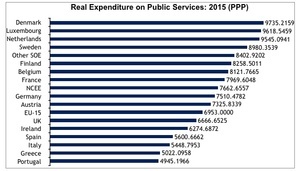
This shows Ireland a low spender. Only the poorer Mediterranean countries spend less on public services. We fall 10 percent below the EU-15 average.
However, it doesn’t tell us much that we spend more per capita than, say, Greece or Portugal – two relatively poor countries in this table.
So when we compare ourselves to our peer group, Northern and Central European economies (NCEE: excludes the Mediterranean countries), we fall 18 percent behind.
And when we compare ourselves to another peer group, other small open economics (SOE: Austria, Belgium, Denmark, Finland and Sweden), we fall 25 percent behind.
But there are a couple of things we should bear in mind:
First, given that we don’t have as high a proportion of elderly, we wouldn’t have to spend as much on health and other elderly-related services. However, we have a much proportion of young people; therefore we have to spend more on education and other services.To what extent these spending ratios cancel each other out would require more research.
Second, Irish spending on public services is subject to very low purchasing power (like consumer spending). We have to spend €113 to match the EU-15’s average €100 just to purchase the same goods and services.
This inflation, though, is not confined to Ireland. Denmark, Sweden and the UK have weaker purchasing power than us.
Another issue is that of reform. The previous government claimed to reform public services but this was mostly made up of cutting employment, increasing hours and cutting wages.
‘Doing more with less’ only means we have less.
A real reform process would include the producers and users – the public sector workers and the users of the public services. It would further distinguish between process issues (are we doing things in the most efficient way) and structural issues.
For instance, does the role of the private sector in our public health system drive up costs? Does it produce perverse incentives that increase costs per patient?
The bottom-line, however, is that we are an under-spender on public services.
To reach the EU-15 average, we’d have to spend an additional €3.6 billion
To reach the average of Northern and Central European economies, we’d have to spend an additional €7.3 billion
To reach the average of other small open economies, we’d have to spend an additional €11.2 billion
These are big sums. Even after tackling inflation and reform issues, we will still be faced with big sums.With the aid of purpose-constructed ratios for specific uses we now see the challenge we are facing.
How will the ‘new politics’ measure up?
Michael Taft is Research Officer with Unite the Union. His column appears here every Tuesday. He is author of the political economy blog, Unite’s Notes on the Front. Follow Michael on Twitter: @notesonthefront

He’s back.
Are Ya Having That writes:
‘LeatherJacketGuy’ asks Irish People to tell American People who to vote for in the U.S. Presidential Election 2016!
So that’s pretty blatant, right? pic.twitter.com/EPnHME7afV
— Mike Hearn (@mikehearn) July 19, 2016
When Melania stood up to to tell
Her story, it started off well
But many a word
Had been already heard
In a previous speech by Michelle.
John Moynes




MORE to folly.

