
Category Archives: Misc

alvyCarragher

te amo/je t’aime/i love you – by poet Alvy Carragher

Alvy writes:

I’ve just released this new poetry video, for my sister, about fighting depression. It’s one of the poems from my upcoming collection on June 13 with Salmon Poetry and addresses the frustration/powerlessness of both the sufferer and those looking on. It also covers things like how much worse social media makes this kind of situation.

Alvy Carragher

Video by Stephen Murphy

Screen Shot 2016-05-17 at 11.28.47

Fianna Fáil’s justice spokesman Niall Collins

You may recall how, in February 2014, Fianna Fáil Niall Collins read into the Dáil record a section of the transcript of a 2012 conversation between Sgt Maurice McCabe and the then Garda Confidential Recipient Oliver Connolly.

The section included the following:

“Maurice, and this is just personal advice to you, if Shatter thinks you’re screwing him, you’re finished…If stuff is to get into print, broadcast media, it becomes public before the court and not any other way. If Shatter thinks it’s you, or if he thinks that it is told by the Commissioner or the gardaí, here’s this guy again trying another route to put you under pressure, he’ll go after you.”

Broadsheet later printed the transcript in full.

In relation to the transcript, Justice Kevin O’Higgins found that Mr Shatter “adamantly repudiated” the allegations and that “His [Shatter’s] denials were unchallenged and uncontradicted, and are unreservedly accepted by this commission”.

Months later, in a speech given on October 3 2014, Mr Collins said:

The problems which have manifested themselves in An Garda Síochána and GSOC and were reported to the former Minister for Justice were ignored, dismissed or glossed over in order to save the embarrassment of those in senior positions who decided that not taking responsibility was a key management skill.

This approach was a massive disservice to the ordinary members of An Garda Síochána and to the citizens of Ireland.

As a result of this dereliction of duty we have seen the resignation of the Garda Confidential Recipient, the Garda Commissioner, the Minister for Justice and Equality and the Secretary General of the Department.

We have also witnessed the establishment of an unprecedented number of Commissions of Investigation surrounding the Department of Justice and there are still more Commissions to be established.

One would hope then that lessons will be learned as to how to deal with issues arising in the Garda force and the Department of Justice from this date forward.

…The Guerin Report highlighted the fact that Sergeant Maurice McCabe was correct in his actions to highlight the failure to administrate justice in Bailieboro Garda District.

To be frank, the findings were an embarrassment for this Fine Gael Labour government who denied there was ever any issue in Justice and defended former Minister Shatter month after month. He dismissed and belittled the Whistle-blowers and was supported by the Taoiseach while doing this.

…The alleged malpractice in Bailieboro undermines the foundations of our criminal justice system. It also undermines the morale of all members of An Garda Síochána.

In order for public confidence to be restored in An Garda Síochána it is necessary to establish fully and frankly how the situation surrounding the malpractice in Cavan was allowed to occur, continue and be covered up over such a long period of time.

Further to this.

Mr Collins spoke with Seán O’Rourke on RTÉ Radio One this morning, following the release of Ms O’Sullivan’s statement last night.

From their discussion…

Niall Collins:We can only deal with what’s written in the report, from what Judge Kevin O’Higgins has reported. And, secondly, my party leader, as you know, called for clarification from Nóirín O’Sullivan over the weekend and we received that clarification and we accept the clarification, I want to say, because Nóirín O’Sullivan is the head of An Garda Síochána and she was asked to give a clarification and she has given it and I think we either accept it or we don’t. And I think the fact that we’ve had so much discussion which is now bordering on very detailed legal argument about, you know, the difference between evidence and submissions, and the fact that the Commission held its work and holds its work in private, you know, is really, bypassing and forgetting the very central players in the whole unfortunate saga who are the victims of crime. And I think we have to keep uppermost and centre stage the impact and the failings of the system and indeed of the State on our victims of crime and if you recall, the terms of reference, which established and enabled the O’Higgins commission investigation was actually dominated – three quarters of the terms of reference were to do with named specific incidences where members of the public weren’t properly served by An Garda Síochána…”

Seán O’Rourke: “So, from what you’re saying, Niall Collins, you would appear to be satisfied with Commissioner O’Sullivan’s statement last night and that should be the end of this affair?”

Collins: “Well, I am. And I’ll tell you why. She’s the head of An Garda Siochana, she’s tasked with an exceptionally difficult job, Seán. We have a whole change agenda, a whole reform agenda and process going on within An Garda Siochana and she has presented to the Oireachtas Justice Committee on many occasions in relation to how she’s doing that. She has an exceptionally difficult job…we are constrained, as I read it, now I don’t have legal background and we have lots of people offering different legal opinion, the Commission has to do its work in private and you know persons aren’t allowed to divulge the proceedings, or indeed, the evidence…”

Previously: No Absence Of Malice

Dáil transcript: Kildarestreet.com

Rollingnews

Mis of cowshions(1)SHELLEY -PANDORA(1)

‘sup?

Charmaine Kenny  at the Irish Workshop [online home of Irish crafts and whatnot], writes:

It’s udderly ridiculous how crazy we are about cows here at The Irish Workshop; it’s just that cows are very amoosing and we’re particularly fond of Brigid Shelly’s ‘cowshions’.

Many of the designs are inspired by her bovine neighbours where she lives in Waterford.

Take for example Pandora  (above in pink) – she is born and reared in Ardmore on Joe Murphy’s farm down the road from Brigid. She isn’t your typical country cow. A self-proclaimed fashionista, she enjoys the finer things in life and has a weakness for single malt whiskey….

Hic.

The Irish Workshop

Irish made stuff to broadsheet@broadsheet.ie marked ‘Irish Made Stuff’

Screen Shot 2016-05-17 at 10.24.24
Screen Shot 2016-05-17 at 10.06.08

From top: Michael Clifford, Colette Sexton and Gavan Reilly; Vincent Browne

Further to the statement Garda Commissioner Nóirín O’Sullivan released last night – in which she stated:

“I want to make it clear that I do not – and have never, regarded Sergeant McCabe as malicious.”

Vincent Browne discussed the matter with his panel on TV3’s Tonight With Vincent Browne last night.

The panel included Irish Examiner journalist Michael Clifford, who last week reported that Ms O’Sullivan’s senior counsel Colm Smyth told Justice Kevin O’Higgins – during his Commission of Investigation into Sgt Maurice McCabe’s complaints – that McCabe told two officers he was acting out of malice.

The allegation was proven to be false after Sgt McCabe produced a recording of his conversation with the two Gardai – and the episode wasn’t included in the final report.

Mr Clifford reported:

The documents show that, at the commission, Mr O’Higgins asked the commissioner’s lawyer whether “you are attacking his [McCabe’s] motivation and attacking his character”.

The reply from Colm Smyth, SC, was: “Right the way through.”

He told the judge that he was acting on instructions.

This morning, Mr Clifford reported that after he received a draft of the O’Higgins report, he threatened to get an injunction against the publication of the report – because the episode wasn’t included.

Colette Sexton, of the Sunday Business Post and Gavan Reilly, of Today FM were also on the panel.

Grab a tay…

Gavan Reilly: “On the question of who was acting on whose instructions, by the way, Vincent, it’s worth bearing in mind that the senior counsel involved in this particular exchanged that formed Mick’s story on Friday. Not only were they hired and instructed by the Chief State Solicitor but they were the same legal team that represented not only Noirin O’Sullivan but the two former commissioners Fachtna Murphy and Martin Callinan and all the other members of the Gardai who were implicated by Maurice McCabe’s allegations the whole way down so…”

Talk over each other

Vincent Browne: “That makes it even more confused because it could have been somebody else that…”

Michael Clifford: “No, the counsel was specific on whose instructions he was representing.”

Browne: “On what basis are you saying, are you asserting this?”

Clifford: “I’m asserting… it was in the story on Friday. He was asked was it the Commissioner that wanted to follow this line and he said, he was operating on instructions.”

Browne: “I know but where do you get this from?”

Clifford: “It fell off the back of a lorry, I mean what do you expect me to say to that?”

Browne: “Have you two…have you, I assume that it fell, let’s assume it fell off the back of a lorry. But then did you, did you independently confirm that what fell off the back of the lorry was true?”

Clifford: “I am 100% secure and confident in the veracity of that story that was published.”

Browne: “All right, tell us about this story that you have in the Examiner tomorrow, the ‘McCabe threat to injunct inquiry report’. What’s that?”

Clifford: “This is, when the draft report, as I understand it, was released, Sgt McCabe was, as I understand it, very perturbed because he felt that it was entirely imbalanced and that one of his main issues with that was the fact that this matter was not included, at all, in the draft report. As a result of that he was minded to take a legal action, to injunct the report. We saw something similar in the Moriarty draft report, where there was a similar scenario. Now, ultimately, they didn’t do that because the costs would have been so prohibitive. But I think it just demonstrates how perturbed he was that this matter in particular, I think there may have been a few others but this was one of the main reasons…”

Browne: “Which matter are you talking about?”

Clifford: “The matter about the….”

Browne: “The malice issue, yeah.”

Clifford: “The attempt to impugn his character that this hadn’t been included in the report and I have to say, just looking at it, there’s a question there for Kevin O’Higgins. Let’s for example assume that he had, Sgt McCabe didn’t have a tape recording of that and that officers came in and said he had expressed malice, would that have been in the final report? Would it have…we’d have had a very different report, remember, completely. You’d have had a report that suggested that McCabe had brought forward these allegations on the basis of malice and therefore they had to be treated on that basis and seen in that light. That’s the kind of report you’d have had if hadn’t protected himself with a tape recording. And would have that have been included? And if so, why was it not included as it emerged here.”

Reilly: “It does raise the other question though as to whether the inquiry would have been allowed to include that, if, as you mentioned, that if it was included on the basis of arguments by lawyers and not by evidence from witnesses. That if this was something that was brought to the tribunal only by lawyers chatting among themselves really..”

Clifford: “Oh yeah but surely…”

Talk over each other

Clifford: “There’s an indication that there’s going to be evidence to that effect, and then the tape recording was produced, surely it was still incumbent to hear the evidence to see what was going to be said…”

Browne: “OK, we gotta take a break but I think, just before we go to a break, it’s fair to say that yes, questions arise, further questions arise that the Garda Commissioner has got to address but I think it’s fair to say that, given her record and given her stature and known integrity, that it’s very unlikely that she is telling a lie about a matter as central as this to the whole O’Higgins’ report.”

Watch back in full here

Previously: ‘I Have Never Regarded Sgt McCabe As Malicious’

Nóirín’s Disgust

funeralMichael-Taft

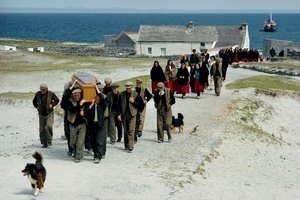
From top: funeral procession, Inisheer Island, Aran Islands, Co Galway, 1968; Michael Taft

Raising the inheritance tax threshold will have no impact on a significant majority of households.

Michael Taft writes”

The Programme for Government has provision for cutting inheritance tax. This is bleak business. Cutting inheritance tax will be a bonanza for high-income groups.

Welcome to the new politics, inseparable from the old politics.

The Government proposes to increase the tax-free threshold from the current €280,000 to €500,000. The regressive impact can be seen from this simple example. I inherit €500,000. Currently, I would pay 33 percent on the amount exceeding the threshold; that is €220,000.

My tax bill would be €72,600. That is an effective tax rate of 14.5 percent. That’s not a bad deal (and arguably already too generous): I inherit half-a-million Euros and keep 85 percent of it after tax.

Under the new proposals, I would pay nothing.

There are many arguments for cutting inheritance tax but the most unimpressive is that it would somehow benefit low and middle income earners.

The fact is that most people don’t have even the current threshold to give away in an inheritance.

The median net wealth (wealth after debts) for those aged over 64 years is €202,300. This means that 50 percent of this older-age group has net wealth less than this amount.

That includes both financial and real (property) wealth. It is reasonable to assume that a significant majority have net wealth holdings of less than the current threshold of €280,000. Of course, not all disponers come from the older-age group but probably a majority does.

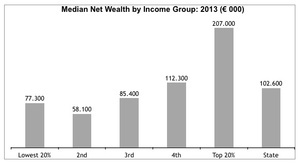
When we look at the national numbers we can get data on income distribution. The following table shows the median net wealth by quintile – or tranches of 20 percent.
1

The top 20 percent income earners have a median net wealth of €207,000 (again, meaning half of this group have a wealth of less than this amount). T

hroughout the state, half of all households have a net wealth holding of less than €103,000. [Note: the lowest income group has a median net wealth holding higher than the 2nd quintile; this can be explained by the fact the lowest group would contain older age groups reliant on state pensions but own their houses).

Based on this, it is reasonable to assume that raising the inheritance tax threshold will have no impact on a significant majority of households.

Even if a household has a much higher level of wealth than the average, raising the thresholds may have little impact. I may pass on €500,000 on an inheritance but if I divide it equally between my two children, then they won’t be liable to tax under the current threshold.

Some argue that the gift/inheritance shouldn’t be taxed because it has already been taxed. This is debateable for two reasons. First, it is taxed in the hands of the recipient who, by definition, is only receiving it for the first time. Second, income is subject to multiple taxes (or double/triple, etc. taxation). I pay income tax on my wage.

But I also pay USC on my wage; and PRSI. After tax, I continue to pay taxes – VAT, excise taxes, levies (ATM withdrawals, etc.). And the after-tax income that I spend in the shops is also subject to taxation; corporate tax for the business and income taxes for the employees. And so the cycle continues.

Still others have referred to the situation whereby a son/daughter inherits a house – but is forced to sell the ‘family home’ to pay the tax bill. Is this just anecdotal?

I receive a house in an inheritance. If I already own a home, I have inherited a second home (adding substantially to my wealth). I can either rent out the house, earning income; or I can sell it. Either way, I receive a substantial gain – even after the tax bill.

If I rent, I can move into the house with full equity and increase my income through reduced rent payments. The tax bill is a once-off, my rent reduction is permanent. This is not to say there are not issues regarding inheritances and payments – I look at some of them below. But gaining a house through inheritance is a gift of a substantial asset.

The cut in inheritance tax is estimated to cost €75 million, not a trifling sum. However, the real issue is that ever since estate duties were abolished and replaced by the Capital Acquisitions Tax, inheritance tax revenue has been subdued.
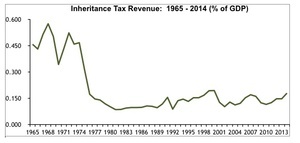
2
There is a strong argument for an increase in inheritance and gift taxes, especially give these tight fiscal times.

This argument gains force when we consider that this is a tax on unearned income. We tax unearned income so that we don’t have to impose that amount on earned income – a PAYE wage or the income of the self-employed or a business.

Economic efficiency would see higher, not lower, taxation on unearned income.

There are three issues that could be considered in the context of a more progressive inheritance tax regime.

First, is the issue of inheriting a house; currently, there is an implication that a child who is living in the ‘family home’ can only inherit tax-free if the parent is not living in the house (in other words, the parents have two houses).

There are exceptions for those caring for a parent. If there is a problem in this area it should be cleared – so that a child living in the house, with conditions, is not barred because they share the house with the parent.

Second, consideration should be given to extending the situations whereby the inheritance tax can be paid over 60 months.

Third, prior to 1999, there are varying rates for inheritances – ranging from 20 percent to 40 percent. This added a progressive element to the tax. Reintroducing a low rate and top rate could also be considered.

But if we entering into an era of ‘new politics’ then the Government should bring forward evidence as to the distributional impact of cutting inheritance tax – who will gain and by how much?

Is this a transfer to high-income groups from the rest of us?

In any event it will be interesting to see how the Government squares this commitment to cut inheritance tax with a commitment in the Government programme to poverty-proofing new policies.

I suspect it can’t be done.

Michael Taft is Research Officer with Unite the Union. His column appears here every Tuesday. He is author of the political economy blog, Unite’s Notes on the Front. Follow Michael on Twitter: @notesonthefront

Pic: James Sugar/National Geographic

Screen Shot 2016-05-16 at 21.21.01

Garda Commission Nóirín O’Sullivan

As previously stated, An Garda Síochána has fully accepted the findings and recommendations of the O’Higgins Commission. We will examine what lessons can be learnt and ensure the issues arising are fully addressed.

Our immediate concern, arising out of the O’Higgins Commission, must be with victims who believe – with justification, they were not dealt with properly by An Garda Síochána.

We are sorry the victims did not get the service they were entitled to, and we will seek to work with them.

A key element of our modernisation and renewal programme is ensuring victims are at the
heart of the Garda Service and they get the service they are entitled to.

In order to ensure a victim centred approach our first steps have been the setting-up of 28 Victim Service Offices throughout the country to keep victims up-to-date on the progress of their case through the justice system and the establishment of the National Protective Services Bureau, which among its work provides support for vulnerable victims.

These measures will help ensure we meet our obligations under the EU Victim Rights Directive.

We are learning from our past mistakes and following a number of reports in recent years, improvements in relation to how An Garda Síochána conducts investigations, manages incidents, trains its personnel, and liaises with victims of crime have been introduced or are in the process of being introduced as part of An Garda Síochána’s modernisation and renewal programme.

Every day, the men and women of An Garda Síochána do great work to protect and support
communities. In doing this, they consistently show great depth of character, resolve and commitment.

The initiatives we are undertaking as part of our modernisation and renewal programme are designed to ensure they have the necessary supports to provide the very best service to the communities we serve.

I have been asked to clarify certain matters in relation to the proceedings before the
O’Higgins Commission.

I am legally precluded from so doing under section 11 of the Commissions of Investigation Act 2004, which provides that it is a criminal offence to disclose or publish any evidence given or the contents of any document produced by a witness.

The witnesses who gave evidence before the Commission did so on the expectation that
their evidence, except as may be included in the final report, would remain private
.

Accordingly, I have been advised that I cannot discuss the details of any proceedings before the O’Higgins Commission.

I have consistently and without exception, within An Garda Síochána and in public, stated clearly that dissent is not disloyalty, that we must listen to our people at every level with respect and with trust, and that we stand to gain, rather than lose, when members bring to our attention practices they believe to be unacceptable.

Like every member of An Garda Síochána, Sergeant Maurice McCabe’s contribution is
valued and the service has changed for the better in response to the issues about which he complained.

I want to make it clear that I do not – and have never, regarded Sergeant McCabe as malicious.

Any member of An Garda Síochána who raises issues will be fully supported.

Each and every one of them must know they have the right and responsibility to raise their concerns and be confident that they will be listened to and addressed.

They won’t always be right and we in management won’t always be right either. But we are on a journey towards a markedly better policing service and we will learn from
every mistake we make.

A statement from Garda Commissioner Nóirín O’Sullivan released tonight.

Previously: Nothing To Say Here

Nóirín’s Disgust

McCabe And Ms O’Sullivan

Rollingnews