
Category Archives: Misc

Screen Shot 2016-03-22 at 01.06.56

Mickey Twopints asks:

Since the Central Bank of Ireland introduced “rounding” of change for cash transactions in shops and supermarkets, I haven’t heard a complaint, nor do I have one to offer. Except, that is, to the signage on display in each branch of one of our favourite German supermarkets.

No mention there of the voluntary nature of the arrangement, the rights of a customer to demand exact change, or of the “policy” of the Central Bank (detailed in their “Rounding – Retailer Guidebook”):

“(the retailer)…could also choose to apply Rounding in a compulsory manner at some part of their store, as long as the customer has some option in that store to get their exact change if they want it.

For example, they could apply compulsory rounding at self serve machines and to direct customers who want exact change to manned tills. In such cases the options should be clearly communicated to the customer with appropriate signage.”

Incompetence or Germanic arrogance? Was sagst du?

Screen Shot 2016-03-21 at 16.26.12tubridylls

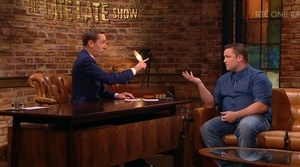
From top:  John Connors (above) and Ryan Tubridy on the Late Late Show last Friday

You may have seen actor John Connors speak to Ryan Tubridy on RTÉ’s the Late Late Show last Friday.

Mr Connors’ appearance came ahead of his documentary, called I Am Traveller, to be  broadcast on RTÉ Two on Thursday night.

Grab a tay.

Ryan Tubridy: “I’ve heard you saying that you felt that the Travelling community were well represented in Love/Hate in a way that you hadn’t before. Is that the case?”

John Connors: “Yeah.”

Turbridy: “Did you enjoy playing that role?”

Connors: “Yeah, I did yeah. Though I think, because what it dis was for the first time it portrayed a culture realistically – we talked in our language and we had our music involved. I know that I was a pipebomb dealer making pipebombs and, you know, killing people…”

Tubridy: “So you were delighted with the representation?”

Connors: “Yeah, 100%.”

Laughter

Connors: “But you see the way I justified it in my own mind…”

Tubridy: “Go on, why?”

Connors: “Every other settled person there was killing people..”

Tubridy: “Yeah.”

Connors: “So once there’s one Traveller killing people, it wasn’t too, we had to balance it up a little bit.”

Tubridy: “So we’re all ok then?”

Connors: “Yeah.”

Tubridy: “Ok. Well you’ve made this programme, the documentary called I Am Traveller and I watched it and it packs a punch, let’s face it. And it’s, I guess, well why don’t you tell me: what is it? Or why is it called, even, I Am Traveller?”

Connors: “Well it’s called I Am Traveller because RTE called it I Am Traveller.”

Tubridy: “You didn’t decide it?”

Connors: “No, no, the original name was actually The K Word, knacker basically. And I thought that was a powerful title but..”

Tubridy: “Did you want to call it The Knacker?”

Connors: “No, The K Word. Just to show, just The K Word, to show the power behind the word.”

Tubridy: “Yeah.”

Connors: “You know what I mean? And to show that. But RTE changed that, probably shouldn’t go down that road.”

Tubridy: “Tell us, it’s a pity in some ways because it would have said, it would have packed a bigger punch, for you, cause you wanted to say it and highlight that.”

Connors: “Yeah, yeah, 100%.”

Tubridy: “And why, why The K Word?”

Connors: “Why The K Word? Because, well because knacker is a word that’s used day in, day out in Irish society, and it’s used towards Travellers and it’s a very hateful word.”

Tubridy: “Yeah.”Continue reading →

Erica-Fleming-3

Erica Fleming

You may recall how Erica Fleming featured in an RTÉ documentary, My Homeless Family, earlier this year.

The documentary showed how Erica, 30, has been living in a Dublin hotel room with her nine-year-old daughter Emily since last summer. Erica works 29 hours a week at a business which has employed her for five years.

You may also recall how Erica’s questions during a post-Budget RTÉ phone-in last October caused a bit of a headache for Minister for Public Expenditure and Reform Brendan Howlin and Finance Minister Michael Noonan.

Further to this…

Erica writes:

One hundred years ago, brave Irish men and women took to the streets of Dublin to fight for an Ireland that was more equal than the one they had known previously. They fought for a Republic that guaranteed equal rights and equal opportunities. Most notable for me as a mother, they fought for an Ireland where all of the children of the nation would be cherished equally.

They were incredibly brave but their vision for how our Republic should be, has not been realised. In our Ireland today, 130,000 children live in consistent child poverty. To our great shame, there are 1,600 children in our city who are homeless and spending large parts of their childhood living in single room hotel accommodation.

My beautiful daughter Emily is one of those children. As a mother I want to fight for her. I want to take to the streets and stare power in the eye and hold it to account for the experiences of poverty that are facing my child daily. Her playground is a hotel corridor: I rarely get to provide her with a home cooked meal. As I tuck her in at night, I can’t even afford her the dignity of leaving the room. This isn’t the Republic that people died for and I feel duty bound to demand that my daughter be cherished equally in the eyes of this State.

I feel that the best way that I, and others like me. can pay tribute to the heroes of 1916, is to also take to the streets of Dublin over the Easter weekend.

So here’s what I’m proposing. On Easter Sunday, I invite all of the homeless people of this country to stand with me and other campaigners on O’Connell Street and remind those politicians who will be celebrating the centenary of the Rising, that our children are important too.

Stand with me and, through our presence on the day, let it be known that the best way to pay tribute to those who sacrificed themselves for this Republic, would be to prioritise solving the homeless crisis that is plaguing the lives of so many people in this country.

This will be a friendly, family-orientated event and all we will be doing on the day is standing in solidarity with homeless families. There will be no speeches, there will be no rallies or microphones and there will be absolutely no hate permitted from anybody standing with us – regardless of where it’s directed.

Our intention on the day is to highlight that our children matter and that a home is the minimum we should be affording our children on this anniversary of an event associated with such strong themes of equality and what it truly means to live in a Republic.

Please share this message! Let this event be known to your friends and families and let’s try make this event one that those who sacrificed their lives a century ago would be proud of. This is my duty as a mother. This is our duty as citizens of this Republic.

Easter Sunday protest for the homeless (Facebook)

Previously: “It’s Not Really A Response, Is It? It’s Just A Speech”

A Phoney Phone-In

SeanadChamber2_800

IMG_2930

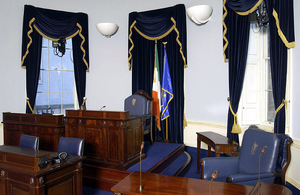
From top: Seanad chamber; Independent candidate Barry Johnston

London-based, Expat rights activist Barry Johnston is running for the Seanad as an independent and the first candidate to stand from ‘abroad’

It’s time, he says, for the upper house to get obstreperous

Barry  writes:

Ever since Fianna Fáil latched on to the idea of a ‘Programme for Parliament’, there’s been lengthy discussion about how the current challenges in appointing an executive may present an opportunity to rebalance the power towards the legislative branch of our government.

It is tempting to engage in a cathartic round of eye rolling when you hear Deputies, many having sat long on the Government benches, talking with the zeal of a convert about the need for ‘radical’, ‘far-reaching’, ‘root and branch’ political reform.

That the clichés about ‘Punch and Judy’ and ‘New Politics’ trip so lightly from TD’s tongues should prompt concern about the thoughtfulness of any proposals being trotted out.

Of course such cynicism might be misplaced, and the rebuke to the old order of politics delivered by the electorate could prompt our politicians to change their spots and vote for Christmas.

For what it’s worth, from my own experience working in parliamentary strengthening with Commonwealth legislatures, there are really three things that are required to shift power within Government: relaxing the whip, introducing the right of recall so voters can kick out under-performing representatives, and providing greater legal and research expertise to enable TDs to become legislators rather than solely case-workers.

One minor element has been missing from the debate however. Up until now discussion on parliamentary reform has focused solely on the Dáil, thereby ignoring fully one half of our parliamentary chambers.

It’s ironic, given how much huffing and puffing there was about Seanad reform in the last Oireachtas, that we seem to have forgotten the place exists while discussing reform in the new one.

But it does still exist. And it really does need reform.

This is usually the part where proponents of reform propose a new commission, maybe a working group. No, an expert group! It looks like the Dáil is getting an all-party committee on reform. Maybe we’d need one of those in the Seanad?

But we’ve been there. We’ve had numerous tracts on Seanad reform, not the least of which was last year’s paper by Maurice Manning.

This presents a ready to go package of reform that could be introduced immediately, bringing ‘radical’, ‘far-reaching’, ‘root and branch’ changes without the need for a referendum.

This would include universal suffrage, including citizens abroad. And these changes could be in place by the next-but-one Seanad elections – which might be very soon indeed depending on developments in the Dáil.

It’s not for want of new ideas that we have the arcane upper house we have; it’s a lack of political fortitude, including from within the Seanad itself. But with our TDs focused literally getting their own house in order could, and would, the new Seanad achieve something similar?

The role of the Seanad is constitutionally subordinate to that of the Dáil; and its powers are designed in such a way as to avoid any rivalry or blocking. Nonetheless, the Seanad does possess a variety of significant constitutional powers it can deploy independently of the Dáil.

It can veto a whole host of executive actions, can petition the president to refer controversial legislation to referendum, and can delay Government legislation for up to 3 months.

Normally of course, these powers aren’t used as successive Governments have had inbuilt majorities of heavily patronised voting fodder (with honourable exceptions) installed in the upper house.

But then of course, these are not normal times. As has been written elsewhere, the executive capture of the Seanad may be about to come unstuck.

The traditional alignment of local and national party politics that had previously ensured a Government majority has been disrupted.

Even with the 11 Seanad appointees in the gift of the Taosieach, neither a Fianna Fáil or Fine Gael minority government would likely secure enough votes for a majority in the Seanad.

An executive formed in such circumstances would have to enter into a wholly new arrangement with the upper house, relying on negotiation, consent and bargaining to pursue its legislative programme (the Seanad has no say in budgetary or ‘money’ matters).

This presents a unique, and possibly fleeting, opportunity for a Seanad to propose genuine reform of the chamber in exchange for assenting to other legislative measures desired by the Government. In short, it’s time for the Seanad to become a bit … awkward.

Of course the insidious whip hand of the parties will still be felt in the upper house with many, ostensibly independent Senators, having secured their positions through patronage at the local government level.

There’ll be prominent jobs on offer with the smaller parties, and plenty of favours to be won in backing the bigger parties jockeying for power.

In this context, the six votes of the University panels Senators could very well hold the balance of power on significant matters.

With ballot papers arriving in the post next Monday, there’s never been a more important time for university panel voters to weigh their privileged extra vote carefully, scrutinise the record and policies of candidates, and look for truly independent voices committed to reform.

A genuine reform programme for parliament will rely on it.

Barry Johnston is the founder of EmigrantManifesto, an independent candidate for the Seanad NUI Panel based in London, and a former advisor to the Commonwealth Parliamentary Association, UK.


Logo 1

When Irish Eyes Are Watching.

A new podcast about Ireland and the Irish in film.

Alex, Cliona and Séan write:

Each episode we discuss a film that features Ireland (or Irish characters) as a main element of the story. It was inspired after a stomach-turning viewing of Leap Year (2010)…

Many Irish people may know that perturbed feeling when a moon-faced eejit called Séamus blows something up in a Harry Potter film. Or feel a sting of resentment when Michael Fassbender, Brendan Gleeson or Saoirse Ronan are nominated for “Best British Performance.” Or even just experience a jab of begrudgery when Kevin Spacey saunters into Dublin to make a kooky caper film that turns Martin Cahill into Danny Ocean.

Our podcast is about such feelings.

So far we’ve covered Far & Away (1992), In Bruges (2008), Gangs of New York (2002) and we’ve just uploaded our latest episode on Michael Collins (1996)

Subscribe on iTunes here

When Irish Eyes Are Smiling