

Double hop!
Neil Houlihan writes:
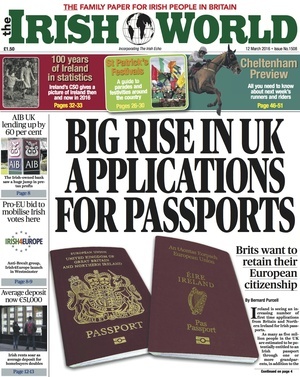
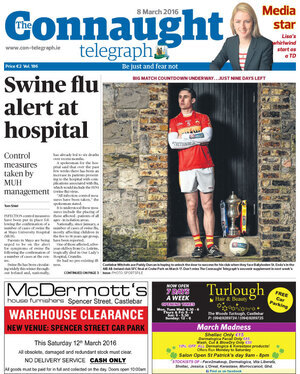
Article in the Economist about how China is trying to take over soccer has a picture of the chairman kick balls in Croke Park!
I’m not sure if this is an off-side or a square ball?
Thanks Neil



Double hop!
Neil Houlihan writes:
Article in the Economist about how China is trying to take over soccer has a picture of the chairman kick balls in Croke Park!
I’m not sure if this is an off-side or a square ball?
Thanks Neil






MORE to folly.

At Leinster House this afternoon; From left: Pearse Doherty, Mary Lou McDonald, David Cullinane, Gerry Adams,and Aengus Ó Snodaigh
“As the party with the largest number of votes on the island, as the largest bloc within the Right2Change movement and as the third largest party in the Dáil and the main party of the working class in this State, it is incumbent on Sinn Féin to nominate a candidate for the position of Taoiseach when the Dáil resumes.
“Those who are homeless and those on hospital trolleys can’t wait for Fine Gael and Fianna Fáil – two parties with the same political philosophy and policies, with the numbers to do a deal – to try and figure out how they can control both sides of the Dáil. It is completely unacceptable.
“Sinn Féin will push for the Dáil to continue sitting, even if a Government is not formed on Thursday, to ensure ministers are held accountable for their decisions and to ensure accountability on the issues affecting citizens.”
Gerry Adamas, Sinn Féin President this afternoon
Gerry Adams to be nominated for Taoiseach (breakingNews)
Leah Farrell/Rollingnews
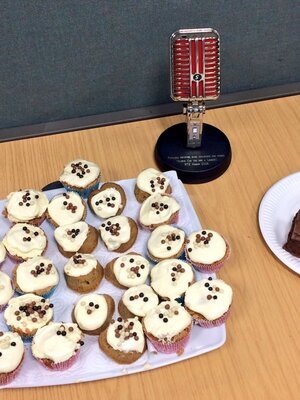
Valerie Cox at her farewell gathering in RTÉ this morning
RTÉ journalist Valerie Cox announced her retirement during the Today with Sean O’Rourke show this morning.
She has worked at RTE for 24 years in total, the past 11 as a staff member.
Readers may wish to note that Ms Cox returned to Greece in January to document the arrival of refugees. Her experiences will be shown on RTE’s Would You Believe next Sunday at 10.30pm.
Pics: Today Sean O’Rourke

https://www.youtube.com/watch?v=c-0VPmLQhzg
A recruiting tool for the IRA, they said.
It wouldn’t be shown again.
They were wrong.
Tara O’Brien writes:
For the first time since its original broadcast in 1966, RTÉ is to screen the 8-part drama Insurrection over consecutive nights beginning on RTÉ One from Friday 18 March.
Originally produced and broadcast by RTÉ as part of the 1966 commemoration of the 50th anniversary of the Easter Rebellion 1916, Insurrection was set in the style of a special TV News report depicting the events of the Rising as they unfolded day-by-day.
With a stellar Irish cast including Ray McAnally (top) as the studio presenter and such luminaries of stage and screen as Anna Manahan, Jim Norton, Ronnie Walsh and Kathleen Watkins with legendary Abbey actor Eoin O’Suilleabhain as Padraig Pearse, Insurrection was written by Hugh Leonard and produced and directed by Louis Lentin and Michael Garvey.

Glenda Gilson (right) and Elisha Stanley with their personalised Lindt Gold Bunnies
It’s nearly Easter.
That can mean only one thing.
Crucifixion!
Chocolate!
Specifically Lindt Gold Bunnies.
Joanne writes:
Brown Thomas this week launches an exclusive personalisation service. Customers now have the opportunity to customise a red ribbon that’s wrapped around Lindt’s most exquisite milk chocolate Gold Bunny with a loved one’s name.
Lovingly created by the Lindt Master Chocolatiers, consumers are bound to find the magic of Easter with the adorable Lindt Gold Bunny.
Made from the finest Lindt chocolate, wrapped in endearing gold foil packaging and finished with the iconic red ribbon and ringing bell, the Lindt Gold Bunny is guaranteed to bring a smile to the face of your loved ones.
Over the course of time, the Lindt Gold Bunny has become a symbol of Easter. For people of all ages, when they see him they know Easter is not far away!
This Easter, why not spoil yourself or someone special with an extra special ‘My Lindt Gold Bunny
We have FOUR personalised Lindt gold bunnies to give away to a Broadsheet commenter of YOUR choosing.
To enter, just complete this sentence.
Please give a personalised Lindt Gold Bunny to Broadsheet commenter _________________ because ______________
Lines MUST close at 5.10pm 7.45pm

Shopping on Grafton Street, Dublin last Christmas; Michael Taft
The ‘squeezed middle’ are used to blame low-income groups of being a burden on average earners and, therefore, argue for cuts in both social protection and taxation.
This is far from the reality.
Michael Taft writes:
Seamus Coffey, of University College Cork, has been digging up some more numbers which he self- deprecatingly refers to as one more ‘silly addition’ to what can be done with income distribution statistic.
But silly they are not. They give insight into another aspect of Ireland’s income structure.
When we debate income distribution we usually do so through the prism of the relationship between the ‘top’ and ‘bottom’ income groups or the Gini co-efficient.
What Seamus looks at are the fortunes of the middle income group and specifically compares Ireland with Sweden in the middle deciles (a decile represents 10 percent of the population).
I have reproduced Seamus’s table below but if it is difficult to read you can access it here.

The numbers measure the percentage of ‘equivalised income’ each decile receives (equivalised factors in household size).
In the table we see that in green Ireland, the lowest 10 percent income group receives 3.2 percent of all income; the top 10 percent receives 24.4 percent – or nearly a quarter of all income.
Regardless of the magnitude, there is nothing surprising in this. Top income groups take more than low-income groups.
However, Seamus points us to the middle of the decile group – what has been described in the debate as the ‘squeezed middle’ and compares us to blue Sweden.
There is a huge gap between the two countries in these middle deciles – 4th to 7th. Indeed, if Irish squeezed middle households took as much of a percentage of total income as Swedish middle decile households, each Irish household would be, on average, €5,000 better off. That’s a nice tidy sum.
Using the Eurostat data here is my own take. Rather than compare Ireland to Sweden (Sweden is pretty egalitarian but they’ve been at it for decades), I compare Ireland with the average of our peer group – other small open economies: Austria, Belgium, Denmark, Finland and Sweden.
And since I’ve used the middle 60 percent in the past I’ll keep to that and calculate the income for households in the 3rd to 8th decile. That’s a bigger middle.

Ireland’s low and middle income groups are below the share of those same groups in the other small open economies.
However the Irish top 20 percent group take considerably more than their counterparts in the other five countries.
What does this mean in Euros? If Ireland had the same share of disposable income:
Households in the lower income group would receive, on average, an extra €2,200.
Households in the middle income group would receive, on average, an extra €2,300.
Households in the high income groups would, however, lose on average €9,100.
In small open economies, low and average income groups make more at the expense of their high income groups.
Of course, one could argue that the real issue is not the share of total disposable income but rather how much income. You can be more equal but a lot poorer.
So let’s look at the top cut-off point for each decile (the point at which you enter the next highest decile) measured in purchasing power parities to factor in currency and living costs.

Other small open economies are more equal and more prosperous. Irish households are between 14.8 percent below the other countries (7th decile) to 20.6 percent below in the 3rd decile.
When income inequality is mentioned the first that many people do is reach for Robin Hood’s bow and arrow. Yes, it’s good to be well-armed but there are other issues besides tax and redistribution.
Here are two that might help explain the gap.
First, in other European countries there is greater collective bargaining coverage than in Ireland – one reason being that workers have a right to collective bargaining which employers are required by law to respect. This is not the case in Ireland.
Trade union density and collective bargaining have been show to increase workers’ wages.
Frank Walsh of UCD estimates that workers in trade unions engaged in collective bargaining are 8 to 10 percent better off than their non-union counter-parts in a like-for-like comparison (occupation, economic sector, workplace size, etc.).
But there are other labour-related issues: the right of part-time workers to take up extra hours in the workplace when they become available; the right of part-time workers to certain hours (that is, ending precariousness); and statutory rights to Sunday premium and overtime pay.
Strengthening labour rights through workplace organisation and statutory rights can translate into higher living standards for middle income groups.
Second, we’ve come to think of social protection as ‘welfare for the poor’. In other European countries, social protection is just that – protection throughout society and throughout the workforce.
For instance, if you become sick and your employer doesn’t have a sick-leave plan, you have to wait for a week to get Illness Benefit from the Social Protection Department and then it’s only €188 per week. In other EU countries you can start to receive sick-leave after the first or second day and they are income-related, covering up to 70 to 80 percent of your wage.
Or take maternity leave: in Ireland it’s a flat-rate of €230 per week. In other EU countries, up to 100 percent of the wage is provided.
A strong social protection system – that protects people both in work and out of work – helps maintains income during periods of illness and injury, temporary unemployment, maternity (and paternity) leave and retirement. That could be another contributing factor in supporting middle income groups.
There are some who use the ‘squeezed middle’ trope as part of ideological discourse that seeks to blame low-income groups of being a burden on average earners and, therefore, argue for cuts in both social protection and taxation. This is far from the reality.
You want help the ‘squeezed middle’? Increase labour rights in the workplace and build a strong social protection system. That’s an agenda for all workers.
Michael Taft is Research Officer with Unite the Union. His column appears here every Tuesday. He is author of the political economy blog, Unite’s Notes on the Front. Follow Michael on Twitter: @notesonthefront
Gavin Sheridan, of The Story, writes:
But a website like this [The Story], run entirely on good will by volunteers in their spare time can only last so long. We have therefore decided that rather than shut it down and get on with our lives – we will try and move the needle even further.
But to do so we need your help.
Our proposal is this: start an organisation on a not-for-profit basis, which is both a media outlet and a transparency organisation. We are calling it Right To Know.
TheStory.ie will continue, but will become the publishing arm of Right To Know. And for the first time since we started doing this work, we will very deliberately be asking you for support – on a membership basis, initially per year.
Clearly, the more members we have the more ambitious we can be – but our objective is to build a self sustaining organisation, without ads, without paywalls, funded entirely by its supporters.
And the mission? To act as a watchdog, an advocate, an investigator, a trainer, and a partner to other NGOs and the media.

Therapy? – Tides
Here’s what you may need to know…
01. The gatekeepers of the Irish underground are in rude health as always. Twenty-seven years and counting in the game, with their fourteenth album Disquiet hitting shelves last year, Ballyclare/Larne’s Therapy? unleash their best ‘pop’ single in years with Tides.
02. Though many casual observers associate the boys in black with their major-label heyday in the mid-Nineties, they never went away.
03. Sadly unloved belters include 1999’s Suicide Pact – You First and 2004’s Never Apologise Never Explain, but most notably a pair of honest-to-jaysus classics in 2010’s cerebral Crooked Timber and 2012’s groovy A Brief Crack of Light.
04. Disquiet, from which Tides is taken, acts as a sequel of sorts to 1994’s million-selling Troublegum, and sees the band revisiting that album’s teenage protagonist as a middle-aged man in the throes of further tumult.
05. The song itself is inspired singer/guitarist Andy Cairns‘ time living in Dun Laoghaire [Co Dublin], as evidenced by the single’s artwork.
06. Keen punk fans will spot the other reference in the cover art immediately, and it’s intentional: Bob Mould, of hardcore trailblazers/accidental college-rock inventors Hüsker Dü was a major influence on the song’s writing.
Verdict: Though the album itself feels a little retro after the band’s insistence on forward-thinking for the better part of three decades, Tides is one of its highlights. Here’s hoping for more of this somewhat psychey, washed-out pop in the not too dim ‘n’ distant.

