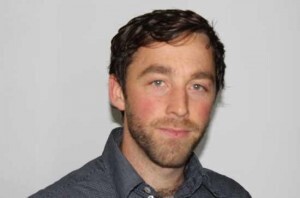
From top: The Sunday Independent Rich List; Dr Rory Hearne
Rejoice.
The rich have recovered.
Dr Rory Hearne writes:
We should be honest about the state of this place and change the name of our country from the Republic of Ireland to the Republic of Inequality.
Two issues that emerged in the last week showed the reality of the recovery and the inequality at the heart of it.
Firstly we found out that more families became homeless in Dublin in January than any previous month on record. 134 families, including 269 children became homeless bringing the number of homeless children in Dublin to 1,570.
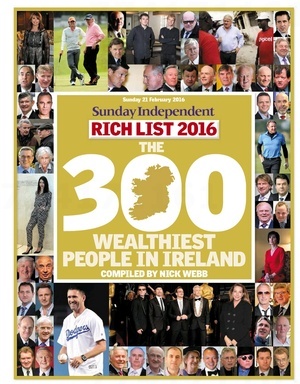
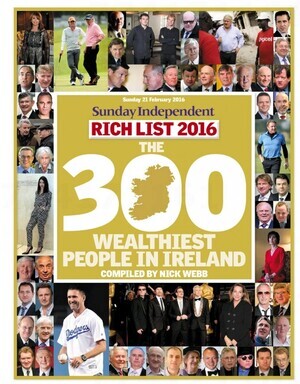
Secondly, the Sunday Independent Rich List showed that the top 300 wealthiest people doubled their wealth since 2010. These 300 people alone have €87.7bn in wealth. That is a fifth of all the wealth in the country.
This shows why, for most people, the election choice between stability and chaos – keeping the recovery going or ‘going backwards’ are meaningless slogans that ignore the reality that the economic recovery has been deeply unequal.
Rising inequality in Ireland has not been given sufficient attention despite the growing global evidence that inequality is a major concern.
Another fact about wealth distribution: half of all the people in Ireland have less than 5% of the wealth in the country while the top 20% have 70% of the net wealth.
Growing income and wealth inequalities between the top of society (the 1%) and stagnating or dis-improving incomes for the rest (or the 99%) has become a major global issue. Rising inequality threatens the global economy and social cohesion.
Discussions of the Irish economy during the election should have given greater treatment to the issue of inequality. Taking indicators of inequality such as deprivation and poverty we score very poorly.
As I have highlighted here before, the number of children aged 0-6 (the most vulnerable age) suffering from deprivation in Ireland, for example, doubled from 55,000 in 2007 to 105,000 in 2014. Ireland now has the third highest deprivation rate for children aged 0-6 in the EU15 – at 25%.
This is over 8 times Norway’s level. This combined with our youth unemployment rate of 19% and 35,000 young Irish emigrating last year shows a problem of ‘intergenerational inequality’.
Another aspect is gender inequality where women are paid over 14 per cent less than men and represent 60 per cent of all low paid workers.
Then there is inequality across the country where at risk of poverty rates in the Border, Midland and Western areas are over five percentage points (at 20.5%) higher than the Southern and Eastern Region.
Inequality is clearly the human rights and economic issue of our time. It was also one of the key issues when the Irish Republic was proclaimed 100 years ago with the aspiration of guaranteeing:
“equal rights and equal opportunities to all its citizens, and…cherishing all of the children of the nation equally…”
Inequality really matters and the failure to take it seriously and take initiatives to address it, in part explains why the government’s message of ‘keep the recovery going’ has not resonated with voters.
Consistent opinion polls are showing that a majority of the public are in favour of policies that would address inequality such as greater public investment instead of tax cuts and for increasing taxes on higher incomes and wealth.
Ireland is at a defining point. The current level of economic inequality in Ireland has not happened by accident or as a force of nature – it has resulted from the type of economic policies we have pursued – and because of the political choices about who had to bear the burden of austerity and debt –and at European level regarding the response to the financial crisis.
We face a choice as to whether we want to continue along this path of an unsustainable and unequal economy.
Our economy is becoming increasingly ‘free-market’ or ‘lassiez-faire’ oriented where key aspects of our human needs and rights such as health, housing, education, childcare, water etc is marked by a social apartheid between underfunded public services and the private, ‘for-profit’ commercial, services.
The majority are left with the challenges of public services while the wealthy escape to their privilege of private health care and education. This ‘neoliberal’ economics has seen Irish economic growth marked by persistent boom and bust patterns and a marked rise in inequality and deprivation.
But a different economic and social path is possible – a more equitable and sustainable economic path. And it is one based on economic equality.
Recent research by Wilkinson and Pickett (authors of The Spirit Level: Why More Equal Societies do Better) has shown again that more equal countries do better in terms of their social and economic indicators, particularly in having less social problems and better weathering economic storms.
They highlight that some wealthy societies such as the Nordics (Denmark, Sweden, Norway) are able to reduce inequalities due to their “societal commitment to greater equality.”
That is something we should aspire to.
Despite what we are told there are always alternative policy choices available and our current scale of inequality is neither inevitable nor is it sustainable.
The government is asking you to vote for their recovery on Friday. The reality of that recovery is laid bare by the fact that on that very Election day 13 Families face eviction from a Hostel in Mountjoy St in Dublin. That is 13 Families and their children, all with different stories, all caught in a trap of homelessness, being dumped on to the streets.
Is that the recovery we want? Is that the Republic of Inequality we want?
If it is not, then on Friday – vote in hope for a more equal Ireland.
Not in fear of chaos. The housing and health crisis are chaos enough.
We have been obedient, subservient, silenced, foolish, gullible, naïve, abused, lied to, corrupted, shamed and suffered for long enough.
It’s time for change.
Dr Rory Hearne is a Senior Policy Analyst with TASC, the Think-Tank for Action on Social Change. His column appears here every Wednesday. Rory is an independent candidate for the Seanad NUI Colleges Panel. Follow him on Twitter: @roryhearne