
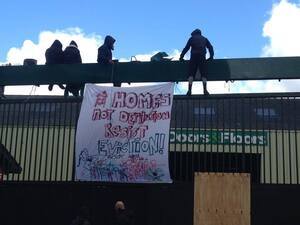

Earlier.
A second attempted eviction – this time by ‘goons’ – of the much-loved community squat in Grangegorman, Dublin 7 is successfully thwarted.
More as we get it.



Earlier.
A second attempted eviction – this time by ‘goons’ – of the much-loved community squat in Grangegorman, Dublin 7 is successfully thwarted.
More as we get it.


Yesterday’s Irish Examiner showing the letter sent by the foster father of Grace to the then Minister for Health Michael Noonan, above, in August 1996
You may recall the story of Grace, the mute child – now a woman in her 40s – who remained in a foster home with an abusive family in the south east of Ireland for more than a decade after other children had been removed.
The other children were taken out of the home in 1995, after concerns were raised with the then Southern Health Board in 1992.
Yesterday’s Irish Examiner reported how – after the health board initially decided that Grace be removed – Grace’s foster family appealed against this decision but lost.
Following that, the foster father, in 1996, sent a letter lobbying the Minster for Health Michael Noonan to allow Grace stay in the home.
It’s unclear what exactly happened after this letter was sent but Grace did stay at the home for another 13 years.
Daniel McConnell, of the Irish Examiner, spoke with Matt Cooper on Today FM yesterday evening to explain the significance of the letter.
He said:
“Whether, it seems, by accident, or inadvertently, the intervention seems to have had a chilling effect because what’s detailed in the documents is that Grace’s removal was delayed on foot of the request from the foster father. Then that removal never happened.”
“…We put a series of detailed queries through the Fine Gael press office, to him [Noonan], last [Monday] night and he said he had nothing more to add…”
Separately.
Readers may also recall the allegations made by former Fine Gael councillor and barrister Garry O’Halloran in relation to Minister Noonan.
Mr O’Halloran has claimed that, at the 1997 Fine Gael Ard Fheis in Dublin, Michael Noonan ‘ran away’ from him even though Mr Noonan was scheduled to meet with him.
Mr O’Halloran wanted to speak with Mr Noonan – not about Grace – but about the late Fr Jim Grennan, who had abused several children in Monageer, Co. Wexford, the diocese of Ferns. One of Fr Grennan’s victims was with Mr O’Halloran at the Ard Fheis.
At this point, in 1997, Fr Grennan was already dead, having died in 1994.
Mr O’Halloran, who was chairman of the then South Eastern Health Board, wished to speak with Minister Noonan to request that he order an inquiry into the health board’s response to abuse allegations made by 10 children against Fr Grennan back in 1988.
Mr O’Halloran explained:
“The allegations were raised in 1988 and they were validated immediately. There was a local teacher, a local social worker and a local guard who all did a very good job. But after that, a superintendant came along and destroyed the file and the guards did nothing, the health board did nothing.”
“He [Grennan] went on to carry out devastating rapes after that, with devastating consequences.”
Mr O’Halloran was prompted to lobby Mr Noonan in 1997 – three years after Fr Grennan died – because Mr O’Halloran had learned that one of Fr Grennan’s victims had been gravely abused for several years, on a regular basis, after 1988.
The day after Fr Grennan died, on May 9, 1994, aged 61, a child of 13 took an overdose of medication and was admitted to hospital. On May 30, the child told their mother they had been molested by Fr Grennan, in the months prior to Fr Grennan’s death.
Mr O’Halloran explained:
“I was asking questions. I was in the health board and everything was being denied. The acceptance of any clerical child abuse was denied. When we got the thumbs down from the authorities, there was only three of us working on it at this stage – Billy Moroney, a farmer from New Ross, journalist Veronica Guerin, and myself.”
“We worked closely together. But Billy and myself set up a group called Survivors and we used to meet every month in Waterford and, very quickly, we had people coming and all the situations were the same. All the victims had raised a complaint about being raped and abused and they were all ignored.“
The eventual Ferns Report, which was published in 2005 and looked at 100 allegations of child sexual abuse made between 1966 and 2005 against 21 priests in the Diocese of Ferns, confirmed all of Mr O’Halloran claims and those of Fr Grennan’s victims.
In light of the findings of the Ferns Report, readers may wish to read Mr O’Halloran’s recollections of the Ard Fheis. He said:
“[Noonan] kept us waiting all night, no sign of him. Eventually I spotted him leaving the podium and he was heading for the door and, when I followed him, he sprinted as fast as he could and when I reached the door he was already in his car and there was black smoke whirring up into my face, from the wheels spinning. And Phil Hogan was standing alongside me and Phil said to me, ‘you relax, the Minister for Children [Austin Currie] is meeting your deputation, everything will be fine.‘”
“So we met him [Currie] and, after about half an hour, he said, ‘right you have your inquiry’. So that was fine. I contacted his secretary on the Monday morning to progress the matter and she said, ‘hang on a minute’. And then she came back and said, ‘No there isn’t any inquiry’.”
“And I said, ‘Oh yes there is, we met the [junior] minister on Saturday night, he said we have our inquiry.’ And she said, ‘oh no he [Currie] didn’t. What he told you was that he would inquire into it and, having inquired, there’s no substance to your claims and allegations’.
Last Saturday, Mr Currie denied this was the case, telling the Irish Times:
“I said I would inquire into their allegations when I got back to the department on Monday. The next thing I heard in the press I had promised an inquiry. I had not. I know I brought that family’s concerns to the officials in the department.”
So what does Monageer have to do with Grace?
It should be explained that Mr O’Halloran came forward to recall his non-meeting with Minister Noonan at the Ard Fheis in 1997 – after he heard Minister Noonan give an interview with Richard Crowley on RTÉ Radio One on Thursday, February 4.
During that interview Minister Noonan was briefly asked about the letters he received about Grace.
Mr O’Halloran knew nothing of Grace when he heard the interview – but it jogged his memory in relation to Fr Grennan. Mr O’Halloran also felt it was important to explain that the case of Grace wasn’t an isolated incident.
Ever since his allegations about the Ard Fheis were published, many people have contacted Mr O’Halloran about Grace.
Further to this, he has written to both the Garda Commissioner Noirin O’Sullivan and Minister Noonan.
He has asked Ms O’Sullivan to investigate Minister Noonan’s conduct – for his time as Minister for Health from 1994 to 1997.
In addition, he’s asked Minister Noonan to resign.
Mr O’Halloran, a barrister, explained his reasons for this:
“In 1995, having received repeated evidence of complaints of child sex abuse in the particular foster care facility, it was decided to place no further children in that facility and to remove Grace forthwith. The foster parents had an entitlement to appeal that decision and they did appeal it.”
“The appeal committee accepted that the original decision was a proper decision and that it was in the best interest of the child that she be removed forthwith from that facility. In response to that the foster father wrote directly to the minister stating that they did not accept those decision and hence they were putting in a further appeal to him.”
“Notwithstanding the fact that he had no statutory function in the matter, he passed the matter on to his officials and his junior minister. He was notified by the health board, the matter was governed by Section 43 of the Childcare Act, which meant that if there was any ongoing concerns that a judge of the District Court should make the decision on the basis of what was in the best interest of the child.”
“Instead of the matter going to a judge, it ended up with a further appeal committee – the composition of which remains unknown to this day – deciding that the child be left at this foster care facility, and there she remained for a further 13 years until a social worker recently appointed to her case, brought the matter to attention.”
“As far as I’m concerned [Minister Noonan] is a man that shouldn’t be holding high public office and he merits investigation.”
Listen back to Mr McConnell’s interview in full here
Austin Currie drawn into case of girl at ‘foster’ home (Kitty Holland, Irish Times)
Irish Examiner/Rollingnews

This morning.
Joanna Barry writes:
Just in case you’re in the mood for a bit of ‘Sure where would you get it’ today, this was taken from our garden on Silsean mountain in Blessington Lakes [Co. Wicklow] at 7.20am this morning, -6 but the moon!!


From top: The launch of the Social Democrats youth policy yesterday, Anne Marie McNally (centre) with Soc Dem supporters Ronan Mac Giolla Rua (left) and Jack Power; Anne Marie with fellow Soc Dem candidate Gary Gannon,
Political apathy among our young has never been because of a lack of passion on their part but rather on the part of the political establishment.
Anne Marie McNally writes:
In less than 48 hours people will go to polling booths across Ireland and decide the fate of our country for the foreseeable future and beyond. Many will do so based on historical voting habits but an increasing number will cast their vote with change in mind.
They will be hopeful that their vote can make a difference and buck the almost 90 year old status-quo that has dominated Irish political life. In larger numbers than ever before, young people will get out and cast their vote.
Some will do so because they became politicised during the Marriage Equality referendum but yet more will do so because they are angry. They realise how abandoned they have been by the political establishment and they want to have their voice heard and their plight acknowledged.
Yesterday Gary Gannon [Social Democrat candidate in Dublin Central] and I launched the Social Democrats youth manifesto. We asked young party supporters to tell us what the key issues for them were and we took their responses and created the youth manifesto.
The issues weren’t surprising – housing, decent employment, climate issues, the 8th amendment, mental health – all topics of serious concern to young people. Speaking at the launch I made the point that we are the first generation of Irish people who cannot realistically aspire to own our own home.
Home ownership has become a pipe dream for far too many of us and in the meantime we are forced to rely on a rental sector that is unprofessional insecure and unreliable. In other words our housing needs are not met and the knock-on effects of this include emigration, people putting off starting families and people who simply cannot see how they will ever be in a position to settle down and start a family.
We spoke to people who had struggled with mental health issues or those whose family or friends had been impacted by mental health issues. People who understand first-hand that the services are not fit for purpose and that this is the one issue that not even enough lip-service is paid to by the establishment parties.
Young people will not be silenced on this issue nor will they be fobbed off by politicians who have sat by and watched as the #anyonesbrother hashtag trended following the death of yet another young person abandoned by a mental health service that has failed so many before.
The voices then came loud and clear on the 8th amendment – the last referendum was held in 1983, this generation has not had our say. We deserve and demand the opportunity to have our voices heard on this human rights issue.
Those who voted in 1983 have lived their lives based on their choices. Those 33 year old choices should not determine our current choices and on that the message is clear; in 2016 Ireland, we will not be silenced.
As we move into the last few hours of this campaign, Social Democrats teams across the country will be putting in the final big push to hit as many doors as possible to get the message out.
Those teams are made up of a wide demographic spread from Irish society but every team contains a significant amount of younger voters who are involved in active politics for the first time.
They are eager and they are excited because for the first time they feel their voice has a home and a party that is prepared to listen and heed the voices of young people when formulating policy.
Political apathy amongt our younger people has never been because of a lack of passion on their part but rather on the part of the political establishment. This campaign has witnessed a sea change in that regard.
The Social Democrats have ensured that is the case and I’m proud to finish out this campaign surrounded by young people who will, quite literally, rock the vote.
Anne-Marie McNally is General Election candidate for the Social Democrats in the Dublin Mid-West constituency. Follow Anne-Marie on Twitter: @amomcnally

Ailbhe Ní Bhroin writes:
Until 1979, the Pharmaceutical Society of Ireland offered a Pharmaceutical Assistant’s qualification which, in its most recent incarnation, consisted of 3 years’ apprenticeship and 1 year’s full-time study in an academic institution culminating in an examination.
Upon conferral, a Pharmaceutical Assistant (PA) was “competent to transact the business of a pharmacist in his/her temporary absence … In general terms therefore, and in circumstances where the registered pharmacist is temporarily absent from the pharmacy a registered PA may act on his/her behalf and carry out the functions of the pharmacist.”
Their qualification also stipulates that PAs cannot own a pharmacy, except under particular conditions which include employing a registered supervising pharmacist.
The PSI have recently (February 8, 2016) opened a draft publication to public consultation which seeks to redefine the qualification conferred upon PAs.
At present there are less than 400 registered PAs. The last examinations for this qualification were sat in 1985, meaning that the youngest PAs are in their mid-fifties. In other words, these – mainly – women will all be retired in approximately 10 years, making this particular qualification obsolete at that time.
However, the PSI are attempting to force them out of the workforce now by changing the conditions under which PAs can work: In particular in Rules 7 & 8 of the draft publication. Rule 7 defines the heretofore (since 1890) undefined “temporary absence” as no more than 12 hours per week.
This means that a PA will only be allowed to work for 12 hours in any week; this will most certainly lead to PAs losing hours, if not their jobs: A pharmacist will no longer be able to take 2 full days off in a week if his employee is a PA, therefore it will make more sense to hire a registered pharmacist in place of the PA.
Furthermore, if there is any sort of emergency, or the employing pharmacist plans a holiday, the PA – who up until this draft publication has been considered fully competent to cover during these periods, and has been for decades – will be unable to cover, meaning an unknown – to the customers – and usually inexperienced locum will be required.
Again, the inconvenience of this will lead to a number of PAs losing their jobs, or at the very least, losing the chance to work some extra hours.
Furthermore, Rule 7 requires that a PA work alongside a supervising pharmacist for 12 hours in the preceding month. The PAs have – at the very least – 30 years practical experience in retail pharmacy.
They have, generally, worked alone in the temporary absence of their employer; they do not need to be supervised in this way. This belittles both their qualification and their experience.
Again, very few pharmacists will be able to justify paying a PA for these supervised 12 hours per month, when a registered pharmacist is not required to work them.
Rule 8 stipulates that a PA cannot act in the capacity of the supervising pharmacist. In practical terms, this completely vacates the qualification conferred on assistants by no longer allowing them to “act on his/her [the supervising pharmacist’s] behalf, and carry out the functions of the pharmacist.”
This draft publication is open to the public until Monday, March 7. Comments are welcome via email at consultation@psi.ie with the subject “Temporary Absence Consultation” or via post to Pharmaceutical Society of Ireland, PSI House, Fenian Street, Dublin 2.
Anyone?

Taoiseach Enda Kenny outside RTÉ last night
Last night during the Leaders’ Debate on RTÉ One.
Miriam O’Callaghan: “You promised, and I quote you, ‘a democratic revolution’. You were going to reinvent our country and yet one of the most embarrassing crony examples, John McNulty, you appointed him to the board of IMMA to get him on to a bigger board, the Seanad. You out Bertied Bertie….Taoiseach this was naked cronyism and, to be fair, you said at the time, you left your own standards and integrity down.”
Enda Kenny: “Yes.”
O’Callaghan: “What did you mean by that? What did you do?”
Kenny: “What I did was, I didn’t, what I did was make an appointment that did not need to be made. And I’ve changed the rules since then…”
Hmm.
In respect of the appointment to the board of IMMA, that was made by the Minister, Deputy Heather Humphreys, exercising her right as the Minister for Arts, Heritage and the Gaeltacht in respect of examining the qualifications of Mr. McNulty, who is a completely innocent person in this regard. Mr. McNulty was formally nominated on 17 September.
Taoiseach Enda Kenny addressing the Dáil on September 30, 2014.
Previously: The Crony Crisis Timeline
H/T: Elaine Byrne and Kildare Street

This morning.
Grand Canal at Drimnagh, Dublin 12.
Name that jammer anyone?
Thanks Paul McQuillan
Update:

Another angle.
Thanks Rory
Update:

And another angle.
Thanks Amy Murray
Enda’s Plan to find an Appropriate Woman (credit to @chrisrooke also). @broadsheet_ie @Oireachtas_RX #leadersdebate pic.twitter.com/TYGlqpjm1G
— Eve Kearney (@kearnivale) February 23, 2016
Yesterday: ‘An Appropriate Woman’

We’ll take two.
*calls previous partner(s)*
Medical Centre: STI Screening for €59 at Choice of Two Locations 61% off (Groupon)
Thanks Oval Head





MORE to folly