Category Archives: Misc

imgres


Almost 62,000 applications for access to landline, mobile phone and internet data were made to companies providing services to the Irish public by State authorities in a five-year period.

An Garda Síochána made almost all of the requests, security sources have told The Irish Times.

…The information received for the five-year period to the end of 2012 has been made available by the Irish authorities to the European Commission. Between 2008 and 2012 the number of applications for data reached 61,823; a rate of more than 1,000 a month. Of those, 98.7 per cent were granted.

… In 2012, half of the requests made by the Garda and other agencies such as GSOC, Defence Forces and Revenue Commissioners related to mobile phone records. The remaining applications for data were split roughly evenly between landlines and internet services.

Majority of 62,000 data requests made by Garda (Irish Times)

Previously: GSOC Snoop Guide

They Snoop To Conquer


unnamed-1Screen-Shot-2016-01-19-at-16.36.43-1024x780

From top: Academics and students in a recent stand-off with police at Turkey’s Kocaeli University; and researchers Francis O’Connor and Semih Celik

Limerick researcher Francis O’Connor, along with friend and colleague Semih Celik, have co-written an article in Roar magazine about the recent arrest, detention and, in some cases, violence inflicted upon certain academics in Turkey.

The measures carried out by the Turkish authorities follow the signing of an open letter – by 1,128 professors, researchers and students from Turkey and around the world – calling for an end to state violence in the Kurdish region of south east Turkey.

Mr O’Connor and Mr Celik write:

Since August last year, the Turkish government has imposed intermittent open-ended military curfews on an array of Kurdish cities in its campaign against young militants in the YDG-H, which is linked to the PKK. These have been dramatically scaled up since mid-December, however, when a number of cities — most notably the Sur district of Diyarbakir, Cizre, Silwan, Şırnak and Silopi — were put under military siege.

In these cities, around 200,000 civilians are trapped in what remains of their houses, in some cases for up to 30 days — many without electricity, water or even food in some places. Injured civilians have been prevented from accessing medical attention and have subsequently died of their wounds. Families have been prevented from reclaiming the bodies of their loved ones.

According to the Turkish Human Rights Foundation, the civilian death toll as of January 8 is 162 civilians, including 32 children, 29 women and 24 victims over 60 years of age. These extensive sieges involve enormous deployments of soldiers and police officers encircling urban centers before targeting them with heavy artillery, oblivious to the presence of local residents.

In light of Turkey’s flagrant disregard for both its own laws and international human rights protocols, more than a thousand Kurdish and Turkish academics signed a letter declaring that they would not pay silent witness to the ongoing atrocities. They announced: “we will not be a party to this massacre by remaining silent and demand an immediate end to the violence perpetrated by the state.”

The letter further called for an immediate end to the curfew, the presence of international monitors in the affected districts and a restoration of the peace negotiations which Erdoğan deliberately scuppered in an effort to restore the AKP’s electoral dominance last summer.

In response to the call for an end to the violence, Erdoğan decried the signatories’ ignorance, accused them of favoring colonialism and ultimately of treason. In the immediate aftermath, state prosecutors initiated legal proceeding against all the original signatories of the declaration, charging them with “propagandizing for a terrorist organization” and “overtly insulting the Turkish nation, the State of the Republic of Turkey, Grand National Assembly of Turkey, the Government of Republic of Turkey and the judicial organs of the state.” These charges can result in sentences of up to five years in prison. Twenty-two of the signatories have already been taken into custody.

In addition to these legal proceedings, the Council of Higher Education (Yükseköğretim Kurumuo, or YÖK) has vowed to take further punitive measures against the signatories. YÖK has demanded that Prof. Bülent Tanju from Abdullah Gül University in Kayseri resign, while individual university administrations — contrary to all legal protocols — have suspended or fired their own staff members, such as in the case of Professor Latife Akyüz in Düzce University.

In cities like Bolu and Kocaeli in northwestern Turkey, police have raided the houses of signatories. Incidentally YÖK was established by the military government in 1982 as a means to limit universities’ autonomy and restrict their capacity to serve as sources of opposition to the state.

In parallel to this blatant suppression of freedom of expression, a concerted media and political campaign is trying to further demonize the signatories. Turkey’s far-right MHP party has been to the forefront these efforts: one of its Istanbul deputies, İzzet Ulvi Yönter, declared that “the government should immediately take action and fight as it does in the districts of Sur, Cizre, Dargeçit and Silopi against the terrorists in universities.”

Meanwhile, other figures with links to fascist or Turkish nationalist organizations such as the criminal Sedat Peker have threatened: “at that moment, the bell will toll for you all … I would like to say it again: we will spill your blood and we will shower in it!

This cannot be dismissed as an idle threat. Turkey has a long and shameful history of murdering intellectuals, critical academics and journalists. Calls like these are seized upon by university students of extreme right-wing political organizations like the Grey Wolves, responding with insults and threats to the signatories, mostly by marking and sticking threatening letters on their office doors promising to “make the city hell” for their own professors.

Tonight, thousands of brave academics, journalists and activists across Turkey are anxiously awaiting a knock at the door — a knock that could potentially escort them to years in prison or add them to the tragic list of great minds murdered for views considered impermissible by the state. Similarly, tens of thousands of civilians are cowered down in the basements of Silopi, Cizre and Sur, parents attempting to lull hungry children to sleep while being bombarded by their own government.

Francis O’Connor is from Monagea, close to Newcastle West in Co. Limerick, and he has completed a PhD at the European University Institute in Florence, Italy. He has worked on the conflict in Turkey between the PKK and the Turkish state and is currently an external collaborator of the Scuola Normale Superiore in Florence. His research interests include social movements and political violence.

Semih Celik is from Istanbul and is a historian working on famines in 19th century Anatolia.

Academics for Peace: “enemies of the state” in Turkey (Roar magazine)

Pic: ODA TV

Screen Shot 2016-01-19 at 14.57.53

Fine Gael Minister for Housing Paudie Coffey on Claire Byrne Live last night

Last night, minister for housing Paudie Coffey appeared on Claire Byrne Live following the broadcast of documentary My Homeless Family on RTÉ One.

During his appearance, Mr Coffey said:

“It’s factual that 2,000 people actually exited homelessness in the last year. In the last year as well, this Government and, you know, this society has provided 13,000 additional housing units for people. That’s up 86% on previous years. So progress is being made but not enough obviously.”

Further to this…

Cockamamie, hogwash, twaddle and horsefeathers?

Or plain not?

YOU decide.

Watch Claire Byrne Live back in full here

1percent_facebook_en-24_0Michael Taft

From top: Oxfam warning 2014; Michael Taft

The recovery is benefiting one tiny group above all others.

Michael Taft writes:

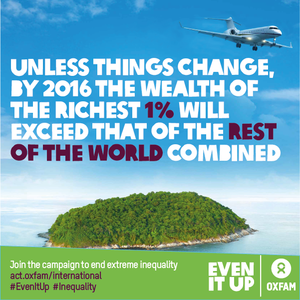
The One Percenters are back in the news with an Oxfam study showing that the world’s richest 1 percent owns more wealth than all the rest of the planet put together.

So what about our own One percent? How are they doing? Let’s have a look at how that 1 percent and other top earners have been getting along in the crisis.

What follows is based on the EU’s Survey of Income and Living Conditions measurement of income. It is a different concept from what Oxfam used: wealth. Wealth ownership refers to assets – real estate (buildings, land) and financial property (shares, bonds, cash, equities, pension pots, etc.). Income refers to the annual flow, whether it is employee or self-employed earnings, investment income, pensions, etc.

Income is only one measure of economic power and influence in the economy. Profits levels, the relative strength of labour and capital, degree of financialisation, place in the production process, social status, ownership of assets – it could be argued that income is the result, not the cause, of unequal power relationships in the economy.

But it’s an informative measurement and can reveal something of what is happening around us or, in this case, above us.
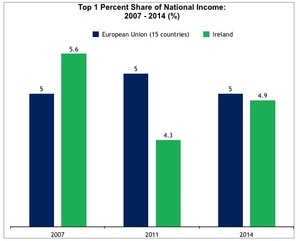
1

Prior to the crash the top 1 percent held nearly six percent of the share of national income, above the EU-15 average. This fell to 2011 – primarily due to losses in capital and self-employment income arising from property and speculative losses in the crash.

However, since 2011 (and the current government), things are on the mend with the 1 percent trending upwards. Still a ways to go to pre-crash levels but with a little time and a few tax cuts, normal business should be be resumed.

There are other ‘tops’ we can look at.
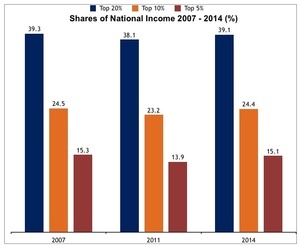
2

All the top percentages are experiencing a recovery and are returning to pre-crash levels.
Of course, the situation at the bottom is still pretty bottom.

The lowest 20 percent have only an 8.3 percent share (compared to 39.1 percent at the top)

The lowest 10 percent have only 3.2 percent share (compared to 24.4 percent at the top)

The lowest 5 percent have only a 1.1 percent share (compared to 15.1 at the top)

And the lowest 1 percent? It is so low that it is represented in the Eurostat tables as 0.0 percent.

There are many who would see these figures and the first thing they reach for is the tax axe. There’s something to that. Redistribute €250 million from high income groups to low income groups and watch consumer spending, business turnover and GDP rise.

But there is far more to inequality than just income. If there is affordable childcare, I may be able to take up a job or increase my working hours; otherwise I can’t afford the private fees. If I get sick, I may have to wait in a queue because I can’t afford queue-jumping insurance or private health fees. If public transport fees fall, I have more to spend. Public services are vital – not only in order that people can have access to services they might not otherwise, but that access doesn’t leave a further hole in the pocket.

There is also labour power. Giving people in the workplace stronger rights (right to collective bargain, part-time workers’ right to extra hours, statutory Sunday premium and overtime pay, extension of statutory collective bargaining) pushes up wages, especially the low-waged, and bridges the gap between the highest and the lowest by raising the floor.

Then there’s freedom of economic information to allow for a social monitoring of widening gaps. Full business accounts disclosure, including executive remuneration; and the gap between executive and average pay in the firm will allow society, consumers and investors to monitor enterprise performance and take decisions accordingly.

There are many strategies we can pursue to produce more egalitarian outcomes. Failure to do so will facilitate the acquisition of more power and resources at the top.

So, how’s the ol’ One percent doing? They went through a bit of a rocky patch but they’re back on the mend. Unless we take steps.

Michael Taft is Research with Unite the Union. His column will appear here every Tuesday. He is author of the political economy blog, Unite’s Notes on the Front. Follow Michael on Twitter: @notesonthefront