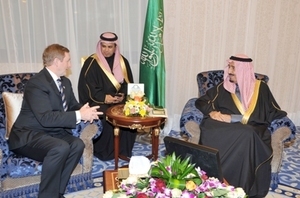
Taoiseach Enda Kenny with HRH Crown Prince Salman, Deputy Premier and Minister for Defence during visit to Saudi Arabia in January 2014
Further to the mass execution by Saudi authorities of Shia dissidents…
A recent paper published by Donnacha Ó Beacháin [Senior Lecturer in Politics/International Relations, and Director of Research at the School of Law and Government in Dublin City University] recalled Taoiseach Enda Kenny’s five-day trip to the Middle East in January of 2014 which saw him visit Saudi Arabia, Qatar and the United Arab Emirates.
In his paper entitled Ireland’s Foreign Relations in 2014 , Donnacha writes:
Collectively the three economies had an estimated annual GDP of €1.2trillion, and Ireland had exported goods worth €626 million to Saudi Arabia in 2012. The taoiseach was joined on the trip by Minister for Enterprise, Jobs and Innovation (and former rival for the Fine Gael party leadership) Richard Bruton and over 100 senior executives from 87 companies…
Economics and trade dominated the taoiseach’s meeting with Saudi Arabia’s Crown Prince Salman. Eager to impress their hosts the delegation frequently made improbable comparisons between Ireland and the Arab states of the Persian Gulf. Patrick Moynagh, special advisor at the Saudi Arabian Monetary Agency, said that pre-Celtic Tiger Ireland and Saudi Arabia were ‘not that different given [their] backgrounds as colonised nations and the influence of an orthodox religion’.
The taoiseach warmed to this theme and told the Saudi Minister for Higher Education that the two states had a shared history of colonialism, famine and emigration.
The objective, however, was less to swap parallels in the long but overlooked history connecting Ireland to Saudi Arabia than to secure additional Saudi students for Ireland.
A staggering 150,000 Saudis study overseas on the King Abdullah scholarship programme, of which 2,700 were enrolled in Ireland as of 2014, and the taoiseach said the figure would soon rise by another 500.
Human rights also were discussed, though not in the manner that might be expected. After the meeting the taoiseach said that he had congratulated the prince on his kingdom’s recent election to the United Nations’ Human Rights Council (UNHRC), though this obscured the fact that there had been no election per se given that Saudi Arabia’s candidature was approved without a contest.
It also masked the reality that Saudi Arabia, unlike neophyte Ireland, was a veteran member of the UNHRC having been a member since its inception in 2006 without any amelioration of its appalling human-rights record.
By stating that ‘Ireland obviously will work with Saudi Arabia in terms of human rights and their participation on the council’, the taoiseach implied that the two countries would work together at the UNHRC to fight for human rights in third countries, rather than addressing imperfections in their own states.
Addressing questions regarding the marginalisation of women in Saudi Arabia, the taoiseach stated that he had spoken to some female university lecturers during his trip, before admitting that they lectured at women-only universities.
The Fine Gael leader also said that he had ‘congratulated the Saudis on their leadership in terms of moderation here in the Gulf region and their desire for a peaceful situation on a lot of very complex and technical issues’.
This statement was at odds with the view of Saudi Arabia familiar to many western observers. An absolute monarchy where political parties are banned, Saudi Arabia has long been a negative force in the region, a huge financial backer of Islamic fundamentalism and eager to suppress any democratic impulse in the Middle East, as demonstrated when it sent troops to neighbouring Bahrain during the Arab Spring. Trials and sentencing can be arbitrary, while public floggings and beheadings are a weekly occurrence for crimes such as blasphemy, ‘losing the faith’ and practicing witchcraft.
Meanwhile, In Qatar…
The taoiseach encountered similar questioning on his approach to raising human-rights issues in the Middle East when he arrived in the tiny absolute monarchy of Qatar.
In proclaiming that projects such as the 2022 soccer World Cup in Qatar ‘will be catalysts for broad economic expansion in the host countries and beyond’, the Department of Foreign Affairs and Trade de-emphasised the well-documented exploitation of migrant workers (a remarkable 90% of Qatar’s workforce is imported from abroad), many of whom live in slave-like conditions; Amnesty International reports that workers have been dying at the rate of one per day while building the FIFA stadia in which theWorld Cup soccer matches will be played.
Asked about scandals surrounding the exploitation of South Asian workers, the taoiseach responded by saying that, “my assumption is that those who work internationally on such projects would have proper working conditions and proper facilities and I expect that to be the way…the instinct here is that the stadia to be provided will be absolutely world class.“
By the time the Taoiseach arrived in Abu Dhabi, coverage of his trip inI reland was becoming bogged down on the issue of human-rights abuses in the Gulf States.
Asked if the interests of making profits were being put before human rights, the taoiseach responded that trade and investment opportunities were the priorities for the mission, and that while Ireland had ‘always been very consistent in highlighting human rights issues’, it would do so ‘at the appropriate forum’.
Asked if he specifically mentioned human-rights concerns in his meetings with either Saudi Arabia’s crown prince or Qatar’s prime minister, the taoiseach replied that he was on a trade mission and that the focus of the tour was to promote the ‘credibility and integrity’ of Irish companies.
Minister Bruton adopted a similar line of responses and emphasised that while Ireland raised human-rights issues through the EU and UN, ‘our focus here is exports and jobs’.
Ireland’s Foreign Relations In 2014 (Donnacha Ó Béacháin, Academia.edu)
Brutal decision by Saudi Arabia to execute dissidents adds to escalating conflict between Shia and Sunni branches of Islam (Irish Times editorial, January 5, 2016)
Previously: Bullets To Afghanistan
Pic: Merrion Street