



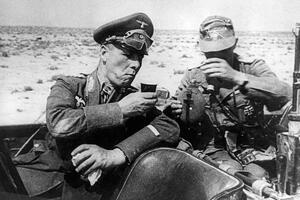

From top: Nazi General Edwin Rommel (at left); David Langwallner
Philosopher Isaiah Berlin‘s famous parable or table top discussion, ‘The Hedgehog and The Fox‘ (1953) is about different forms of intelligence. The Hedgehog knows one big thing, the fox many things. Perhaps the ideal human intelligence ought to combine both?
I have always been fascinated by the ‘Desert Fox’, Erwin Rommel. The reasons are obvious in my case. I have always been a Junker at one level but never quite a member of the establishment. I endorse the remark of Groucho Marx that one should never be a member of a club that would have one as its member. I also have an innate sympathy with the underdog and he was certainly in that position in the impossible war of The Afrika Corps. The man who won against impossible odds. A far better general than Montgomery.
Now, all judgments at one level must be context-specific. So, the negative. He was a National Socialist and a card-carrying member of the Nazi party. He was also a German General and initially very close to Hitler. He was a military man and, described by Desmond Young in his definitive biography, the perfect fighting animal. It is quite clear that he was a great military strategist, resourceful, winning against odds and brilliant in the game of bluff and counter-bluff.
The relationship between the Anglo-Saxon and Germanic race has always been complicated. Similar Hapsburgian blood in their royal families, thickened by dynastic and familial inter breeding didn’t help. They were never natural enemies, but twice got pitted against each other. So, the officer class of both establishments always had respect for fellow officers of the same perhaps ruthless disposition – mitigated by an old-fashioned sense of compassion or honour.
As illustrated by the performance by Von Stroheim as the German Commander in Renoir’s ‘La Grande Illusion‘ (1939), some of the Junker class had a measure of civility. Regarding the rules of combat and proper treatment of prisoners during wartime, it is quite clear that most American, German, Japanese and to a significantly lesser extent British generals did not observe them, but Rommel largely did.
‘La Grande Illusion,’ a film of the first world war, says a lot about the need for pacifism and the somewhat courtly treatment of prisoners of war. It also demonstrates the futility of any war or any form of conflict that descends into tribalism, nationalism and chauvinism which is where we are now headed.
Renoir elaborated in commentary on the film that all cultures are cliquish and have their own rules, their own protocols and their own way of dealing with those who do not observe the rules of the game or the rule of law.
When it opened, a largely right wing audience in France went berserk, like the reception in the Abbey Theatre to ‘The Playboy of the Western World’ in 1907. Renoir’s acid comment was in effect that these people were doomed and the audience reaction showed that “people who commit suicide do not do so in front of witnesses.” He had touched a raw nerve.
Rommel, though not Renoir, was a tolerably-civilised Junker and given the awfulness of the military mindset and the circumstances, a tolerably civilised human being compromised by his service to awfulness. The real mystery about him relates to his knowledge of the Van Stauffenberg plot and his final disenchantment with his mentor Hitler. He either knew of, or did not disavow, or plotted with the removal of Hitler – hence his death by cyanide pill in the back of the car.
As a new form of corporate and military industrial barbarism takes hold, the actual rakes of the game have shifted. Normal laws have given way to executive action, ouster clauses, emergency legislation driven by the pandemic and many of the decision makers now rough-hewn combatants engaging in inconsequential thinking that might be viewed historically in hindsight as a combination of blinkered vision and indeed war crimes or crimes against humanity.
When the rules of the game have become replaced by real or fake wars in an age of disinformation then the narrow tinsel of legality has broken down. Johnson venerates Churchill and references him like the Bible to in effect trumpet and blow up his own reputation. Churchill was a great man but also a war criminal not least in sanctioning Bomber Harris and the bombing of Dresden with the death of many innocent civilians as documented in Kurt Vonnegut’s ‘Slaughterhouse.’
So, Rommel does matter in a perilous age.
He was with a few contrary incidents very decent to prisoners of armed conflict and was a civilised European gentleman. Ultimately, he had enough of a barbaric and unstable regime and his subtle but recognisable opposition was enough.
Currently even that scant level of heroism within the establishment is perhaps enough. The last remnants of civilisation. And Renoir the hedgehog saw clearly in 1939 that we are on the brink of a precipice as we are now. People such as Rommel the Fox are needed to instill moderation. And for their unique skill sets of both military tactician and humanist.
David Langwallner is a barrister specialising in public law, immigration, housing and criminal defence including miscarriages of justice. He is emeritus director of the Irish innocence project and was Irish lawyer of the year at the 2015 Irish law awards. His column appears here every Tuesday and Friday. Follow David on Twitter @DLangwallner
Getty


