Category Archives: Politics

from the Dail to the White House and back via Downing Street and elsewhere.

bono

The Frontman examines Bono’s role in Irish investments before the economic collapse; his paternalistic and often bullying advocacy of neoliberal solutions in Africa; his multinational business interests; and his hobnobbing with Paul Wolfowitz and shock-doctrine economist Jeffrey Sachs. Carefully dissecting the rhetoric and actions of Bono the political operator, The Frontman shows him to be an ambassador for imperial exploitation, a man who has turned his attention to a world of savage injustice, inequality and exploitation—and helped make it worse.


The Frontman by Harry Browne (Amazon)

‘Factivism’ and Other Fairytales from Bono (Harry Browne, CounterPunch)

BloomGrab2

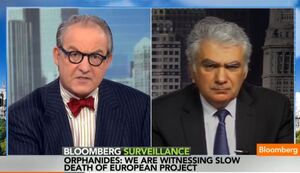
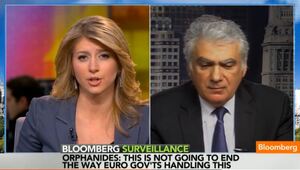
The former governor of the Central Bank of Cyprus and a former member of the Governing Council at the European Central Bank, Athanasios Orphanides, speaking to Tom Keene and Sara Eisen on Bloomberg earlier:

Athanasios Orphanides: “What we’re witnessing is the slow death of the European project. We’re in a situation where some European governments are essentially taking action so that they’re telling citizens of other member states that they’re not equal under the law and being here, in the United States, you can realise how catastrophic this is for the sentiment inside of Europe. What we have seen in the last few days is a very serious blunder by European governments, that essentially blackmailing the government of Cyprus to confiscate the money that belongs rightfully to depositers in the banking sector in Cyprus. It’s not clear how this can affect, in a positive manner, the European project, going forward. And this is really a concern about all of Europe.”

Tom Keene: “Professor, I think you own, within research, the “toolbox”. You’re the one who came up with that and popularised the phrase. What is in the toolbox for Germany? What is in the toolbox for Brussels, to move forward constructively?”

Orphanides: “Frankly, it was totally unnecessary to move on with this particular move. Cyprus did not have a problem, before, earlier blunders that were made by the European governments. Even the banking sector is indeed, quite large. But it’s in a solid state. And the only reason we have an issue in Cyprus right now, or talking about this, is because earlier decisions of the European governments imposed many billions of losses on banks, through the haircut they imposed on Greek sovereign debt. So, frankly, the toolkit is to go back to what earlier European leaders were saying, that European leaders should actually sit down and actually try to work together, to get us out of this problem, that their own decisions have been creating. Instead of trying to shift the damage from one member state, at one time, another member state, the other time. Let me tell you what I mean by that.”

Keene: “Please.”

Orphanides: “This is a crisis that is systemic in the Euro area. We have had decisions taken by the strongest government in Europe, that have been spreading misery sequentially to citizens in Greece, in Ireland, in Portugal, in Spain, in Italy. And this is not going to end the way European governments are handling this. We need to have a decision-making process, wherein governments are asked to care for the citizens of the other states. This is not happening. And what we have seen is Cyprus, is just a clear demonstration of this. The way the strongest governments of Europe have blackmailed the Cypriot government to confiscate deposits, is essentially sending a message that nobody with deposits in a small country, like Luxembourg, should feel safe about their deposits. Nobody with deposits in a weak country like Spain should feel safe about the deposits. And you realise this only makes the economic climate in Europe worse instead of contributing to the solution of the crisis.”

Sara Eisen: “Are you envisioning bank runs across Europe?”

Orphanides: “I do not know if there would be bank runs across Europe and I would hope not. But frankly, this is what I find so amazing about this. We have finance ministers from a number of countries who should have known better and they have taken the decision with encouraging bank runs in the Euro area. But I have to also say that it’s not bank runs everywhere. So in decisions like this, much like in the decisions we hear capping Greek debt in October of 2011, actually benefits some countries. For example, as we’ve seen from the markets yesterday a decision like this reduces the financing costs for the German government, so the German government can now borrow at negative rates as a result, while it inflicts pain on other countries. Not everybody is equal under the law, the way European governments are behaving in these days. This is why I worry about the future of Europe.”

Eisen: “Well, clearly, you disapprove of the method here. You talk about systemic risk and contagion. Is the European Central Bank, and Mario Draghi’s pledge to do whatever it takes, a credible backstop to this problem?”

Orphanides: “Well, frankly, the European Central Bank has been quite unclear in its position on this. According to Press reports, the European Central Bank was used as a vehicle to blackmail the Cypriot government. I hope this is wrong because I cannot envision  my former colleagues at the European Central Bank contributing in this way to the destruction of Europe.”

Keena: “Professor, let me bring in Megan Greene, our guest host this afternoon, from Maverick Intelligence economist. Megan, Professor Orphanides.”

Greene: “Yeah, I’m wondering what you think of what’s happening in Cyprus means for a banking union in Europe. Do you think that we can have a banking union, if we’ve made such a mockery of deposit guarantee schemes?”

Orphanides: “Not under these conditions. And this is one of my biggest concerns for the future of the Euro area. A year ago, after the June 2012 decision of the European Council, I was more optimistic that European governments understood that in order for the Euro area to stay together, they needed to form a banking union which meant that they needed to have a common credible deposit insurance guarantee for everybody in the Euro area. So, indeed, by making a mockery of that right now, the governments who pushed for this measure are sending a message that they want no part of a banking union.”

Keene: “Professor, you are arguably the representative of Cyprus to the business community in America with your research at the Fed. What is the message you would send to the Cyprus Parliament as they vote this evening or into tomorrow in Nicosia. What would you tell the people of Cyprus about what their politicians need to do.”

Orphanides: “Frankly this is an incredibly tough decision. And I do not want to give advice to the members of parliament in Cyprus about what they should do. Let me again, try to explain to you what this is about. You have other governments in the European Union who are asking members of the Cypriot parliament to vote to confiscate people’s money. It’s not clear what those members of parliament should do under these circumstances and frankly, I really I would, I would much rather go back and ask the other European governments that contributed to this blackmail to rethink: Is it really a positive for the future of Europe to be working in this way?It’s not. Is this really in the interests of the German people? Of the French people?And of everybody else?It’s clearly not.”

Watch in full here.



sirenSiren, the feminist magazine that took issue (and they weren’t alone) with an especially strident and misleading Youth Defence poster last Summer, launched an online edition today.

Sirenette Fiona Hyde writes:

On the site at the moment, we have: an article by Darragh McCausland on being stalked for a decade by a stranger called The Intensity of Her Stare, an article by Michael Garvey on growing up gay in Ireland called Playing House, a piece from our print edition by Megan Nolan on friendship after a big relationship called Looks Like We Made It, and two photo essays by Cait Fahey, one called That’s Mine on her relationship with her brother, and one titled A Vision in Purple on women standing against domestic violence in the Irish Islamic Cultural Centre.

Crikey.

You may allow it to lure you onto the rocks here.

Previously: Have You Got A Minute?

90279472(Above: Bill and Enda Enda Kenny at the Merrion Hotel last October at the launch of Bill’s autobiography “We’ll Leave It There So”.)

Minister for Arts, Heritage and the Gaeltacht Jimmy Deenihan said Mr O’Herlihy would prove to be an “excellent chairman” of the board and has been tasked with increasing indigenous audiences for Irish film.

Mr O’Herlihy had been one of former Fine Gael Taoiseach Garret FitzGerald’s media “handlers” in the 1980s, but Mr Deenihan stressed that he had no involvement in politics in recent decades.

“He was never an adviser in my time for the last 30 years. I’ve never seen Bill at any Fine Gael function. I have never met Bill in any other context other than sport and television.”

We’ll leave it there, so.

O’Herlihy to chair Irish Film Board (Ronan McGreevy, Irish Times)

(Sasko Lazarov/Photocall Ireland)

Book2

Mmm.

Snug.

Sheilagh writes:

I came across this pic of Fine Gael’s online campaign team during the 2011 election in Michael Gallagher and Michael Marsh’s How Ireland Voted 2011: The Full Story of Ireland’s Earthquake Election.

In a chapter on the online side of the election, the authors [Matthew Wall and Maria Laura Sudulich] found Fine Gael led the way in using online technologies for their campaign.

They said Fine Gael had over THIRTY volunteers working full time.

However, they couldn’t determine how this activity related to the [party’s] performance.

Thirty.

It’ll be like the West Wing, they said.

More on the book here.

90292969 9029296890292966March1

CBMarch

March3

Rosary

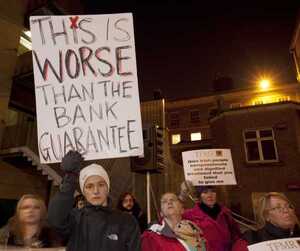
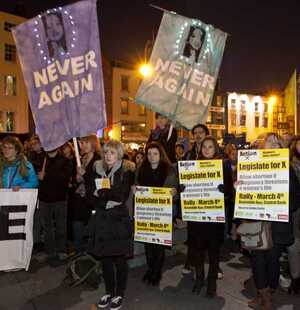
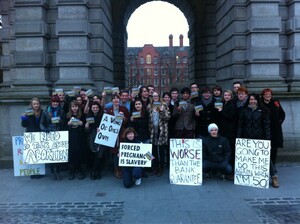
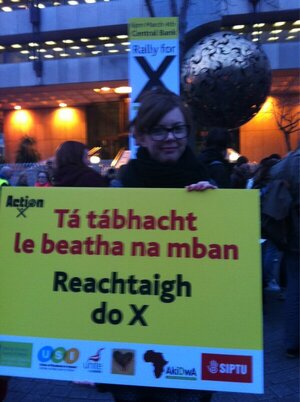
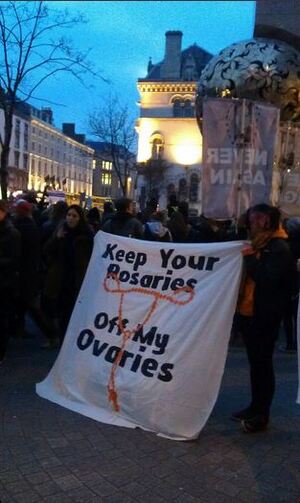
The legislate for X protest, which attracted a crowd estimated at 800, at the Central Bank, Dame Street, and outside EU health ministers’ informal meeting in Dublin Castle.

Eamonn Farrell/ Photocall Ireland (pics 1-13); Niamh Puirseil, Caraquest, Stephanie Lord, Workers Solidarity and Arman Maroufkhani

KenBar

James Mackintosh, of the Financial Times, takes issue with European Commission President Jose Manuel Barosso who last week claimed Ireland is ‘turning a corner.

He writes:

“So long as the Irish people show a willingness to put up with the vicissitudes of austerity, bondholders can be pretty confident of getting their money back. The more confident they become, the less the burden on Ireland (as interest rates drop) and the lower the risk of a bond market panic prompting a liquidity crunch. This creates a spiral of success which makes the bonds even more appealing.”

“In another sense, though, the bond yield presents far too optimistic a picture of Ireland. Just because its yield is low does not mean its economy is really turning the corner – or as some wags on Twitter put it, Ireland might go round the corner and straight over another cliff. After all, the previous government famously declared that Ireland had “turned the corner” in December 2009, just before plunging into the deepest economic crisis in the country’s history.”
…

“Ireland has met every one of the 190 requirements of the Troika of the IMF, ECB and European Commission overseeing its rescue programme. But IFAC, Ireland’s equivalent of Britain’s Office of Budget Responsibility, thinks forecasts for the effect of the next round of budget reductions are too optimistic.”

“IFAC adjusted the Troika’s predictions for errors made in economic forecasting in the years before the crisis. Even excluding the massive error of missing the crisis itself, they estimate that similar errors in future mean there is a 30 per cent chance of missing the goal of stabilising the debt-to-GDP ratio by 2015.”

He also questions the recent CSO figures which indicate a rise in employment.

A fun  read.

More here.

Laura Hutton/Photocall Ireland

TippLowryAnd why not – sure isn’t he a local man?

Michael Lowry gave an exclusive interview to the Tipperary Star about that transcribed phone call.

It was published on Wednesday and is now on their website:

Things that may make you go hmm.

 Deputy Lowry said this week, “The Register at the UK Land Registry and company records clearly show that I never had any direct or indirect shareholding or beneficial interest in Doncaster Rovers or it’s associated companies.”

“The Holycross man also confirms that he never had any material or beneficial interest in ‘Glebe Trust” – an entity which owned Westferry – a company which had been set up by Mr Phelan and later sold to [Denis] Mr O’Brien to facilitate the purchase of the Doncaster Rovers site – that site was very recently the subject of a sale agreement in a joint venture with Doncaster Council, involving a sum reported to be in the region of St£10m…”

Hmm.

The Sunday Independent had kept watch at Deputy Lowry’s home in Holycross and at his constituency office in Abbey Road, Thurles on Saturday in a bid to put a series of questions to him. And, attempts had been made through close political allies to contact him in order to arrange an interview.

All of these efforts proved fruitless with the Independent stating that the only place Deputy Lowry could be found was in the pages of The Tipperary Star.”

Hmm.

Lowry Solicitor To Probe Leak Tape (Tipperary Star)

(Pic: Michael Lowry Facebook)

SBPGavin

Gavin

Gavin Sheridan (above), known as the FOI-nator for his repeated requests for documents under the freedom of information act, will today learn if Nama and Anglo/IBRC are considered ‘public authorities’ under an EU directive, known as Access to Information on the Environment (AIE) Regulations.

It’s been a three-year campaign for Gavin, who told his story in the most recent edition of the Sunday Business Post magazine (above), saying:

“Without adequate access to information, all citizens do not have proper freedom of expression, and we all suffer as a result. If we really want a reformed Ireland, and to learn from the lessons of the past, we must make a decision: secrecy or transparency? And if we choose the latter it must come from the top down. Anything less and we are doomed to repeat the mistakes of the past.”


Fair play though. In fairness.

More here.

Update:


Nama Loses Information Appeal (Irish Times)